Chen Guo from China Securities Co., Ltd. pointed out in the Research Reports that the role of foreign capital in Hong Kong stocks is mainly impulsive. This can be clearly seen from the two market trends in May and September of last year, where foreign capital rapidly flowed in for certain reasons, but once the logic reversed, hedge funds would continue to Sell. Moreover, after Trump's administration, the uncertainty in international relations that foreign capital faced was even greater. Therefore, if a macro-level black swan event occurs in the future, the attitude of foreign capital will change, and it should not be used as a fundamental basis for the funding situation in the Hong Kong stock market.
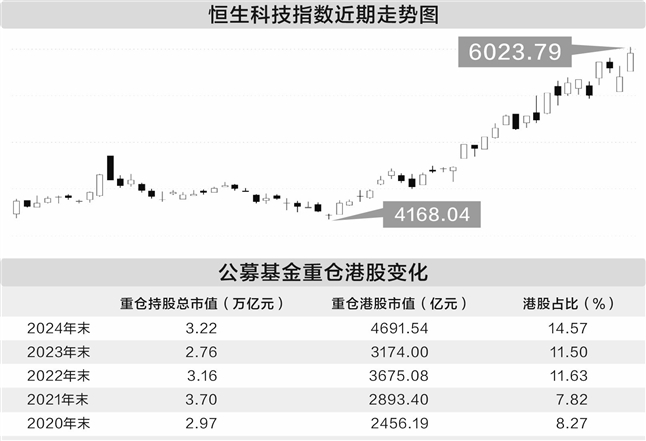
On February 26, the Hong Kong stock market regained its upward momentum after a brief one-day adjustment. $Hang Seng TECH Index (800700.HK)$ During the trading session, it broke through 6000 points, reaching a new high since 2022. As the Hong Kong stock market soars, capital from the mainland has also accelerated its flow southward, which includes significant Buy activities in Hong Kong stocks by Funds.
Data shows that both the Market Cap of Hong Kong stock symbols heavily held by public funds and the weight of Hong Kong stocks among the heavyweights in Fund have set historical records.
1. The trading volume accounted for nearly "half the territory".
 In this round of recovery in the Hong Kong stock market, the participation of southbound Assets has continued to increase, also enhancing its influence on the Hong Kong stock market day by day.
On February 25, affected by factors such as the "America First Investment Policy," the Hong Kong stock market opened lower but ultimately recovered. That day, southbound capital net purchased Hong Kong stocks amounting to 22.033 billion Hong Kong dollars, the second highest this year, while the proportion of southbound capital trading volume accounted for 48.68% of the Hang Seng Index trading volume, nearly half the territory.
On February 26, southbound capital continued to flow in significantly, leading Hong Kong stocks to regain their upward momentum after a brief one-day adjustment. On that day, the Hang Seng TECH Index surged by 4.47%, with a net inflow of 104 million Hong Kong dollars, accounting for 46.88% of trading volume, among which, $XIAOMI-W (01810.HK)$ 、$TENCENT (00700.HK)$the trading volume of several leading stocks has already surpassed 50%.
Earlier, on February 17, the trading volume of southbound funds reached as high as 200.671 billion HKD, accounting for 50.13% of that day's Hang Seng Index trading volume, breaking through the 50% threshold.
Jin Meiqiao, the fund manager under the billion-dollar private equity firm Qianlin, stated in a letter to investors that the pricing power and influence of southbound funds in the Hong Kong stock market are continuously increasing. The ongoing inflow of southbound funds demonstrates the interest of mainland investors in Hong Kong stocks. "If the annual southbound funds of 800 billion HKD continue for 2-3 years, the pricing power of Hong Kong stocks will inevitably be dominated by mainland funds. In the fourth quarter of 2024, the proportion of mainland investors in Hong Kong trading will rise to a record 45%. If this trend continues, it is very likely to exceed 50% in 2025," Jin Meiqiao stated.
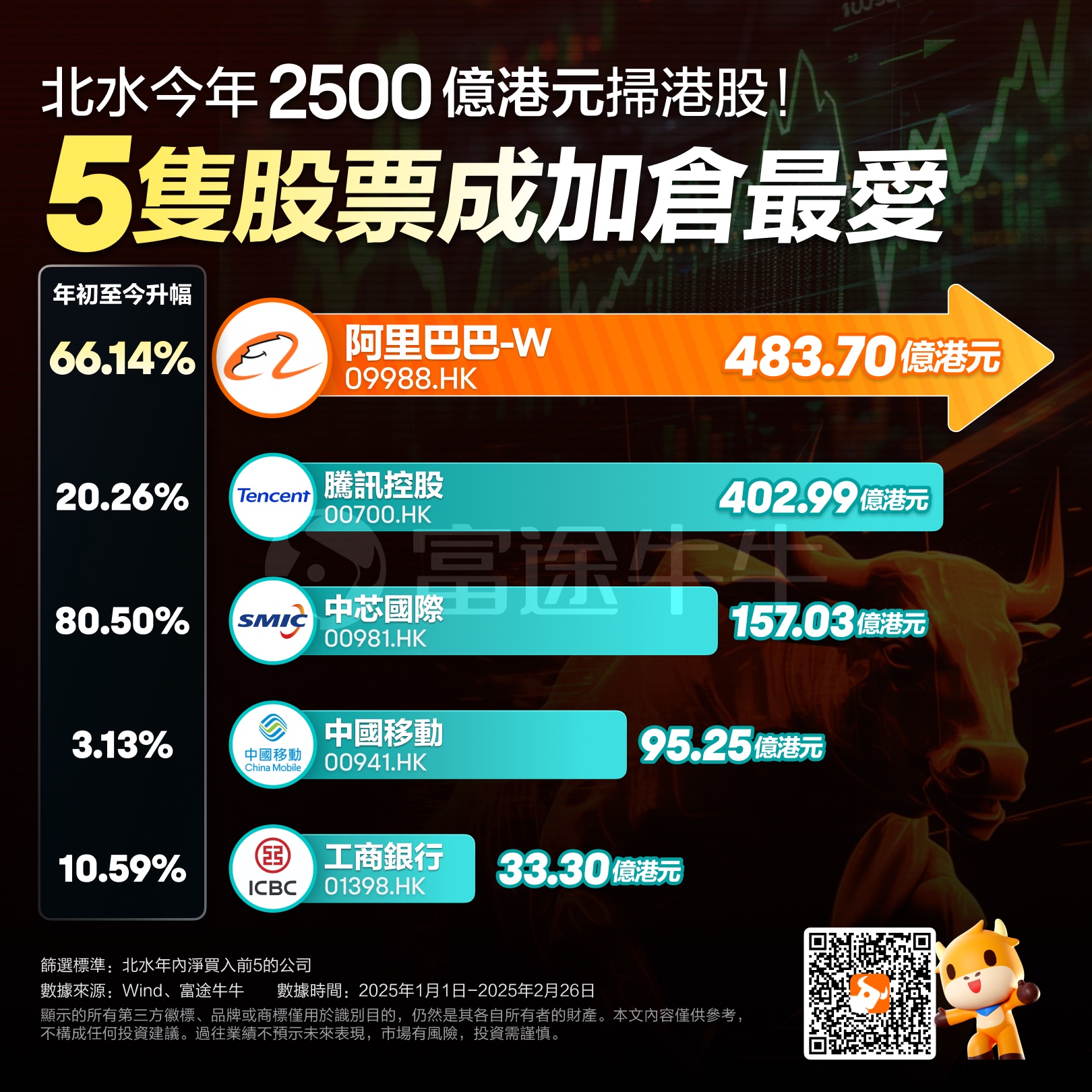
As of now, the target of a trading volume proportion exceeding 50% has been achieved. Additionally, as of February 26, the net inflow of southbound funds into Hong Kong stocks since the beginning of the year has reached 249.6 billion HKD, a significant increase compared to the same period in previous years.
Chen Guo, the Chief Strategist at China Securities Co.,Ltd., pointed out in the latest Research Reports that southbound funds will continue to be an important driving force for the rise of Hong Kong stocks. He believes that the difference in funding costs between domestic and foreign capital provides the basis for the inflow of southbound funds. Domestic interest rates remain at a relatively low level, while the USA maintains high interest rates, resulting in a high yield spread between stocks and bonds anchored by Chinese bonds, and a lower yield spread for stocks and bonds anchored by US Treasury bonds. Therefore, the willingness of domestic capital to flow into Hong Kong stocks is evidently stronger than that of foreign capital. Considering the high probability of a slowdown in interest rate cuts in the USA this year, it is expected that this phenomenon will persist for a long time.
2. Funds assist domestic capital in reclaiming pricing power.
As an important institutional investor, the Fund is a significant component of the southbound funds and also a key force driving the recent rebound of Hong Kong stocks. According to statistics from East Money Information Choice data, as of the end of the fourth quarter of 2024, the total market cap of Hong Kong stocks held by public funds reached 469.2 billion yuan, setting a historical record, with a quarter-on-quarter increase of 1.03% and a year-on-year increase of 38.12%, both higher than $Hang Seng Index (800000.HK)$the corresponding increase of the Hang Seng TECH Index.
The weight of Hong Kong stocks in the portfolios of public funds has also reached a historical high. As of the end of the fourth quarter of 2024, the total Assets held heavily by public funds amounted to 3.22 trillion yuan, with Hong Kong stocks accounting for 14.57%, setting a new historical high. From 2020 to 2023, this weight was 8.27%, 7.82%, 11.63%, and 11.50%, respectively.
Some public funds have even increased their positions in Hong Kong stocks to historical highs. For instance, the position of the Fuguo Minyu Hu-Gang-Shen Select Fund in Hong Kong stocks rose from 87.66% at the end of last year's third quarter to 92.4% at the end of the fourth quarter, marking the highest level in history; the position of the Harvest Hong Kong Internet Industry Core Assets Fund increased from 93.03% at the end of last year's third quarter to 93.58% at the end of the fourth quarter, once again breaking the historical highest value.
Chen Cong, the manager of the Xingquan Hu-Gang-Shen Two-Year Holding Fund, stated that the current market situation is significantly different compared to the 2020 'southward move to seize pricing power'.
On one hand, the proportion of mainland investors in the overall Hong Kong stock holdings is sufficiently high, to the point that it has gradually become a stock market for domestic capital. In recent years, many Institutions have been increasingly participating in Hong Kong stock investments, whether through pure Hong Kong stock funds or through funds investing in Hong Kong stocks via the Stock Connect program. The increase in domestic capital's share of investments in Hong Kong stocks will, to some extent, change the market attributes of Hong Kong stocks, which may slowly transform from a purely offshore market to a semi-offshore market. Future volatility and fluctuations, especially the downside risks, may be somewhat better than in the past.
On the other hand, the pricing aesthetics of the Hong Kong stock market are increasingly resembling those of the A-share market. For example, some purely growth-oriented symbols would not have the current stock prices in a purely foreign capital system, but due to the domestic capital's emphasis on high growth potential, these companies are likely to maintain relatively high valuation levels for a considerable period of time. This also proves that at least for a certain period, a part of the pricing power in the Hong Kong stock market is in the hands of domestic capital.
3. The synergy between domestic and foreign capital.
In addition to the large influx of domestic capital represented by funds, recently, multiple foreign capital Institutions have been bullish on Hong Kong stocks. The 'top-up' of global funds may inject new vitality into Hong Kong stocks, forming a synergy between domestic and foreign capital.
Huatai Securities pointed out that recently, passive foreign capital has accelerated its inflow into Hong Kong stocks, while active foreign capital continues to flow out but at a reduced scale. As of February 19, the Hong Kong stock market has received accelerated inflow of passive funds (ETFs), with the scale of passive foreign inflow rising from 0.54 billion USD the previous week to 0.91 billion USD, mainly focused on funds investing in China and U.S.-listed Chinese stocks, in line with investors' characteristics of trading technology trends using these two index tools; outflow of active capital (predominantly Long-only) has narrowed, mainly focused on funds that specialize in China and Emerging Markets, while inflows are centered around funds investing in U.S.-listed Chinese stocks.
Goldman Sachs' latest report also shows that between February 14 and February 20, hedge funds increased their willingness to bet on Asian stock markets, which has now reached the highest level since 2016, among which A-shares and Hong Kong stocks account for nearly half of the inflow of funds.
The approach of 'underweight is an opportunity, rebalancing is a trend' is believed by WF Fund. The global 'top-up' of capital will inject new vitality into Hong Kong stocks, especially the Hong Kong Internet Sector, ultimately supporting the current Internet market of Hong Kong stocks to rise healthily in both 'quality' and 'quantity.' Currently, the pricing power of Southbound funds has reached over 40%, and the resonance of domestic and foreign capital sentiment may still have momentum.
However, Chen Guo pointed out in the Research Reports that the role of foreign capital in Hong Kong stocks is mainly pulsing. In the market fluctuations of last May and September, it was clearly observed that foreign capital quickly flowed in for certain reasons in the short term, but once the logic reversed, hedge funds would continue to Sell. Additionally, under Trump's administration, foreign capital is facing greater uncertainty in international relations, so if a macro-level black swan event occurs in the future, the attitude of foreign capital will also change and should not be considered as the fundamental support for the capital market of Hong Kong stocks.
Editor/rice