
After several months of continuous rising, the strong trend of the USA Stocks seemed to come to an abrupt halt in February:
Since $S&P 500 Index (.SPX.US)$ After reaching an all-time high on February 19, the index began to fluctuate downward, having accumulated a drop of 4.6% over nearly six trading days, $Nasdaq Composite Index (.IXIC.US)$ and has accumulated a total drop of 7.54%.
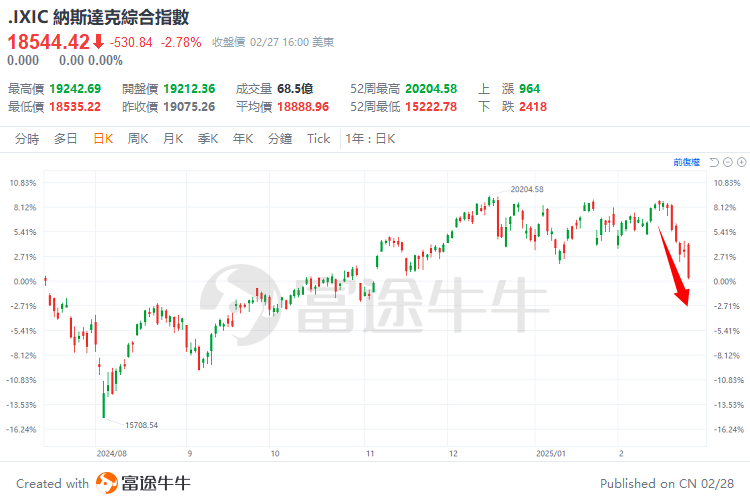
Meanwhile, the USA Stocks"BATMMAAN" (Batman)The portfolio is also hard to avoid. $Apple (AAPL.US)$ 、 $NVIDIA (NVDA.US)$、 $Microsoft (MSFT.US)$ 、 $Amazon (AMZN.US)$ 、 $Alphabet-A (GOOGL.US)$、 $Meta Platforms (META.US)$、 $Broadcom (AVGO.US)$、 $Tesla (TSLA.US)$ All have experienced varying degrees of pullback.
 After the extreme fluctuations in US stocks, how are the valuations of the eight major Technology giants? Has the premium cleared up, is there potential for bottom-fishing, or will it continue to decline? These have become the key focus for investors.
According to Bloomberg data, among the eight major Technology giants, NVIDIA, Microsoft, Amazon, Alphabet, Broadcom, and Tesla have dynamic PE ratios that are below the average levels of the past five years. Meanwhile, Apple and Meta have also seen their dynamic PE ratios fall back to near the average levels of the past five years.

It is worth noting that NVIDIA fell over 8% after its earnings report last night.
Market opinions suggest that from a valuation perspective, NVIDIA's current forward PE ratio is 27 times, lower than Apple's forward PE ratio of 32 times, which is also part of the 3 trillion dollar Market Cap club. However, NVIDIA's growth rate is 20 times that of Apple—Apple's latest quarterly revenue grew only by 4%.
Barron's magazine states that this comparison makes NVIDIA's valuation seem relatively 'cheap.'
Additionally, it is worth noting that well-known investor Duan Yongping has begun to go long on NVIDIA. Yesterday, Duan Yongping expressed in an interaction with online users on Social Media: 'Although I don't fully understand, I'm prepared to sell a bit of NVDA puts. AI is worth paying attention to, NVIDIA is actually a very good company.'
What else needs to be focused on in the future market?
Overnight, Trump announced that starting from March 4, tariffs would be imposed on countries such as Canada and Mexico, which led to a significant drop in the USA stock market after the opening.
Analysis suggests that the tariff policy has become the biggest risk faced by NVIDIA this year, especially potential tariffs on chips that could affect NVIDIA's products produced in Asia.
Economic data released on Thursday also showed unsettling signals regarding USA inflation expectations, consumer confidence, existing home sales, and initial unemployment claims.
Notably, Trump will deliver a speech to a joint session of Congress at 11:30 a.m. EST on March 4, marking his first important speech during his second term.
The media anticipates that his speech will outline key legislative goals and set the tone for his second term. Although Trump's speech may address economic issues, National Security, and foreign policy, specific policy statements remain uncertain.
It should be noted that although the format is similar, this speech is not an official State of the Union address. Since President Reagan in 1981, newly inaugurated presidents typically give a speech to Congress in the early days of their term, but these speeches are not technically referred to as 'State of the Union.'
Furthermore, according to Morgan Stanley, one potential danger signal behind the significant drop in the S&P 500 Index on Thursday is that it has broken below a red line triggering mid-term liquidation in CTA (Commodity Trading Advisors): 5887 points.
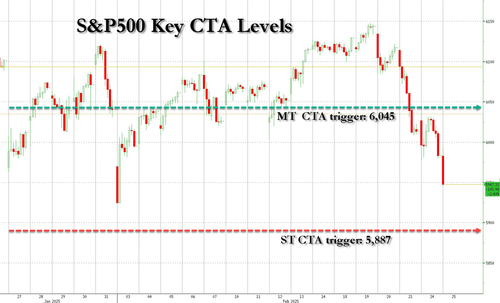
The team from Morgan Stanley's Algo and Derivatives strategy department noted that this means that in the coming week, macro systemic strategies will sell over 40 billion dollars in stocks, most of which will come from CTAs. Although there may be 10 billion to 15 billion dollars in demand from Pension/Asset Allocators by the end of the month to partially offset the selling pressure, overall market sentiment remains tense.
However, the market view is that despite the policy uncertainties, investors should pay more attention to the fundamental outlook of these large Technology Stocks.
Looking ahead to today, the USA will announce the January Consumer Expenditure Price Index (PCE) tonight.
The market view is that as the inflation indicator most closely watched by the Federal Reserve, the January PCE may continue on a "slow cooling" path, alleviating some concerns raised by the inflation report earlier this month. However, the stickiness of the service sector still restricts the pace of policy shift. At the same time, Trump's tariff threats cast a shadow over inflation forecasts, adding uncertainty to future economic and price conditions, thus increasing the challenges to the Federal Reserve's interest rate stance.
 Worried about missing out on good prices in buying and selling? Futu's Stop Limit Order can help you! Go to the stock page > Trade > Select Stop Limit Order or Take Profit Limit Order to trade!
Click to view the tutorial:

Editor/Somer