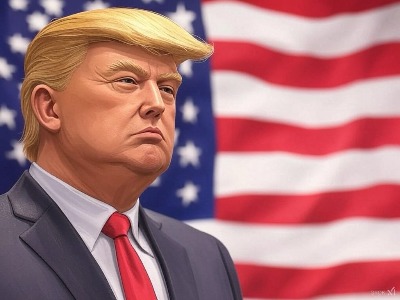
Frequent "tweet bombs" from Trump severely impact the market, prompting investors to explore a new risk avoidance strategy of "not acting for three days."
After Trump returned to the USA political scene, he frequently used Social Media to release policy information, causing market turbulence. To avoid losses from rapid policy reversals, bond market investors have summarized the "72-hour trading rule": if there is no reversal within 72 hours of Trump's message, they will then take trading actions.
Bond market investors are overly cautious.
Bond investors have suffered losses multiple times by immediately responding to Trump's tweets.
 For example, after Trump posted a threat to impose a 200% tariff on European wine, several investment banks quickly carried out OTC transactions, betting on the decline of the bond prices of related companies (such as packaging company Ardagh Group, Verallia, and label manufacturer Fedrigoni SpA).
However, a few days later, when the final tariff list was announced without any wine included, bond prices quickly rebounded, catching those who acted prematurely off guard. Similarly, the threat of a 50% tariff on Canadian Steel was also quickly abandoned.
These frequently reversed events have made bond investors wary of Trump's tweets.
"72-hour rule": seeking certainty in repetition.
After careful reflection, some Banks and investors have begun to adopt the "72-hour rule," which means avoiding action within 72 hours after Trump releases policy information to prevent losses from rapid policy reversals.
Media reports quote three senior Bonds market experts stating that after Trump releases any potential significant policy information, they will refrain from acting for three days (72 hours). If at that time his position remains unchanged or is not retracted, the market is inclined to believe that the policy may be genuinely implemented and trades accordingly.
Catherine Braganza, a Fund manager at Insight Investment, stated:
"We no longer act immediately, as there is always the risk of policy reversals. Investors are gradually becoming immune to this type of information."
Racing against the "tweet storm": time zone advantages and accelerated trading.
In addition to post-event observation, the market is also seeking to proactively avoid risks.
Bankers in Europe have found that by utilizing time zone differences, they can gain valuable time. They have started to accelerate the bond issuance process, aiming to complete pricing and lock in investors before Trump "wakes up" to Post and before potential emotional disturbances in the US market open.
"Everyone is highly alert to the 24-hour headline risk, especially during US hours when the frequency is higher," admitted Matteo Benedetto, co-head of Morgan Stanley EMEA Investment Grade Syndicate, "It's definitely better to complete trades before the NYSE opens."
This sense of urgency has changed operating practices: the Irish telecom company Eircom Finance DAC completed a rare issuance of junk bonds, roadshow, and pricing all in one day; even blue-chip giants like LVMH chose to finalize the terms of their €1.9 billion bond before 1 PM European time to avoid risks in the US market.
Investment focus has shifted to the 'anti-tariff' industry.
Ongoing policy uncertainty, compounded by economists estimating a 45% likelihood of a 'Trump-induced recession' in the coming year, has prompted credit investors to reassess risks, leading companies like General Motors, Mercedes-Benz, McDonald's, and Procter & Gamble to possibly withdraw performance guidance or report sales declines, further strengthening the market's risk-averse sentiment.
Against this backdrop, investors began to favor non-cyclical industries that are less affected by trade frictions and have stable demand.
Braganza from Insight Investment stated that her firm is focusing on canned tomato producers, mobile service providers, etc. 'People won’t stop cooking because of tariffs, nor will they throw away their phones,' she explained.
Some investors are calling for a return to Fundamental Analysis, focusing on the core values of companies, but in the reality of deeply intertwined global supply chains, 'it is easier said than done.'
Perhaps, as Fabiana Fedeli from M&G Investments said, managing the risk of Trump's tweets is 'more of an art than a science.'
Editor/Lee