
Barclays believes that the new job positions exceeded expectations, but nearly half came from government sectors, and there may be a reversal in July. Wage growth is slowing, total working hours are declining, and income growth is stagnating, raising concerns about consumer spending. The possibility of the Federal Reserve maintaining interest rates at its July meeting has greatly increased, keeping the prediction of lowering rates until December unchanged.
Barclays stated that the non-farm employment data appears strong on the surface, but deeper details reveal signs that the labor market is gradually cooling down. The bank believes that the likelihood of the Federal Reserve staying put in July has significantly increased, and rate cuts may be delayed until December.
On July 4th, according to the news from the Futures Trading Desk, Barclays stated in its Research Reports that the additional non-farm jobs in June were 0.147 million, exceeding expectations, but nearly half came from government sectors, while the private sector only added 0.074 million jobs.
 The report pointed out that the household survey data in June presented a more complex employment situation, with the unemployment rate declining mainly due to a lower labor participation rate, and the underemployment rate remaining high, indicating some slackness in the labor market, although other Indicators did not reflect this.
Barclays also found that wage growth slowed in June, with average working hours decreasing, leading to stagnation in income growth, raising concerns about consumer spending.
Despite the signs of weakness in the June employment report, Barclays believes that this is still not enough to prompt the Federal Reserve to consider rate cuts at the upcoming July meeting, maintaining the prediction that the next rate cut will wait until December, while also needing to pay attention to the upcoming inflation data.
The Industry shows signs of structural problems.
The report states that the headline figures of the June non-farm employment report are indeed impressive, with an increase of 0.147 million jobs, exceeding Barclays' expectation of 0.1 million and the market consensus of 0.106 million. Moreover, the three-month moving average reached 0.15 million, an increase from 0.13 million a year earlier.
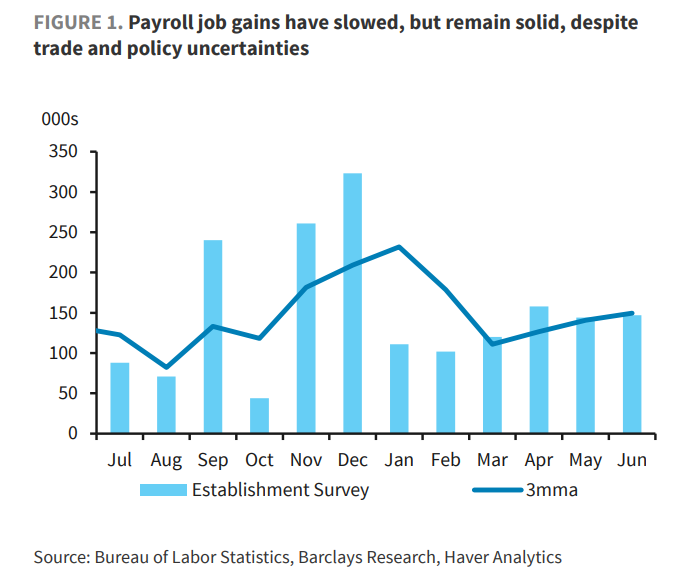
However, the composition of the data is concerning. Government departments contributed nearly half of the job growth, adding 0.073 million positions, most of which came from state government education departments. Barclays analysts believe:
The surge in state government education employment occurred during the months typically characterized by seasonal layoffs, raising questions about whether the seasonal adjustments were adequate. If the adjustments are inappropriate, this job growth may reverse in July.
Meanwhile, private sector job growth sharply slowed from 0.137 million to 0.074 million. The slowdown in private sector job growth is mainly concentrated in the service industry, which added only 0.068 million positions in June. The commodity-producing sector increased by 0.006 million positions, with construction adding 0.015 million, while manufacturing decreased by 0.007 million and mining decreased by 0.002 million.
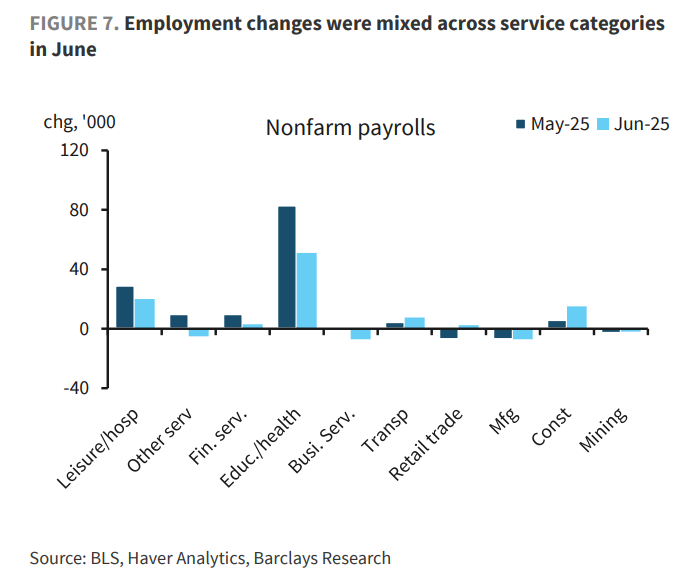
Within the service industry, education and Medical Services added 0.051 million positions, leisure and hotel services added 0.02 million, but professional and business services decreased by 0.007 million positions. Barclays believes this differentiation reflects the complexity of jiegoutiaozheng.
Household survey data presents a complex picture.
It is well known that the U.S. non-farm employment report is mainly divided into two survey data: enterprise surveys and household surveys. Among these, enterprise survey results show non-farm employment growth data, while household surveys show unemployment rate data.
Barclays believes that household survey data reflects a more complex employment situation. The unemployment rate fell by 13 basis points to 4.1%, which appears to be a Bullish Signal. However, this decline is mainly due to a decrease in the labor force participation rate, with the labor force shrinking by 0.13 million, while household employment only increased by 0.093 million.
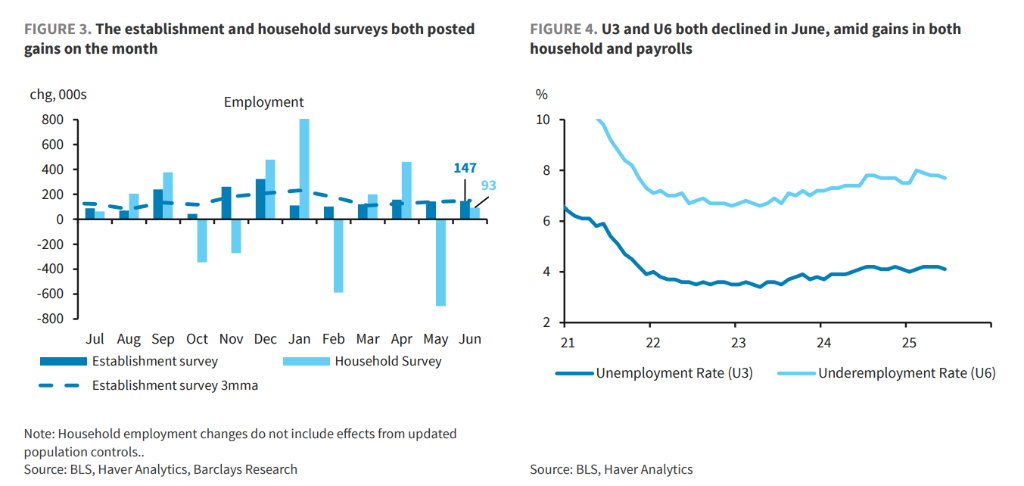
The broader measure of underemployment (U6) slightly decreased to 7.7%, but remains at a relatively high level, indicating that there is some slack in the labor market, which is not fully reflected in other indicators.
The labor force participation rate declined by 0.1 percentage points to 62.3%, mainly reflecting the drop in participation rates for the age group 16-24 and those over 55.
Barclays expects the unemployment rate to peak at 4.3% in the third quarter, with monthly job growth slowing to 0.075 million by the end of the year, primarily due to the impact of tariffs and immigration policy on economic activity and recruitment. The bank stated:
The relatively modest rise in the unemployment rate is partially due to the sharp decrease in immigration inflow and the impact of an aging population on labor force participation.
The loss of momentum in wage growth is concerning for consumer spending.
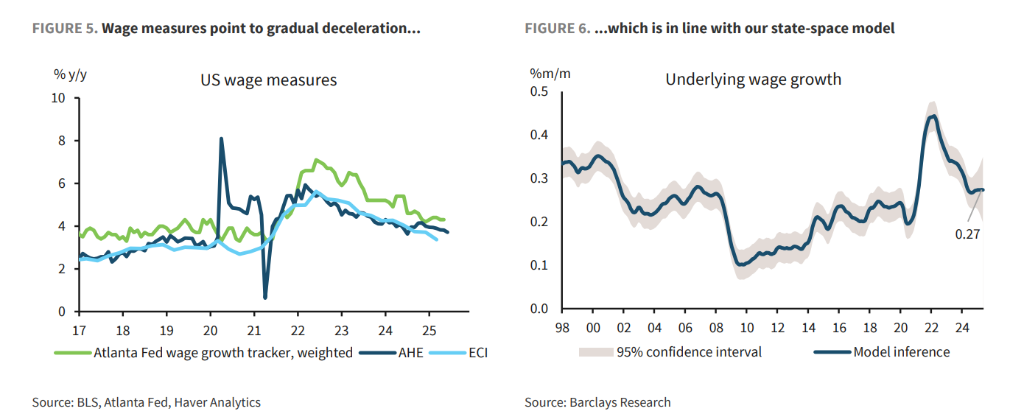
Wage data shows more pronounced signs of a cooling labor market. In June, the average hourly wage grew by 0.2% month-on-month and 3.7% year-on-year, significantly down from the 0.4% month-on-month increase in May.
Barclays' state space model shows a potential monthly wage growth rate of 0.27%, equating to an annualized growth rate of 3.3%, remaining roughly flat compared to previous months.
Even more concerning is the outlook for total income. The average workweek decreased by 0.1 hours to 34.2 hours, and combined with job growth, total hours worked fell by 0.3% month-on-month. This change, along with the slowdown in wage growth, led to wage income growth stagnating in June, marking the softest performance since July of last year.
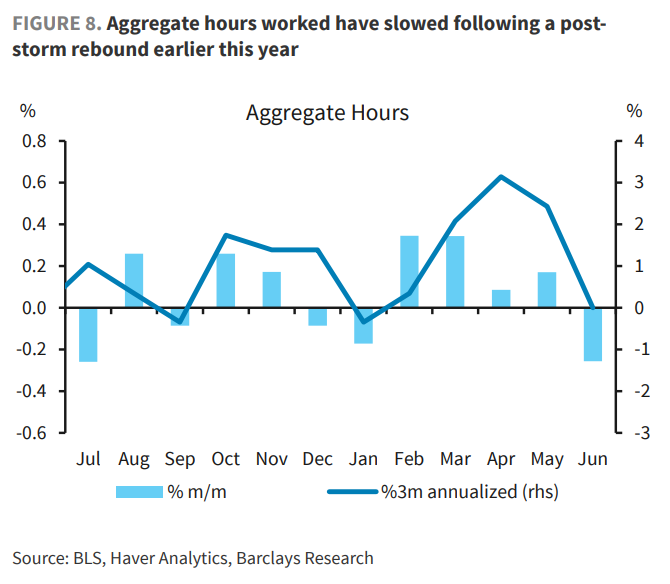
As the rebound effect of working hours at the beginning of the year fades, the three-month annualized growth rate of wage income drops to 3.0%, halving from the 6.0% growth rate during the period from December to March. However, private sector wage income still shows an annualized growth of 4.5% over the past six months, exceeding the inflation level.
Editor/melody