
1. U.S. Treasury prices generally softened on Monday, with long-term yields rising broadly, as the U.S. tariff drama resurfaced, reminding many investors of the memory of the sell-off in the Treasury market following the April "Liberation Day" equivalent tariffs; 2. Later this week, a series of U.S. long bond auctions will take place, and any signs of disturbance at this sensitive moment will undoubtedly make traders cautious.
According to the Financial Association on July 8 (editor: Xiaoxiang), after the short holiday for the "Independence Day" last weekend, U.S. Treasury prices generally softened on Monday, with long-term yields rising broadly, as the U.S. tariff drama resurfaced, reminding many investors of the memory of the sell-off in the Treasury market following the April "Liberation Day" equivalent tariffs.
Later this week, a series of U.S. long bond auctions will take place, and any signs of disturbance at this sensitive moment will undoubtedly make traders cautious.
 Market data shows that the yields on U.S. Treasuries with maturities from 10 years to 30 years rose by at least 5 basis points during the day, reaching the highest levels in over a week, continuing the sell-off triggered by the strong June non-farm payroll data released last Thursday. The bond market sell-off last Thursday was primarily led by short-term U.S. Treasuries, as the data weakened market expectations of a Fed rate cut this year, while the baton of decline on Monday was passed back to long-term bonds.
As of the end of the New York session, yields on U.S. Treasuries across all maturities rose collectively, with the 2-year yield up by 1.04 basis points at 3.890%, the 5-year yield up by 2.45 basis points at 3.955%, the 10-year yield up by 3.56 basis points at 4.377%, and the 30-year yield up by 5.59 basis points at 4.914%.
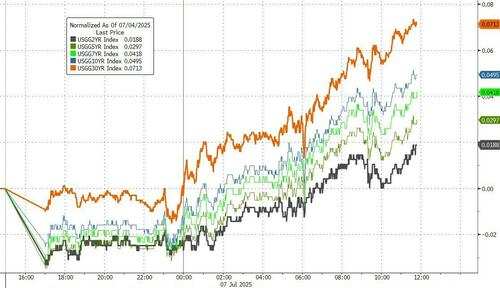
After a block sell-off initiated by sellers occurred in the long-term Treasury futures market, yields on Treasuries across all maturities reached their highs for the day. Several factors have exacerbated the negative sentiment in the bond market at the beginning of this week, including new uncertainties arising from the tariff timeline, the signing of the large Infrastructure Act expected to expand the deficit over the weekend, and the three medium to long-term U.S. Treasury auctions beginning this Tuesday (3-year, 10-year, and 30-year bonds)...
"Trading in the bond market is very tricky because there is always a conflict between when rates might be lowered and the impact of all these macro themes," said Kathryn Kaminski, Chief Research Strategist at AlphaSimplex Group, during an interview.
The tariff drama has resurfaced.
According to CCTV news reports, on the 7th local time, President Trump sent a letter to 14 countries, including Japan and South Korea, threatening to impose tariffs. Later, he signed an executive order extending the 'reciprocal tariff' deferral period until August 1.
This move has made Trump's uncertain tariff policy the biggest focus in the financial market again. Investors are worried that tariffs will drive up prices and slow down economic growth, and the final uncertainty of the policy could lead to even greater drag, as it may cause companies to delay decisions.
Valentin Marinov, head of G10 currency Forex research and strategy at Credit Agricole in France, stated, 'With the July 9 trade agreement deadline approaching, uncertainties have increased, and investors are starting to factor in the risk that President Trump may further escalate global trade tensions, thus impacting the global economic outlook.'
Will Compernolle, a macro strategist at FHN Financial in Chicago, pointed out, 'It is this uncertainty that hinders companies from laying off employees, hiring new staff, and making investment decisions. Therefore, I believe that the longer this uncertainty lasts, the more likely the paralysis it causes will lead to substantial economic weakness.'
After Trump announced the "liberation day" tariffs on April 2, the U.S. stock market experienced a significant decline — such turmoil typically raises demand for U.S. Treasury bonds as a safe haven. However, the situation at that time was not as expected — in the week following the trade policy shock, U.S. Treasury bonds recorded the largest drop in over twenty years. Along with the sharp decline of the dollar, the triple hit in the U.S. stock, bond, and currency markets raised concerns about a massive withdrawal of foreign investors from U.S. assets.
The shadow of U.S. Bonds reappears.
Clearly, the experience of April has also made many long U.S. Bond holders nervous again this week, especially under the backdrop of the recently enacted 'Big and Beautiful' legislation, which could lead to a surge in U.S. deficits and borrowing levels. This law has raised the U.S. debt ceiling by 5 trillion dollars.
Tom Simons, chief U.S. economist at Jefferies Financial, stated that concerns about a long-term increase in U.S. Bond sales may still exist because the fiscal situation will worsen further after Congress passed a tax and spending bill last week, which will increase the deficit and lead to an increase of trillions of dollars in public debt over the next decade.
Vincent Mortier, Chief Investment Officer of Amundi SA, one of Europe's largest Asset Management companies, stated that the negative impact of the Inflation Reduction Act on the U.S. fiscal deficit is more important than the issue of tariffs, as the "costs of tariffs will be borne by multiple parties."
In an interview on Monday, he stated that the sustainability of the U.S. debt trajectory will begin to be questioned. An increasing number of investors will attempt to hedge or gradually but firmly diversify their allocations away from the dollar. The company also holds a bearish view on the dollar.
It is expected that the auction of U.S. Bonds this week will also become a focus of the market. According to the schedule, the U.S. Treasury will auction $58 billion of three-year bonds on Tuesday, $39 billion of ten-year bonds on Wednesday, and $22 billion of thirty-year bonds on Thursday.
Editor/rice