
① Wall Street investment banks expect any impact to be reflected in the monthly core CPI data - this Indicator excludes the volatility of food and energy prices; ② Strategists from TD Securities and economists from Bank of America expect that rounding off, the month-on-month growth rate of the U.S. core CPI for June is likely to jump to 0.3%, up from 0.1% in May, a number consistent with the median estimate from a media survey of economists.
The next important economic data report from the United States is undoubtedly the June CPI data that will be released by the U.S. Bureau of Labor Statistics next Tuesday. This report, which is highly regarded even by Federal Reserve Chairman Powell, is expected to reveal to investors whether Trump's tariff war initiated against the world has had a significant impact on domestic price pressures in the United States.
Wall Street investment banks expect any impact to be reflected in the monthly core CPI data - this Indicator excludes the volatility of food and energy prices.
 Strategists from TD Securities and economists from Bank of America expect that rounding off, the month-on-month growth rate of the U.S. core CPI for June is likely to jump to 0.3%, up from 0.1% in May, a number consistent with the median estimate from a media survey of economists.
This will also be the highest level since the core CPI month-on-month growth rate recorded 0.4% in January.
The importance of the core CPI month-on-month rate lies in its ability to help investors, businesses, and decision-makers better understand potential inflation trends by excluding the more volatile food and energy components. This Indicator will also provide guidance for Federal Reserve officials in interest rate decisions and may even have a significant impact on the Forex and Bonds markets. This largely depends on whether market participants view the potential higher core CPI month-on-month rate in June as a one-time event or a signal indicating more inflationary pressures to come.
Lawrence Gillum, chief fixed income strategist at LPL Financial, stated, "Based on the direction of inflation swaps and breakeven inflation rates, I believe the bond market has not yet truly anticipated that inflation will come back."
Gillum pointed out, "Although inflation expectations have moved up somewhat, the bond market is deliberately ignoring one or two higher inflation data points, while not worrying about the continued rise of the CPI. Despite the inflation swap rates having risen from the levels in April, they are still below the levels for 2023 and 2024 - indicating that the market believes we will not enter a second wave of inflation."
The strategist pointed out that how market participants react to the CPI data next Tuesday will depend on the breadth of the inflation pressures seen in the Commodity sector.
Gillum stated, "The risk faced by the Bonds market is that if we indeed see inflation accelerate again, we may see bond yields rise due to misjudgments. If U.S. Treasury yields rise in the context of resurgent inflation pressures, the expected rate cuts in the market may decrease, which in turn could affect the stock market. If we ultimately fall into a trade war—imposing more tariffs on top of existing ones, this is clearly not priced in by the market."
A report released by a strategist at TD Securities on Thursday stated, "We expect that the increase in Commodity prices in June will accelerate, reflecting some transmission effects of tariffs. At the same time, unlike in May, we expect that the service sector will not help offset this strength."
Economists at Bank of America wrote in a report that they expect the core CPI month-on-month increase of 0.3% will translate into a year-on-year increase of 3%.
On Thursday, U.S. Treasury yields from 1-year to 30-year were essentially flat across all maturities. Earlier data revealed that initial jobless claims fell to a near two-month low last week, and there are currently no signs indicating that President Trump's trade war has led to large-scale layoffs in the private sector. Meanwhile, U.S. stock markets rose again, with both the S&P 500 Index and the Nasdaq Composite Index further setting new historical highs.
Market data shows that by the end of the New York session on Thursday, the 2-year U.S. Treasury yield rose 3.13 basis points to 3.870%, the 5-year U.S. Treasury yield rose 3.15 basis points to 3.932%, the 10-year U.S. Treasury yield rose 1.78 basis points to 4.348%, and the 30-year U.S. Treasury yield rose 0.30 basis points to 4.868%.
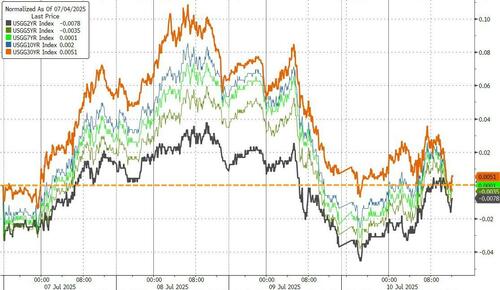
After the U.S. Treasury's auction of $22 billion in 30-year bonds received strong demand, yields on all maturities of U.S. Treasuries reduced some of their earlier increases during the session. The winning bid rate for this auction was 4.889%, close to the level in the secondary market prior to the auction. However, the bid-to-cover ratio was below average, falling to 2.38. This 30-year bond auction was the last batch of the week's $119 billion coupon-bearing bond auctions.
Want to learn more market analysis?Futubull AI is now online!Accurate answers, comprehensive insights, seize key opportunities!

Editor/melody