
The latest U.S. CPI data has been released, with the core inflation rate unexpectedly surging to a five-month high. Analysts have candidly stated, 'This is not a good sign,' leading to increased market bets on a September interest rate cut...
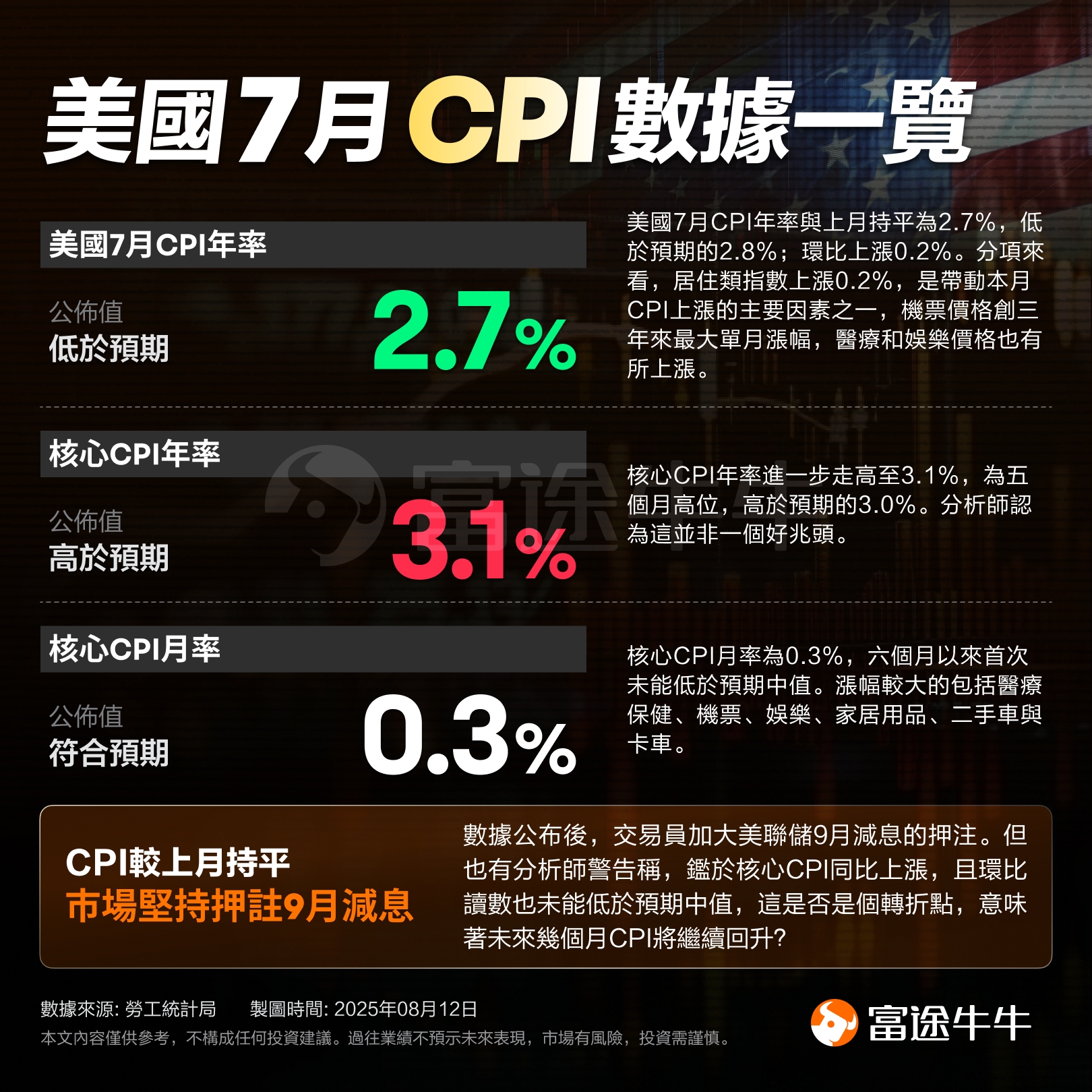
At 8:30 PM Beijing time on Tuesday, the U.S. core CPI for July (unadjusted) rose to 3.1% year-over-year, marking a five-month high and exceeding market expectations of 3.0%. The core CPI on a monthly basis increased to 0.3%, reaching its highest level since January, in line with market expectations and higher than the previous value of 0.20%. The overall CPI year-over-year recorded 2.7%, below the expected 2.8% and unchanged from the previous value. The monthly CPI recorded 0.2%, in line with expectations and lower than the previous value of 0.30%.
Following the data release, spot gold surged to a high of $3,354 per ounce before sharply retreating and then rising again. The U.S. dollar index fell by more than 30 points in a short period. Non-U.S. currencies generally rose, with the British pound breaking through 1.35 against the U.S. dollar. The U.S. dollar fell below 148 against the Japanese yen, and the euro rose nearly 50 points against the U.S. dollar.
 U.S. short-term interest rate futures declined, with traders increasing their bets on a Federal Reserve rate cut in September and continuing to bet on a rate cut in December.
Analyst Anstey noted that this is the first time in six months that the monthly core CPI reading has not fallen below the median expectation. The question is whether this marks a turning point, with inflation beginning to exceed expectations in the coming months. The July core CPI slightly exceeded expectations, and Federal Reserve Chairman Jerome Powell has repeatedly stated that policymakers are focused on the 12-month inflation rate. Therefore, this is not a positive sign.
The 'supercore services' metric, which was once a focal point for Federal Reserve policymakers, became a significant driver of inflation in July. This metric, which excludes housing, goods, food, and energy costs, rose by 0.48% in the month. This is the largest increase since January and the second-largest in 16 months. Such a large jump has been rare in recent times.
Airfare prices were a key factor in the rise of 'supercore services.' The 4% increase in this category this month is the highest in over three years. Another category driving the metric up was dental services, which saw a 2.6% increase, setting a new record.
Anstey mentioned that new car prices remained flat this month. Katherine Judge from CIBC Capital Markets noted: The automotive industry expects prices to rise when new models are released this fall. 'We expect new car prices to rise due to tariffs as new models enter dealerships and inventories before the tariffs are depleted.'
Economists have been closely monitoring whether categories such as furniture are affected by tariffs. This category rose by 0.7% this month, marking a slight slowdown in the rate of increase. Nevertheless, its year-on-year growth of 2.4% has reached a two-year high.
Video and audio products are another category under close scrutiny for tariff impacts. The monthly increase was 0.8%, similar to furniture prices, which is the smallest rise since May. On an annual basis, the increase was 0.4%, which may not sound like much, but it is the largest increase since 2021.
Clothing prices increased by 0.1% month-over-month, again marking the smallest increase since May. From the perspective of tariff impacts, at least preliminary observations suggest that the effects have not intensified and may have even slightly weakened.
Notably, the two categories often emphasized by Trump—groceries and energy costs—both saw declines in July. 'Household food' prices fell by 0.1%, while energy prices dropped by 1.1%, with gasoline prices decreasing by 2.2%.
Analyst Jersey's initial take on the July U.S. CPI report is that the Treasury market seems concerned about rising CPI, but the overall monthly CPI data suggests that the PCE data received before the September meeting may be close enough to the 2% target to allow the Federal Reserve to ease monetary policy in September. Jersey stated, 'We still believe that the market is likely to move higher.'
'With the new highlights in the job market fading, perhaps merely avoiding an unexpected rise in inflation is enough for the market to continue digesting more rate cuts,' said Zachary Griffiths, Head of Investment Grade and Macroeconomic Strategy at CreditSights. 'Overall, we view this statement as neutral, but we still expect the Fed to cut rates in September. Our base case is a larger 50-basis-point cut, as the labor market has become a focal point for policymakers.'
Always stepping on landmines with your investments?Futubull AI is now live!Precise answers, comprehensive insights, and the ability to seize key opportunities!

Editor/joryn