
Last weekend, when asked about his "preferred trade" ahead of a potential Federal Reserve rate cut next month, Josh Schiffrin, Chief Strategist for Global Banking and Markets at Goldman Sachs, listed short-term government bonds as his top choice...
Schiffrin specifically highlighted the five-year U.S. Treasury note, stating, "I find the valuation of five-year Treasury yields in the range of 3.75% to 4% to be attractive."
Last weekend, when asked about his "preferred trade" ahead of a potential Federal Reserve rate cut next month, Josh Schiffrin, Chief Strategist for Global Banking and Markets at Goldman Sachs, listed short-term government bonds as his top choice...
 In a podcast episode of "Markets" that aired on Goldman Sachs' official website last Friday, Schiffrin emphasized the five-year U.S. Treasury note during a conversation with Mike Washington, Managing Director of Goldman Sachs' Equity Sales Trading.
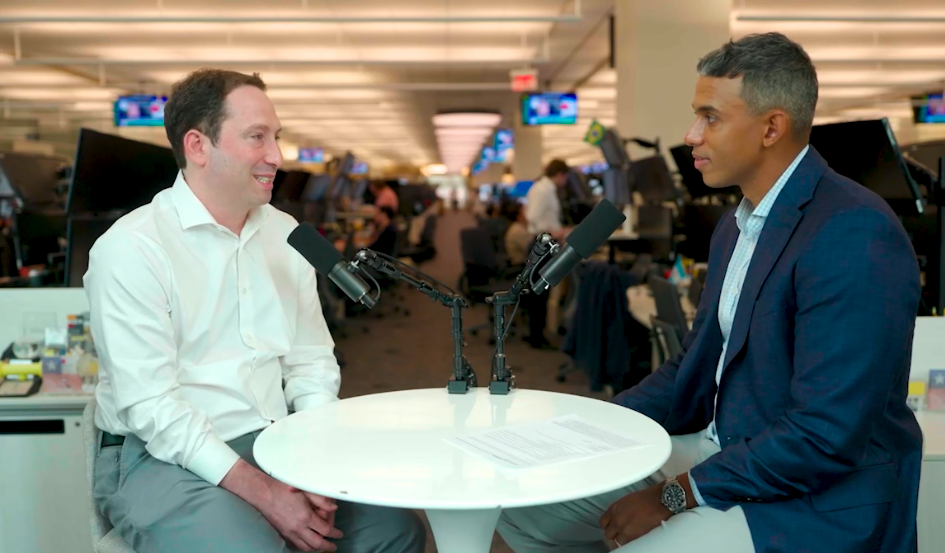
"I believe that the valuation of the $5-Year U.S. Treasury Yield (US5Y.BD)$ in the range of 3.75% to 4% is attractive," Schiffrin stated.$U.S. 5-Year Treasury Notes Yield (US5Y.BD)$in the range of 3.75% to 4% is attractive," Schiffrin stated.
He added, "I also believe that if the risk markets show signs of weakness, they possess good risk-hedging characteristics."
As of the end of trading on Monday, the yield on five-year U.S. Treasury bonds was trading around 3.84%, having significantly decreased from 4.38% at the beginning of the year.
Schiffrin expressed a preference for short-term U.S. Treasury bonds, as he anticipates that the Federal Reserve will ease monetary policy next month, and the U.S. labor market is cooling. Data earlier this month showed that the U.S. added only 73,000 jobs in July, below the expected 106,000.
Schiffrin noted that it is "highly likely" the Federal Reserve will ease policy in September, stating, "I feel that a 25 basis point rate cut in September is very likely."
He also added that the likelihood of the Federal Reserve maintaining rates unchanged at that time is even lower than the possibility of a 50 basis point rate cut.
Previously, a survey conducted by industry institutions of 110 economists also indicated that 61% of respondents expect the Federal Reserve to lower interest rates by 25 basis points at its next meeting on September 17, to a range of 4% to 4.25%. This would mark the first rate cut of the year. Most of the remaining respondents believe that the Federal Reserve will keep rates unchanged at the next meeting.
Over the past few months, U.S. President Trump has repeatedly publicly pressured Federal Reserve Chairman Powell to cut rates, but the last five Federal Reserve decisions have not adjusted rates, including the most recent meeting at the end of July. Powell and his colleagues at the Federal Reserve have cited the uncertainty of Trump's tariffs, inflation rates exceeding the Fed's 2% target, and relatively low unemployment rates as reasons for maintaining unchanged rates.
The most closely watched event this week will be the Federal Reserve's Jackson Hole Economic Symposium held in Wyoming. Some market participants are closely focused on whether Chairman Powell will signal a rate cut in September.
Editor/Melody