
I still remember early last week, when the global market was anxious about the possibility of the 30-year U.S. Treasury yield breaking above 5%. However, just a week later, the focus of the bond market seems to have rapidly shifted from one extreme to another: is the U.S. Treasury yield dropping too quickly?
I still remember at the beginning of last week, the global market was anxious about the possibility of yields breaking above 5%.$U.S. 30-Year Treasury Bonds Yield (US30Y.BD)$However, just a week later, the focus of the bond market seems to have rapidly shifted from one extreme to another: Are U.S. Treasury yields falling too quickly?
Market data shows that, influenced by expectations of an imminent interest rate cut by the Federal Reserve and concerns over a slowdown in the growth prospects of the U.S. economy,$U.S. 10-Year Treasury Notes Yield (US10Y.BD)$recently declined significantly, with this 'global asset pricing anchor' having fallen over 24% this year, standing at 4.049% at the time of publication.
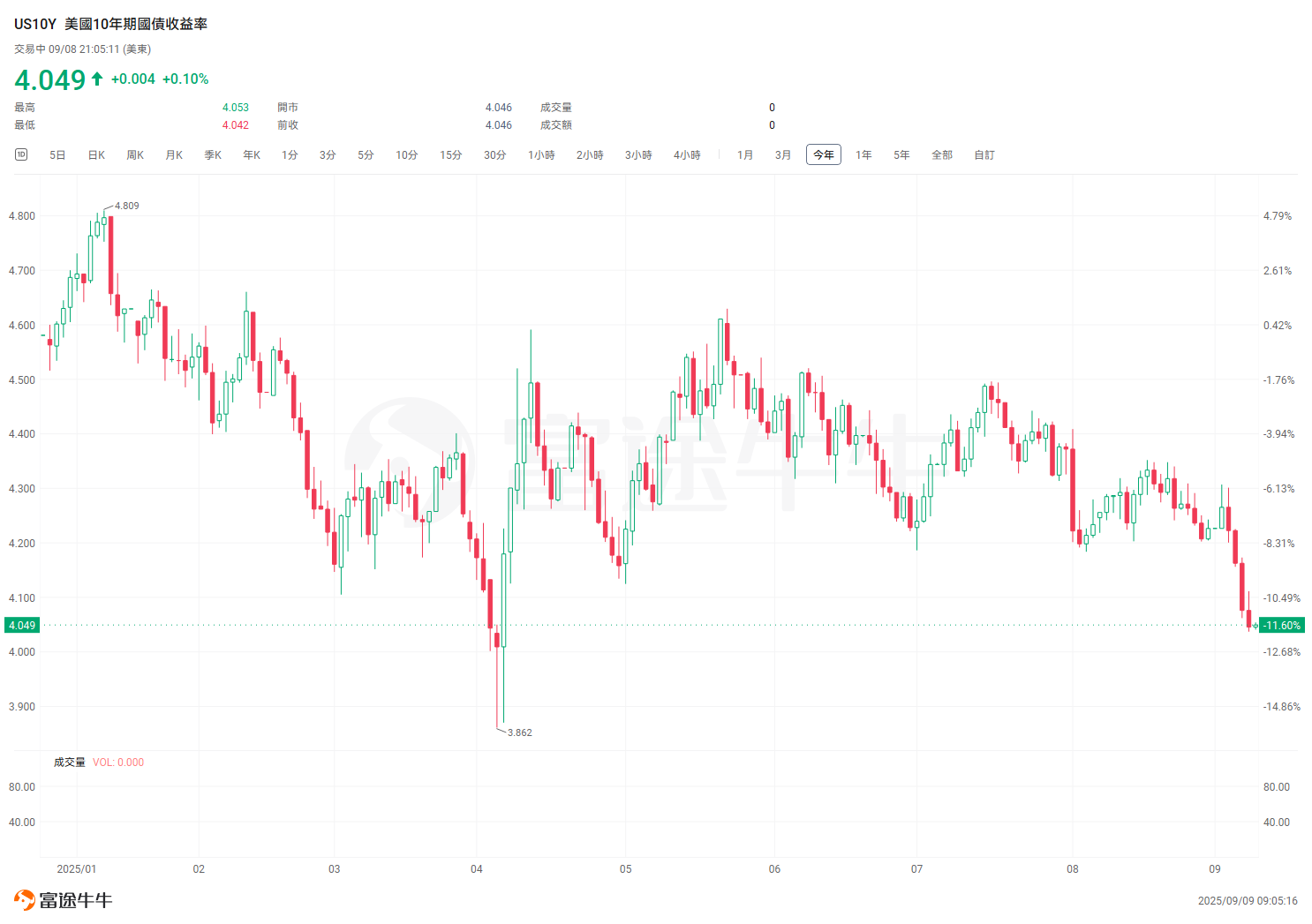
 From the trend perspective,$U.S. 10-Year Treasury Notes Yield (US10Y.BD)$Currently, it not only has reached the lowest level since April 7 but may also test the 4% integer level downwards. Driven by the decline in yields of shorter-term bonds, last week, the yield that approached the 5% mark has also significantly retreated.$U.S. 30-Year Treasury Bonds Yield (US30Y.BD)$By Monday's closing, it had already dipped to around 4.68%.
The impact of the drop in the 10-year U.S. Treasury yield on the stock market can be both positive and negative, depending on how investors and traders interpret it. Generally, a decline in yields reduces the capital costs and borrowing costs for companies, thereby enhancing the present value of their future earnings and stock valuations. However, a prolonged decline in long-term Treasury yields often indicates a weakening of market confidence in the U.S. economic outlook.
Last Friday's dismal non-farm payroll data undoubtedly became the latest catalyst for the decline in bond yields. Data released by the U.S. Department of Labor showed that non-farm payrolls increased by only 22,000 in August, far below the expected 75,000 and the upwardly revised 79,000 from July, causing investors to downplay the economic growth outlook and firmly lock in the possibility of an interest rate cut by the Federal Reserve this month.
In this regard, Derek Tang, an economist at Monetary Policy Analytics, stated that the current 10-year U.S. Treasury yield can be regarded as an "indicator of economic recession."
He further pointed out that the trajectory of the declining yield is "largely related to the probability of an interest rate cut by the Federal Reserve." "The key is whether the rate cut is a proactive choice or a forced action. If it is a proactive choice, it will be positive for the stock market, indicating that the Federal Reserve is taking preventive measures against recession and providing a stronger safety net; however, if it is a forced action, it suggests that the Federal Reserve is catching up with the reality of an already slowing or recessionary economy, which means the stock market will face some pressure."
Currently, the Bank of America Securities strategist team has revised its year-end forecast from 4.25% to 4%, a change prompted by the weaker-than-expected employment data released last Friday for August.$U.S. 10-Year Treasury Notes Yield (US10Y.BD)$
It is noteworthy that despite market expectations that the U.S. Consumer Price Index (CPI) for August, to be released this Thursday, may indicate persistent high inflation, the 10-year U.S. Treasury yield continued its downward trend on Monday.
Will Compernolle, a strategist at FHN Financial in Chicago, stated that the decline in the 10-year U.S. Treasury yield indicates a complete shift in the macro environment compared to the beginning of the year, when most believed that 2025 would exhibit characteristics of a 'Trump inflation' trade (i.e., high growth coupled with rising inflation).
The strategist added that the current situation points instead to a slowdown in economic growth, with the sustained decline in the 10-year Treasury yield over the past few months reflecting a downward adjustment in market expectations for growth. In his view, this trend is more likely to be interpreted as a sign of 'risk aversion' rather than a positive for the stock market.
Compernolle noted that unless employment growth accelerates significantly, it may be difficult for market sentiment to reverse.
Editor/Melody