
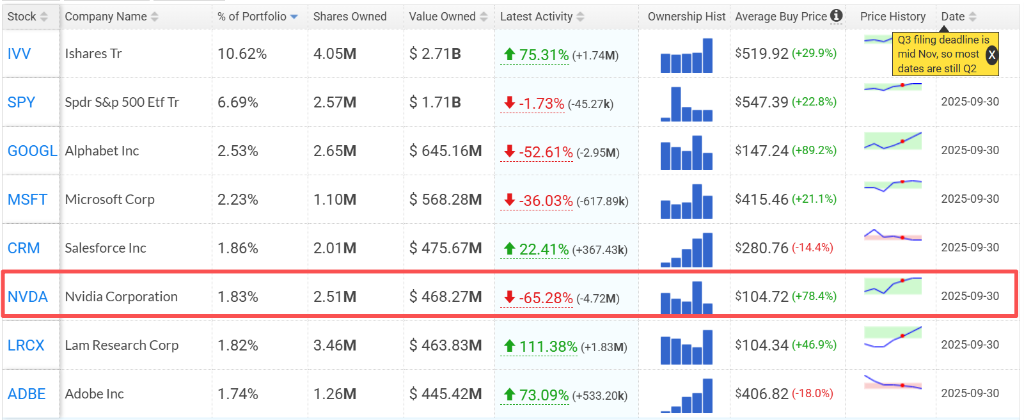
As of September 30, Bridgewater held 2.51 million shares of NVIDIA, a sharp decline of 65.3% from 7.23 million shares at the end of the second quarter. In the previous quarter, Bridgewater had significantly increased its position in NVIDIA. The holding of the U.S. large-cap ETF SPY surged by 75.3% to 4.05 million shares, accounting for 10.62% of the portfolio, making it the largest holding. Bridgewater reduced its holdings in Alphabet and Meta by 52.6% and 48.3%, respectively, while cutting Microsoft's position by 36% and reducing Amazon's stake by 9.6%.
As the AI bubble, sovereign debt risks, and the global liquidity turning point converge, Ray Dalio's 'debt cycle alarm' seems to be transitioning from theory to reality.
According to the latest 13F filing, in the third quarter, Bridgewater Associates, the world’s largest hedge fund, not only slashed its NVIDIA holdings by 65% but also significantly increased its position in U.S. large-cap index ETFs while divesting multiple heavily weighted emerging market stocks during the same period — a 'risk-averse portfolio adjustment' is quietly taking place.
Significant Reduction in NVIDIA Holdings: Short-Term Risks Escalate
 The report shows that as of September 30, Bridgewater held $NVIDIA (NVDA.US)$ 2.51 million shares, a sharp decline of 65.3% from 7.23 million shares at the end of the second quarter. In the just-concluded second quarter, Bridgewater had significantly increased its holdings in NVIDIA by over 150%. The sharp reversal over two quarters signifies a clear strategic shift: from 'following trends' to 'prioritizing risk management'.
According to a previous article by Wall Street News, Bridgewater founder Ray Dalio recently reiterated his warning that the global debt cycle has entered its late-stage risk phase. He believes the next financial crisis is more likely to stem from sovereign debt issues rather than traditional market speculation. Rising U.S. public debt, geopolitical tensions, and central bank interventions are collectively elevating systemic risks.
As a major beneficiary of the AI boom, NVIDIA’s market capitalization has surged significantly; however, Bridgewater’s retreat suggests the fund has reassessed its risk exposure amid an environment of tightening fiscal and monetary policies.
This reduction contrasts sharply with other hedge funds, as David Tepper’s Appaloosa Management increased its NVIDIA holdings to 1.9 million shares during the same period.
Increasing U.S. Large-Cap ETF Holdings: Betting on 'Stable Growth' and Enhancing Hedging
While reducing individual stock risks, Bridgewater significantly increased its allocation to U.S. large-cap ETFs:
$SPDR S&P 500 ETF (SPY.US)$ The position surged by 75.3% to 4.05 million shares, with the proportion increasing to 10.62%, making it the largest holding.
$iShares Core S&P 500 ETF (IVV.US)$ The proportion increased to 6.69%, ranking it as the second-largest holding.
The two ETFs collectively represent over 17% of the fund's portfolio, qualifying as a "core asset-level" weight within Bridgewater's traditional industry-macro portfolio.

The intent behind this adjustment is clear:
Reduce sector concentration: Avoid excessive exposure to AI and tech stocks driving portfolio volatility.
Embrace stable cash flows from large-cap stocks: In the late economic cycle, blue-chip stocks present more controllable risks compared to growth stocks.
Enhance portfolio flexibility: ETFs facilitate short-term fine-tuning and risk hedging.
For Bridgewater, which adheres to a "risk parity + diversification" strategy, this move aligns perfectly with its style of "seeking opportunities while playing defense."
Liquidation of Multiple Individual Stocks and Emerging Market ETFs: Accelerated Retreat from Non-Core Assets
In addition to reducing its position in NVIDIA, Bridgewater also completely divested from 10 key individual stock holdings during the third quarter, including $Lyft Inc (LYFT.US)$ 、 $Spotify Technology (SPOT.US)$ 、 $JPMorgan (JPM.US)$ 、 $United Airlines (UAL.US)$ 、 $Pfizer (PFE.US)$ , and reduced its holdings in $Amazon (AMZN.US)$ (reduced position by 9.56%), $Microsoft (MSFT.US)$ (reduced position by 36.03%), $Meta Platforms (META.US)$ (reduced position by 48.34%) and $Alphabet-A (GOOGL.US)$ (Reduced position by 52.61%) among the holdings of the "Magnificent Seven" members.

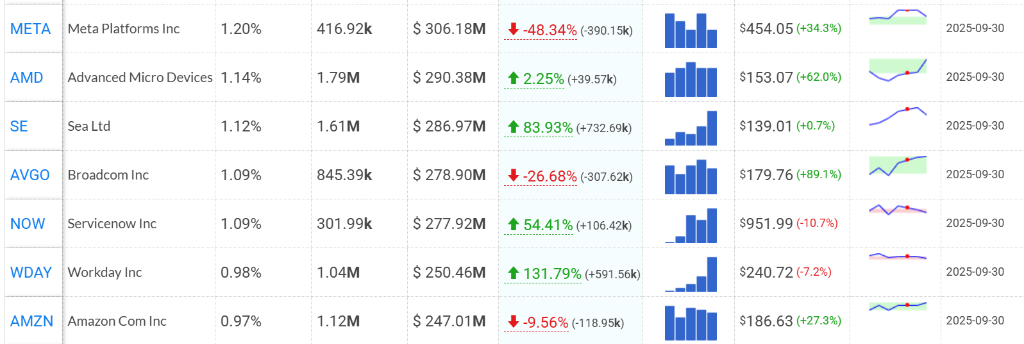
These companies span multiple industries, including finance, pharmaceuticals, technology, transportation, real estate, and resources—Bridgewater’s move clearly reflects a comprehensive “trimming down” of non-core assets to focus on a few highly liquid and stable investments.
Moreover, the 13F filing reveals that Bridgewater continued to reduce its allocation to emerging market ETFs, underscoring concerns about the vulnerability of emerging markets amid tightening global liquidity.
Significant Additions in Certain Sectors: Netflix, Monster Beverage, and MEL (Latin American E-commerce)
Despite the overall risk-reduction strategy, Bridgewater significantly increased its positions in several individual stocks, reflecting its Alpha approach of “seeking undervalued recovery assets”:
$Netflix (NFLX.US)$ : Position surged by 896%
$MercadoLibre (MELI.US)$ (Latin American e-commerce giant): Increased position by 1237%
$Popular (BPOP.US)$ / $Evercore (EVR.US)$ / $Monster Beverage (MNST.US)$ / $Exelixis (EXEL.US)$ : All have seen increases in holdings ranging from 1,000% to 5,000%.
$Trane Technologies (TT.US)$ (HVAC and refrigeration equipment giant): Holdings increased by 5,343%.
These position increases share common characteristics: stable profitability, strong cash flow, low industry cyclicality, and greater resilience amid macroeconomic volatility. Their valuations are also not as high as those of tech giants. This indicates that Bridgewater is steering clear of high-valuation, high-volatility AI sectors while strategically investing in fundamentally robust companies poised for recovery.
 Understand institutional holdings and stay updated with the latest investment trends. Market > US Stocks > Institution Tracking

Editor/KOKO