
①When other assets weaken, investors tend to turn to gold as a safer “safe haven” for funds. However, this has not been the case this month… ②Recently, gold and U.S. equities have often fallen in tandem, prompting some industry insiders to worry that this may indicate a more severe situation in the market—especially when it implies that investors have nowhere to seek a safe haven.
Cailian Press, November 17 (Edited by Xiaoxiang) When other assets weaken, investors tend to turn to gold as a safer “safe haven” for funds. However, this has not been the case this month…
Recently, gold and U.S. equities have often fallen in tandem, prompting some industry insiders to worry that this may indicate a more severe situation in the market—especially when it implies that investors have nowhere to seek a safe haven.
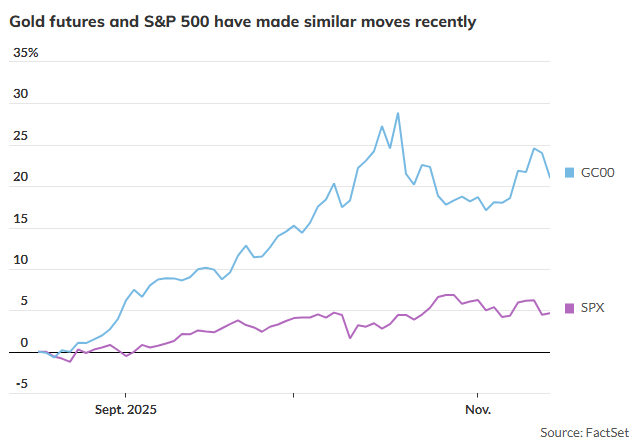
 Last Friday, the spot gold price $XAU/USD (XAUUSD.CFD)$ fell by 2.4% to $4,082 per ounce, hitting a one-week low at one point during the session. During the same period, $S&P 500 Index (.SPX.US)$although it opened lower but closed higher, it still failed to avoid a second consecutive daily loss. Even worse was the fate of $Bitcoin (BTC.CC)$the price — as the cryptocurrency plunged below $94,000 over the weekend, the largest digital currency has erased all its gains for the year.
Michael Armbruster, Co-Founder and Managing Partner of futures brokerage Altavest, stated, "In the short term, as investors seek liquidity, gold may move in tandem with other risk assets."
From a market perspective, the recent pullback in U.S. tech stocks has undoubtedly been the most concerning. With the tech sector dragging down performance and persistent concerns about macroeconomic health weighing on the S&P 500 Index, the index is currently heading for a decline in November. Notably, the S&P 500 had previously recorded six consecutive months of gains.
Following a bet against Palantir by Michael Burry, the legendary investor and prototype for 'The Big Short,' market participants have grown increasingly concerned about an AI bubble in recent weeks.$Palantir (PLTR.US)$ Adrian Ash, research director at BullionVault, noted: "If the sell-off in the AI sector persists, at least in the short term, investors attempting to hedge tech stock risks with gold may be disappointed."
Why does the correlation between gold and U.S. equities matter?
Ash stated that gold, as a recognized safe-haven asset, typically benefits when market sentiment shifts toward risk aversion, but "it is well-known that its long-term correlation with equity movements is non-existent."
However, the current positive correlation means the two assets are moving in tandem—this could represent investors who are incurring losses in the stock market urgently liquidating their gold holdings to cover losses.
An analysis of FactSet data by Dow Jones Market Data showed that as of last Friday, the 21-day rolling correlation coefficient between the most active gold futures on COMEX and the S&P 500 Index was 0.22, indicating a slight positive correlation. Throughout most periods in October and November this year, this coefficient maintained a moderate positive correlation.
Ash pointed out that while the rolling monthly correlation coefficient between gold and the S&P 500 Index fluctuated between positive and negative values this year, the annual average remained close to zero.
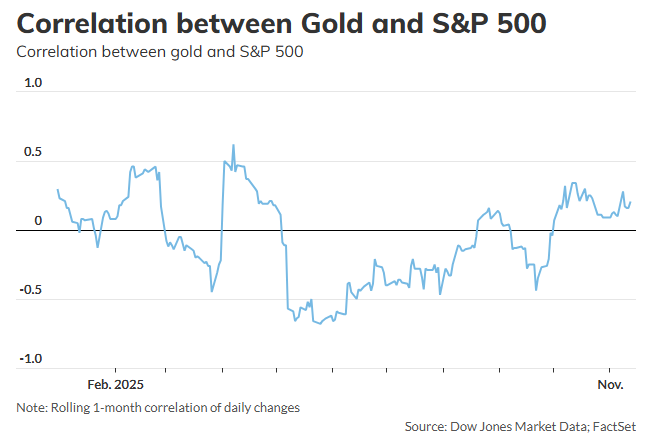
He explained that a correlation coefficient of 1.0 implies synchronized movement between the two, whereas -1.0 suggests an inverse relationship. An average value near zero indicates that during this period, there was 'absolutely no daily correlation' between gold and the stock market.
However, he noted that the nearly zero average correlation for this year actually 'masked the fact that gold prices sometimes exhibited strong positive correlations with the stock market and at other times strong negative correlations.'
Notably, during 'true crises,' all correlation coefficients will approach 1.0 — meaning that gold and the S&P 500 Index move in perfect synchronization because 'traders who incur losses in one asset class need to cash out from profitable positions.'
Ash explained that this is why gold prices fell during the worst phase of the 2008 financial crisis and plummeted in the initial stages of the 2020 COVID-19 panic.
Nevertheless, Ash added that the long-term value of gold as financial insurance will eventually be validated — this safe-haven metal tends to 'bottom out and rebound earlier than stocks, experience stronger gains, and continue its long-term upward trend, thereby reducing overall portfolio losses.'
Ash emphasized, 'While there are no absolute guarantees, it is generally beneficial to look beyond short-term noise and maintain a diversified allocation.'
Editor/Rocky