When Peter Thiel completely exited NVIDIA, it sounded an alarm bell behind the AI boom.
Thiel Macro LLC, the investment firm under Peter Thiel, often referred to as the "Godfather of Venture Capital" in Silicon Valley and a long-time close associate of U.S. Vice President Vance, has not merely made minor adjustments to its position in NVIDIA, but has completely exited its stake in the "AI chip leader." $NVIDIA (NVDA.US)$ This move by Peter Thiel comes at a surprising moment when Wall Street is busy proclaiming NVIDIA as the top tech stock pick while insisting that the so-called 'AI bubble moment' is nothing more than market overreaction.
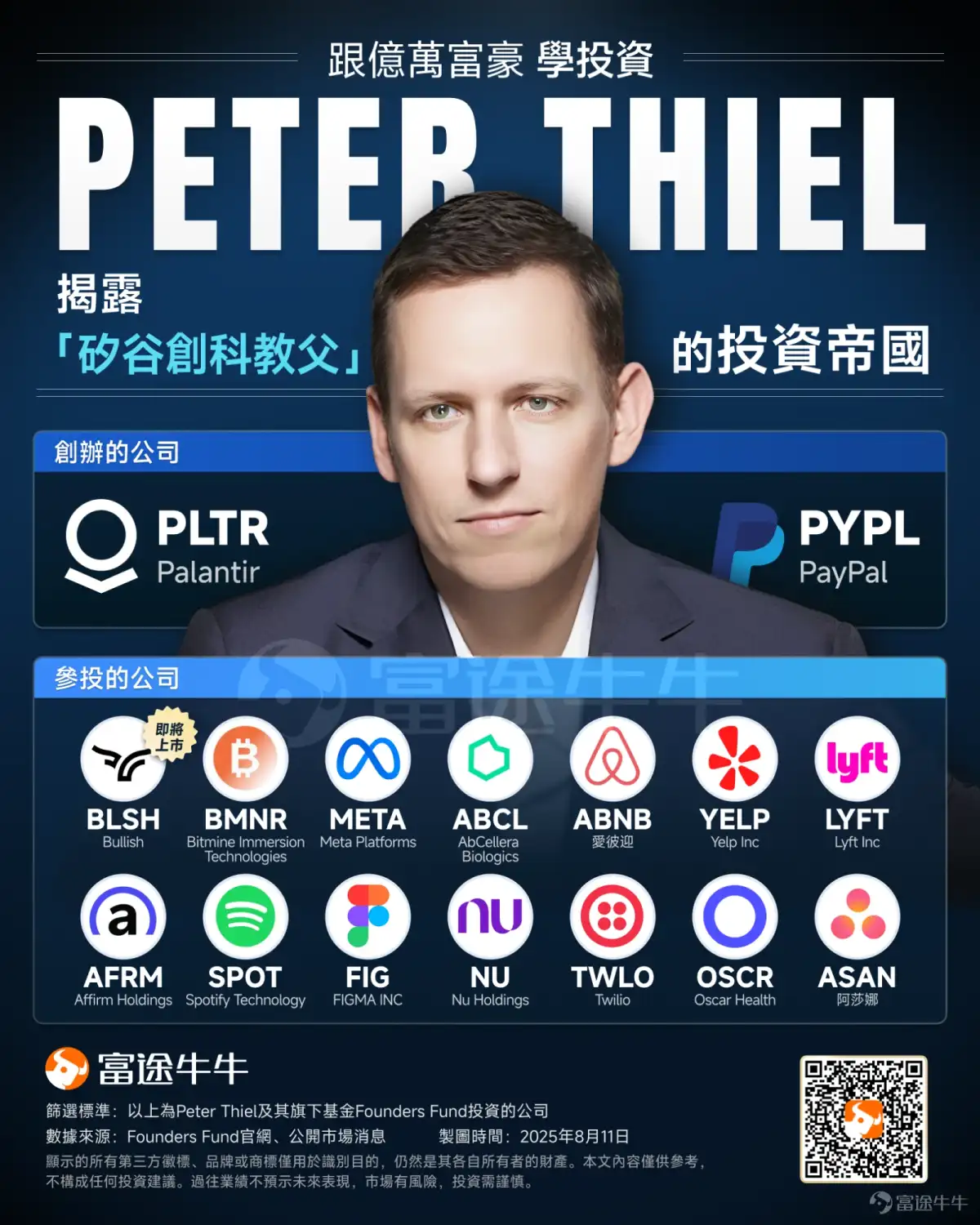
Relevant content:From PayPal and Palantir to today’s Bullish: Can the Midas touch of Silicon Valley's legendary investor Peter Thiel strike again?
 Despite NVIDIA recently surpassing the epic milestone of a $5 trillion market cap and Wall Street continuously raising its price target for NVIDIA to levels nearing $300, this did not stop Thiel from fully divesting his position in the stock. Additionally, Peter Thiel's hedge fund reduced its overall equity portfolio by approximately two-thirds, concentrating its funds into three mega-cap technology stocks — $Apple (AAPL.US)$ 、$Microsoft (MSFT.US)$as well as$Tesla (TSLA.US)$Among them, Microsoft and Apple represent the institution's first-time positions, while Tesla has been significantly reduced.
Some analysts believe that Peter Thiel’s latest portfolio changes are far from a simple rebalancing but more akin to a clear statement.
Peter Thiel himself had warned not long ago that the market hype cycle around AI was running far ahead of its actual economics, and his third-quarter portfolio adjustments align with this view.
Although Peter Thiel has repeatedly praised NVIDIA’s absolute leadership in the AI hardware field, his latest investment decision suggests that he believes the AI transformation will be a 'slow burn' process. He has also stated that, in his view, companies providing durable economic growth value will be platform-based software firms, rather than pure-play chip companies currently valued at historical highs.
Peter Thiel’s decision to completely divest from NVIDIA, a popular AI tech stock, as of September 30 in the third quarter, fully aligns with the recent global tech stock correction driven by the 'AI bubble narrative.' This highlights growing skepticism about the sustainability of the over two-year-long AI investment frenzy, as tech giants continue to pour substantial resources into building AI computing infrastructure while the path to AI monetization remains highly uncertain and valuations of these AI-related stocks grow increasingly stretched. Amid the ongoing market correction from all-time highs due to the escalating 'AI bubble concerns,' investors now have ample reason to cash out or take profits from high-valuation stocks closely tied to AI, including NVIDIA, Micron, SK Hynix, Google, Microsoft, and others.$Advantest (6857.JP)$Other stocks closely associated with AI, such as these, are also being targeted for profit-taking or partial liquidation.
Who is Peter Thiel?
Peter Thiel is no casual investor wandering through the tech world; in fact, he has played a pivotal role in shaping the modern tech ecosystem, earning him the title 'Godfather of Silicon Valley Venture Capital.'
He co-founded the global fintech giant$PayPal (PYPL.US)$, and at the time, served as its CEO, eventually leading the company to become publicly traded on the US stock market, later becoming the first external investor in Facebook.
Later, he co-founded Palantir, a leader in 'AI + data analytics' that is currently highly favored by global investors and also a builder of US defense AI systems,$Palantir (PLTR.US)$and has continued to serve as the company’s chairman while helping Founders Fund become one of the most influential venture capital firms in Silicon Valley, making significant investments in companies such as SpaceX,$Airbnb (ABNB.US)$among others.
In terms of investments, he manages Thiel Macro LLC, his namesake hedge fund, which held approximately $74.4 million worth of US equities in the third quarter, a sharp decline from $212 million in the second quarter.
Moreover, as of 2025, Thiel’s personal net worth has reached an astonishing $16.3 billion.
Thiel sold NVIDIA at the peak of the AI frenzy
Thiel’s third-quarter 13F filing reveals one of the most dramatic investment shifts in the tech sector this year. Despite NVIDIA's continued success over multiple quarters and surpassing a $5 trillion market cap, Thiel’s hedge fund, like many retail investors who turned bearish on NVIDIA, took the opposite route by completely liquidating its position.
The hedge fund not only fully reduced its NVIDIA holdings but exited the position entirely, meaning it liquidated all NVIDIA shares in the third quarter—a move that could be seen as accurately anticipating the market panic sell-off caused by an AI bubble.
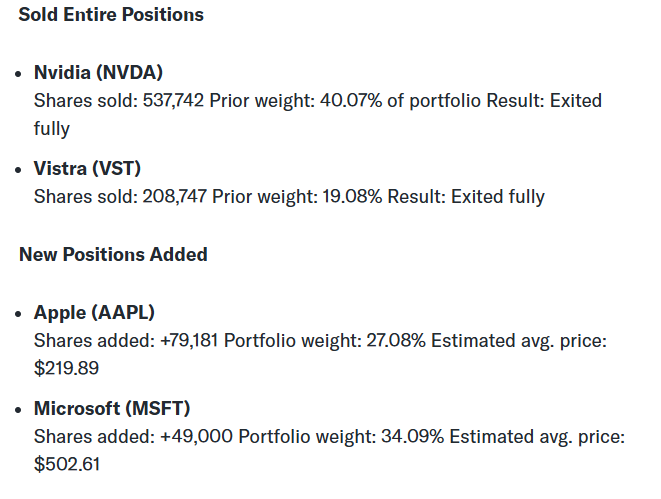
More than 537,000 shares of NVIDIA, accounting for approximately 40% of its portfolio, disappeared from the latest 13F report. American Electric Power, the biggest winner of the electric utility stock boom in 2024 —— $Vistra Energy (VST.US)$ was also completely liquidated by the hedge fund, which previously accounted for 19% of its portfolio.
Even more striking is that despite NVIDIA’s quarterly revenue rising sharply from $39.3 billion to $46.7 billion, with data center revenue surging by 56%, and Wall Street analysts widely expecting annual sales to reach $1 trillion by 2030, Thiel completely exited this stock position.
The disclosed US equity holdings of Thiel’s hedge fund fell from nearly $212 million in the second quarter to $74.4 million in the third quarter, a reduction of nearly two-thirds.
Moreover, the hedge fund’s portfolio turnover rate exceeded 80%, leaving only three holdings: Tesla, Microsoft, and Apple.
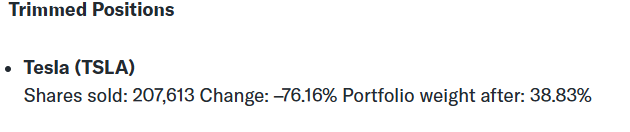
However, the position in Tesla was reduced by approximately 76%, leaving only 65,000 shares, which now account for nearly 39% of the hedge fund’s portfolio. At the same time, Thiel's hedge fund made significant new investments in Microsoft and Apple, representing 34% and 27% of its portfolio, respectively.
The specific operations of Thiel's hedge fund institution's third-quarter 13F portfolio are as follows:
Why Thiel’s complete exit from NVIDIA holdings sends a starkly different signal
As Thiel fully exited his position in NVIDIA, the market has clearly received a bearish and negative signal at a time when it is completely obsessed with AI.
NVIDIA’s fundamentals have been outstanding, and Thiel once praised its absolute dominance, calling NVIDIA the clear leader in the AI hardware space.
On the other hand, he warned that the market's hype cycle surrounding the AI boom has exceeded even his own expectations. He compared this moment to 1999, when investors were pricing in a future that would take approximately 15-20 years to materialize.
He is not the only one who thinks so.$Amazon (AMZN.US)$Jeff Bezos, the founder, described the massive AI boom as “the perfect industrial bubble.” David Solomon, CEO of Goldman Sachs, pointed out that the stock market may experience a healthy correction of more than 10% within the next 12 or 24 months. Similarly, legendary investor James Anderson referred to NVIDIA and OpenAI’s $100 billion funding plan for circular AI as “unsettling.”
Recently, Michael Burry, the prototype character from the Hollywood movie 'The Big Short,' has also established significant bearish short positions in NVIDIA and Palantir, the two core beneficiaries of the U.S. stock market’s AI investment frenzy. Since 2023, the share prices of these two giants have increased several-fold.
This is also why Peter Thiel turned to Microsoft and Apple, as these tech giants have more diversified revenue streams, such as extensive cloud computing businesses, consumer electronic devices, and software service lines.
Thiel believes that while AI is transformative, it is a slow-moving process. Platform-based software service companies provide genuinely sustainable economic growth benefits, rather than the currently overvalued 'pure-play chip companies.' Microsoft and Apple are precisely the tech giants that build platforms, ecosystems, and integrate software, hardware, and services, giving them a stronger 'long-term profitability foundation' in the integration of AI, cloud, and devices. Additionally, compared to NVIDIA, Microsoft and Apple possess more robust debt structures, rock-solid free cash flow, and more mature multi-business models, which make them attractive when seeking to avoid 'high-stakes and high volatility.'
Since 2023, Apple Inc. (AAPL.US), the tech behemoth behind globally popular consumer electronics products such as the iPhone and iPad, has faced considerable opposition on Wall Street for not aggressively investing in AI infrastructure like other tech giants such as Google and Meta during this unprecedented wave of artificial intelligence enthusiasm. However, since April, Apple's conservative and unique 'cost-saving approach to AI' strategy has unexpectedly become a major boon for this consumer electronics giant, drawing market attention to how Apple manages to embody both a 'safe haven' and an 'AI Beta' dual investment positioning.
Although Apple, with its vast iPhone ecosystem and over 2.3 billion installed devices, is still viewed by Wall Street as one of the potential big winners of the AI boom, it does not bear the heavy capital expenditure risk associated with AI infrastructure. Moreover, Apple has substantial free cash flow on its balance sheet, and some Wall Street analysts believe that the 'AI inference blue ocean' and 'physical AI' will become new revenue drivers for Apple. These factors have made Apple’s stock stand out as the only tech stock in the global technology industry that combines the attributes of a 'safe haven' and AI exposure amid growing market skepticism about the global AI investment wave.
The logic behind hedging, according to Brian Mulberry, client portfolio manager at Zacks Investment Management, lies in the fact that 'Apple remains a large technology company, but it is not a pure-play AI company like NVIDIA. However, it is still tangentially related to AI.' He added, 'The market holds a very positive perception of Apple because it doesn’t have to answer the critical existential question that all other companies face: What is the return on your massive AI investments?'
Editor /rice