
This week, the spotlight in global markets will once again fall on AI giant — $NVIDIA (NVDA.US)$ NVIDIA is highly likely to once again deliver an earnings 'beat-and-raise' scenario, according to JPMorgan, following the release of its Q3 earnings report this Thursday (after the market close on November 19, Eastern Time).
On November 18, according to HardAI News, JPMorgan noted in its latest research report that the current factor determining NVIDIA’s growth rate is not demand but the production capacity limits of its extensive supply chain. The report forecasts Q3 revenue to exceed the market consensus of approximately USD 55 billion, with guidance projected between USD 63 billion and USD 64 billion, significantly higher than the market expectation of USD 61.5 billion.
The report indicated that another robust 'Beat-and-Raise' scenario is already anticipated, with the magnitude of upside largely depending on NVIDIA’s supply chain’s ability to expand production within three months.
 According to JPMorgan’s analysis, demand for AI computing power continues to significantly outstrip supply. NVIDIA’s largest customer base, including hyperscale cloud service providers, emerging cloud companies, and AI labs, still faces bottlenecks in computing power. Regarding supply chain capacity, the firm estimates that shipments of Blackwell/Blackwell Ultra racks grew by approximately 50% quarter-over-quarter in Q3, reaching a scale of about 10,000 racks. Looking ahead, this growth momentum is expected to continue into Q4.
The report pointed out that during the post-earnings conference call, market attention will focus on management’s commentary regarding the growth trajectory of the Blackwell/Blackwell Ultra products in the first half of fiscal year 2027, as well as responses to key issues such as the sustainability of AI spending, data center infrastructure power constraints, and the impact of component cost inflation on gross margins.
“Supply falling short of demand” remains the dominant theme, and exceeding earnings expectations is a high-probability event.
In the opening of the report, the firm explicitly stated that the focal point of current market discussions about NVIDIA is no longer whether demand is healthy, but whether its supply chain can keep pace with customers’ ambitious plans for AI computing power deployment.
JPMorgan noted that in the “initial phase” of a multi-year growth cycle for AI data center spending, demand for AI computing power still “significantly exceeds supply.” Major customers, including hyperscale cloud service providers, emerging cloud service providers, and AI research institutions, continue to face shortages in computing power despite more than two years of an AI investment boom.
Against this backdrop, JPMorgan predicts that NVIDIA's earnings report for this quarter will once again surpass Wall Street expectations. In terms of specific figures, the bank expects revenue for the third quarter of fiscal year 2026 ending in October to exceed the consensus expectation of approximately USD 55 billion. Additionally, it forecasts that the company will guide fourth-quarter revenue to a range of USD 63 billion to USD 64 billion, above the market consensus of USD 61.5 billion.
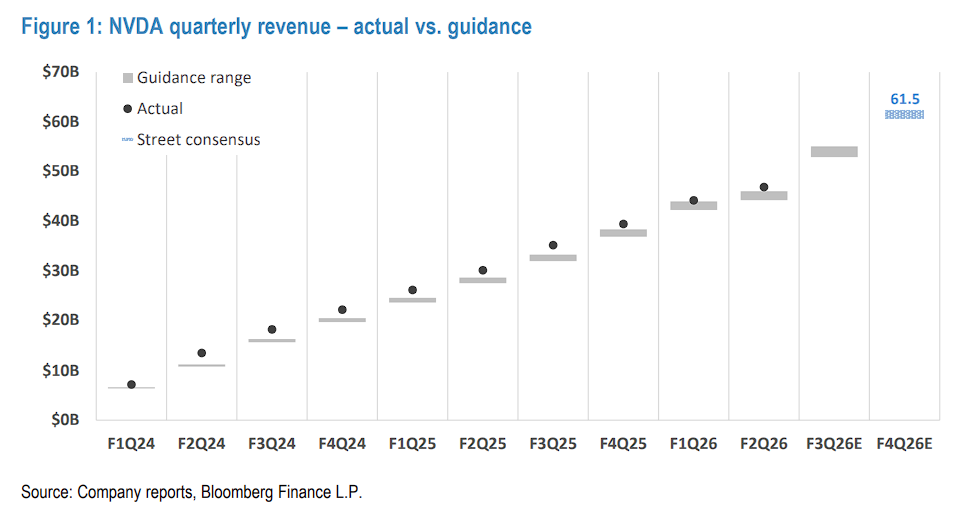
The report emphasizes that achieving another 'earnings beat and guidance raise' is a 'foregone conclusion' (in the cards), with the extent of the outperformance depending entirely on the scale of capacity increase within its supply chain over the next three months.
Supply Chain Capacity: The Sole 'Brake' on Growth
Since demand is not an issue, supply remains the only constraining factor.
The report provides a detailed analysis of the execution of NVIDIA’s supply chain. Over the past 3-4 months, its partners have demonstrated strong performance in shipments of Blackwell/Blackwell Ultra racks, with third-quarter shipments expected to achieve approximately a 50% quarter-over-quarter growth, reaching a scale of about 10,000 racks.
Looking ahead, this growth momentum is expected to continue into Q4. JPMorgan forecasts that NVIDIA’s total rack shipments for the entire fiscal year 2026 will reach between 28,000 and 30,000 units.
Although additional 3nm and CoWoS chip production capacity over the next 12 months will provide some upside potential for GPU shipments, the bank firmly believes that supply chain capacity will remain a key limiting factor for NVIDIA’s revenue growth, a situation that will persist until 2026.
Nevertheless, the bank provided an extremely optimistic long-term signal in the report.
JPMorgan believes that NVIDIA’s supply chain has sufficient capability to support a doubling of rack shipments year-over-year in fiscal year 2027/calendar year 2026, reaching between 60,000 and 70,000 units.
Most crucially, based on information disclosed by NVIDIA at the GTC conference in October, its order backlog for the 2026 calendar year has already exceeded the level of 70,000 racks. This indicates that the company’s current order volume has surpassed its maximum production capacity for the entire next year, providing exceptionally high certainty for future growth.
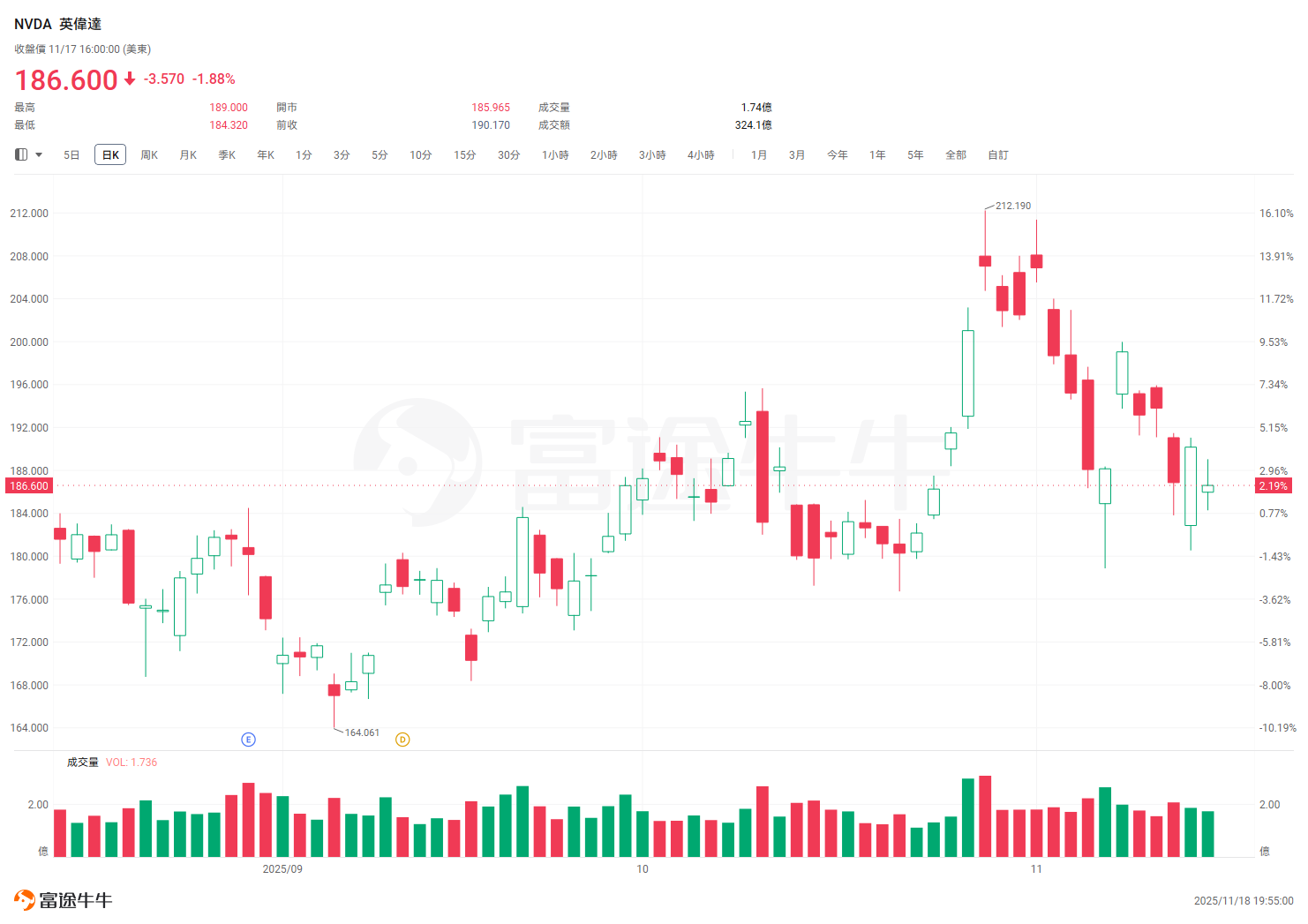
Based on this, JPMorgan maintains its 'Overweight' rating on NVIDIA with a target price of $215, implying a potential upside of 15% from current levels.
Beyond Earnings Reports: Four Key Long-Term Variables Investors Are Focused On
JPMorgan believes that for the upcoming earnings call, the stock price reaction may depend more on management's articulation of the future outlook rather than just the numbers. Investors should pay close attention to how management addresses the following four core concerns:
The production ramp trajectory for Blackwell/Blackwell Ultra: The pace of capacity expansion into the first half of 2026 (i.e., the first half of NVIDIA’s fiscal year 2027).
The sustainability of AI spending: On this matter, a recent in-depth report by JPMorgan’s global team concluded that funding sources for the AI sector will remain abundant through 2030.
The impact of power constraints: Over the next five years, an estimated 120 gigawatts (GW) of data center power capacity is expected to come online globally. However, delivery times for new gas turbines have surged to 3-4 years, while the construction period for nuclear power plants exceeds 10 years, making electricity a real bottleneck.
The impact of component cost inflation on gross margins: Particularly pressures from rising prices of raw materials such as memory and chips.
Notably, on the issue of gross margin, which investors are highly concerned about, the report provides a detailed breakdown.
JPMorgan believes that rising LPDDR memory prices represent a more significant pressure point than HBM memory. Although HBM4 is expected to see a 30-40% increase in average selling price (ASP) compared to HBM3e, NVIDIA can incorporate this cost into the pricing structure of its next-generation Rubin platform in advance.
However, for LPDDR memory, companies may have to accept variable market prices — even long-term agreements (LTAs) can only guarantee supply volumes but cannot lock in prices.
Nevertheless, JPMorgan believes that NVIDIA still has the ability to achieve its targeted gross margin of around 70% by the end of fiscal year 2026. However, considering inflationary pressures on input costs, there will be limited room for further gross margin expansion at that level.
 Performance updates have been fully upgraded, giving you a head start in uncovering investment opportunities!
Path Guidance: Open Futubull > Individual Stock Page > Click on the [Company] Tab >Earnings Express

Editor /rice