As the largest weight in the S&P 500 and a central hub for AI trading, NVIDIA's earnings have unprecedented importance. Analysts note that if investors are satisfied with the Q3 results and guidance, the bulls will drive global markets to an optimistic year-end close; if not, markets may face deeper adjustments.
Global markets are caught in a perilous collective anxiety, and the only force capable of breaking this deadlock may well be $NVIDIA (NVDA.US)$ . This chip giant, with a market capitalization of $4.5 trillion, is set to release its third-quarter earnings report after the U.S. stock market closes on Wednesday (early Thursday morning Beijing time). This earnings report will determine the trajectory of global markets in the final weeks of the year.
At present, market tension is spreading: from $Bitcoin (BTC.CC)$ to technology stocks, from gold to government bonds, from private equity markets to corporate bonds—almost all asset classes are facing selling pressure. Against this backdrop, investors have turned their focus to NVIDIA, a move driven by both hope and necessity. The company’s performance will directly reflect the real returns on the tech giants’ hundreds of billions of dollars in AI investments.
 Currently, Wall Street analysts are generally optimistic about NVIDIA's upcoming earnings report, expecting both net profit and revenue to grow by over 50%.
Analysts point out that if investors are satisfied with NVIDIA’s third-quarter results and fourth-quarter guidance, bulls will drive the market toward an optimistic close; if not, the market may face deeper adjustments. As one Wall Street insider put it, "This is a report where how NVIDIA performs will dictate how the market performs."
Notably, amid heightened market concentration risks, NVIDIA stands as $S&P 500 Index (.SPX.US)$The largest weighted stock and the center of AI trading have never been more important in terms of performance. However, some market participants have pointed out that concentration risk is exciting during market upswings but could turn into a nightmare during downturns.
NVIDIA: The Sole Redeemer of the Current Market?
A more somber sentiment is spreading across the market, and only NVIDIA can break this gloom.
The most speculative segments of the financial markets are currently under pressure. Bitcoin—the purest gauge of speculative enthusiasm—has fallen 29% from its peak, turning negative for the year.
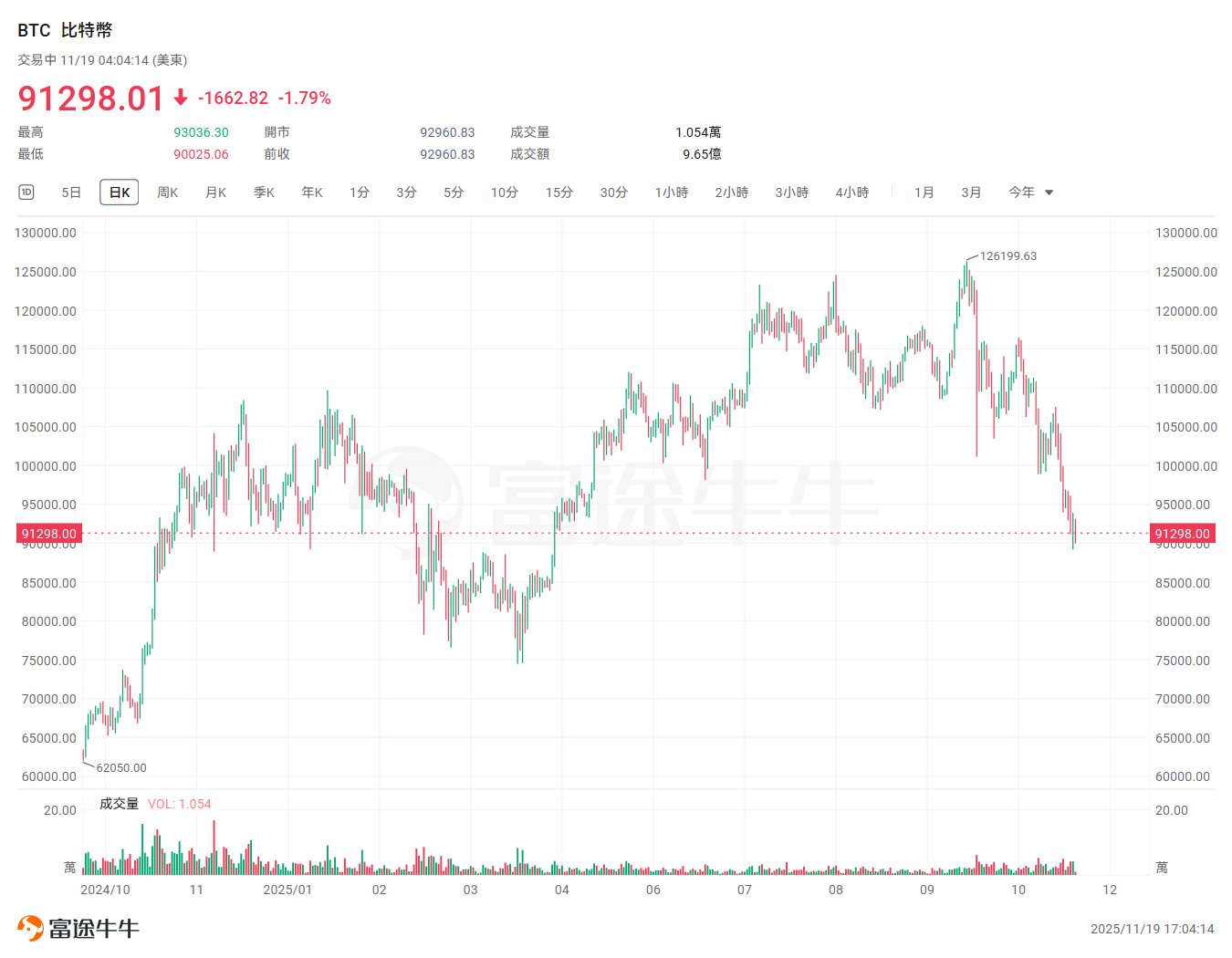
Companies that hold and store Bitcoin have seen their stock prices fall into serious trouble. The largest among them, $Strategy (MSTR.US)$ (formerly MicroStrategy), has seen its stock price drop by more than 30% this year, with a decline of over 50% from its summer highs.

The share prices of unprofitable U.S. tech companies have been sluggish for weeks, indicating that investors, even adventurous retail investors, are beginning to lose patience with the hype.
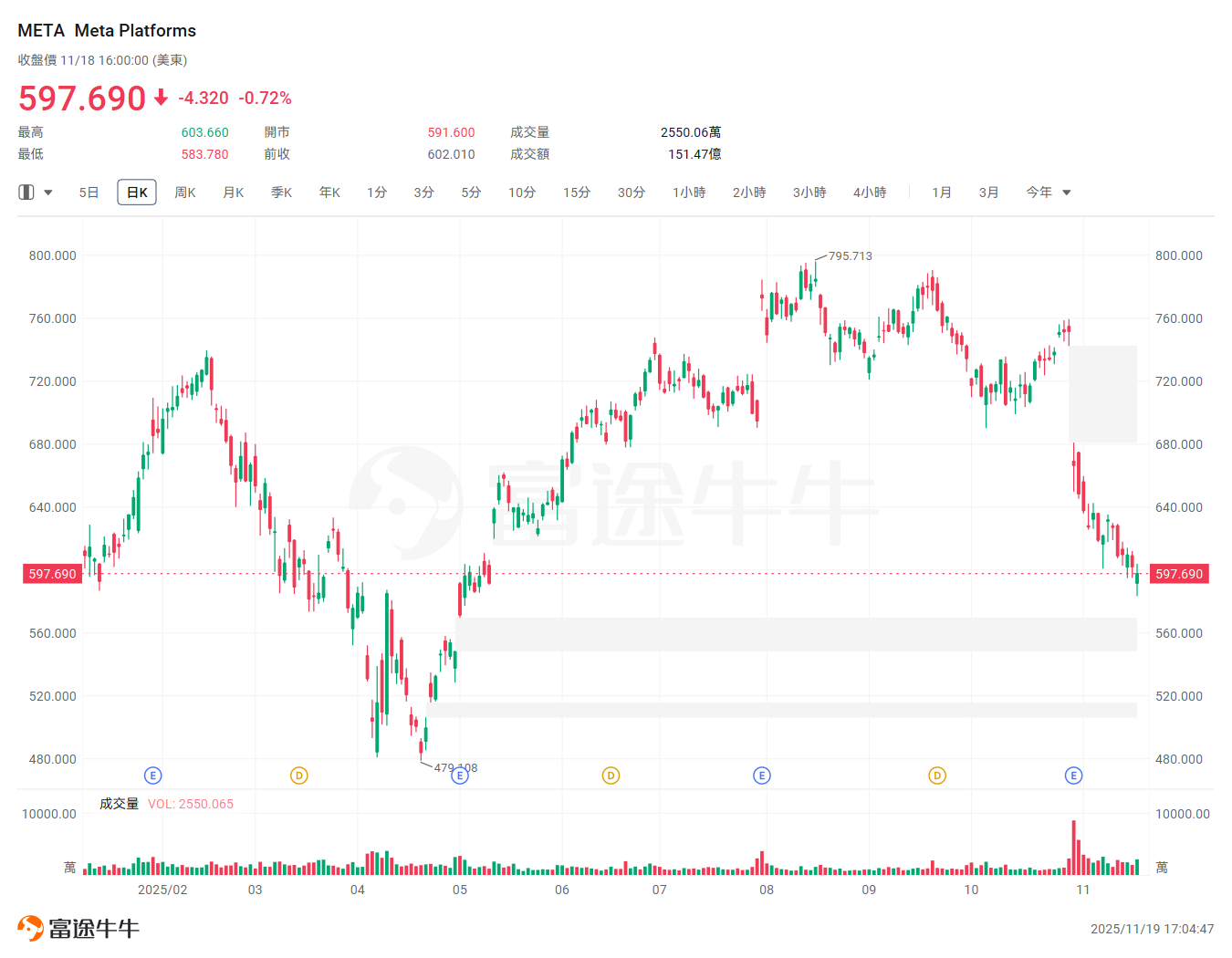
More unsettling is that the turbulence is not limited to the more aggressive areas of tech stocks. Meta Platforms, the parent company of Facebook, $Meta Platforms (META.US)$ The company's share price has remained flat this year and has erased a quarter of its market value since August, as investors grow uneasy about what seems like endless spending on artificial intelligence.
Although pressures in the private market are not always easily visible, a string of high-profile blowups over the past few months has rattled market nerves. An index compiled by Absolute Strategy Research that tracks companies like Blackstone and KKR has fallen 13% this year, in stark contrast to the S&P 500.
Analysts point out that the significant rise in benchmark U.S. indices clearly masks numerous underlying issues. Beneath the surface, investors are becoming increasingly difficult to please. The clear risk is that this could evolve into a full-scale market correction for what has been a hopeful market since spring this year.
In this market environment, the importance of NVIDIA's earnings report has become increasingly prominent.
Despite the recent sell-off, NVIDIA's stock price is still up 35% this year, more than double the approximately 17% increase in$NASDAQ 100 Index (.NDX.US)$the broader market.
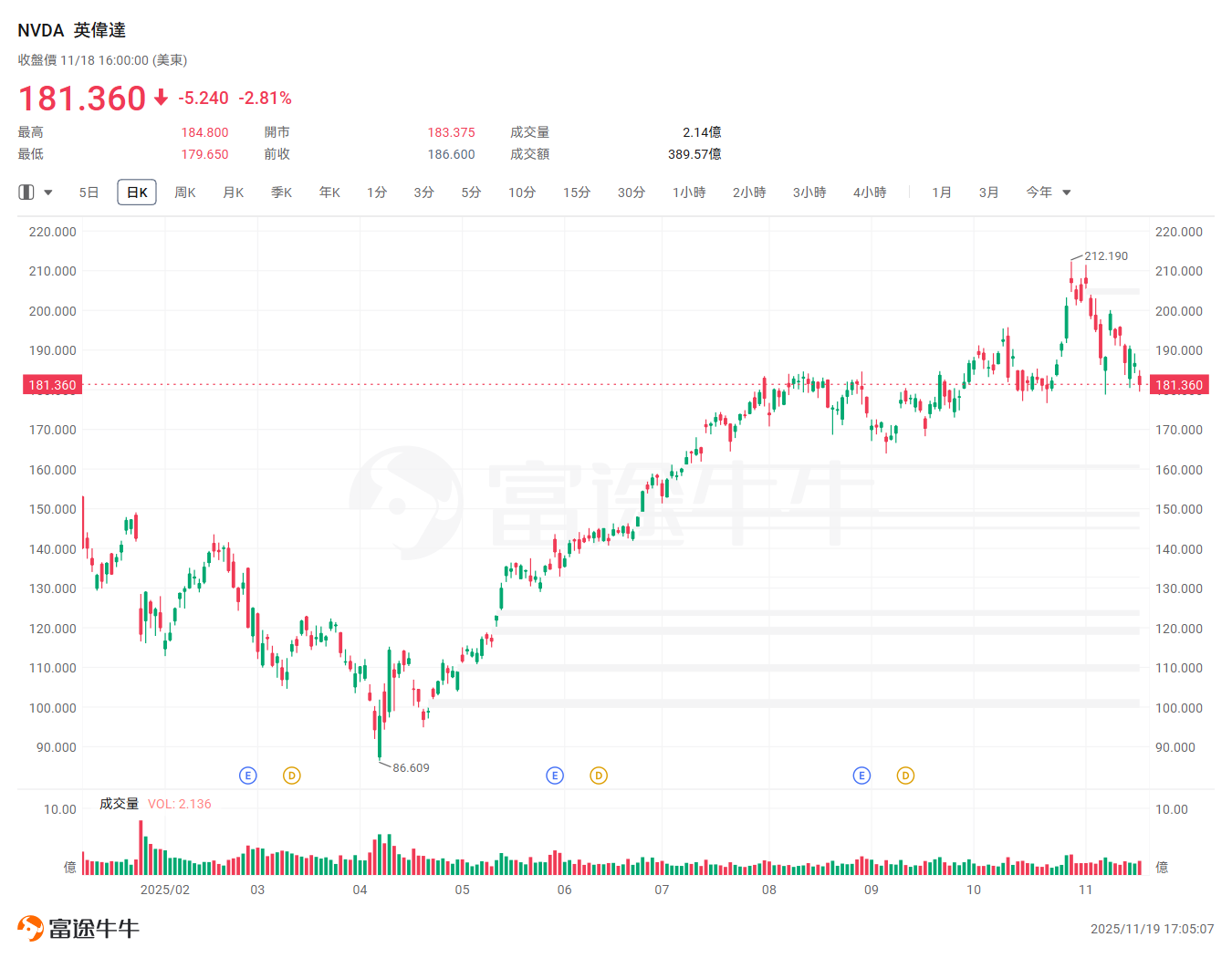
Meanwhile, the decline in share price has made the company's valuation relatively attractive. NVIDIA’s current forward price-to-earnings (P/E) ratio is about 29 times, significantly lower than its 10-year average of 35 times and slightly higher than the Nasdaq 100 Index's approximate level of 26 times.
"Considering NVIDIA’s growth rate, a P/E ratio of 30 times doesn’t seem excessive at all," said Scott Martin, Chief Investment Officer at Kingsview Wealth Management.
For the upcoming earnings report, Wall Street analysts expect NVIDIA’s net profit and revenue for the third fiscal quarter to both grow by more than 50%.
Data compiled by Bloomberg shows that,$Microsoft (MSFT.US)$、$Amazon (AMZN.US)$、 $Alphabet-C (GOOG.US)$ and $Meta Platforms (META.US)$ these four companies collectively account for over 40% of NVIDIA's sales, and their AI spending is projected to grow by 34% in the next 12 months, reaching USD 440 billion. Therefore, this company’s performance will directly reflect the real return on hundreds of billions of dollars in AI investments.
Analysts pointed out that if investors are satisfied with NVIDIA’s Q3 results, the bulls will drive the market toward an optimistic close; if not, the market may face a deeper correction. As Martin stated:
"This is an earnings report where 'NVIDIA’s performance determines the market direction.' If NVIDIA delivers strong results and forecasts higher sales and activity levels, everything will improve."
Wall Street Bets on Earnings Report "Beating Expectations Once Again"
Wall Street investment banks generally hold an optimistic view of NVIDIA’s earnings report.
According to HardAI News, JPMorgan noted in its latest research report that NVIDIA is highly likely to repeat the 'Beat-and-Raise' scenario—exceeding earnings expectations and raising guidance. The bank expects Q3 revenue to surpass the market consensus of approximately USD 55 billion and provides a revenue guidance range of USD 63 billion to USD 64 billion, significantly higher than the market expectation of USD 61.5 billion.
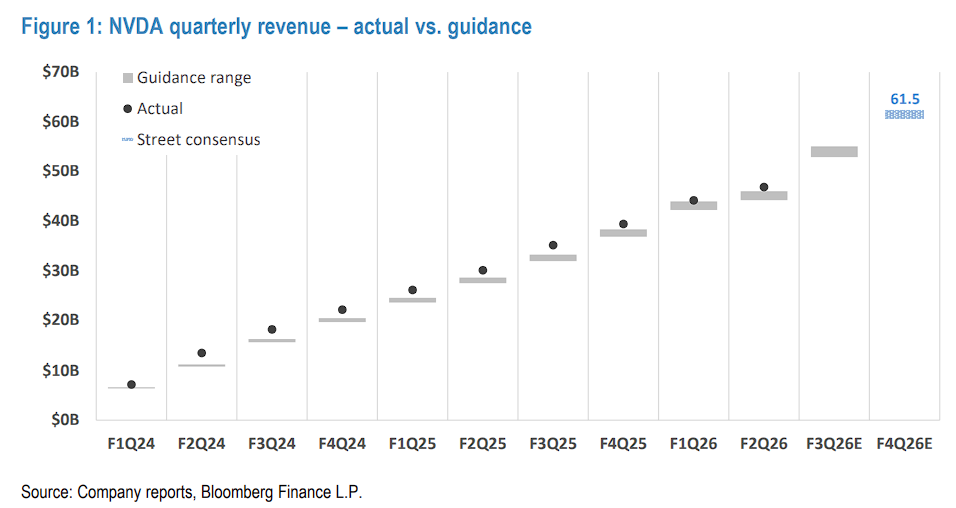
JPMorgan stated that what currently determines NVIDIA's growth rate is not demand but the production capacity limits of its vast supply chain. The demand for AI computing power continues to significantly exceed supply, and NVIDIA’s largest customer groups—including hyperscale cloud service providers, emerging cloud computing companies, and AI labs—still face bottlenecks in computing power.
Supply chain capacity is expanding rapidly. JPMorgan estimates that the shipment volume of Blackwell/Blackwell Ultra racks increased by approximately 50% quarter-over-quarter in Q3, reaching around 10,000 racks, with this growth momentum expected to continue into Q4. The bank forecasts that NVIDIA’s total rack shipments for the entire fiscal year 2026 will reach between 28,000 and 30,000 units.
More importantly, according to information disclosed by NVIDIA at the October GTC conference, its backlog of orders for calendar year 2026 has already exceeded 70,000 racks, surpassing next year’s maximum production capacity. Based on this, JPMorgan has maintained its "Overweight" rating on NVIDIA, with a target price of $215.
In its research report, JPMorgan also noted that investors should closely monitor how management addresses four core concerns:
The first is the trajectory of capacity ramp-up for Blackwell/Blackwell Ultra, particularly the pace of capacity expansion entering the first half of 2026 (i.e., the first half of NVIDIA’s fiscal year 2027).
The second is the sustainability of AI-related spending. The conclusion from JPMorgan’s global team’s recent reports is that funding sources for the AI sector will remain abundant through 2030.
The third is the impact of power constraints. Over the next five years, an estimated 120 gigawatts of data center power capacity is expected to come online globally, but delivery times for new gas turbines have surged to 3-4 years, while construction cycles for nuclear power plants exceed 10 years. Power has become a real bottleneck.
Finally, there is the impact of component cost inflation on gross margins. JPMorgan believes that rising LPDDR memory prices are a greater pressure point than HBM memory. Nevertheless, the bank believes that NVIDIA still has the ability to achieve its target gross margin of 70% midpoint by the end of fiscal year 2026.
Morgan Stanley is more optimistic, raising NVIDIA's target price to $220. Analyst Joseph Moore stated in a report on November 14 that industry surveys indicate a substantial acceleration in demand. NVIDIA has fully resolved the early rack-related issues, while demand continues to surge.
Morgan Stanley’s industry survey indicates that signals from NVIDIA’s customers and suppliers in Q3 all point to accelerating growth, contrasting sharply with the prevailing market view that NVIDIA’s growth metrics have peaked.
On the customer front, expectations for cloud capital expenditure in Q3 were revised upward to $142 billion, with each of the four hyperscale cloud service providers adding more than $20 billion. The dollar growth for 2025 now stands at $115 billion, up 60% from a quarter ago.
From the supplier perspective, ODM Quanta expects its AI server revenue to accelerate in Q1 2026, with year-on-year growth exceeding 100% in 2026. To support this demand, Quanta plans to double its AI server production capacity next year, as order visibility extends to 2027.
Morgan Stanley raised its revenue forecast for NVIDIA's October quarter from $54.4 billion to $55.0 billion and its January quarter forecast from $61.2 billion to $63.1 billion. Analysts noted that achieving an $8 billion sequential increase in both the October and January quarters would set a new record high for the industry.
However, deep market concerns are difficult to dissipate.
Although Wall Street investment banks generally have a positive outlook on NVIDIA's earnings report, concerns about AI investments are growing, and these concerns are already reflected in investor behavior.
According to a previous article by Wall Street News, Peter Thiel's hedge fund sold all of its NVIDIA shares in the third quarter.$SoftBank Group (9984.JP)$also exited its position to provide funding for other AI investments.
Scion Asset Management, run by Michael Burry, who gained fame for shorting the real estate market during the 2008 financial crisis, disclosed the purchase of put options on NVIDIA. Burry warned of a bubble in AI.
Meanwhile, an analysis by Bloomberg of 13F filings from 909 hedge funds found that the number of funds increasing and decreasing their NVIDIA positions was nearly equal in the three months ended September 30. Michael O'Rourke, Chief Market Strategist at JonesTrading, stated:
"Participants in the AI field have been relentlessly raising the bar for expectations, and now they must not only deliver on the numbers but also continue to meet the market's rising expectations—a dangerous game for public companies."
Moreover, the key risk facing the market currently is that if major AI spenders, particularly non-public companies like OpenAI, are forced to scale back their commitments, these figures may become unreliable.
Melissa Otto, Director of Technology Research at Visible Alpha, noted: "I think what the market is really grappling with right now is the total addressable market for all this AI infrastructure."
Jake Seltz, Portfolio Manager at Allspring Global Investments, stated that the company holds a significant position in NVIDIA. He will closely monitor the guidance for the next quarter. While the revenue guidance may exceed market expectations, he noted, "It's hard to know how conservative their guidance will be."
 Earnings Express has been fully upgraded, giving you a head start in mining opportunities! Open Futubull > Stock Page > Click [Company] >Earnings Express

Editor/Rocky