
According to a Goldman Sachs research report, first, NVIDIA has confirmed its revenue outlook for the data center segment, with revenue expectations for the 2025/26 fiscal year surpassing USD 500 billion and potential upside remaining. Second, the next-generation Rubin chip is on track to be launched by mid-2026 and is expected to contribute to revenue in the second half of the same year. Additionally, the actual service life of older AI GPUs, represented by the A100, has significantly exceeded customer depreciation expectations.
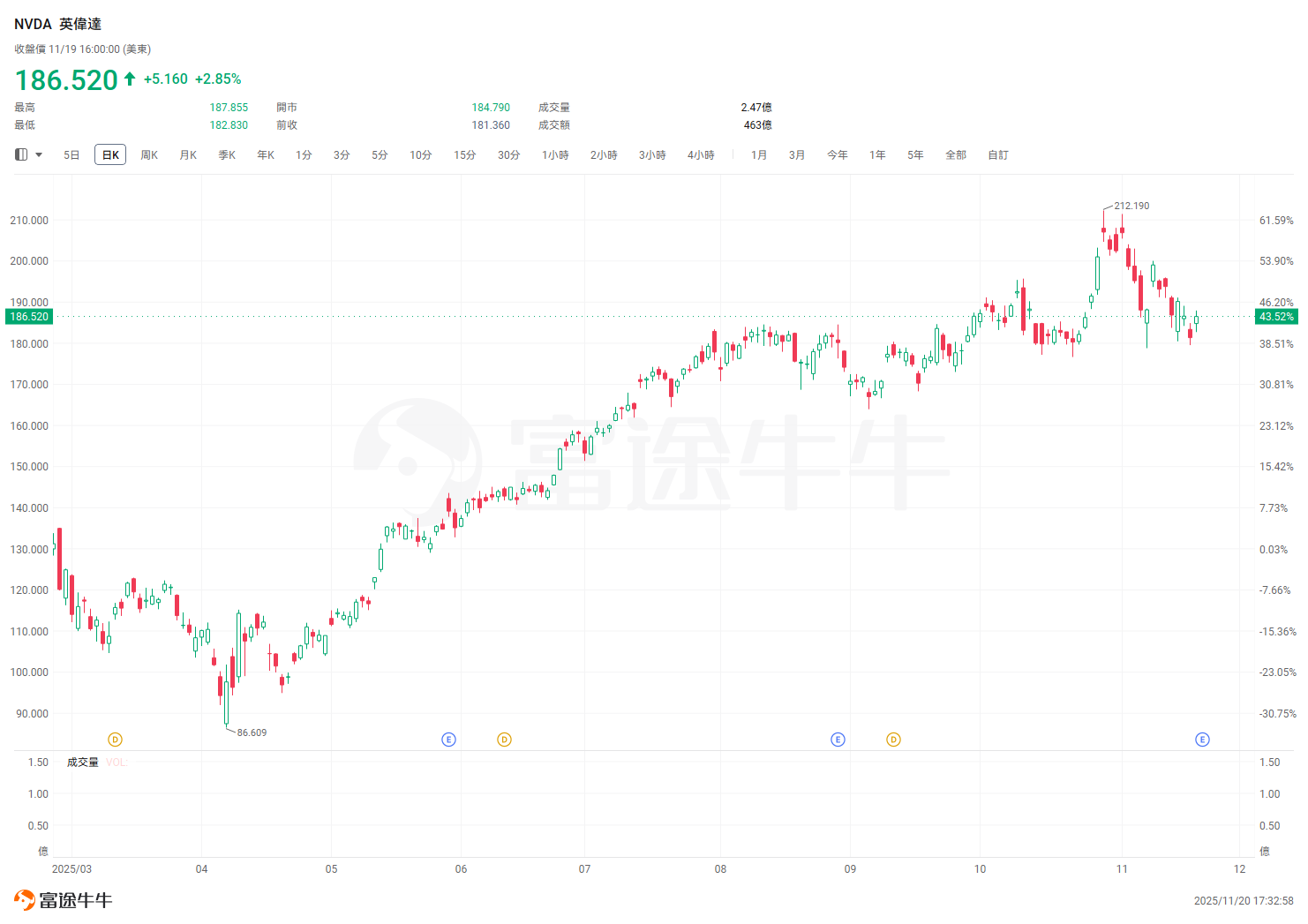
According to NVIDIA's latest earnings report, the company's revenue for the third quarter reached $57 billion, significantly surpassing Wall Street expectations. Additionally, the company's revenue guidance for the fourth quarter is $65 billion, also higher than the market estimate of $62.4 billion. Driven by the outstanding performance, NVIDIA's stock price surged over 5% in after-hours trading on the U.S. stock market.
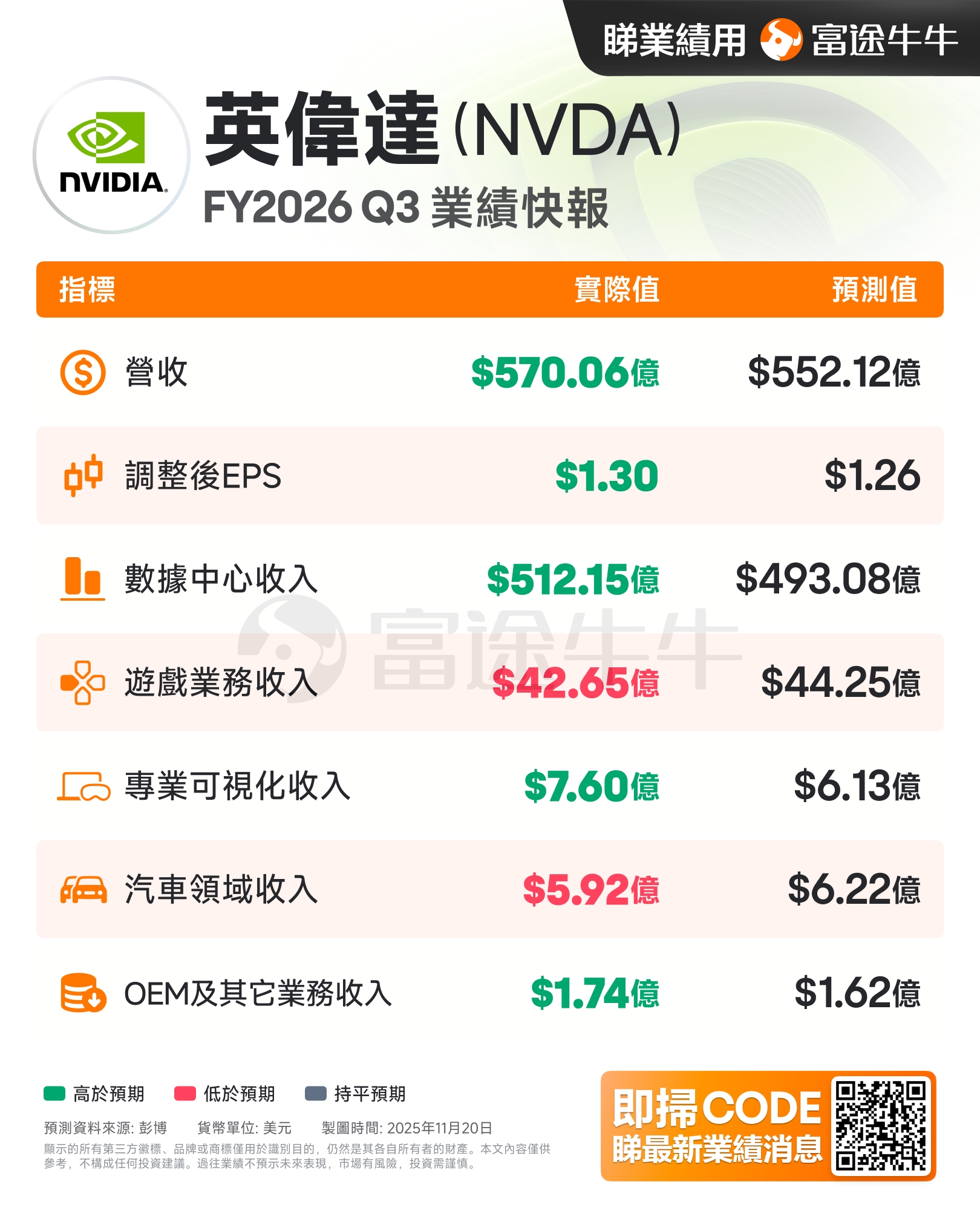
In response to this earnings report, Goldman Sachs maintained its 'Buy' rating on NVIDIA in its latest research note and raised the 12-month target price from $240 to $250. Goldman Sachs analysts noted that, compared to the robust financial data, management’s responses to three key issues during the earnings call were more strategically significant.
 These three issues covered the outlook for data center revenue, the progress of the next-generation Rubin chip, and the product lifecycle of GPUs. The clear responses from management provided investors with crucial insights into the company’s long-term growth certainty. The report further noted that although investor expectations for this quarter’s performance had been relatively high, management’s clarity is expected to support continued upward momentum in the stock price.
The earnings report showed that NVIDIA expects its gross margin to rebound to 75% in the fourth quarter, reaching the target level previously set by management. Despite pressures from rising costs of HBM memory and other components, the company remains confident that it can maintain a gross margin of around 70% by 2026 through optimized product pricing and cost control measures.
Based on further optimism about revenue and gross margin prospects, Goldman Sachs raised its earnings per share (EPS) estimates for NVIDIA over the next few years by an average of 12%. Additionally, Goldman Sachs provided its first EPS forecasts for fiscal years 2028 to 2030, projecting $15.60, $18.65, and $22.10, respectively. The report highlighted that NVIDIA possesses a sustainable model advantage in AI training applications compared to its peers, indicating significant upside potential for future performance.
Clear answers provided for three key issues
Goldman Sachs analysts pointed out that NVIDIA’s management provided clear responses to the three core issues most concerning to investors during this earnings call:
First, the company reaffirmed its expectation of demand for data center products exceeding $500 billion in fiscal years 2025/26 and indicated that this scale could potentially increase further as new customer orders continue to flow in.
Secondly, the next-generation Rubin chip is on track to launch by mid-2026 and is expected to make a significant revenue contribution in the second half of the same year. The clear announcement of this timeline has effectively alleviated previous market concerns regarding the execution progress of the product roadmap.
Thirdly, in response to doubts about the product lifecycle of GPUs, management provided strong evidence: the Ampere architecture GPU (A100), which was launched six years ago, is still operating under heavy load, indicating that AI-related GPUs not only exhibit excellent durability but also generally exceed customers' original depreciation expectations in terms of actual service life.
Strong Growth Driven by Data Center Business
NVIDIA’s data center computing business achieved revenue of $51.2 billion in the third quarter, representing a 56% year-on-year increase. In terms of product mix, the new-generation Blackwell Ultra (GB300) accounted for two-thirds of the total shipments of the Blackwell series, with GB200 contributing the remainder. Notably, legacy Hopper architecture products still generated $2 billion in revenue this quarter, demonstrating strong lifecycle resilience.
The data center networking business showed particularly robust performance, growing 162% year-on-year to $8.2 billion. This growth was primarily driven by strong demand for NVLink, Spectrum-X, and Infiniband solutions. Major clients such as Meta, Microsoft, Oracle, and xAI made significant contributions in this area.
Looking ahead, NVIDIA maintains its long-term outlook for the AI infrastructure market, projecting that global annual spending will reach $3-4 trillion by 2030. The company has clearly stated its commitment to capturing a significant share of this vast market. Management also reiterated that confirmed customer demand for both the Blackwell and Rubin generations is expected to exceed $500 billion across computing and networking domains.
Editor /rice