
FAW Jiefang demonstrated outstanding performance in the heavy truck sector, securing the top position in both traditional and new energy medium and heavy trucks in September to become the only "double champion" in China, with a 17.6% market share in new energy. Morgan Stanley predicts that the electrification of trucks will drive a 23% growth in CATL's battery business by 2026, with the commercial vehicle market emerging as a core growth engine.
$CATL (03750.HK)$ is building a new business growth engine by deepening its layout in the commercial vehicle sector.
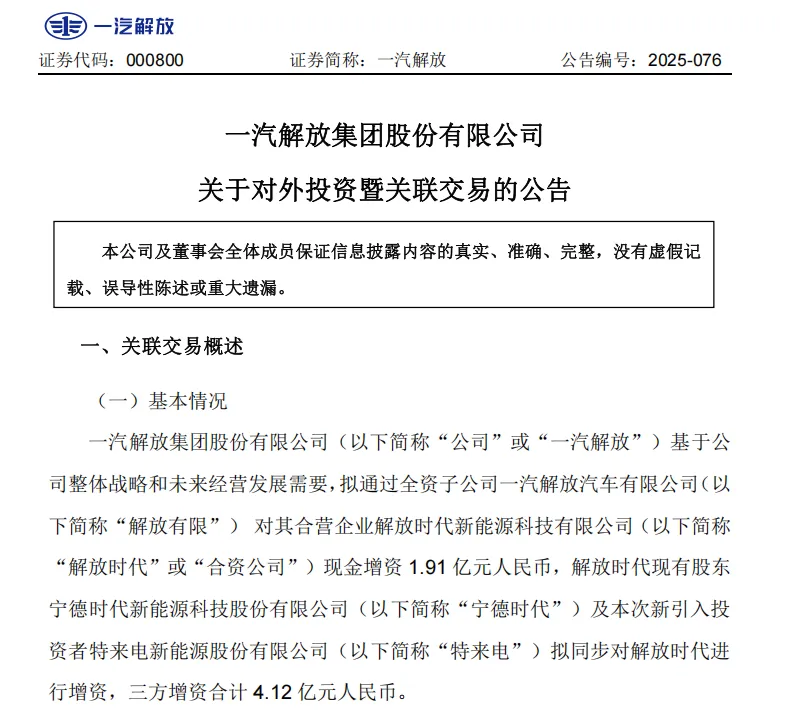
On the evening of November 27, $FAW Jiefang Group (000800.SZ)$ announced that it would increase its capital investment in its joint venture company, Jiefang Times New Energy Technology Co., Ltd., by RMB 191 million through its wholly-owned subsidiary. CATL and newly introduced investor Teld New Energy Co., Ltd. will also contribute to the capital increase simultaneously, with the three parties collectively investing an additional RMB 412 million.
 Data shows that in September this year, FAW Jiefang sold 13,700 traditional medium- and heavy-duty trucks, capturing 25.7% of the market share, while selling 3,800 new energy medium- and heavy-duty trucks, accounting for 17.6% of the market share, making it the only 'double champion' in China's medium- and heavy-duty truck terminal market for that month. Recently, the company also released a new energy trunk transportation solution to further promote the practical implementation of new energy technologies.
As mentioned by Wall Street News, Morgan Stanley noted in a research report released on the same day that the rapidly growing electric truck market will effectively offset the weakness in the passenger vehicle market and become a core pillar of CATL’s business growth in the coming years. The firm predicts that the electrification of trucks will help CATL achieve a 23% year-on-year growth in its electric vehicle battery business by 2026.
Transitioning from product competition to ecosystem competition, CATL's deepened cooperation with FAW Jiefang, coupled with analysts' robust expectations for this sector, is bringing the commercial vehicle market from the periphery to center stage, potentially reshaping the growth outlook for the leading player in power batteries.
Strategic Partnership Deepens: Building a Closed-loop Ecosystem of 'Vehicle-Battery-Network'
This capital increase will reshape the equity structure and resource allocation of Jiefang Times.
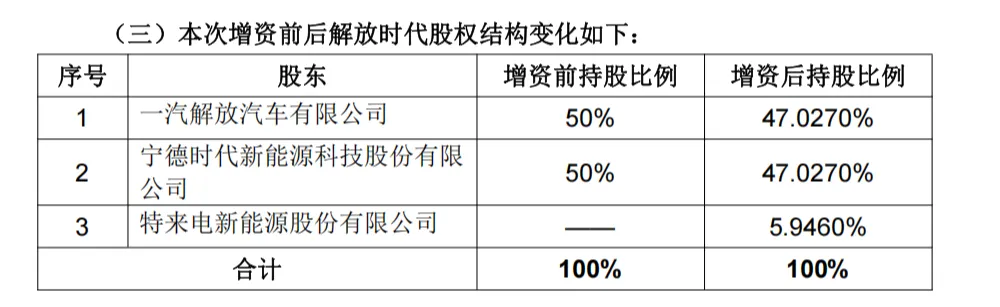
Upon completion of the transaction, the registered capital of Jiefang Times will increase significantly from RMB 90 million to approximately RMB 491 million. In terms of equity structure, FAW Jiefang and CATL will each hold 47.0270%, while Teld, a leader in charging facilities, will own 5.9460% of the shares.
Liberation Times was established in March 2023 as a joint venture with equal 50% equity stakes held by Liberation Limited and CATL. The company focuses on full lifecycle services for new energy commercial vehicles, with core businesses spanning battery swapping, charging station operations, and green electricity trading.
According to reports, since the initiation of cooperation between the company and CATL, continuous technological collaboration and business synergy have laid a solid foundation for the scaled development of the new energy commercial vehicle market.
The introduction of TELD, a leading enterprise in charging infrastructure, represents an important strategic decision made by FAW Jiefang based on the development trends of the new energy commercial vehicle industry. TELD’s participation will further enhance Liberation Times’ service capabilities in the field of energy replenishment terminals.
FAW Jiefang emphasized that this capital increase aims to integrate the strengths of vehicle manufacturing (FAW Jiefang), battery core technology (CATL), and energy replenishment networks (TELD) to systematically build an ecological closed loop with full-chain synergy across 'vehicles, batteries, and networks.'
This move also marks that competition in the new energy commercial vehicle sector is evolving from a single product dimension to higher-level ecosystem competition.
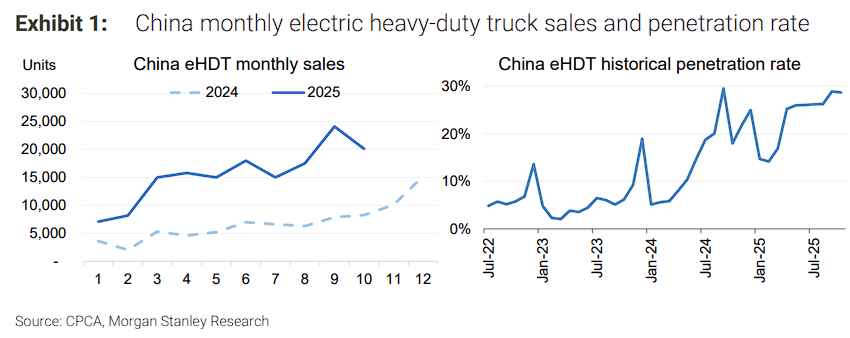
The electrification of heavy-duty trucks is gaining momentum, with penetration rates nearing 30%.
The electrification process in the commercial vehicle market is accelerating.
Morgan Stanley data shows that in October 2025, electric heavy-duty truck sales in China increased by 144% year-on-year, with the monthly penetration rate reaching approximately 29%, implying that one out of every three heavy-duty trucks sold is electric. The firm predicts that the penetration rate of electric heavy-duty trucks will further rise to 35% in 2026.
As the leader in China’s medium and heavy-duty truck market, FAW Jiefang became the only 'double champion' in September this year by simultaneously securing the top sales position in both traditional and new energy medium and heavy-duty trucks. Its market share in new energy medium and heavy-duty trucks reached 17.6%, indicating that its transformation is already yielding initial results.
The electric light truck market has also demonstrated strong growth momentum.
In October 2025, electric light truck sales increased by 40% year-on-year, with cumulative sales up 92% year-to-date. Although the penetration rate retreated to 8.7% in October from its August peak, Morgan Stanley forecasts that the penetration rate of electric light trucks will rise from 10% in 2025 to 25% in 2026, reaching 38% by 2027.
Corresponding to the increase in penetration rate, battery demand driven by electric light trucks will grow from 30 GWh in 2025 to 95 GWh in 2026, further climbing to 150 GWh by 2027.
Analysts believe this highly predictable incremental market provides battery suppliers with an opportunity for both volume and price increases.
CATL: A Core Beneficiary Under the Commercial Vehicle Wave
The acceleration of commercial vehicle electrification undoubtedly opens up new growth space for CATL, the world's largest power battery supplier.
According to reports, market analysts widely believe that the certain growth in truck electrification will effectively offset concerns about a slowdown in the growth of electric passenger vehicles next year.
Morgan Stanley explicitly noted that, leveraging its leading position in technology and market share, CATL will fully benefit from the long-term trend of truck electrification. The firm expects robust demand in the truck market to support a 23% year-on-year growth in CATL’s electric vehicle battery business by 2026.
Morgan Stanley maintains its 'Overweight' rating and RMB 490 target price for CATL, which implies a potential upside of 31% relative to the stock price at the time of the report.
For investors, the commercial vehicle market is becoming an indispensable part of assessing the future value of this battery giant.
Editor/Liam