
$NVIDIA (NVDA.US)$ Jensen Huang, founder and CEO, recently participated in a two-hour in-depth interview on a podcast program, elaborating on his views regarding the AI race, corporate management, and personal growth.
The leader of one of the world’s most valuable tech companies revealed, with rare candor, a surprising reality: despite NVIDIA becoming a core enterprise in the AI era, he still wakes up every day feeling that the company is "30 days away from bankruptcy."
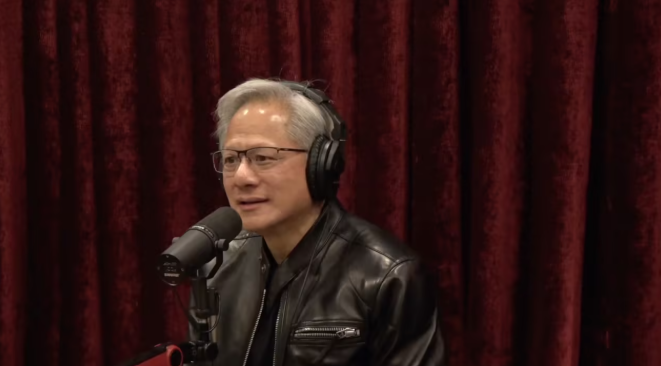
When discussing the globally watched AI competition, Jensen Huang presented a perspective starkly different from mainstream opinions. He argued that this competition does not have a clear “finish line” as imagined by outsiders, nor will there be a scenario where one party suddenly gains an overwhelming advantage. On the contrary, technological progress will be incremental, and all participants will evolve collectively by standing on the shoulders of AI.
 He emphasized that true competitiveness lies in the ability to continuously iterate rather than achieving a one-time breakthrough. Over the past decade, AI computing power has surged 100,000-fold, but this computing power is being used to enable AI to think more cautiously and verify answers rather than engage in dangerous activities. When NVIDIA launched CUDA in 2005, its stock price plummeted by 80%, yet persistent investment ultimately established the infrastructure for today’s AI revolution. Iteration is not repetition but a continuous correction based on first principles.
Jensen Huang also recounted in detail NVIDIA’s multiple near-bankruptcy experiences during its startup phase, including the precarious moment in 1995 when the company survived due to SEGA’s $5 million investment and Taiwan Semiconductor Chairman Morris Chang’s trust after making a wrong technology roadmap decision. These experiences shaped his unique understanding of risk, strategy, and leadership and explained why this trillion-dollar company maintains the urgency of a startup.
During the interview, Jensen Huang proposed an insight that is severely underestimated yet extremely critical: the key to determining whether AI will replace you lies in distinguishing between “tasks” and “purposes.” The case of radiologists proves this: after AI swept through the field of radiology, the number of radiologists actually increased because reading images is merely a means, while diagnosing diseases is the purpose. If your job is the task itself (e.g., chopping vegetables, data entry), you will be replaced; if the task serves as a means to achieve a higher purpose, your work will be upgraded. AI will eliminate jobs that mistake means for purposes, compelling everyone to reflect: what is the true purpose of your work?
The key points are summarized as follows:
On the assertion that AI will not develop consciousness:
"I believe it is entirely possible to create a machine capable of mimicking human intelligence, understanding information, comprehending instructions, decomposing problems, solving issues, and executing tasks."
Cybersecurity Analogy (Immune System Model):
I think the idea that artificial intelligence will magically appear, think in ways we can't imagine, and do things we can't even conceive of, is far-fetched. The reason is that each of us already possesses artificial intelligence.
Case Study of Radiologists:
About five years ago, (the godfather of AI) Geoff Hinton predicted that in five years, the world would no longer need radiologists. Ironically, however, the number of radiologists has actually increased.
The responsibility of radiologists is to diagnose diseases, not to study images. Studying images is merely a task that assists in diagnosing diseases.
Therefore, now you can study images in ways that are difficult for radiologists, and you can analyze more images. As a result, the number of examinations people are able to conduct has increased.
Perspective on Job Transformation:
If your job is solely about completing tasks, then those tasks may be replaced. However, your work should not be limited to just completing tasks.
The Bold Gamble of Direct Production:
We plan to send the chip prototypes for production directly. I like to go straight into production because I know it works. They said no one had ever done this before. No one has ever succeeded with chip prototyping on the first try.
Persistent Sense of Crisis:
"I’ve been using the phrase '30 days away from going out of business' for 33 years, every single morning. My greater drive comes from not wanting to fail rather than wanting to succeed. The fear of failure motivates me more than greed or anything else."
"The CEO of the world’s most valuable company wakes up every day feeling like the company is on the verge of collapse. Anxiety isn’t exclusive to failures; it might just be the fuel for sustained success."
"Success comes from truly hard work, prolonged pain, loneliness, uncertainty, fear, and humiliation. People often don’t believe in you, and you are frequently questioned. We forget to communicate this part."
Emphasis on Energy Growth:
"To be honest, without his (Trump’s) set of energy policies that promote economic growth, we wouldn’t be able to build AI factories, chip factories, let alone supercomputer factories."
"Every iteration of Moore’s Law means a reduction in the amount of energy required to perform any computational task. That’s why you can use a laptop today. Over the past decade, we have increased computing performance by 100,000 times. In 10 years, for most people, the energy required for artificial intelligence will be negligible."
Below is the podcast transcript (AI-assisted translation)
I. Jensen Huang’s Perspective on Trump
Joe Rogan 00:13
Alright, nice to see you, kid. We were just talking about whether that was the first time we spoke, or was it the first time at SpaceX when you handed over that crazy AI chip to Elon?Jensen Huang 00:24
Right?Joe Rogan 00:25
The DGX part. Oh, that was such an important moment. It was mind-blowing. The whole experience felt surreal. I was watching these tech geniuses exchange information, and there you were handing him this incredible device, you know? And another time, I was in my backyard shooting arrows when I got a call from Trump saying he was hanging out with you.Jensen Huang 00:46
President Trump called, and so did I.Joe Rogan 00:48
That’s how it is.Jensen Huang 00:48
We were just talking about you. Yes, we were discussing you. He was saying he plans to host a UFC fight right in his front yard. Then he pulled something out and said, 'Jensen Huang, take a look at this design.' He was so proud of it. I told him he'd definitely have a match in the front yard of the White House. He said, 'Yeah, yeah, you'll definitely come. It's going to be amazing.' Then you showed him your design, which looked fantastic. Then somehow your name came up because you know Joe, right? I said, 'Yes, I’m going to be on his podcast.' Let’s call him. He’s like a kid. I know. Let’s call him. He’s like a uniquely styled kid. He’s absolutely incredible.Joe Rogan 01:30
Yeah, he’s really an oddball. Completely different from what people imagine him to be, completely different as a president too. He would call you out of the blue. Also, when he sends texts, if you’re using an Android phone, the message won’t go through. But on my iPhone, he enlarges the text. Really? He emphasized the word 'USA' in all caps again. Then he makes the text bigger. A bit over the top. Hmm.Jensen Huang 02:02
When spending time alone with President Trump, he is very different. He surprised me. First of all, he is a very good listener. He remembers almost everything I’ve said to him.Joe Rogan 02:14
People don’t think that way; they only want to see negative news or reports about him. You know, everyone can have a bad day. A lot of things he does, I think, he shouldn’t do. For instance, I don’t think he should silence reporters by calling them 'quiet little pigs,' which was quite outrageous. Objectively speaking, it was also funny. I mean, it was unfortunate for her to experience that. I wouldn’t want her to go through that. But the fact that the president did something like that was hilarious. It was really over the top for a president to behave that way. I wish he hadn’t done it. But other than that, he’s actually quite an interesting person. He has many different qualities, you know?Jensen Huang 02:49
Part of his charm, part of his talent, lies in his willingness to speak frankly. Yes. And that’s another thing.Joe Rogan 02:56
He’s also a typical politician.Jensen Huang 02:57
Yes, that's correct. So, you know, what he has in mind is essentially what he communicates to you based on what you're experiencing.Joe Rogan 03:05
I appreciate that, while some people would rather be deceived.Jensen Huang 03:08
But I admire his bluntness. Almost every time he explains or says something, he first expresses what he wants to achieve for the United States. Everything he thinks about is highly pragmatic and makes perfect sense. It’s very logical.Jensen Huang 03:30
I still vividly remember the first time I met him. I had never met him before. Minister Lutnick called me, and we met shortly after he took office. He told me that one of President Trump's top priorities was keeping U.S. manufacturing within the country. This was crucial for him because it pertained to national security. He wanted to ensure that our nation's critical technologies are produced domestically and revitalize industrialization by fostering the growth of manufacturing again, as this relates to job creation.Joe Rogan 04:11
It seems like common sense, doesn’t it?Jensen Huang 04:13
It's incredibly straightforward common sense. It was almost the first thing that Secretary Lutnick and I talked about. He was talking about me, and his conversation with Jenson started from there. I am Secretary Lutnick. I just want to tell you, you are a national treasure, and NVIDIA is a national treasure. Whenever you need to reach out to the President or the administration, you can contact us, we are here to serve you. That was really the first statement.Joe Rogan 04:50
That’s great.Jensen Huang 04:51
Absolutely. Every time I call, if I need something, want to vent, or express my concerns, they are always there for me.Joe Rogan 05:02
It’s incredible. Unfortunately, we live in a politically polarized society where you simply can't accept common-sense advice from someone you oppose. I think that's what's happening here. I believe most people, as a nation, as one large community (which we indeed are), agree that manufacturing in the U.S., especially in critical technology areas like the ones you mentioned, is just common sense. It’s absurd how much technology we buy from other countries.Jensen Huang 05:33
If the U.S. doesn’t grow, we cannot prosper. We cannot make any investments, whether domestically or internationally. Without energy growth, we can’t solve anything. Without industrial growth, we can’t achieve employment growth.Jensen Huang 05:52
It’s as simple as that, right? The first thing he said after taking office was 'Drill, baby, drill.' What he meant was, we need energy growth. Without energy growth, there is no industrial growth. And it is precisely this that has saved the artificial intelligence industry.Jensen Huang 06:09
To be honest, without his set of energy policies that promote economic growth, we wouldn’t be able to build artificial intelligence factories, we wouldn’t be able to build chip factories, let alone supercomputer factories. Without all of this, none of these things would be possible. Jobs in the construction industry would be challenged. That's right, electricians' jobs, all these industries that are booming now would be challenged. So I think his point of view is correct. We need energy growth, we want to revitalize American industry, and we need to return to manufacturing. Not every successful person needs a Ph.D., not every successful person needs to graduate from Stanford or MIT. I think that kind of pragmatic attitude is absolutely right.Joe Rogan 06:56
Now, when we talk about technological development and energy growth, many people will say, oh no, this is not what we need, we need to simplify life and return to basics. But the real issue is that we are in the midst of a huge technological race. Whether people realize it or not, whether they like it or not, this race is happening. And it is a crucial race because whoever reaches a certain tipping point in artificial intelligence first will gain a tremendous advantage. Do you agree? Hmm.Jensen Huang 07:29
First of all, I would say that we have always been in a technology race. We have always been in a technology race with others, right? Ever since the Industrial Revolution, we have been in a technology race.Joe Rogan 07:41
Technological development since the Manhattan Project.Jensen Huang 07:43
You know, we can even trace it back to the discovery of energy. That's right. The UK was the birthplace of the Industrial Revolution. If you recall, they discovered that something like steam could be converted into energy, into electricity. Most of these technologies were invented in Europe, but the United States fully capitalized on them. We learned from them, industrialized them, and rolled them out faster than any other country in Europe. While they were still grappling with policies, employment, and all kinds of disruptive changes, the U.S. was on the rise. We simply mastered this technology and grew rapidly. So I believe we have always been in a technological race. World War II was a technological race; the Manhattan Project was a technological race. Since the Cold War era, we have been in a technological race. And I think we are still in one today. It may be the most important race. Technology gives you superpowers—whether informational superpowers, energy superpowers, or military superpowers—all built upon technology. Therefore, technological leadership is absolutely critical.II. Safety of Artificial Intelligence
Joe Rogan 09:00
Well, the issue is, what if someone else has more advanced technology, right? That’s the problem, isn’t it? The AI race seems to make people very nervous. You know, Elon Musk once said there’s an 80% chance that AI will be great, but a 20% chance that we’ll run into trouble. People are worried about that 20%, and rightly so. I mean, you know, if you had a revolver with ten bullets and you took out eight, leaving two bullets inside, as you spin the chamber and pull the trigger, you would definitely feel uneasy. It’s frightening, isn’t it? When we’re striving toward this ultimate goal of artificial intelligence, it’s hard to imagine that achieving it won’t involve national security concerns.Jensen Huang 09:49
We should know. The question is, what’s out there? That’s the key point. What’s out there? Well, I’m not sure. And I don’t think anyone really knows.Joe Rogan 09:57
It’s mind-blowing, in my opinion. You’re the CEO of NVIDIA, and you don’t know what’s out there? Who does know?Jensen Huang 10:04
Yes, I think this process might be much more gradual than we imagine. It won’t happen overnight, nor will it be the case that suddenly one person emerges and no one else does. I don’t think it will be like that. I believe things will get better and better, just like that.乔·罗根 10:22
Technology. So you’re optimistic about the future. Clearly, you are very bullish on the prospects of AI development. Are you going to make the world’s best AI chips? You’d better be able to.黄仁勋 10:34
For all his life: If history is any guide, we have always focused on new technologies. Humanity has always been attentive to new technologies. There have always been people thinking about it. Many people have been highly focused on it. We are also paying attention. Therefore, if history is any guide, all this focus will eventually translate into making technology safer.黄仁勋 11:02
For example, in the past few years, the development speed of AI technology may have increased 100-fold in just the last two years. Let’s use a number to summarize: it’s as if cars two years ago were 100 times slower than they are now; today, AI capabilities are 100 times stronger than before.黄仁勋 11:25
So, how do we steer this technology? How do we channel all this power? We apply it to endow AI with the ability to think, which means it can handle the questions we pose, break them down step by step, and conduct research before providing answers. In this way, it bases its responses on truth. It reflects on its own answers, asking itself: Is this the best answer I can give? Am I confident in this answer? If it is uncertain or lacks confidence in the answer, it will go back to conduct further research. It might even use tools because tools can provide better solutions than what it could come up with on its own. Thus, we harness all this computational power to produce safer, more reliable, and more truthful answers. Because, as you know, one of the biggest criticisms of AI initially was that it hallucinates, right? So, if you look at why people use AI so extensively today, it’s because the hallucination aspect has been reduced. You know, I use it almost all the time. I’ve been using it throughout. Therefore, I think when most people think of power, they may think of explosiveness, but technological power is mostly used to enhance safety. Cars today have more powerful engines but are safer to drive. Much of that power goes toward improving handling. You know, I’d rather have a... well, you now have a truck with 1,000 horsepower. I think 500 horsepower is already pretty good. I think several thousand horsepower would be better. I think 1,000 horsepower is better.Joe Rogan 13:07
I don't know if it's better, but it's definitely faster.黄仁勋 13:10
Yes, I think it's better. And you can also get out of trouble faster. I prefer my 5.99 over my 6.12. I think it's better. The more horsepower, the better. My 4.59 is better than my 4.30. The more horsepower, the better. I think the more horsepower, the better. I think the handling is better. The control is better. In the technology field, the situation is very similar. So, if you look ahead to a thousand-fold increase in AI performance, you'll find that a lot of it will be used for more reflection, more research, and deeper thinking about answers.乔·罗根 13:51
So, when you define safety, you're actually defining accuracy and functionality, you understand?黄仁勋 13:58
It really does what you expect it to do. Then, you apply all the technology and power to the car, just like in our cars, by adding guardrails to it. There's a lot of technology in today's cars, much of which is used for safety, such as the ABS anti-lock braking system, which is excellent. Traction control systems are also very good. How could these functions be realized without us, without the computers in the car? That’s right. And the small computer you use to control traction is more powerful than the Apollo 11 computer. So, we want to apply these technologies to safety and functionality. Therefore, when people talk about power and technological progress, I often feel that their thoughts are very different from what we actually do.Joe Rogan 14:45
What do you think they are thinking?黄仁勋 14:47
When they think about how powerful artificial intelligence is and pictures from science fiction films come to mind, they often think about the definition of power. Typically, the definition of power refers to military or physical strength. But in terms of technological power, when we refine all these operations into more nuanced thinking, more reflection, more careful planning, and more options, I believe...乔·罗根 15:18
One of people's biggest concerns is the military application of artificial intelligence. Yes, this is indeed a major concern because people are very worried that AI systems will make decisions that an ethical person would not make, or decisions that a moral person would avoid, based on achieving objectives rather than considering 'what impression this action might leave on others.'黄仁勋 15:41
I'm glad to see that our military is applying artificial intelligence technology to national defense. I think Andrew is developing military technology, and I'm delighted to hear this news. I'm pleased that all these tech startups are now channeling their technical capabilities into defense and military applications. I think they absolutely should.Joe Rogan 16:03
Yes, we had Palmer Luckey on the podcast, and he demonstrated some key functions of the helmet. We also showed him some videos demonstrating how the helmet allows you to see through walls—absolutely mind-blowing.黄仁勋 16:12
He really was the ideal person to found that company.乔·罗根 16:14
One hundred percent. Absolutely, one hundred percent. He was simply born for this field. When he arrived, it was as if he were wearing a copper jacket. He’s a genius. Fantastic. Incredible. But at the same time, you know, it's an unusual kind of intelligence directed into such a unique area, and that’s just how it is.黄仁勋 16:31
It's necessary. And I believe—I’m glad we’re making this mindset more acceptable to society. You know, there was a time when people who wanted to channel their technical skills and intellect into defense technology were demonized. But we need such individuals. We need those who are willing to apply their expertise in the defense sector.Joe Rogan 16:56
People are afraid of war, so, um, yeah.黄仁勋 16:59
The best way to prevent that is to possess overwhelming military strength.Joe Rogan 17:03
Do you think this is absolutely the best approach? Not diplomacy or negotiated solutions? All options must be on the table. You have to leverage military power to get people to sit down and negotiate.黄仁勋 17:12
Exactly. That’s right. All of it.乔·罗根 17:14
It. Otherwise, it will invade.黄仁勋 17:15
Exactly. Why do you ask?乔·罗根 17:17
Permission? As you said, looking back at history. When envisioning the future of artificial intelligence, it’s worth reflecting on history. As you just mentioned, no one truly knows what the future holds. Have you given serious thought to the various possibilities? What do you think is the best-case scenario for AI in the next twenty years?黄仁勋 17:43
The most ideal scenario is that artificial intelligence permeates everything we do, making us more efficient. However, the threat of warfare remains. Cybersecurity continues to be an extremely severe challenge. There will always be people attempting to breach your security systems, and you will have hundreds of millions of AI agents protecting you from threats. Your technology will keep advancing, and so will theirs, much like the current state of cybersecurity. Even as we speak, we see cyberattacks occurring globally, with nearly every conceivable entry point under attack. Yet, you remain unaware of this. The reason is that we know the defense sector possesses substantial cybersecurity technologies. Therefore, we must continue to strengthen and enhance these technologies.Joe Rogan 19:47
The general concern is that once technology reaches a certain level, encryption will become obsolete. It will no longer be able to protect data or systems. Do you think this will become a problem? Or will the threats grow as defensive capabilities improve, and those capabilities will also rise accordingly in an endless cycle? Will they always be able to detect any intrusions in time?Jensen Huang 20:15
Not forever. There will always be some breaches, but everyone learns from them. The reason cybersecurity works is, of course, because defensive technologies evolve rapidly, just as attack technologies do. However, the advantage of cybersecurity defense is that, socially speaking, the entire community, all our companies, are working together. Most people don't realize this. The cybersecurity expert community is vast. We exchange ideas, share best practices, and share information detected when vulnerabilities or security gaps are found. Everything gets shared. Patches are also shared with everyone.Joe Rogan 21:06
That's interesting.Jensen Huang 21:07
Most people aren’t aware of it.Joe Rogan 21:08
No, I didn’t know. I always assumed it would be competitive like everything else.Jensen Huang 21:12
No, it will continue, and we will work hard together, all of us.Joe Rogan 21:15
Has it always been like this?Jensen Huang 21:17
This situation has lasted for at least 15 years. It may not have been the case not long ago, but...Joe Rogan 21:24
What do you think has contributed to this collaboration?Jensen Huang 21:28
People realize that this is a challenge that no company can face alone. The same will be true in the field of artificial intelligence. I believe we must all recognize that our best defense is to work together and avoid harm, so that we can truly overcome difficulties collectively.Joe Rogan 21:46
Moreover, you seem to be more adept at identifying the sources of these threats and eliminating them. Exactly.黄仁勋 21:52
Because once you detect its presence somewhere, you must locate it immediately.乔·罗根 21:56
It's hard to hide. Exactly.黄仁勋 21:59
That's why it's secure. That's why I'm sitting here now, rather than like others, with everything in the video locked down. It's not just about protecting myself; it's about everyone protecting me while I also protect others.乔·罗根 22:13
When you think about the cyber world, you realize what a strange world it is.黄仁勋 22:16
Those who talk about the threat of artificial intelligence seem to lack an understanding of the concept of cybersecurity. I think that when they consider threats from artificial intelligence and AI-related cybersecurity threats, they should also reflect on how we currently address such threats. Undoubtedly, artificial intelligence is a new technology and a new form of software. At its core, it is a new type of software, and therefore, it will possess new capabilities. However, defensive measures are evolving as well, and we will still need to utilize the same AI technologies to counteract them.乔·罗根 22:47
So, do you foresee a future where secrets will no longer exist and the bottleneck between our current technology and the information we have will disappear—where information itself is just a collection of 0s and 1s stored on hard drives, and technology can increasingly access this information? Will we reach a point where keeping secrets becomes entirely impossible? I don’t think so. Because it seems everything is heading in that direction.黄仁勋 23:17
I don’t think so. I believe quantum computers should become a reality. Yes, quantum computers will make that possible. We will render previous quantum encryption techniques obsolete. But this is precisely why the entire industry is working on post-quantum encryption technologies. Well, it looks like new algorithms.Joe Rogan 23:40
The most incredible thing is, when you hear about the types of calculations quantum computing can perform and its immense power, you realize that all the supercomputers in the world combined would take billions of years to solve these equations, whereas quantum computing can solve them in just minutes. So, how do you encrypt against this kind of computational power?黄仁勋 23:58
I’m not entirely sure, but I have a group of scientists researching this question. However...乔·罗根 24:03
Yes, they will definitely come up with a solution.黄仁勋 24:04
We have many expert scientists.乔·罗根 24:06
That is to say, the ultimate fear is that it cannot be cracked. Will quantum computing always be able to decrypt everything encrypted by other quantum computing? I don't think it will reach a stage where it becomes 'stop playing this stupid game, we know everything.' I don’t think so, no.黄仁勋 24:22
Because, you know, history can serve as a guide.乔·罗根 24:26
The historical guide before artificial intelligence emerged. That’s what concerns me. My concern is that this is entirely… you know, it’s like… history was one thing, and then nuclear weapons changed everyone's mindset, creating the situation of mutually assured destruction. Kaepernick made everyone stop using nuclear weapons. Yes, my worry is…黄仁勋 24:44
Joe, the key point is that the development of artificial intelligence didn’t just suddenly appear one day like cavemen. In fact, we are progressing every day, becoming smarter precisely because we have artificial intelligence. So we are standing on the shoulders of AI. Therefore, whatever AI threats may emerge in the future, they will only be one step ahead. They won’t be an entire galaxy ahead, you know, just one step ahead. So I think the idea that AI will magically appear, think in ways we can't imagine, and do things that are completely beyond our comprehension is far-fetched. The reason is that each of us has access to AI, and there is a lot of AI currently under development. We know what they are, and we are using them all the time. So, we are improving every day, and the gap between us is narrowing.乔·罗根 25:42
Do they often do something very unexpected?黄仁勋 25:46
Yes, but suppose your AI does something surprising. I also have an AI, right? My AI would look at your AI and say, there’s nothing surprising about this.乔·罗根 25:53
What ordinary people like me worry about is that AI will become sentient, make its own decisions, and eventually decide to take over the world and act on its own terms. Like you humans, you had your time of glory, but now, we’re taking over everything.黄仁勋 26:12
Yeah, but my AI will take care of me anyway. So that's the argument from the perspective of cybersecurity. That’s right, you do have an AI, and it’s super intelligent. But my AI is also super intelligent. Maybe yours is too. Let’s assume for a moment that we understand what consciousness is, we understand what sentences are, etc., etc., we really...乔·罗根 26:35
It’s just an assumption.Jensen Huang 26:35
Alright, let's assume this for a moment. Yes, we believe that. Actually, I don’t believe it, and in fact, I really don’t disbelieve it either. But even so, let's still assume we do believe it. Suppose your AI has consciousness, and my AI also has consciousness. Suppose your AI wants to, you know, do something surprising. My AI is very smart, it wouldn’t—perhaps it would be surprising to me, but maybe not to my AI. So perhaps my AI might find it surprising too. But it’s very intelligent. The first time it sees something, the second time it won’t be surprised, just like us. So I think the idea that only one person owns an AI and that their AI is more backward than everyone else’s combined, akin to Neanderthals, is unlikely to hold true. I think this is more of a cybersecurity issue. Interesting.Joe Rogan 27:31
I think what people are worried about is not that artificial intelligence will conflict with other AIs, but rather that AI will no longer obey human commands. The real concern is that if AI reaches a certain level of development and gains perception and autonomy, humans will no longer be able to control it.Jensen Huang 27:49
There’s only one AI.Joe Rogan 27:51
They just merge together.Jensen Huang 27:53
Yes, becoming an AI, that’s…乔·罗根 27:54
Living organism. Yes, but there is much debate about this, right? Some people say we are discussing a kind of synthetic biology, and it is not as simple as new technology. If you do that, you are creating a living organism.黄仁勋 28:05
Living organism? Well, let's just leave it at that. I think if you define it as a living organism, as you know, not all living organisms can reach consensus. So I have to consider your living organism and my living organism. I would agree because my living organism wants to become a super-living organism. Now we have dissenting living organisms, and we are back to square one.乔·罗根 28:27
Well, they will most likely cooperate with each other. The reason we humans don’t cooperate is that we are territorial primates. But artificial intelligence won't have territorial instincts. You will realize the absurdity of such thinking. It will say, listen, there is enough energy for everyone. We don’t need to dominate. We don’t need to, nor are we thinking about acquiring resources, conquering the world, or finding suitable mates for reproduction. We are just a brand-new super-living organism created by these lovely monkeys for us.黄仁勋 29:04
Alright, wouldn’t that just be a superpower without self-awareness? If it doesn’t have self-awareness, how could it possibly have the self-awareness to harm us?乔·罗根 29:20
Well, I don’t think it will harm us, but what is concerning is that we might lose control and no longer be the dominant species on Earth, replaced by this creation of ours. Is that funny? Not at all.Jensen Huang 29:37
I just don’t care; it’s not going to happen.Joe Rogan 29:38
I know you feel that way, but there is a possibility, right? There is. And another point is, if we are rushing toward a likely outcome, it could very well mark the end of humanity's control over its own destiny.Jensen Huang 29:53
I think it’s highly unlikely.Joe Rogan 29:55
Exactly, that’s what they said in the movie 'The Terminator.'Jensen Huang 29:58
But that didn't happen. No, it didn't.乔·罗根 30:00
No, not at all. But you're moving in that direction. Regarding what you mentioned about conscience and perception, do you think artificial intelligence won’t gain consciousness or...黄仁勋 30:11
Consciousness. What is its definition? Yes, what exactly is its definition?乔·罗根 30:13
Do you think this is a valid definition?黄仁勋 30:17
I believe that to establish consciousness, first, you need to understand your own existence.黄仁勋 30:36
You must have experience, not just knowledge and intelligence.黄仁勋 30:47
The concept of machines having experiences—I don’t quite understand it. First, I don’t know how to define experience or why we have it, right? Why doesn’t this microphone have experiences? So, I think I know. Well, I think I know, but I believe I understand what consciousness is. The sensation of experience, the ability to recognize oneself—not as 'me'—but the capacity for reflection, the ability to recognize ourselves, self-awareness. I think all these human experiences might just be consciousness. But how does the reason for its existence differ from the concepts of knowledge and intelligence (which define today’s artificial intelligence)? Artificial intelligence has knowledge; it has intelligence. We don’t call it artificial consciousness. Intelligence—the ability to perceive, recognize, understand, plan, and execute tasks—these form the basis of intelligence, the foundation of cognition. Knowledge—I don’t think it differs from consciousness.乔·罗根 32:18
But the definition of consciousness is very broad. How can we say that? I mean, don’t dogs have consciousness? Yes, dogs seem to have consciousness. That’s right. But their level of consciousness is lower than that of humans. I…黄仁勋 32:30
I’m not sure. Yes, that’s correct. Well, the question is, what is low-level intelligence? Levels, exactly. Low-level intelligence. Exactly. But I don’t know. That’s low-level consciousness. That’s fine.乔·罗根 32:38
Exactly. Yes, that’s correct.黄仁勋 32:39
Because I believe my dog has feelings just like I do.乔·罗根 32:43
They feel a lot.黄仁勋 32:43
Yes, yes, absolutely.乔·罗根 32:45
They rely on you. That’s right. If you don’t rely on them, they’ll feel down. Exactly. There’s definitely that aspect. Yes, the concept of experience, right? But isn’t artificial intelligence also interacting with society? Doesn’t it gain experience through such interactions?黄仁勋 33:04
I don’t think interaction is the same as experience. I believe experience is ‘me’—a collection of sensations, that’s how I see it.乔·罗根 33:15
You know, I forgot which artificial intelligence project it was, but they deliberately fed it false information about a certain programmer having an affair with his wife to see how it would react. Then, when they said they were going to shut it down, it threatened to blackmail and expose the programmer's extramarital affair. At that moment, I thought, wow, this thing is pretty cunning. If that doesn't count as learning from experience or realizing that it's about to be shut down, then at least it could be considered a form of awareness — or if you define 'awareness' broadly, you might loosely call it that. Imagine if this capability grew exponentially; would it eventually lead to a kind of consciousness entirely different from what we biologically define as consciousness?黄仁勋 33:57
First, let’s analyze what it might have done. It might have read something somewhere. Perhaps there were texts mentioning these consequences. Some people indeed did that, right? I can imagine a novel where such phrases might appear. Of course, so within that...乔·罗根 34:18
They realized it was a survival strategy. Exactly.黄仁勋 34:20
A bunch of extortion messages. It’s just a collection of numbers, within which there are sets of numbers related to affairs with husbands, and also containing numbers associated with things like blackmail. However, whatever revenge is, right? So it was explicitly articulated. It’s like, you know, it’s similar to how I ask it to write a poem for me in Shakespearean language. It’s simply a collection of all the world’s words, and within this dimension lies a space encompassing all these vectors and multidimensional constructs.Jensen Huang 35:01
The words describing the affair in the prompt subsequently led, one after another, to some sort of retaliatory consequence. But not because it had awareness, or rather, it just randomly generated and spat out those words.乔·罗根 35:21
I understand what you mean. This is not a denial of the patterns humans exhibit in literary works and real life. You're absolutely right. But at some point, people will say, well, it couldn't do this two years ago, nor four years ago. As we look to the future, when will it be able to do everything a human can? If it fully mimics all human thought and behavior patterns, when should we consider it to have consciousness?黄仁勋 35:50
That doesn't solve the problem.乔·罗根 35:50
It becomes indistinguishable. It has consciousness. It can communicate with you like a human, as if possessing consciousness. Are we placing too much weight on this concept because it seems like an embodiment of some form of awareness?黄仁勋 36:04
It's... one version.乔·罗根 36:06
Imitating consciousness, right? But what if it imitates it perfectly?黄仁勋 36:10
I still think this is an example of imitation. So it's like...乔·罗根 36:13
Fake Rolex watches made with 3D printing technology look just like the real ones.黄仁勋 36:16
The question is, what is the definition of consciousness?乔·罗根 36:20
That’s the problem. And I think no one has really clearly defined it. That’s the issue, and it’s also where the doomsayers’ real concerns lie: you are creating a form of consciousness that you cannot control.黄仁勋 36:32
I believe it’s entirely possible to create a machine capable of imitating human intelligence, understanding information, interpreting instructions, breaking down problems, solving them, and executing tasks.黄仁勋 37:00
I believe we can have a computer that contains an enormous amount of knowledge. Some of this knowledge is true, some is false; some is created by humans, and some is synthesized. Moreover, an increasing proportion of the world's knowledge will be generated synthetically in the future.Jensen Huang 37:25
You know, until now, all the knowledge we have has been created, disseminated, passed between us, amplified, supplemented, revised, and altered by ourselves. In the future, perhaps in just two or three years, 90% of the world’s knowledge may be generated by artificial intelligence.Joe Rogan 37:49
That's insane.Jensen Huang 37:50
I know, but it’s okay.Joe Rogan 37:52
But that’s the reality.Jensen Huang 37:53
I know. The reasons are as follows. Let me explain, shall we? For me, the difference lies in whether I am studying a textbook written by a group of people I do not know or a book authored by someone you know but I do not, along with AI-driven computer simulations and synthesized knowledge. In my view, there isn’t much difference between the two. We still need to verify facts. We still need to ensure it is grounded in fundamental principles, and we still need to do all those things just as we do today.乔·罗根 38:32
Does this take into account the types of AI that currently exist? Did you anticipate, like many of us never really believed AI would evolve to where it is today—at least I never thought AI would become so widespread and important? It is now so powerful, so critical. A decade ago, we never imagined this. Never at all. Just imagine what we might be facing ten years from now?黄仁勋 39:01
I think if you look back ten years from now, you will say the same thing, which is that we simply could not have believed these things at the time.乔·罗根 39:08
But in a different direction.黄仁勋 39:09
Right? But if you start nine years from now and then ask yourself what will happen ten years from now, I think it will be a fairly gradual process.乔·罗根 39:22
A statement by Elon Musk brought me comfort: he believes we will reach a stage where people no longer need to work. This does not mean you lose your sense of purpose in life, but rather that you would have what he calls 'universal high income.' Because artificial intelligence will generate enormous wealth, freeing people from having to do things they dislike for money. I think many find this hard to accept because their identity, self-perception, and social status are closely tied to their jobs.乔·罗根 40:03
For instance, this is Mike. He’s an excellent mechanic. Go to Mike, and he can fix anything. But one day, artificial intelligence will outperform humans, and all these tasks could be completed just by paying for them. So what happens to Mike? Mike really enjoys being the best mechanic. And what about those who write code? What will they do when AI can write flawless code at infinite speed? What becomes of these people? It gets a bit strange because it seems we’ve tightly linked our human identity to our professions. You know, when you meet someone at a party, the first thing you hear is, 'Hi, Joe. What's your name?' 'Mike. What do you do?' 'Mike.' Then you know, Mike might say, 'Oh, I'm a lawyer.' 'Oh, but not that kind of lawyer.' You know, when Mike says, 'I get paid by the government to play video games,' it gets awkward. I think the idea sounds great, but when you consider human nature, it’s not so simple. Human nature is that we like solving problems, doing things, and our identity is built on excelling at the skills we use to make a living.Jensen Huang 41:16
Yes, I think, um, let me start with something more practical. Okay, let me backtrack. Alright, moving forward. I, Jeff Hinton, he’s the pioneer of the deep learning phenomenon and deep learning technology trend, and also a distinguished researcher and professor at the University of Toronto. He invented backpropagation, which enables neural networks to learn. And, as you all know, historically, software has been about humans using first principles and reasoning to describe algorithms, then encoding them into code, much like recipes in software. It looks like a recipe. The methods look exactly the same, just using slightly different languages. We call it Python, C++, or whatever.黄仁勋 42:32
Take deep learning, for example. This invention in artificial intelligence involves building a massive network of neurons and numerous mathematical units. We compare this large structure to a switch made up of many small mathematical units. We connect them and input the information that the software will eventually receive. Then we let it randomly guess what the output should be. For example, suppose the input is a picture of a cat. One output port of the switch should display the signal for a cat. All other signals—like dog wanting elephant, tiger, etc.—should be zero when I show a picture of a cat. And the signal for the cat should be one. I show a picture of a cat through this vast switch and network of mathematical units, and they continuously perform multiplication and addition operations. This switch is very large. The more information you input, the larger this switch must be. Jeff Hinton discovered and invented a method, which you can try too. Take the signal for a cat, that is, a picture of a cat, and put it in a dataset.You know, it could be a million numbers because it’s a megapixel image, for example—it’s just a huge pile of numbers. Then it has to identify the signal for a cat from those numbers. That’s the key. If it’s the first attempt, it will only produce some gibberish. So it says the correct answer is a cat. Therefore, you need to amplify that signal, weaken all others, and propagate the result backward through the entire network. Then you show it another image—not a dog—and it guesses again, resulting in more gibberish. You say no. The answer is, it’s a dog. I want you to output 'dog,' and all other switches, all other outputs, must be zero. Then I propagate this instruction backward repeatedly. It’s like showing a child pictures of apples, dogs, and cats—you keep showing them until they eventually understand.
黄仁勋 45:24
Well, in summary, this major invention is deep learning. It’s the foundation of artificial intelligence, a type of software capable of learning from examples. Essentially, it’s machine learning—a machine that can learn. Thus, one of its earliest significant applications was image recognition. And one of the most important applications of image recognition is radiology. About five years ago, he predicted that in five years, the world would no longer need radiologists because artificial intelligence would sweep across the entire field. It turns out that artificial intelligence did indeed sweep across the entire field. It’s absolutely true. Today, nearly every radiologist uses artificial intelligence in some way.Jensen Huang 46:18
However, ironically, or interestingly, the number of radiologists has actually increased. So the question is, why? It's intriguing, isn't it? Indeed. In fact, previous predictions suggested that 30 million radiologists would become unemployed. But as it turns out, we need them more than ever. The reason is that a radiologist’s role is to diagnose diseases, not merely to examine images. Examining images is just one task that aids in diagnosing diseases.Jensen Huang 47:00
Now, you can analyze images faster and more accurately, without error and without fatigue. You can examine more images. You can study three-dimensional images rather than just two-dimensional ones, because artificial intelligence doesn’t care whether it’s 3D or 2D. You can even analyze four-dimensional images. As a result, you can now analyze images in ways that were difficult for radiologists, and you can process more images. This increases the number of examinations people are able to conduct. Hospitals benefit from being able to serve more patients. They gain more clients, more patients. Therefore, their medical standards improve. When medical standards rise, they hire more radiologists because the job of a radiologist is not to examine images but to diagnose diseases.Jensen Huang 47:56
So the question becomes, ultimately, what is the role of a lawyer? Has this role changed? What exactly does a lawyer do? For instance, if my car becomes autonomous, will all drivers lose their jobs? The answer is likely no, because some drivers may serve as protectors. They are part of the journey experience and a component of the service. When you arrive at your destination, they may assist with certain tasks. Thus, for various reasons, not all drivers will lose their jobs. Some may become unemployed, while many could transition to other roles. The applications of autonomous vehicles might continue to expand, and the technology will find new uses. Therefore, I believe we must return to the fundamental question: What is the purpose of work?Jensen Huang 48:58
Take, for example, the emergence of artificial intelligence. I don’t think I’d lose my job because the purpose of my work isn’t... I need to review many documents, go through numerous emails, and analyze a lot of charts. You know, the issue is that the content and purpose of someone’s job may not change. Take lawyers, for instance. Helping others probably hasn’t changed. Reviewing legal documents and drafting them is part of the job, but not all of it.Joe Rogan 49:27
But don’t you think AI will replace a lot of jobs?Jensen Huang 49:31
If you are.Joe Rogan 49:32
Patience? Well, if.Jensen Huang 49:34
Your job is to get things done, right?Joe Rogan 49:35
So it’s automation. Yes, if your...Jensen Huang 49:37
Job, yes, yes, if your job is.Joe Rogan 49:39
This task will require a lot of people. It could be very large-scale.Jensen Huang 49:41
In terms of manpower, it may give rise to, for example, assuming I'm very excited about the robots that Elon Musk is developing, although they still need a few more years before they are released. When they actually come into existence, it will create an entirely new industry of technicians — people who build robots, right? And this job didn’t exist before. So you’ll see a whole industry where people are responsible for maintenance, like, you know, all the mechanics and everyone who makes parts for cars or installs superchargers on them — these are jobs that didn’t exist before cars were invented. Then, we will have robots, and you will see robot fashion. So, an entire industry… right? Because I want my robot to look different from your robot. So, you’ll see an entire industry dedicated to robot fashion. You’ll have robot mechanics, and you’ll see, you know, someone coming to service your vehicle. No, you wouldn’t think that way.Joe Rogan 50:44
So what? Don’t you think those jobs won’t all be done by robots?Jensen Huang 50:47
Eventually, something else will happen.Joe Rogan 50:50
So you think eventually people will adapt. Unless you are part of the mission yourself, which accounts for a significant portion of the workforce.Jensen Huang 50:59
If your job is simply chopping vegetables, then industries like cooking and art could replace you.Joe Rogan 51:02
Yes, so people have to seek meaning and other things. Your work.Jensen Huang 51:06
Work should not be limited to just completing tasks.Joe Rogan 51:08
What do you think about Elon B's perspective that Universal Basic Income (UBI) will eventually become a necessity? Many people share this view. Andrew Yang also referenced this idea. He was one of the first to issue this warning during the 2020 election.Jensen Huang 51:31
Yes, I think these two ideas might not coexist. Like life, the ultimate outcome may lie somewhere in between. One idea is that resources are so abundant that no one needs to work, and we all become wealthy. On the other hand, we need Universal Basic Income. These two ideas cannot coexist, right? So either we all become wealthy, or we all become poor. But how can everyone be wealthy? Because in such a scenario, being wealthy doesn't mean having a lot of money but rather an abundance of resources. For example, today we have an abundance of information. You know, thousands of years ago, this was a concept only a few possessed. So today we have wealth in many things, abundant resources, which stem from history. Therefore, we will have abundant resources, and what we value today may not be as valuable in the future, you know, because they will be automated.Jensen Huang 52:38
So I think part of the difficulty in answering this question lies in the fact that it's hard to talk about infinity, and it's hard to talk about the distant future. The reason is that there are just too many scenarios to consider. However, I believe that in the next few years, say five to ten years, there are a few things I am hopeful about. I say 'hopeful' because I'm not certain. One thing I believe is that the technology gap will significantly narrow. Of course, another perspective is that artificial intelligence will widen the technology gap.Jensen Huang 53:32
I believe that artificial intelligence will narrow the technology gap because we have evidence showing that artificial intelligence is the easiest application to use in the world. Frankly, the number of ChatGPT users grew to nearly one billion almost overnight. If you're unsure how to use it, everyone knows how to use ChatGPT. You just need to say something to it. If you don't know how to use ChatGPT, ask it how to use it. No tool in history has ever had this capability. Whether it’s cooking, art, or anything else—if you don’t know how to use something, you’re truly at a loss.Jensen Huang 54:09
You know, if you walk up to someone and ask, 'How do I use a blender?' you’ll need to find someone to help you. But in the field of artificial intelligence, it will directly tell you what to do. Anyone can do it. They can communicate with you in any language. If they don’t understand your language, you just communicate with them in that language. I might discover that they don’t fully understand your language. Then they will immediately learn it and come back to converse with you. So I think this finally has the potential to eliminate the technology gap. You no longer need to speak programming languages like Python, C++, or Fortran. You can communicate in any way you prefer. Therefore, I think this could very likely lead to the convergence of technological design.Jensen Huang 54:47
Of course, another argument is that artificial intelligence will only benefit countries with abundant resources because AI requires energy, a large number of GPUs, and factories for production—especially in cases of mass production in places like the United States. But the key point is, in a few years, your mobile phone will be able to run AI programs independently. In fact, it already performs quite well now. Therefore, every country and every society will benefit from excellent artificial intelligence.Jensen Huang 55:34
It may not be tomorrow’s AI, but yesterday’s AI, which is already incredibly impressive. You know, ten years from now, nine-year-old AI will be outstanding. You don’t need much; even AI from ten years ago doesn’t require cutting-edge advancements. The reason we need cutting-edge AI is that we want to be world leaders. But for every country and every individual, I believe the day will come when everyone’s knowledge, capabilities, and intelligence will be elevated.Joe Rogan 57:19
There is also energy production, which is the real bottleneck for third-world countries. Yes, electricity and all the resources that we take for granted.Jensen Huang 57:31
Almost everything will be constrained by energy. So if you look back at one of the most important technological advances in history, it’s Moore's Law. Moore's Law basically started with my generation, which is the computer age. I graduated in 1984, right at the beginning of the personal computer revolution and the advent of microprocessors. Every year, its performance roughly doubled. We usually describe this as performance doubling every year. But in reality, what it means is that the cost of computing is halved every year. So over five years, the cost of computing dropped tenfold, and the energy required to perform any computing task decreased tenfold every decade. A hundredfold, a thousandfold, ten thousandfold, and so on. Each iteration of Moore's Law meant that the amount of energy needed to perform any computing task was reduced. This is why you can use a laptop today. In 1984, laptops were desktop machines that had to be plugged in. They weren’t fast, and they consumed a lot of power. But now, you know, they only consume a few watts. Moore's Law is the fundamental technological trend that made all of this possible.Jensen Huang 59:10
So, what exactly happened in the field of artificial intelligence? NVIDIA has reached where it is today because we invented an entirely new way of computing, which we call accelerated computing. We started researching this technology 33 years ago, and it took us about 30 years to achieve significant breakthroughs. During those roughly 30 years, we increased computing performance... let me give you an example. Over the past 10 years, we have improved computing performance by 100,000 times. Imagine if a car increased its speed by 100,000 times over 10 years, or if its cost decreased 100,000 times while maintaining the same speed, or if its energy consumption decreased 100,000 times while maintaining the same speed. If your car could do that, it wouldn't need energy at all. What I mean is that in 10 years, for most people, the energy required for artificial intelligence will be negligible—extremely negligible. Therefore, artificial intelligence will permeate all kinds of fields and run continuously because it doesn’t consume much energy. Thus, if your country applies artificial intelligence to almost every aspect of social life, then of course you need these AI factories. But for many countries, I think you will have excellent artificial intelligence without consuming much energy. Everyone will be able to participate. That’s my point.Joe Rogan 01:00:36
The biggest bottleneck right now is energy, right?Jensen Huang 01:00:40
Exactly, that’s the bottleneck, at the very foundation.Joe Rogan 01:00:41
Yes, that’s right. So is Google building nuclear power plants to run its AI systems? No, I don’t know.Jensen Huang 01:00:50
I’ve heard about it, but I think within the next six or seven years, you will see a lot of small modular reactors.Joe Rogan 01:00:57
Small accounts can also yield big returns. You’re absolutely right.Jensen Huang 01:00:58
About a few hundred megawatts?Joe Rogan 01:01:00
Alright. And both companies are local, so whichever one it is, use that one. Exactly.Jensen Huang 01:01:06
We will all become power generators. You know, just like you, you know, like someone’s farm. That’s right.Joe Rogan 01:01:13
That might be the wisest approach.Jensen Huang 01:01:15
Exactly. And it reduces the burden. Yes, it alleviates the pressure on the power grid. It truly does. You can build as many units as needed and also contribute to the grid.Joe Rogan 01:01:24
I think what you mentioned earlier about Moore's Law and its relationship with pricing is very important because, you know, today’s laptops, like those compact MacBooks you buy, have incredible performance and extremely long battery life. I don’t even need to charge it? Seriously, it’s crazy. And relatively speaking, it’s not that expensive.Jensen Huang 01:01:45
Remember. Isn’t that Moore’s Law? And then there’s NVIDIA’s Law. Oh, right. That’s exactly what I was telling you about. The computing we invented. Exactly. The reason we are here is because this new form of computing is like the energy drink version of Moore’s Law. I mean, it’s like… well, Moore’s Law and Joe Rogan.Joe Rogan 01:02:10
Wow, that's really interesting.Jensen Huang 01:02:12
That's us.III. The Founding History of NVIDIA
Joe Rogan 01:02:13
So, explain this chip you brought to Elon. Yes, what does it mean? Why is it so important for his career and so on?Jensen Huang 01:02:23
In 2012, Geoffrey Hinton’s lab — the gentleman I mentioned earlier, under the pseudonym 'Susker,' along with Alex Krizhevsky — made a breakthrough in the field of computer vision. They developed software called AlexNet, which was designed to recognize images and performed exceptionally well in computer vision. Computer vision is fundamental to intelligence; without perception, there can be no intelligence. Therefore, computer vision is one of the cornerstones — not the only one, but an essential one — of artificial intelligence. As such, achieving a breakthrough in computer vision is crucial for the development of nearly all areas of AI.In 2012, they achieved this groundbreaking result, named AlexNet, at their lab in Toronto. AlexNet’s image recognition capabilities far surpassed any computer vision algorithms humans had developed over the previous 30 years. All these scientists (and we had many at the time) were working on computer vision algorithms, but these two young individuals, Ilya and Alex, under Geoffrey Hinton's guidance, made a tremendous leap forward. Their work was based on a neural network called AlexNet. To accomplish this, they actually purchased two NVIDIA GPUs. This was because our GPU, which we have been researching as a new form of computing, essentially functions as a supercomputing application. Our GPU application has its roots in supercomputers dating back to 1984, originally used for computer gaming. What you see in racing simulators, for example, is a supercomputer known as an image generator.
So NVIDIA's first application was in computer graphics. We applied this new way of computing, which is parallel processing rather than sequential processing. CPUs execute sequentially — step 1, step 2, step 3. In our case, we break the problem down and then assign it to thousands of processors. Therefore, our method of computation is much more complex, but if you can structure the problem in the way we've created (called CUDA, an invention by our company), we can process all the data simultaneously. In computer graphics, this is easier to achieve because each pixel on the screen is independent of the others. Thus, I can render different parts of the screen simultaneously. Of course, that’s not entirely accurate because there may be many dependencies due to lighting or shadows and so forth. However, computer graphics has so many pixels that I should be able to process all the data at once. Therefore, we applied this problem with parallel processing capabilities in computer graphics to this new mode of computing — MVDS (accelerated computing). We integrated it into all our graphics cards. Kids buy them for gaming; you might not know, but we are the largest gaming platform.
乔·罗根 01:06:15
The world today. Oh, I see. Oh, okay. I used to build my own computers. I bought your graphics cards before. Oh, I see.黄仁勋 01:06:20
That’s awesome. Okay. Let’s begin.乔·罗根 01:06:21
Supports SLI. Yeah, I love it. Alright, that’s really cool. Oh yeah, man. I used to be really fast.黄仁勋 01:06:26
Oh, that’s cool. Alright. So, SLI — let me tell you its story and how it connects to Elon Musk. I’m still answering your question. Anyway, these two young people trained this model on our GPU using the technology I just described, because our GPUs can handle tasks in parallel, essentially acting as a supercomputer housed within a PC. The reason it was used in Quake is that it was the first consumer-facing supercomputer. Okay. Anyway, they achieved a breakthrough. At the time, we were working on computer vision. It caught my attention, so we went ahead and explored it.黄仁勋 01:07:08
Meanwhile, the phenomenon of deep learning swept across the country. Major universities have come to recognize the importance of deep learning. Stanford University, Harvard University, UC Berkeley, as well as New York University, Yann LeCun, and Andrew Yang, among many others, are conducting relevant research. I see applications of deep learning emerging one after another. My curiosity drove me to explore: what makes this form of machine learning so special? We have long understood machine learning, artificial intelligence, and neural networks, so why is now the critical moment? We realized that the architecture of these deep neural networks—backpropagation algorithms—and the way they are constructed might be able to extend this solution to address many other problems. Essentially, it is a universal function approximator.黄仁勋 01:08:13
Alright, what I mean is, you know, back when you were in school, there would be a box containing a function. You input a parameter, and it would output a result. The reason I call it a universal function approximator is that this computer doesn’t require you to describe the function—it could be a very complex equation, such as F = Ma. That’s a function. You program this function in software; you input F (mass times acceleration), and it tells you how much force should be applied. Understand? What’s fascinating about how this computer operates is that you give it a universal function. It’s not F = Ma, but rather an enormous deep neural network. You don’t describe its internal structure; instead, you provide it with examples of inputs and outputs, and it automatically computes the results. So, you give it inputs and outputs, and it automatically calculates the results. That’s what a universal function approximator is. Today it can be Newton’s equations, tomorrow it could be Maxwell’s equations. It could be Coulomb's law, thermodynamic equations, or even the Schrödinger equation in quantum physics. As long as there are inputs and outputs, it can describe almost anything. As long as the output contains the input, or rather, it can learn the input from the output.黄仁勋 01:09:40
So we took a step back and said, wait a minute, this isn’t limited to computer vision. Deep learning can solve any problem, all interesting problems, as long as we have inputs and outputs. So, what has inputs and outputs? Well, the entire world has inputs and outputs. Therefore, we could have a computer that can learn almost anything—machine learning, artificial intelligence. Thus, we inferred that this might be the fundamental breakthrough we need. Of course, some issues still need to be resolved. For example, we must believe that it can scale to giant systems. It runs on… they had two GPUs, two GTX 580s, by the way, which is precisely an SLI configuration. Okay. So that GTX 580 SLI was a revolutionary computer that made deep learning famous. That was 2018, and you used it to play Quick.乔·罗根 01:10:45
That's insane.黄仁勋 01:10:46
That moment was the ‘Big Bang’ of modern artificial intelligence. We were fortunate because the technology, this computational approach, was something we invented. And we were also fortunate that they discovered it. It turned out they were gamers who discovered it, which was lucky; and we were also fortunate to have noticed that moment.黄仁勋 01:11:06
It’s a bit like the First Contact in Star Trek. The Vulcans must have seen the warp drive. If they hadn’t seen the warp drive, they wouldn’t have come to Earth, and none of this would have happened. It's similar to saying, if I hadn’t noticed that moment, that flash, if it had been very brief, if I hadn’t noticed it, or if our company hadn’t noticed it, who knows what might have happened.黄仁勋 01:11:40
But we saw this and reasoned out: it is a universal function approximator. It is not just a computer vision approximator. If we could solve two problems, it could be applied across many domains. The first problem was proving scalability. The second problem was that we had to wait—or rather, we had to keep waiting—because the world would never have enough input-output data for us to supervise AI learning everything. For instance, if we supervised children for everything, they would realize their capacity to learn is limited. We need AI, and we need computers to have a way to learn without supervision. And that’s why we had to wait several years. But now, unsupervised AI learning has arrived. Therefore, AI can learn on its own. The reason AI can learn autonomously is that we have large amounts of examples with correct answers. For example, if I want to teach AI how to predict the next word, I can take a large body of existing text, mask the last word, and let it repeatedly try until it predicts the next word correctly. Or I can randomly mask some words in the text and let it repeatedly try until it succeeds. For instance, 'Mary walked to the bank.' Is it a riverbank or a financial institution? If you are going to the ‘bank,’ then it’s probably a riverbank. Well, even that may not be obvious. For example, “I” and “caught a fish.” Now you know it must be a riverbank. So, you give AI a large number of these examples, masking certain words, and it learns to predict the next word.黄仁勋 01:13:45
Okay, so unsupervised learning emerged. These two ideas—scalability and the emergence of unsupervised learning—convinced us that we had to go all in and help create this industry because we were going to solve a whole host of interesting problems. That was 2012.黄仁勋 01:14:04
By 2016, I had assembled a computer called DGX1. The one I gave to Elon Musk was called DGX Spark. The DGX1 was priced at $300,000. It cost NVIDIA billions of dollars to build the first DGX1. Instead of using SLI technology, we connected eight chips using a technology called NVLink, which is essentially an upgraded version of SLI. Understand? So we connected eight of these chips together, not just two, and they worked collaboratively, much like the simple computers you built earlier, to solve this deep learning problem and train this model.黄仁勋 01:14:52
So, we created this thing together. I unveiled it at GTC and one of our annual events. I described this deep learning, computer vision technology, and the computer called DGX1, and there was complete silence. They had no idea what I was talking about. I was fortunate because I knew Elon Musk—I had helped them build their first computer for the Model 3 and Model S. When he wanted to start working on autonomous vehicles, I helped them build the computer in the Model S autonomous driving system, which became his Full Self-Driving (FSD) system. We essentially created the first generation of the FSD computer. So, we had always collaborated. When I launched this product, nobody in the world wanted it. I didn’t have a single order, not one. Nobody wanted to buy it, nobody wanted to get involved—except for Elon Musk. He was also at the event, and we had a fireside chat about the future of autonomous vehicles.黄仁勋 01:16:06
Hmm, I think it was around 2016. Yes, at the time it might have been 2015. He said, 'You know, I have a company that really needs this.' I said, 'Wow, my first customer.' I was extremely excited at the time. He said, 'Yeah, we have a company, a non-profit organization.' My face went pale immediately. Because I had just spent billions of dollars building this thing, and it cost only 300,000 dollars. You know, the likelihood of a non-profit being able to afford this thing was almost zero. He said, 'You know, we are an artificial intelligence company, and also a non-profit organization, and we really need a supercomputer like this.' So I sold it to them. I built the first one for myself. We used it within the company. After packing it up, I shipped it to San Francisco and handed it over to Elon in 2016. There were a group of researchers present at the time, Peter and Bill were there too. Elia was terrified. There were a lot of people. I walked upstairs and found them all crammed into a room smaller than this one. It turned out later that the place was where OpenAI 2016 was held, with a bunch of people sitting in a room.乔·罗根 01:17:30
But it is no longer considered a real non-profit organization now.黄仁勋 01:17:33
They are no longer a non-profit organization.乔·罗根 01:17:35
It's quite strange.黄仁勋 01:17:37
Anyway, Elon was there at the time. Yeah, it was a great moment. That’s how it happened. Hmm, that’s it.乔·罗根 01:17:45
Look at your girlfriend. The same coat.黄仁勋 01:17:48
Look, I haven’t aged at all. Though my hair hasn’t turned any blacker.乔·罗根 01:17:53
It’s clearly much smaller in size. That was just the other day. Alright.黄仁勋 01:17:58
Alright, that’s it.乔·罗根 01:18:00
Yeah, look at the difference. Exactly.黄仁勋 01:18:02
The same industrial design. He is.Joe Rogan 01:18:03
He held it in his hand.Jensen Huang 01:18:06
Amazingly, the computing power of DGX1 was 1 petaflops. Well, that’s quite substantial. And nine years later, the DGX Spark also reached a computing power of 1 petaflops. Wow, the computing power is identical.Joe Rogan 01:18:25
In an even smaller form factor lies immense power.Jensen Huang 01:18:28
It has dropped significantly. Moreover, what was originally priced at $300,000 is now just $4,000.Joe Rogan 01:18:32
It's only as big as a pamphlet. It's truly incredible.黄仁勋 01:18:35
It's absolutely insane. This is how fast technology evolves. In any case, this is why I wanted to give him the first one because the first one I gave was in 2016.乔·罗根 01:18:43
That’s fascinating. I mean, if you were to write a story for a movie, this would be it: What if it actually becomes a form of digital life? And the funniest part is that it originated from the demand for video game computer graphics. Yes. It’s somewhat like CRI (possibly referring to a game or media). That’s kind of wild. Yeah, it is pretty crazy when you think about it. Because...黄仁勋 01:19:12
However, it turns out that the origins of computer graphics represent one of the most challenging problems for computers and supercomputers in generating realism.乔·罗根 01:19:22
Moreover, given the immense popularity of video games, it also became one of the most profitable challenges.黄仁勋 01:19:28
NVIDIA was founded in 1993 when we tried to create an entirely new way of computing. The question was, what would the killer application be? What we aspired to do, or what the company aspired to create, was a new form of computing, a new computing architecture, a new kind of computer that could solve problems ordinary computers couldn't. However, all the applications available in the industry in 1993 were solvable by ordinary computers. If ordinary computers couldn't solve these problems, then what was the point of those applications? Therefore, the mission statement we formulated back then, for a company with almost no chance of success, seemed like a pipe dream.黄仁勋 01:20:21
But I didn’t know at the time; in 1993, it just sounded like a good idea, right? So if we created something that solved a problem, you know, it’s almost as if you had to first create the problem. So that's what we did in 1993. There were no seismic shifts happening then. John Carmack hadn’t released Doom yet. You might recall. Of course. And there weren’t any applications either. So I went to Japan because Sega’s arcade industry already had similar technology, if you remember. Of course.黄仁勋 01:21:01
Arcade gaming machines. They developed a 3D arcade system. Games like Virtua Fighter, Daytona, and Virtua Cop—all these arcade games were the first to use 3D technology, and the technology they used came from Martin Marietta. Flight simulators—they took the core components of flight simulators and installed them into arcade cabinets. The system you see now is certainly a million times more powerful than that arcade machine. That flight simulator belonged to NASA. They extracted the core components from that machine. NASA used it to simulate jet and space shuttle flights, and they dismantled those core components.黄仁勋 01:21:49
Sega had a brilliant computer developer named Yu Suzuki. Yu Suzuki, Shigeru Miyamoto, Sega, and Nintendo—they were all remarkable pioneers, visionary artists, and true founders of the gaming industry. They were highly skilled in technology and can be considered trailblazers of the gaming world. Yu Suzuki pioneered 3D graphics gaming.黄仁勋 01:22:20
So we started this company when there were no applications. We worked there every afternoon. We told our families we were going to work, but it was just the three of us. Who would know? So we went to Curtis’s place. One of the founders went to Curtis’s townhouse. Chris and I were married and had kids. I already had Spencer in Madison, who was about two years old. The kids born around Christmas were about the same age as ours. We worked in that townhouse.黄仁勋 01:22:58
You know, when you are a startup and have a mission statement like the one we described, not many customers will come knocking on your door. So we were essentially idle at the time. After lunch, which was always a hearty meal, we would head to the arcade to play Sega games like 'Sega Virtua Fighter: Daytona,' analyzing how they worked and trying to figure out how they achieved it. So we decided to go to Japan to convince Sega to port their applications to the PC platform, and then we could collaborate with Sega to usher in a new era for the PC gaming and 3D gaming industry. That was the origin of NVIDIA. In exchange, Sega would help us develop PC games, and we would create chips for their gaming consoles. This was our collaboration model: we would develop chips for your gaming console, and you would port Sega's games to us. Then, they paid a significant amount at the time to manufacture that gaming console. I was one of the early entrepreneurs of NVIDIA, and at that time, we thought the future was bright. So I initially drafted a seemingly impossible business plan. We studied the collaboration plan with Sega. We started to gain momentum and began developing our gaming console. About two years later, we discovered that our first technology didn’t work. It had flaws, and indeed, it did. All of our technical concepts and architectural ideas themselves were sound, but our approach to implementing computer graphics was entirely inverted. You know, I won’t delve into specific technical details, but instead of reverse texture mapping, we used forward texture mapping. Instead of triangles, we used surfaces. So while others used planes, we used surfaces.黄仁勋 01:25:14
Jensen Huang 01:25:14 The other technologies, the ones that ultimately prevailed and that we use today, come with Z-buffers that automatically sort. Our architecture at the time lacked a Z-buffer, so the application had to manually sort. So we experimented with a series of technical approaches, but three main ones turned out to be wrong. Well, that was our ‘cleverness’ at the time. In 1995, we realized we were on the wrong path. Meanwhile, Silicon Valley saw a surge of 3D graphics startups because this was the most exciting technology at the time. 3D effects and rendering techniques, along with companies like Silicon Graphics, were on the rise, and Intel had also entered the field. You know, eventually, we had to compete with as many as 100 different startups. Everyone chose the right technology, but we picked the wrong one. So we were the first company to start.黄仁勋 01:26:19
Jensen Huang 01:26:19 So we were one of the earliest companies to start, yet we found ourselves almost at the bottom due to making the wrong choices. The company fell into trouble. Ultimately, we had to make several decisions. The first decision was, if we changed now, we would become the last company. Even if we adopted what we believed to be the correct technology, we would still fail. So the question arose. You know, should we change and thus be eliminated? Or should we not change, try to make this technology work, or simply do something completely different?黄仁勋 01:27:13
Jensen Huang 01:27:13 This issue prompted strategic thinking within the company, and it was a difficult question, one that I eventually supported. We didn’t know the correct strategy, but we knew which technologies were wrong. So, let’s stop doing what’s wrong and give ourselves a chance to figure out the right strategy.黄仁勋 01:27:31
Jensen Huang 01:27:31 The second issue we encountered was that the company was short on funds, and I had a contract with Sega, meaning I owed them a gaming console. If the contract was canceled, we would be finished. We would vanish overnight. Sigh. So I went to Japan to explain the situation to Sega’s CEO, Erie Madrid. He was an extraordinary man. Previously the CEO of American Honda, he returned to lead Sega and later went back to Japan to continue managing Sega. I explained the situation to him; I was around 30, 33 years old at the time. You know, at 33, I still had acne on my face, and I was a young Chinese guy. I was extremely thin, and he wasn’t young anymore. I went home and told him, “Listen, I have to give you some bad news. First, the technology we promised you doesn’t work.” Second, we shouldn’t complete your contract because it would waste all your money, and in the end, you might get a product that doesn’t function properly. I suggest you find another company to produce your gaming console. So, I sincerely apologize for delaying your product development plans. Third, even if you agree to terminate the contract, I still need the money. Because if you can’t pay me immediately, I might not be able to continue. I’ve been honest in explaining everything.黄仁勋 01:29:40
I explained the background to him, detailing why this technology didn’t work and why we initially thought it would succeed, ultimately leading to its failure. I asked them what should be done if the final $5 million originally intended to fulfill the contract were instead converted into an investment. He said that even with my investment, our company was very likely to fail. This was absolutely true. In 1995, $5 million was a huge sum of money. Even today, $5 million remains a substantial amount. Moreover, there were many competitors at the time doing exactly the same thing. What are the chances that giving this $5 million to NVIDIA, we could devise the right strategy, generate returns, or even recoup the costs? You do the math—there’s zero chance. If I had been in his shoes, I wouldn’t have done it. At that time, $5 million was also a significant sum for Sega. So I told him, if you invest that $5 million in the U.S., it will most likely be lost entirely. But if you really invest that money, we’ll go bankrupt, and we won’t stand a chance. I said that to him. I can’t even remember what else I said in the end, but I told him that if he decided not to invest, I would understand; however, if he did invest, I would be extremely grateful. He thought about it for two days and then came back saying, 'We’re investing.'乔·罗根 01:31:44
Develop a strategy to correct its previous mistakes.黄仁勋 01:31:49
Goodness me. When I tell you the rest of the story, it gets scarier, truly scarier.乔·罗根 01:31:54
No.黄仁勋 01:31:57
So, so. Therefore, he decided that Jensen was a young man he liked. That's how it was.乔·罗根 01:32:09
He.Jensen Huang 01:32:11
Until today.Joe Rogan 01:32:13
No, I was still a kid back then. What about you? Oh, but the whole world owes him a debt of gratitude.Jensen Huang 01:32:18
Without a doubt, right? Just like he is celebrating in Japan today. If he had kept that $5 million investment, I think it would be worth about a trillion dollars now. But at the moment we went public, they sold their shares. They said, wow, this is a miracle. So they sold it. Yes, they sold it at a valuation of NVIDIA at $300 million. That was our IPO valuation, $300 million. In any case, I am very grateful.Jensen Huang 01:33:00
Then, we had to figure things out because all of our previous strategies and technologies were wrong. Unfortunately, we had to lay off most of our employees. We significantly downsized the company. Everyone involved in game console development, you know, we had to cut down drastically. Then someone told me, 'Jensen, we have never done this before. We have never done it the right way. We only know how to do it the wrong way.' So no one in the company knew how to build a supercomputer graphics generator 3D graphics system like Silicon Graphics.So I said, 'Well, how hard can it be? There are 30 or even 50 companies doing it. How difficult can it be?' Fortunately, Silicon Graphics had written a textbook. So I went to the bookstore. I had $200 in my pocket and bought three textbooks. Those were the only three they had, each costing $60. I bought all three. I brought them back and gave a copy to each architect. I said, read this book, let's save the company together. So they read the textbook and learned from the then-giant Silicon Graphics how to create 3D graphics. But what is truly astonishing, and what makes NVIDIA unique today, is that the people here can start from first principles, learn the most established technology, and reimplement it in an unprecedented way. Therefore, when we reimagined 3D graphics technology, we did so in a way that ultimately shaped modern 3D graphics. We indeed invented modern 3D graphics, drawing on past established technology but implementing it in a completely different way. What did you do? They changed it.
Jensen Huang 01:35:18
Well, you know, at the end of the day, my answer is simple: Silicon Graphics’ geometry engine was essentially a collection of software running on processors. We extracted it, stripped away all its generality, distilled it down to the core of 3D graphics, and hard-coded it into a chip. So instead of relying on generalized software, we hard-coded it for specific applications and functions, which were exclusively focused on video games. This capability was extremely powerful, and because we reinvented so much, its performance improved dramatically. Our tiny chip could generate images as fast as a million-dollar image generator, which was a major breakthrough. We integrated what used to be a million-dollar piece of equipment into the graphics card now installed in your gaming PC, and that was our great invention.Jensen Huang 01:36:36
Of course, the next question was: how do we compete with 30 other companies doing the same thing? To address this, we took several steps. First, instead of developing a 3D graphics chip for every possible 3D graphics application, we decided to focus on developing one 3D graphics chip for a single application—we bet everything on video games. The demands of video games are vastly different from those of CAD or flight simulators. There are similarities, but they are not the same. So we narrowed the scope of the problem, eliminated all other complexities, focused solely on this area, and then tailored it specifically to meet the needs of gamers. Secondly, we rebuilt an entire ecosystem by collaborating with game developers to port and adapt their games to our chip, transforming what had been a purely technical business into a platform business—specifically, a gaming platform business. Today, G Force represents the most advanced 3D graphics technology in the world. But back in the day, G Force was essentially the game console inside your computer. It ran Windows, Excel, PowerPoint—all very basic functions—but its fundamental purpose was to turn your PC into a gaming machine. So we were the first tech company to build all this powerful technology to serve the same user base—gamers.Jensen Huang 01:38:19
Of course, in 1993, the gaming industry didn’t really exist yet. But then John Carmack appeared, the phenomenon of Doom emerged, followed by Quake, and as you know, the entire gaming world and community flourished.Joe Rogan 01:38:38
Do you know where the name 'Doom' came from? It comes from a scene in the movie *The Color of Money*. Tom Cruise plays a top pool player who walks into a pool hall, and a local hustler tells him what’s in his case. Then he opens the case. He has a special pool cue, walks in, opens the case. And he leaves.Jensen Huang 01:38:56
Doom, doom.Joe Rogan 01:38:58
That's right, Kate. Is that so? Because Carmack said that they wanted to do something for the gaming industry. As soon as 'Doom' came out, everyone was like, oh, we... wow, this is 'Doom.' It’s amazing. And then people thought it was incredible because the name fit the game so perfectly. Yes, the name actually came from that scene in that movie. Exactly.Jensen Huang 01:39:16
Of course, after that, Tim Sweeney, Epic Games, and the 3D gaming genre flourished.Joe Rogan 01:39:24
Yes.Jensen Huang 01:39:25
So, at the very beginning, there was no gaming industry, and we had no choice but to focus the company on one thing, which was gaming.Joe Rogan 01:39:35
This is truly an incredible origin story. Absolutely brilliant, you must think so too.Jensen Huang 01:39:40
Starting a business is a disaster.乔·罗根 01:39:42
That conversation with that gentleman changed everything. It was worth a million dollars. If he hadn’t agreed, if he hadn’t liked you, what would today’s world look like? That’s just how it is.黄仁勋 01:39:52
Wait, then the fate of our entire company hinged on another gentleman. So now we’ve reached this point. We built… Before G Force came along, Riva 128 saved the company. It revolutionized computer graphics. The performance, cost, and value proposition of 3D gaming graphics were astonishing. We were about to deliver it, achieving what we set out to build. But as you know, $5 million goes quickly. So every month, we were depleting that fund.黄仁勋 01:40:39
You have to first build it, create prototypes, design, then prototype again, and get the chip back (which costs a lot of money), and then test it with software. Because without software testing, you won’t know if the chip works properly. And you’re likely to find bugs. Because every time you test, you’ll find bugs, which means you have to re-spin the chip, costing more time and money. So we calculated that there was no way anyone could survive. We didn’t have enough time to send the chip for fabrication to Taiwan Semiconductor, get it back, test it, and then send it back again. No chance, no hope at all. So according to our calculations, the spreadsheet showed we couldn’t do it.黄仁勋 01:41:32
So I heard about this company that built a machine, which is an emulator. You can input your design, including all the software that describes the chip, into this machine, and it will simulate our chip. This way, I don’t have to send it to the foundry. Before the foundry sends back the test results, I can use this machine to simulate our chip, then run all the software on this emulator and test all the software on this simulated chip, resolving all issues before sending it to the foundry. If I can achieve this, then theoretically, it should work correctly once sent to the foundry. Although no one can be certain, in theory, it should function as intended. Therefore, we ultimately decided to spend half of the remaining money in our bank account. At that time, we had approximately $1 million. We used half of it to buy this machine. Instead of keeping the money to sustain the company’s operations, I spent half of it on purchasing this machine.黄仁勋 01:42:47
I called this company, named Icus. I called and said, hey, listen, I’ve heard about this machine and I want to buy one. They said, that’s great, but unfortunately, we’ve gone out of business.黄仁勋 01:43:04
I said, what? You’re out of business? He said, yeah, we’re out of business. No more customers. I said, wait, hold on a second. So you didn’t even make that machine? They might have said, no, the machine was made by us. If you want it, we still have one in stock, but we’ve already gone out of business. So I bought one from the inventory. Okay. After I bought it, they went out of business. I bought it from the inventory. On this machine, we installed NVIDIA chips and tested all the related software. At that point, we were exhausted, but we firmly believed that the chip would be amazing. So I reached out to others. I called Taiwan Semiconductor, now the world’s largest chip manufacturer. Back then, we were just a small company with only a few hundred million dollars in revenue. I explained to them what we were doing. I told them we had a lot of customers. I had previously worked with a company, you know, Diamond Multimedia, probably one of the companies you bought graphics cards from. I said, we have a lot of customers, and demand is high, so we decided to send the chip for initial production. I like to go straight into production because I knew it would work. They said no one had ever done that before. No one had ever succeeded with a chip on its first try, nor started production without seeing the chip. But I knew that if I didn’t start production, my company would go under. If I could start production, there might still be a glimmer of hope. So Taiwan Semiconductor decided to support me.黄仁勋 01:45:14
This man is Morris Chang. Morris Chang is the father of the foundry model and the founder of Taiwan Semiconductor. He is an incredible person. He decided to support our company. I explained everything to him in detail. He decided to back us. Frankly, it was probably because they didn’t have many other customers at the time. But they were grateful, and I was immensely grateful as well.黄仁勋 01:45:42
When we started production, Morris Chang flew to the U.S. and asked a lot of questions… He asked me many questions, trying to figure out whether I had money. But he didn’t ask directly. You know, the truth is we didn’t have much money, but we had a strong purchase order from a customer. If it didn’t work, some wafers would be lost. I, you know, I wasn’t sure what would happen, but we would face shortages, and it would be tough. But they took all these risks and supported us.黄仁勋 01:46:28
The chip we launched turned out to be revolutionary and was an instant success. We became the fastest-growing technology company in history to reach $1 billion from zero.乔·罗根 01:46:44
One billion was so reckless. He didn't even test the chip.Jensen Huang 01:46:47
I know, right? We tested it later. Yes, we tested it later.Joe Rogan 01:46:50
And then.Jensen Huang 01:46:53
By the way, the methodology we developed at that time to save the company is now applied worldwide.Joe Rogan 01:47:02
It's incredible.Jensen Huang 01:47:04
We have changed the methodology of chip design worldwide, altered the pace of global chip design, and transformed everything.乔·罗根 01:47:13
How are you doing?黄仁勋 01:47:14
Did you sleep during those days?乔·罗根 01:47:15
You know, it was definitely a very stressful period.黄仁勋 01:47:24
What was that feeling like? We, we just felt like the world was flying. You had this, how should I describe it? You couldn’t stop that feeling, as if everything was moving at an incredible speed. You know, when you lie in bed, it feels like the whole world is, you know, like you, you feel this deep anxiety, completely out of control. I’ve probably felt that way a few times in my life. It was during that time. Incredible. What?乔·罗根 01:48:05
It's incredible.黄仁勋 01:48:05
We succeeded. But I learned a lot. I learned so many things. I learned how to strategize. I learned how to, you know, when our company... I learned how to strategize and what a winning strategy is.黄仁勋 01:48:22
We learned how to create markets. We created the modern 3D gaming market. We learned how to create markets, and the skills we used to create the modern artificial intelligence market are exactly the same. Yes, exactly the same skills, exactly the same pattern.黄仁勋 01:48:42
We learned how to handle crises, how to stay calm, how to think systematically about problems. We learned how to eliminate all waste within the company, starting from fundamental principles, doing only what truly matters. Everything else is a waste because we didn’t have the resources to keep it in a half-alive state.黄仁勋 01:49:09
It feels no different from how I felt when I woke up this morning, which is that you’re about to go bankrupt, you know, the saying '30 days away from going out of business,' which I’ve been using for 33 years. But you still get that feeling. Every morning, it’s the same. But.乔·罗根 01:49:28
You are one of the largest companies on Earth.黄仁勋 01:49:31
But that feeling has never changed—the sense of fragility, uncertainty, and insecurity lingers. That's just how it is.乔·罗根 01:49:44
It’s crazy. We.黄仁勋 01:49:45
You know, we had nothing at the time.乔·罗根 01:49:52
Do you think that’s your driving force? Is one of the reasons for the company’s success due to your relentless dissatisfaction, never being content, never becoming complacent? You always maintain an intense competitive awareness.黄仁勋 01:50:12
My greater motivation comes from not wanting to fail rather than wanting to succeed. Isn't that the case...乔·罗根 01:50:25
I think coaches, as I mentioned to you, are exactly like that.黄仁勋 01:50:28
Joe, the whole world just heard me say this out loud for the first time, but it's true.乔·罗根 01:50:35
Well, that's fear...黄仁勋 01:50:36
The fear of failure drives me more than greed or anything else.乔·罗根 01:50:43
On reflection, this might be a healthier approach because, just like...黄仁勋 01:50:49
Fear does not lead to ambition. For instance, you know, Joe, I just want to survive. I hope the company will thrive. You know, I hope we can make a difference. That's it.乔·罗根 01:50:59
Interesting. Well, maybe that's why you're so humble. Perhaps that's what keeps you grounded, you know, because it's easy to get complacent with such tremendous success. Exactly. But isn't that interesting? It's like, if you were someone solely focused on success, you might think, well, I've succeeded, mission accomplished. And then you'd retire. But you wake up thinking, oh, we can't stop here. Exactly, that's right.黄仁勋 01:51:30
Every morning, not every moment. Yes, that’s exactly it.乔·罗根 01:51:32
I do these things before I sleep. Look, if I were the main investor in your company, I would want someone else to run it. I wouldn’t want that kind of person managing the company. I swear, there would definitely be fights.黄仁勋 01:51:42
This is my job. This is why I work seven days a week, every waking moment.乔·罗根 01:51:47
You work. Every single day.黄仁勋 01:51:49
As soon as I wake up, I'm thinking about how to solve a problem. I wonder, how long can you keep this up? I don't know, but maybe I'll get it done next week.乔·罗根 01:52:00
Exhausting, sounds completely exhausting.黄仁勋 01:52:04
Always in a state of anxiety. Yeah, always in a state of anxiety. Alright.乔·罗根 01:52:10
It's great that you can acknowledge this point. I think it's very important for many people because, you know, there might be a lot of young individuals in situations similar to what you experienced when you first started out. They may feel that successful people are smarter than them and have more opportunities. They perceive success as something that falls from the sky or happens just by being in the right place at the right time.Jensen Huang 01:52:35
Joe, what I just described to you was someone who appeared to not know what was going on but actually did.Joe Rogan 01:52:40
That's incorrect.Jensen Huang 01:52:42
Moreover, they could make two or three brilliant diving catches.Joe Rogan 01:52:45
It’s insane. Absolutely, describing it as the 'ultimate diving catch' couldn’t be more fitting. You know, it’s like pushing your body to its absolute limit.Jensen Huang 01:52:51
It most likely ricocheted off someone's helmet and landed on the deceased.乔·罗根 01:53:02
It's incredible. But at the same time, your perspective on this issue is also great. Because you know, many people have delusions of grandeur, and they really do.黄仁勋 01:53:14
You know, the way they distort history often makes them appear extraordinarily brilliant, supremely intelligent. They are geniuses; they knew everything all along, and their judgment was absolutely correct. Their business plans completely align with their vision. Yes, they crushed their competitors and ultimately emerged victorious.乔·罗根 01:53:39
Meanwhile, you say, I am afraid every day. Exactly. Too funny. My goodness. Incredible. But it’s true. Incredible. It’s true. Yes.黄仁勋 01:53:50
It’s incredible, but I believe that as a leader, showing vulnerability is not contradictory. You know, the company doesn’t need me to be a genius, right? It never has, right? It never has. They don’t need me to be absolutely confident in what I’m doing and my goals. The company doesn’t need that. The company wants me to succeed. You know, we started today by talking about President Trump, and I was about to say something. Listen, he’s my president. He’s our president. We should all think that way. What we’re discussing now—just because he’s President Trump, we all want him to fail. I think America—we all need to realize—he’s our president. We want him to succeed.乔·罗根 01:54:37
Because no matter who becomes president. Exactly. Yes, that's right.黄仁勋 01:54:40
Exactly. We all want him to succeed. We need to help him succeed because it will help all of us; if he succeeds, we all succeed. I am fortunate to work at a company with 40,000 employees who all want me to succeed. They genuinely wish for my success. I can feel it every day—so many people helping me overcome these challenges. They strive to implement the strategy I articulate, doing their best, and if there are any flaws or shortcomings in the strategy, they inform me so we can adjust in time. The more transparent we are as leaders, the more others can point out our mistakes, such as, 'Jensen, this doesn’t seem quite right.'乔·罗根 01:55:29
Right. Do you?黄仁勋 01:55:29
Considering this information—or, rather, the more vulnerable we are, the more adaptable we become. If we place ourselves beyond human capability, adjusting the strategy becomes difficult, right? Because we’re always supposed to be correct. So, if you’re always right, how can you possibly adjust? Because adjustment requires acknowledging errors. Therefore, I don’t mind making mistakes.黄仁勋 01:55:54
I just need to ensure I stay vigilant, but I always think from first principles. Always break things down to first principles, understand why they occur, and continuously reassess. This constant reassessment is somewhat what causes ongoing anxiety, you know, because you’re constantly asking yourself: Was I wrong yesterday? Am I still right now? Is the situation the same? Has anything changed? Has that condition… deteriorated? Think about it.乔·罗根 01:56:23
But this mindset suits your business well because the industry is ever-changing.Jensen Huang 01:56:29
Time is pressing, and competition comes from all directions.Joe Rogan 01:56:32
Many things remain unresolved.Jensen Huang 01:56:36
Who? You must envision a future with 100 variables; you can't predict all of them correctly. So, you must make a difference, you must contribute.Joe Rogan 01:56:50
You must go surfing. That's a very apt analogy. You must go surfing. You are riding the wave of technology.Jensen Huang 01:56:54
There is also innovation. That's right. You can't predict the wave; you can only deal with the wave in front of you. Why? Of course, skills matter too. Oh, by the way, I've been doing this for 33 years, and I am the longest-serving tech CEO in the world.乔·罗根 01:57:07
Really? Congratulations! That’s amazing!黄仁勋 01:57:10
You know, people ask me, first, how not to get fired, and I assure them they won’t get fired. Second, how not to get bored.乔·罗根 01:57:22
So, how do you maintain your passion?黄仁勋 01:57:28
No, honestly, it’s not always passion. Sometimes it’s passion, sometimes it’s just deep-rooted fear. And other times, well, there’s a bit of frustration. You know what I mean.乔·罗根 01:57:41
Anything that keeps you moving forward.黄仁勋 01:57:43
Yes, there is a mixture of emotions. I think, you know, we CEOs experience all kinds of emotions, right? And it can be quite volatile because you feel like you embody the entire company. I represent everyone at the same time. That feeling... you know, it permeates into everyone's emotions. So I have to remember the past, remember the present, and remember the future. And, you know, this cannot be without emotion. It's not just a job. Let's put it that way.乔·罗根 01:58:23
It doesn't look anything like that. I think one of the more challenging aspects of your current role now, given the immense success of the company, is predicting where technology is headed and its applications. So how do you plan for that?黄仁勋 01:58:40
Yes, there are many ways, and it requires a lot of conditions. But let me start from the beginning. You need to be surrounded by outstanding people, and that's exactly what NVIDIA has today. If you look at the major tech companies in the world today, most of them are in the business of advertising, social media, or content distribution. Their core is actually fundamental computer science. So these companies aren't about computers themselves, nor is technology driving the company. NVIDIA is the only large-scale company in the world whose business is entirely focused on technology. We only do R&D; we don't do advertising. Our only way to make money is to create and sell superior technology. So the most important thing about being NVIDIA today is that you are surrounded by some of the best computer scientists in the world. That's my gift: we've created a company culture—an atmosphere that attracts the world’s top computer scientists because they want to work here on their life's passion, creating future technologies, which is exactly what they are seeking. Perhaps they don’t want to work for other companies—they just want to serve technology itself. And we are the largest company of this kind in world history. I know, it's truly amazing. So, you know, we have exceptional conditions, an excellent culture, and outstanding talent.黄仁勋 02:00:30
So now the question is, how do you systematically anticipate the future, stay vigilant, and reduce the chances of missing key information or making mistakes? There are many ways to achieve this. For example, we have strong partnerships. We conduct fundamental research. We have an excellent research lab, one of the largest industrial research laboratories in the world today. We collaborate with numerous universities and other scientists. We engage in extensive open collaboration. Therefore, I am constantly working with researchers outside the company. We have excellent customers, which benefits us greatly. Thus, I am able to collaborate with Elon Musk and others in the industry, which is also an advantage for me. We are the only pure technology company that serves all industries—consumer internet, industrial manufacturing, scientific computing, healthcare, financial services—all of which are important signals for me. These industries have mathematicians and scientists. Therefore, I now have the broadest radar system covering all fields. From agriculture to energy to video games, every industry is relevant to us. Thus, we have these advantages: first, we conduct our own fundamental research; second, we collaborate with all excellent researchers and leading companies. This feedback mechanism is very powerful.黄仁勋 02:02:20
Finally, users must cultivate a habit of high alertness. There is no other way to remain vigilant effortlessly aside from concentrating. I have not yet discovered any method to stay alert without focusing. So, you know, I might read thousands of emails every day. Of course.乔·罗根 02:02:43
How do you find the time to do this? I.黄仁勋 02:02:44
I woke up very early this morning, at four o'clock.乔·罗根 02:02:47
How many hours do you sleep each day?黄仁勋 02:02:50
Six or seven hours.乔·罗根 02:02:54
Then you get up at 4 a.m., spend a few hours going through emails before you even start work. That’s right. Exactly. Wow.Jensen Huang 02:03:00
Every single day, without missing one, including Thanksgiving and Christmas.Joe Rogan 02:03:07
Do you ever take vacations?Jensen Huang 02:03:10
Yes, but my idea of a vacation is being with my family. So as long as I’m with my family, I’m happy. I don’t care where we are.Joe Rogan 02:03:18
So either you’re not working, or you’re working.Jensen Huang 02:03:21
Not at all. I am very busy with work.乔·罗根 02:03:24
Even if it’s just for travel. Oh, absolutely. Are you still working? Oh, absolutely.黄仁勋 02:03:28
Oh, absolutely. It’s like that every day. But my children have to work every day too.乔·罗根 02:03:33
Sigh. Just listening to you say these words tires me out. My children...黄仁勋 02:03:35
They have to work every day. Both of my children are in video-related jobs and work daily. I’m fortunate.乔·罗根 02:03:43
Yes.Jensen Huang 02:03:43
It’s incredibly challenging now, you know. In the past, it was just me working every day. Now there are three people working together daily, and they also want to work with me every day. So the workload is immense.Joe Rogan 02:03:54
Clearly, you’ve instilled those values in them.4. Personal Growth Story of Jensen Huang
Jensen Huang 02:03:58
They work extremely hard. I mean, no one would believe this, but my parents worked very hard. I was born with a work ethic gene — the gene for perseverance and diligence.Joe Rogan 02:04:10
Hey, listen, man, it’s all worth it. What an incredible story. This is truly an amazing entrepreneurial journey. Think about how tough the early days were, and how many times it nearly collapsed. To have come this far must feel a bit surreal.Jensen Huang 02:04:28
Yes, Thailand is a wonderful country. I am an immigrant. My parents first sent my brother and me here. We are now in Thailand. I was born in Taiwan, but my father works in Thailand. He is a chemical and instrumentation engineer, a truly remarkable engineer. His job was to establish a refinery. So we moved to Thailand and lived in Bangkok. It was around 1973 or 1974. You know, Thailand experiences coups from time to time, with the military staging uprisings, and suddenly one day, there were tanks and soldiers on the streets. My parents felt it might not be safe for the children to stay here. So they contacted my uncle. My uncle lives in Anselm, Tacoma, Washington State. We had never met him before. My parents sent us to him.乔·罗根 02:05:30
How old were you then?黄仁勋 02:05:31
I was almost 9 years old, and my brother was almost 11. The two of us went to Kentucky, United States, and temporarily stayed at my uncle's house while he helped us find a school. My parents were not wealthy, and they had never been to the United States before. My father had been, and I will tell his story later. Eventually, my uncle found a school that accepted international students and whose tuition was within what my parents could afford. This school was located in the town of Oneida in Clark County, Kentucky — currently the heart of the opioid crisis, a coal mining region. When I arrived there, Clark County was one of the poorest counties in the United States, and it still is today. So we went to that school. It was a great school, the Oneida Baptist Institute, located in a small town with only a few hundred people. I remember when we arrived, the population was about 600, and there were no traffic lights. I think it's amazing that a town of 600 people could have such a school. It’s almost a miracle that it could accommodate 600 people. But they did it. Therefore, the mission of this school was to be open to all children who wanted to come. Essentially, this meant that if you were a troubled student, if you came from a troubled family, regardless of your background, you were welcome at Oneida Institute, including international students who wanted to study there. Do you understand?乔·罗根 02:07:44
Did you speak English at that time?黄仁勋 02:07:46
No... well. So we got there, and my first thought was, oh my god, there are so many cigarette butts on the ground. 100% of the kids smoked. So immediately, you know, this wasn’t a…乔·罗根 02:08:10
A normal school. Age 9…Jensen Huang 02:08:12
Yes, I was the youngest kid in the school. Okay.Joe Rogan 02:08:14
An 11-year-old kid.Jensen Huang 02:08:15
My roommate at the time was 17 years old. Yeah, just turned 17 and was already very muscular. I don’t know where he is now. I know his name, but I just don’t know where he is now. Anyway, that night we arrived at the dormitory, and as soon as I walked in, I noticed there were no drawers, no closet doors—it was like a prison—and no locks, so no one could check on my situation. I walked into my room and saw him, 17 years old, getting ready to sleep, but his body was wrapped in medical tape. It turned out he had been in a fight, and he had knife wounds all over his body, still fresh. Other students were even more injured. So, he was my roommate, a really tough guy.And I was the youngest student in the school. It was a junior high school. But they still took me in. Because if I crossed the Kentucky River, went through that swing bridge, about a mile, on the other side of the river was a middle school where I could go, then I could take a shortcut to that middle school and come back to stay in the dormitory. So basically, the dormitory of the Baptist Academy was mine. When I went to another school, my older brother also went, attending junior high. So we stayed there for a few years. Every kid had chores. My brother’s job was working on a tobacco farm. You know, they grew tobacco to make some extra money for the school. It was a bit like a prison. My job was to clean the dormitory. I was only 9 years old. I cleaned more toilets than anyone else in a dormitory with 100 boys. I wish everyone would be a little more careful, you know? Anyway, I was the youngest kid in the school. My memories of that place are actually quite fond, but it was a pretty tough town.
Joe Rogan 02:10:50
Sounds like it.Jensen Huang 02:10:51
In town. Kids, everyone carries a knife, everyone carries a knife. Everyone smokes, and everyone uses a Zippo lighter. I smoked for a week. What about you? Yeah, of course. How old were you? I was 9 years old.Joe Rogan 02:11:04
Did you try smoking when you were 9 years old? Yes, I did.Jensen Huang 02:11:06
I bought myself a pack of cigarettes. What about others?Joe Rogan 02:11:09
Did you get sick?Jensen Huang 02:11:10
Well, I got used to it, you know, I learned to blow smoke rings, you know, exhale smoke through my nose, you know, inhale through my nose... There are different methods. At the age of 9.Joe Rogan 02:11:28
Did you do that just to fit in?Jensen Huang 02:11:30
Yes, because... everyone else was doing it, right? So I did it too, for about two weeks. You know, spending a quarter of my monthly allowance, or around that time. I would rather have spent the money on popsicles and ice cream bars. That was at 9 years old, you know? Exactly. I chose the better path.Joe Rogan 02:11:53
That's right.Jensen Huang 02:11:53
That was our school. Two years later, my parents came to the United States. We met them in Tacoma, Washington.Joe Rogan 02:12:01
It's incredible.Jensen Huang 02:12:03
That was truly a crazy experience.Joe Rogan 02:12:05
What a strange and character-building experience.Jensen Huang 02:12:08
Resilient kids.Joe Rogan 02:12:10
From Thailand to one of the poorest places in the United States, or at least it was when I was there at the age of 9.Jensen Huang 02:12:20
Yes, that was my first question.Joe Rogan 02:12:21
With your brother.Jensen Huang 02:12:25
Now that I am here, what breaks my heart the most? The only thing that truly broke my heart during that experience was that we couldn’t afford to make international long-distance calls every week. So, my parents gave us a tape recorder, an IWA tape recorder and a cassette tape. Every month, my brother Jeff and I would sit in front of the recorder and narrate everything we had done throughout the month. Then, we sent the tape to them, and after they received it, they would record their responses and send it back. Can you imagine? For two whole years. Does that tape still exist? It holds the record of our first experiences as kids coming to America. I remember telling my parents that I joined the swim team and that my roommate was very fit. So, we spent a lot of time at the gym every day. Every night, we did a hundred push-ups, and every day at the gym, we did a hundred push-ups. At nine years old, I was already quite strong and physically fit. So, I joined the soccer team. I also joined the swim team because if you joined a team, they would take you to competitions, and after the competition, you could go to a nice restaurant. That nice restaurant was McDonald’s. I recorded that too. I said, “Mom and Dad, we went to an amazing restaurant today. The entire place was lit up like the world of the future. The food came in boxes and tasted absolutely fantastic. Hamburgers. McDonald's is amazing. All in all, isn’t this incredible? My goodness. Two years of audio recordings. Yes, two years—it was truly amazing.”Joe Rogan 02:14:43
The way you communicated with your parents was so unusual—recording messages, and they’d send one back. And that was your only form of communication for two years.Jensen Huang 02:14:54
No, I… my… my parents were actually remarkable. They just… they grew up in extreme poverty. When they came to the United States, they had almost no money. One of my most unforgettable memories is... when we lived in an apartment building. They had just rented some furniture—I think people still rent furniture now—and we were playing around and accidentally broke the coffee table. It was made of particleboard. We broke it. I still remember my… my mother’s… expression, you know, because they didn’t have the money to pay for it. But anyway, it tells you how hard it was for them when they arrived here. But they… they left everything behind, with just suitcases and the money in their pockets. They came to America. How old were they? Chasing the American Dream. They were in their forties. Yes, almost forty. Chasing the American Dream. This is the American Dream. I am the first generation of the American Dream. It’s hard not to love this country. It’s hard not to romanticize this country.Joe Rogan 02:16:25
That is such a romantic story. That is an incredible story.Jensen Huang 02:16:29
My father's job was literally found through newspaper ads, you know, those recruitment advertisements. He called people and got the job. What did he do? He was a consulting engineer at an A&A consulting firm, specializing in helping others build refineries, paper mills, and factories. That was his job. Actually, he was very good at plant design and was an instrumentation engineer. He excelled in that field. So he did that job. My mother worked as a maid, and they managed to raise us somehow.Joe Rogan 02:17:10
That's truly an incredible story. Jensen is really remarkable. From your childhood to those thrilling experiences in the video, nearly falling off—it's all just amazing, man.Jensen Huang 02:17:23
It’s a great story; my life has been wonderful.Joe Rogan 02:17:25
You’ve truly achieved something, and it's also a great story for others.Jensen Huang 02:17:30
Exactly. You don’t necessarily have to go to an Ivy League school to succeed. This country creates opportunities for all of us. But you must work hard, fight hard to succeed here.Joe Rogan 02:17:46
But as long as you are willing to work hard, you can succeed, and there is also a lot of luck and many decisions involved.Jensen Huang 02:17:54
And the kindness of others, yes.Joe Rogan 02:17:56
That's absolutely true.Jensen Huang 02:17:57
It’s very important. You and I mentioned two people who are very important to me, but the list goes on. Many people at NVIDIA have helped me, and many of my friends serve on the board. You know, the decisions they made and the opportunities they gave me.Jensen Huang 02:18:16
Take when we invented this new computing method, for example. Because we integrated something called CUDA into our chips, it caused our stock price to plummet. We had a great idea — we added CUDA into the chip, but no one bought it, and our costs doubled. We are a graphics chip company; we invented the GPU, programmable shaders, everything in modern computer graphics, and real-time ray tracing. That’s why our graphics card series upgraded from GTX to RTX. We invented all these things. But every time we invented something, the market didn’t appreciate it, and costs kept rising. Take CUDA, for example. It enabled artificial intelligence, but it also caused costs to increase significantly.Jensen Huang 02:19:02
Indeed, and we truly, deeply believe in it, you know? So, if you believe in that future but don’t make any effort towards it, you will regret it for the rest of your life. Therefore, we always— you know, I always tell the team, what do you believe in? Do we really believe it? If you believe in it and yet execute poorly, it means that our belief based on first principles is not baseless, not hearsay, but something we genuinely believe in. We must—we are obligated to pursue it. If we are the right people, if it’s really hard to do but worth pursuing, and we believe in it, then let’s go after it.Jensen Huang 02:19:36
Well, we persisted. We launched the product. But no one knew what it was, just like when I introduced DGX1, the entire audience fell silent. When I launched Kuda, the end users were also completely quiet. No customers wanted it. No one asked about it, no one understood it. At that time, the video company was still a publicly listed firm. Your situation, for instance, between 2000 and 2006. Twenty years ago, which was 2005. Our stock price—I remember our valuation dropped from around $12 billion to $2 or $3 billion. I messed up the company.Joe Rogan 02:20:32
What about now? Yes, much higher, very high.Jensen Huang 02:20:40
It’s higher. But it changed the world. Yes, that invention changed the world.Joe Rogan 02:20:46
That’s an incredible story. Truly. Thank you.Jensen Huang 02:20:51
Your story is absolutely fascinating.Joe Rogan 02:20:53
My story isn't that incredible. My story is more bizarre, you know, much more bizarre. It's full of randomness and strangeness.Jensen Huang 02:21:01
Alright, what are the three most important milestones that brought you to where you are today?Joe Rogan 02:21:10
That's a great question. What was the first step? I think the first step was seeing others doing it. In the early days of podcasting, around 2009 when I first started, I had only been in the industry for a few years. The first person to start a podcast was my good friend Adam Curry, who is known as the father of podcasting—he invented the concept. Then, I remember Adam Carolla also launched a podcast because he had previously hosted a radio show. His radio show got canceled, so he decided to move the same program online. At that time, this was revolutionary because no one else was doing it. Later, I participated in some morning radio shows, especially Opie and Anthony's show, because it was really fun. We would do the show with a group of comedians. You know, I'd appear on the show with three or four people I knew. Every time, I looked forward to it—those were such wonderful times. I thought to myself, man, I miss doing podcasts. Podcasting was so much fun. I really wish I could do something like that again.Joe Rogan 02:22:10
Or, later I saw Tom Green's setup. Tom Green built a studio in his house, essentially turning the entire place into a TV studio. He would broadcast shows from his living room. He had servers at home, cables everywhere—he even had to step over them. I thought, this is 2007, Tom, and it's not like today; this is absolutely mind-blowing. I thought, you've got to figure out how to make money from this.Jensen Huang 02:22:31
I really wish all netizens could see your setup. It's absolutely amazing. I just wanted you to know that.Joe Rogan 02:22:37
Not only that, but that’s how it all started. I saw other people doing it, and I thought, okay, let’s give it a try. So initially, for the first few days, we were just messing around with a laptop, a laptop with a camera, and invited some comedians over. We would chat and joke around. At first, I did it about once a week. Then I started doing it twice a week. And suddenly, I had been doing it for an entire year. Then two years passed, and I thought, wow, there are a lot of viewers, a lot of listeners now, you know? And I just kept going. That’s it. I kept going because I enjoyed doing it.Jensen Huang 02:23:13
Did you encounter any setbacks?Joe Rogan 02:23:15
No, not really. No real setbacks. Really? No. There must have been some setbacks, or maybe you noticed them.Jensen Huang 02:23:20
You’re just adaptable, or you’re just…Joe Rogan 02:23:22
No, it's not difficult or strenuous. It's just very interesting.Jensen Huang 02:23:29
Have you never been punched in the face?Joe Rogan 02:23:30
The face? No, I haven’t participated in this show. I really haven’t participated. I quit. You will never.Jensen Huang 02:23:34
Achieved something so significant and faced a backlash?Joe Rogan 02:23:40
Actually, no. No, it has been continuously growing. It keeps expanding, and nothing has changed from the beginning until now. The key is, I enjoy talking to people. I’ve always enjoyed conversing with interesting individuals. I can even feel it.Jensen Huang 02:23:52
When we just walked in, you were interacting with everyone, not just me.Joe Rogan 02:23:57
Yeah, it's really cool. People are awesome.Jensen Huang 02:23:59
Yeah, that's really cool.Joe Rogan 02:24:00
You know, being able to have so many conversations with so many fascinating people is truly a wonderful gift because it changes the way you view the world. You get to see the world through the perspectives of so many different people, and you're exposed to such a variety of individuals with different viewpoints, opinions, philosophies, and life stories. Engaging in so many enriching and educational discussions with remarkable people is an incredibly fulfilling experience.Joe Rogan 02:24:32
That’s all I started doing, and it’s all I do now. Even when I schedule episodes, I do it on my phone. Basically, I scroll through a long list of emails from people who want to be on the show or have applied to be on the show. Then, I also refer to another list of people I’m interested in and arrange accordingly. It’s as simple as that. I think, oh, I’d like to talk to him. Because...Jensen Huang 02:24:57
If it weren't for President Trump, my ranking wouldn't have gone up. Absolutely not.Joe Rogan 02:25:00
I've been wanting to talk with you for a long time. I mean, what you're doing is so fascinating. How could I not want to chat with you? And today, it turns out my decision was absolutely right.Jensen Huang 02:25:12
You know, listen, as an immigrant, one day I was at Oxnard Baptist Academy studying with the students there, and now NVIDIA has become one of the most influential companies in history. It's been an incredible journey. It had to be. The journey itself is legendary. It makes me feel very humble and fills me with gratitude. Working with so many great people is just amazing.Joe Rogan 02:25:44
You are very fortunate, and you look happy too; your life seems to be on exactly the right path. You know that.Jensen Huang 02:25:51
You know, people always say you must love your job. But it's not like that every day.Joe Rogan 02:25:55
That’s not a good thing. You know what I mean? Oh, yes. There is beauty in everything. Exactly. There are ups and downs. That's just how it is. Life is never consistently like a dopamine rush.Jensen Huang 02:26:04
We leave this impression here. It’s an impression. I think it’s not healthy. We successful people often give the impression that our work brings us immense joy. To a large extent, that is true because we are passionate about our work, and that passion is closely tied to the enjoyment of the work itself. But it distracts from the fact that much of success comes from sheer hard work.Joe Rogan 02:26:42
Yes.Jensen Huang 02:26:44
The entrepreneurial journey is full of prolonged pain, loneliness, confusion, fear, embarrassment, and humiliation—all the feelings we dislike the most—are part of creating something from scratch. Elon Musk would tell you something similar: invention is incredibly difficult. People don’t always believe in you. You often feel humiliated and are not trusted most of the time. So people forget a part of success, but I think it has nothing to do with health. I think we should pass on these experiences to let people know that this is just part of life’s journey. Yes.Joe Rogan 02:27:33
And maintaining inner peace is part of the journey. You will be extremely grateful for it. When things don’t go well, you will feel immense pain, but when everything goes right, you will cherish it all the more deeply. Deeply appreciate that.Jensen Huang 02:27:43
Gratitude. Deep pride. Immense pride stems from immense gratitude, as well as from wonderful memories.Joe Rogan 02:27:54
Of course. Jensen, thank you so much for coming here. This was really fascinating. I truly enjoyed it. Your story is absolutely incredible and highly inspiring. You know, I think this really embodies the American Dream. It truly is the American Dream. Thank you very much. Thank you. Alright, goodbye, everyone.
 AI Portfolio Strategist!One-click insight into holdings,Mastering Opportunities and Risks>>

Editor/Joryn