
① The CSRC will appropriately “loosen restrictions” for high-quality institutions, further optimize risk control indicators, and moderately expand capital space and leverage limits; ② Landmark restructuring cases such as the merger of Guotai and Haitong have been successfully implemented, achieving a preliminary effect of “1+1>2”; ③ The industry should embrace the four major missions and responsibilities for the '15th Five-Year Plan' period.
Cailian Press, December 6 (Reporter Lin Jian) On December 6, CSRC Chairman Wu Qing attended the eighth membership conference of the Securities Association of China and delivered a speech on the high-quality development of the securities industry, drawing significant attention in the securities sector over the weekend. Many excerpts from Wu Qing's speech went viral on social media platforms.
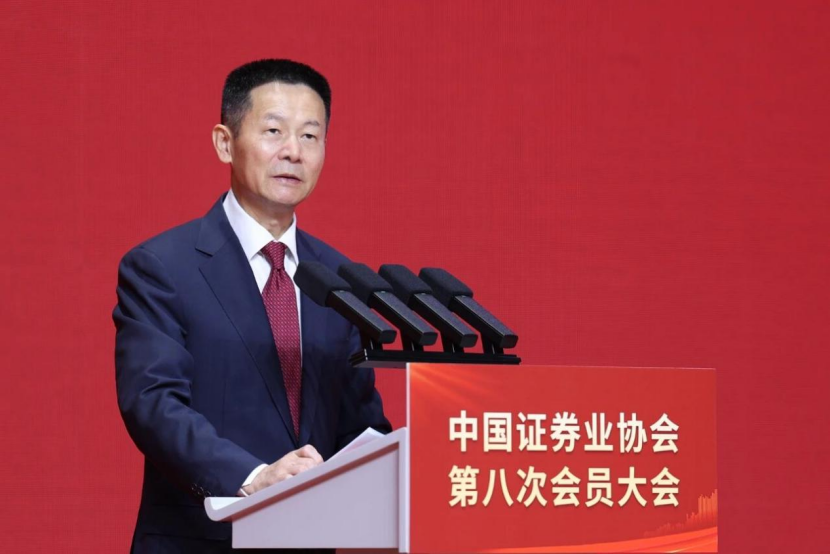
Speech by CSRC Chairman Wu Qing.
 Some analysts believe that Wu Qing’s speech conveys the core principle of “National prosperity or decline, finance bears responsibility,” with “functional implementation” as the key focus. This sets the core path for the securities industry to fulfill its mission and contribute to the high-quality development of the capital market.
According to the reporter’s summary, there are at least ten key points in Wu Qing’s speech.
First, moderately expand capital space and leverage limits.
In terms of regulatory policy, the CSRC will focus on strengthening classified regulation and implementing the principle of “supporting the excellent and restricting the inferior.” For high-quality institutions, it will appropriately “loosen restrictions,” further optimize risk control indicators, moderately expand capital space and leverage limits, and improve capital utilization efficiency. For small and medium-sized brokerages and foreign brokerages, differentiated regulation will be explored in areas such as classification evaluation and business access to promote specialized development.
The reporter noted that while previous regulations advocated for “supporting the excellent and restricting the inferior,” specific supporting tools were not clarified. This is the first time that the policy has explicitly proposed “appropriately loosening restrictions for high-quality institutions, further optimizing risk control indicators, moderately expanding capital space and leverage limits, and improving capital utilization efficiency,” directly providing policy space for the capital deployment capabilities of high-quality institutions and offering quantifiable support for their expanded service scope.
Second, the industry should embrace the four major missions and responsibilities for the '15th Five-Year Plan' period.
It must strengthen its sense of mission in serving the real economy and the development of new quality productive forces; better serve investors and help households optimize asset allocation; accelerate the building of a strong financial nation; and promote high-level institutional openness.
Among them, securities companies and industry investment institutions have demonstrated significant professional advantages in equity investment, price discovery, and risk management. To meet the needs of the times, they should proactively align with diversified wealth management demands characterized by different risk appetites, scales, and time horizons. They must offer a broader range of more precise products and services that are conducive to long-term and value investing, fostering a mutually beneficial relationship with investors while jointly participating in and sharing the fruits of economic and capital market development.
Moreover, every institution must benchmark itself against the goals of building a strong financial nation, diligently enhancing its core competitiveness, market leadership, and risk control capabilities.
Third, set the tone for the fundamentals of the A-share market and the securities industry.
Investor confidence and expectations have significantly improved, and the market's resilience and risk resistance have notably strengthened. Since the beginning of this year, the A-share market has remained generally robust and active, with a total market capitalization exceeding 100 trillion yuan, achieving reasonable quantitative growth and effective qualitative improvement.
The total assets of 107 securities companies reached 14.5 trillion yuan, with net assets amounting to 3.3 trillion yuan, reflecting growth of over 60% and 40%, respectively, in just over four years. From the perspective of customer numbers, the number of A-share investors has surpassed 240 million, marking a 26% increase. The quality and effectiveness of services have continued to improve.
Fourth, summarize the current state of mergers and acquisitions within the industry, particularly noting that mergers among leading brokerages have achieved preliminary results.
Landmark restructuring cases, such as the merger of Guotai and Haitong, have been smoothly implemented, preliminarily achieving a “1+1>2” effect. Leading firms have become even more prominent in their guiding role, while some smaller and medium-sized institutions have made breakthroughs by focusing on niche markets, accelerating the shift from homogeneous operations to differentiated development. Foreign institutions have expedited their domestic business layouts, with 11 wholly foreign-owned or majority-controlled securities firms now operating in China.
All securities companies should leverage their own resource endowments and comparative advantages, transitioning swiftly from price competition to value-based competition.
Leading institutions must maintain a sense of urgency, recognizing that standing still means falling behind. They should set benchmarks and lead by example in terms of market competitiveness, client and investor services, and risk management. There is a need to further strengthen awareness and capabilities for resource integration, making full use of mechanisms and tools for mergers and acquisitions to achieve complementary strengths and efficient allocation. Efforts should aim to cultivate several leading institutions with substantial international influence during the '15th Five-Year Plan' period.
It should be emphasized that top-tier investment banks are not exclusively the domain or 'patent' of leading institutions. Smaller and medium-sized institutions should also capitalize on their strengths and pursue differentiated development, concentrating resources on specialized fields, niche customer segments, and key regions. They should strive to build boutique investment banks, specialized investment banks, and distinctive service providers that are 'small but beautiful.'
Overall, reporters found that regulators no longer adopt a unified policy for the entire industry but instead implement differentiated measures:
For high-quality institutions: unleash vitality by “relaxing capital and leverage constraints” to encourage their expansion of capabilities in serving the real economy and cross-border finance;
For small and medium-sized institutions: guide them to focus on niche markets through “differentiated classification evaluation and business access,” avoiding homogenized competition with leading institutions;
For foreign institutions: support them in “leveraging parent company advantages and introducing international experience” while promoting their “integration into the broader picture of China’s capital market;”
For problematic institutions: “strictly regulate according to law and severely punish violations” to safeguard the financial security底线.
This is essentially about enabling different institutions to find suitable development paths through “tailored measures,” enhancing the overall efficiency of resource allocation in the industry.
Fifth, reputation management must be highly valued, and guidance on public opinion via new media and other platforms should be strengthened.
In recent years, incidents involving individual practitioners indulging in extravagance and flaunting wealth have seriously damaged the image of their companies and even the entire industry, offering profound lessons. Industry institutions must vigorously promote and practice a financial culture with Chinese characteristics, adhere to long-termism, and integrate cultural development into corporate strategies, rules and regulations, and daily operations. They should benchmark against best practices and shape industry culture in line with sector-specific features. Great importance must be attached to reputation management, embedding corporate culture and values into brand building. Proactive efforts should be made to strengthen guidance and response to public opinion on new media platforms, effectively narrating the industry's story, jointly shaping and maintaining the industry’s image and brand, and earning trust and confidence from all stakeholders. The expertise of chief economists and industry research institutions should be leveraged to articulate China’s “stock market narrative” and foster a positive public opinion environment.
Reporters noted that this speech explicitly required the industry for the first time to “leverage the expertise of chief economists and industry research institutions, articulate China’s ‘stock market narrative,’ create a positive public opinion environment, and consciously resist irrational rumors,” directly linking research capabilities with market expectation management and reinforcing brokers’ responsibility to provide “professional voices” in stabilizing market sentiment.
Sixth, strengthen investor protection and align interests with those of investors.
Always bear in mind that the majority of investors in the market are retail investors, and further strengthen the comprehensive advantages of securities companies as the main channel for trading. Consciously uphold the order of market transactions and the principles of fairness, impartiality, and transparency. Lead by example in practicing value investing, strengthen cross-cycle and counter-cyclical strategies, and enhance investment stability and value judgment capabilities.
Industry institutions must further strengthen the alignment of interests with investors, accelerate the establishment of an evaluation system centered on investor returns, and promote the transformation and development of brokerage, investment advisory, and comprehensive wealth management services.
According to reporters' observations, while the previous advocacy focused on 'wealth management transformation,' no clear core evaluation criteria were established. This is the first time that the proposal to 'accelerate the establishment of an evaluation system centered on investor returns' has been made, requiring brokers to 'strengthen alignment of interests with investors' and promoting the transition of brokerage and advisory services from 'channel services' to 'shared returns.' Additionally, it emphasizes 'comprehensive support in products, trading, market-making, and risk management' for long-term capital and refines the development path for a 'long-term investment ecosystem.'
Seventh, emphasize internationalization and cross-border finance.
Enhance comprehensive cross-border financial service capabilities. Adhere to high-level 'going global' and high-quality 'bringing in,' and institutions with conditions should steadily advance internationalization and layout along the 'Belt and Road.' Improve highly specialized services and vertically integrated management capabilities to promote coordinated development across domestic and international markets. It is also hoped that foreign-funded brokerages will fully leverage their parent companies' professional expertise and group advantages to facilitate cross-border resource alignment, introduce more advanced international practices, and better integrate into the broader development of China’s capital market.
Eighth, stress compliance and risk control, strictly preventing illegal arbitrage and disruptions to market order.
Globally, there are numerous cases where the loss of control over risks in one business or product led to the collapse of an entire institution. Although China’s securities industry has made significant progress in compliance and risk management after comprehensive governance, some business areas still experience emerging risks, and failures in governance have occurred at certain institutions. We must remain vigilant.
The key lies in enhancing the effectiveness of governance. Strictly implement rigid requirements for corporate governance and equity management, improve mechanisms to prevent conflicts of interest such as related-party transaction management, resolutely prevent shareholders from improperly interfering in operations, and decisively remove unqualified shareholders. Transaction management must be further strengthened. Enhance the ability and precision of thorough oversight, ensure fair trading services for different types of investors, protect the legitimate rights and interests of small and medium investors, and rigorously prevent illegal arbitrage and disruptions to market order. Strengthen risk prevention in key areas.
For businesses requiring close attention, such as margin trading, over-the-counter derivatives, and private asset management, as well as institutions like remote headquarters and subsidiaries, and key risks including credit, liquidity, and compliance, we must 'keep our eyes wide open' to prevent risks before they occur. For new business models such as crypto-assets, conduct in-depth analysis and proceed cautiously; if something cannot be clearly understood or managed, refrain from engaging in that business, and avoid any illegal or non-compliant activities.
Ninth, actively pursue financial technology innovation while avoiding uncontrolled risks due to regulatory gaps.
Financial technology innovation is burgeoning, profoundly transforming and even reshaping the financial market ecosystem. Industry players must be adept at recognizing changes, adapting to them, and seeking innovation by actively researching and steadily exploring the deployment and application of artificial intelligence, big data, blockchain, and other technologies in the capital markets. This will cultivate new competitive advantages and inject fresh momentum into high-quality industry development. The CSRC, together with industry associations, will streamline mechanisms for securities industry innovation pilots, enriching application scenarios such as regulatory sandboxes. At the same time, it will enhance the monitoring, regulation, and risk response mechanisms for financial innovation activities to prevent uncontrolled risks due to regulatory gaps.
Reporters noted that past discussions of emerging financial sectors often emphasized 'risk monitoring.' This time, specific mention was made regarding crypto assets, urging 'in-depth analysis, cautious handling, and a firm refusal to engage in businesses that are unclear or uncontrollable, as well as any illegal activities.' It explicitly sets out the principle of governance: 'No blind following of trends, no crossing of regulatory bottom lines,' delineating clear boundaries for exploration in the new industry paradigm.
The tenth point focuses on enhancing resilience against risks.
In the face of complex and severe situations and risk tests, industry institutions have pressed ahead under pressure, properly resolving risks in areas such as asset management and stock pledge. High-risk 'system-related' institutions have completed market-oriented liquidation, safeguarding the security baseline and making significant contributions to financial stability.
Professionalism is a core requirement for top-tier institutions and serves as our internal strength and confidence in addressing external risks and challenges. Institutions must adhere to principles of honesty, diligence, responsibility, independence, and objectivity, reinforcing the 'three lines of defense' in investment banking internal controls. They should expedite the transition from gatekeeping IPO entries to providing 'full-process support,' guiding listed companies toward standardized operations and value enhancement, thereby continuously solidifying the foundation for market development. Additionally, they need to strengthen their capacity for value discovery and cultivation.
Not only that, but efforts should also be made to enhance business synergy, improving the professionalism and influence of IPOs and M&A restructuring services while deeply participating in corporate value creation. Emphasis should be placed on strengthening underwriting, sponsorship, and pricing capabilities to promote coordinated and stable development between primary and secondary markets. Wealth management service capabilities should also be enhanced.
Notably, the role of the Securities Association, as an industry self-regulatory organization, has been highlighted. Wu Qing expressed hope that the new council and supervisory board of the association would seize this conference as an opportunity to uphold political leadership, institutional strength, openness in operation, and style revitalization, driving the association’s high-quality development.
Specifically, the SAC needs to strengthen Party leadership, thoroughly study and implement the spirit of the 20th CPC National Congress and subsequent plenary sessions, and ensure the implementation of central government decisions within the industry. Governance mechanisms should be improved; after the new president, representing the industry, assumes office, member recognition, cohesion, and participation must be enhanced to reinforce co-construction, co-governance, and shared benefits. The industry ecosystem should be optimized by focusing on core functions of 'self-discipline, service, and communication,' improving organizational and institutional frameworks, and innovating self-disciplinary approaches. Proactive long-term planning should focus on building world-class investment banks, rallying industry forces to drive the '15th Five-Year Plan' development of the securities sector and capital markets, and leveraging think-tank roles to contribute wisdom.
Editor/Rocky