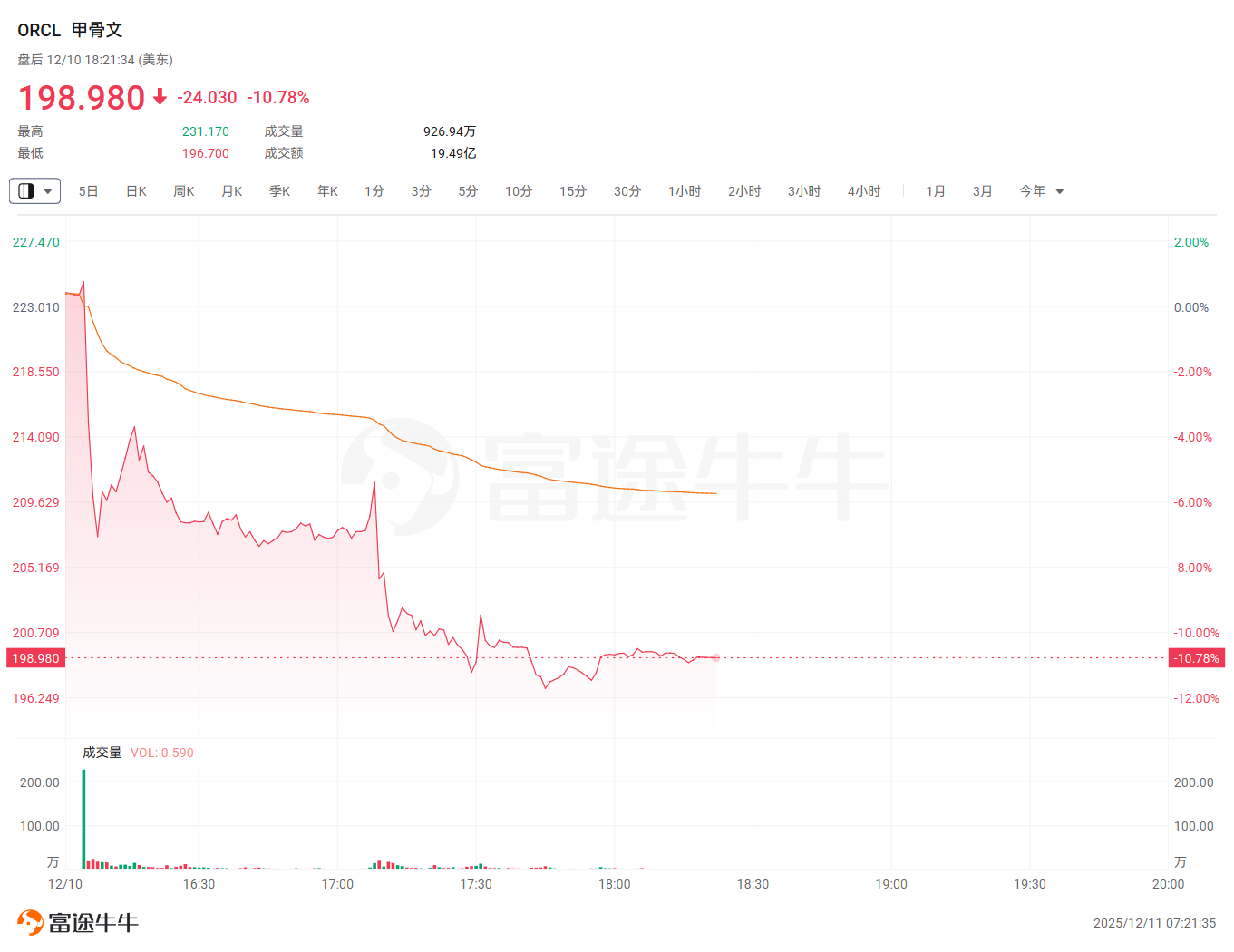
Oracle reported its fiscal second-quarter results for the 2026 financial year after the market closed on Wednesday. Both revenue and cloud business income fell below analysts' expectations, with quarterly free cash flow at -USD 10 billion. The company also raised its full-year capital expenditure guidance, expecting to spend approximately USD 15 billion more than previously anticipated. Following this announcement, Oracle's share price plummeted over 10% in after-hours trading.
$Oracle (ORCL.US)$ Oracle's second-quarter earnings released after the market close on Wednesday showed that the company’s revenue and cloud business both fell short of analysts' expectations. The quarterly free cash flow (FCF) was -$10 billion, and the company projected that its annual capital expenditure would be approximately $15 billion higher than originally anticipated. Oracle's stock price plummeted more than 10% in after-hours trading.
Below are the key highlights from Oracle's second-quarter earnings report:
 Key Financial Data:
Remaining performance obligations: Oracle's remaining performance obligations for the second quarter increased by 438% year-over-year to $523 billion, surpassing the analysts' average expectation of $519 billion.
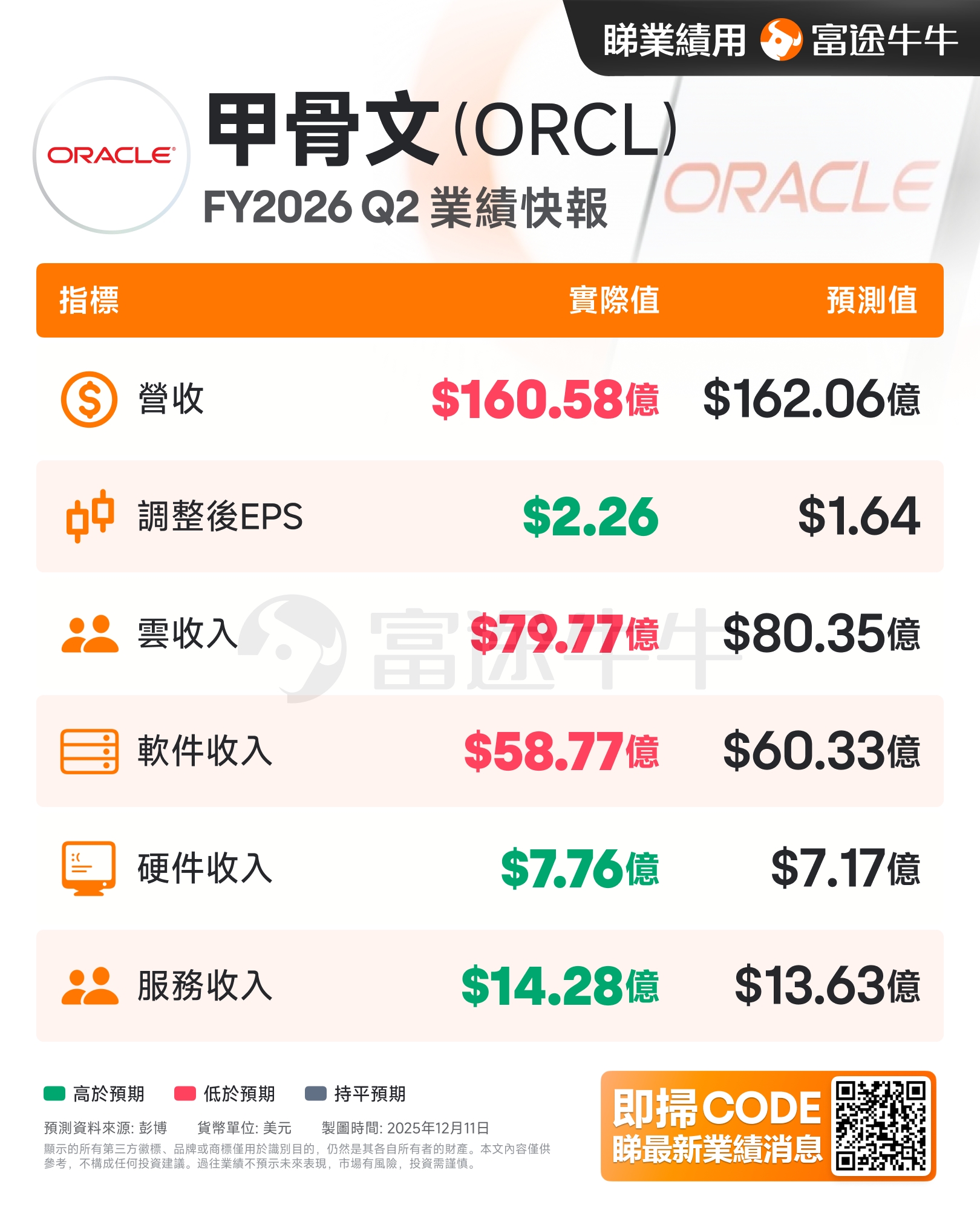
Revenue: Oracle's total revenue for the second quarter grew 14% year-over-year in dollar terms and 13% in constant currency terms, reaching $16.1 billion, which was below the analysts' expectation of $16.21 billion.
Operating profit: Oracle's GAAP operating profit for the second quarter was $4.7 billion, while its non-GAAP operating profit was $6.7 billion, representing a year-over-year growth of 10% in dollar terms and 8% in constant currency terms.
Net profit: Oracle's GAAP net profit for the second quarter was $6.1 billion. The non-GAAP net profit was $6.6 billion, reflecting a year-over-year increase of 57% in dollar terms and 54% in constant currency terms.
Earnings per share: Oracle's GAAP earnings per share for the second quarter were $2.10, growing 91% year-over-year in dollar terms and 86% in constant currency terms. Non-GAAP earnings per share were $2.26, showing a year-over-year increase of 54% in dollar terms and 51% in constant currency terms.
Free cash flow: Oracle's free cash flow (FCF) for the second quarter was -$10 billion.
Cloud Business Data:
Cloud business: Oracle's cloud business revenue (IaaS plus SaaS) for the second quarter amounted to $8 billion, increasing 34% year-over-year in dollar terms and 33% in constant currency terms, but falling short of the analysts' expectation of $8.04 billion.
Cloud infrastructure: Revenue from cloud infrastructure (IaaS) for the second quarter reached $4.1 billion, marking a year-over-year increase of 68% in dollar terms and 66% in constant currency terms, yet still below analysts' expectations.
Cloud Applications: Revenue from cloud applications (SaaS) in the second fiscal quarter was US$3.9 billion, representing an 11% year-over-year increase both in dollar terms and at constant currency; Fusion Cloud ERP (SaaS) revenue reached US$1.1 billion, up 18% year-over-year in dollar terms and 17% at constant currency; NetSuite Cloud ERP (SaaS) revenue amounted to US$1 billion, growing 13% year-over-year both in dollar terms and at constant currency.
Oracle's shares plunged more than 10% in after-hours trading due to weaker-than-expected performance. Since September 10, Oracle's stock has fallen by about one-third. At that time, investor enthusiasm for its cloud business had driven the company’s stock price to a record high.
Ability to achieve explosive revenue growth comes under question.
Oracle, which started with database software, has recently made progress in the highly competitive cloud computing market. The company is aggressively building data centers to provide computational power for technology firms such as OpenAI.
In a statement released on Wednesday, Oracle announced it had secured additional cloud commitments from Meta Platforms, NVIDIA, and other companies. The 'Remaining Performance Obligation' (RPO), a metric used to measure order size, surged to US$523 billion during the quarter, increasing more than fivefold year-over-year, surpassing analysts' average forecast of US$519 billion.
However, Wall Street continues to question the costs and timelines associated with building AI infrastructure at such a large scale. Investors are pressuring Oracle to demonstrate that it can achieve the previously anticipated revenue surge through its aggressive expansion of AI data centers.
In September, Oracle announced that its contract backlog had surged to US$455 billion, a development that initially drove a sharp rise in its share price and briefly made co-founder Larry Ellison the world’s richest person. Subsequently, however, the market began to worry about the level of risk Oracle was taking on in its expansion, leading to a continued decline in its stock price.
RBC Capital Markets analyst Rishi Jaluria stated:
“At the end of the day, the question is, ‘How will Oracle raise this capital?’ Building up a backlog is one thing, but whether these orders can actually be converted into revenue will reflect the company’s ability to meet demand.”
Massive borrowing, with annual capital expenditures increased by US$15 billion.
Oracle has incurred substantial debt and committed to leasing multiple data center sites. The company recently issued approximately US$18 billion in new investment-grade bonds, bringing its total outstanding debt to over US$100 billion, making it the most heavily indebted among large technology companies with investment-grade ratings.
According to forecasts by Morgan Stanley credit analysts, Oracle's 'adjusted debt'—which includes lease liabilities and financial debt—could more than double to around US$300 billion by 2028.
Emarketer analyst Jacob Bourne stated:
"Amid ongoing uncertainty regarding AI spending prospects, Oracle is facing increasing scrutiny due to its debt-driven data center expansion and customer concentration risks. This revenue miss may exacerbate already cautious investor concerns about its OpenAI partnership and aggressive AI spending strategy."
Media reports indicate that investors want to see Oracle convert its rising infrastructure spending into revenue as quickly as promised. Capital expenditure, used to measure data center investments, was approximately US$12 billion for the quarter, up from US$8.5 billion in the previous quarter. Analysts had expected capital expenditure of US$8.25 billion for the quarter.
Oracle executives stated during the earnings call that the company now expects capital expenditures of approximately US$50 billion in the fiscal year ending November 2026, an increase of US$15 billion from the forecast provided in September.
Oracle Chief Financial Officer Doug Kehring stated during the call:
"The vast majority of our capital expenditures are directed toward data center equipment that directly generates revenue, rather than land, buildings, or power facilities, which are addressed through leasing arrangements. Oracle does not incur costs for these leases until the data centers and associated utilities are delivered to us."
Kehring also confirmed that the company’s annual revenue would reach US$67 billion, reaffirming Oracle’s October guidance.
He added:
As a general principle, we expect and are committed to maintaining an investment-grade debt rating.
In addition, Oracle expects revenue growth of 19%-21% in the third fiscal quarter, with cloud growth ranging from 40%-44%, while keeping its annual sales forecast for fiscal year 2026 unchanged at $67 billion.
Ellison: Adherence to a 'Chip-Neutral' Strategy
As part of a data center project named 'Stargate,' OpenAI has agreed to purchase $300 billion worth of computing power from Oracle over approximately five years. Oracle executives stated in October that the company also signed new infrastructure contracts totaling $65 billion with four different clients, excluding OpenAI.
Oracle executives indicated that even if business from OpenAI does not fully materialize, the computing capacity being built will still be supported by demand from other customers.
This year, Oracle divested its stake in semiconductor company Ampere Computing. In a statement accompanying the earnings release, Larry Ellison emphasized that the company will continue to adhere to a 'chip-neutral' strategy.
He stated that Oracle will continue to procure chips from NVIDIA but stressed, 'We must be prepared to deploy any chip that our customers wish to use. Many changes will occur in AI technology in the coming years, and we need to remain flexible to adapt to these changes.'
Kirk Materne, an analyst at Evercore ISI, wrote in a report ahead of the earnings release that some of the recent negative sentiment among investors stemmed from growing market skepticism about OpenAI's business prospects. OpenAI is facing more intense competition from companies such as Google, a subsidiary of Alphabet. He added that investors would like Oracle's management to explain how the company plans to adjust its spending should demand from OpenAI change.
 Looking to pick stocks or analyze them? Want to know the opportunities and risks in your portfolio?For all your investment-related questions, just ask Futubull AI!

Editor/jayden