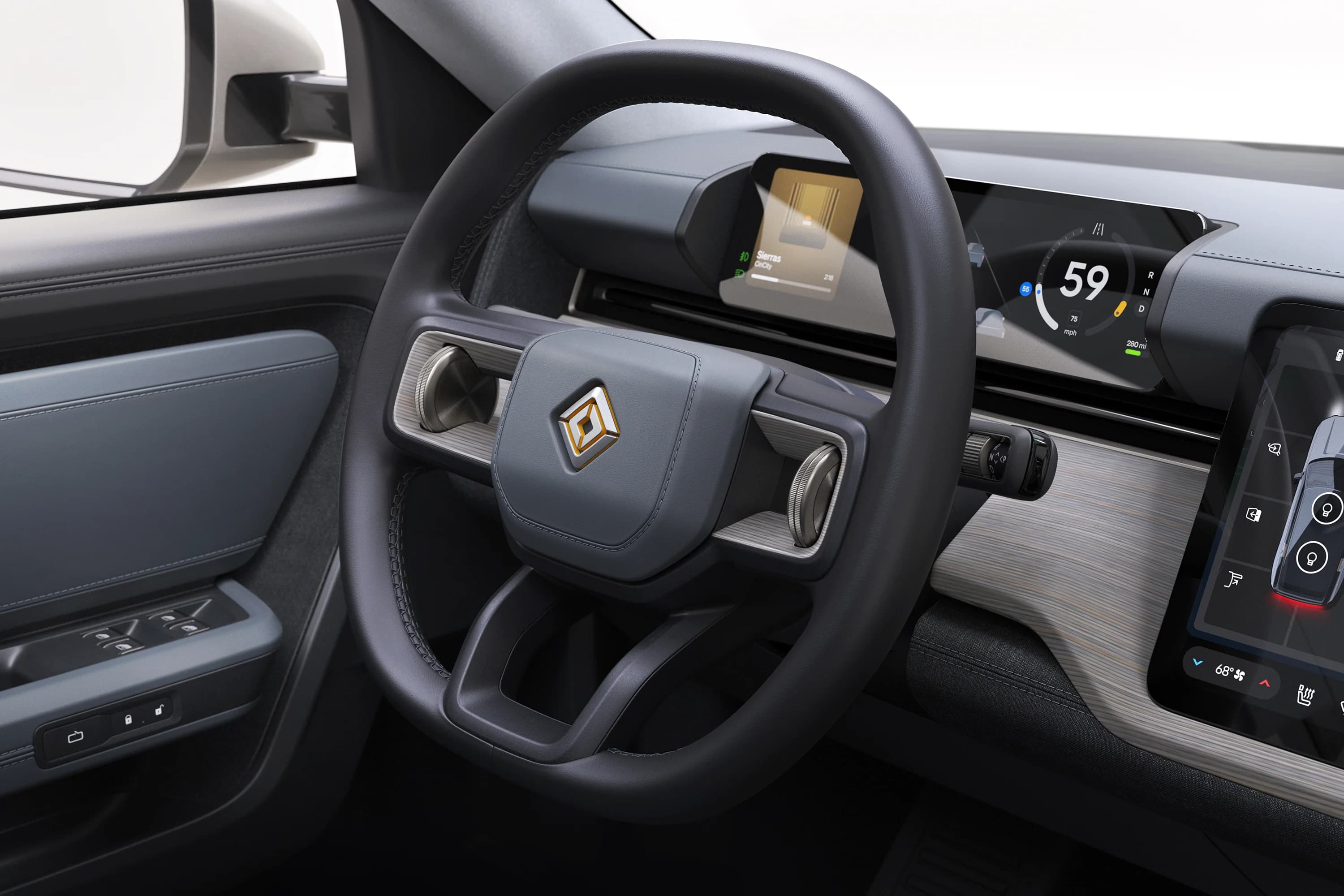
Rivian announced on Thursday its self-developed AI chip RAP1, the next-generation in-vehicle computer, and a new AI model, with plans to replace NVIDIA's solution in the R2 model and introduce a subscription service called Autonomy+. The company is betting on LiDAR and Level 4 autonomous driving technology, aiming to unlock higher profit margins through its software business. However, investor response was lukewarm, with the stock price falling by as much as 10%.
Rivian, a competitor of Tesla, announced on Thursday its self-developed artificial intelligence chip, an in-vehicle computer system, and a new AI model, with plans to replace NVIDIA's chip system. The company hopes these technologies will enable it to incorporate autonomous driving capabilities into upcoming models. However, following the announcement, Rivian's stock price fell by as much as 10%.
Rivian stated that its upcoming R2 SUV model will be equipped with a chip named Rivian Autonomy Processor 1 (RAP1), along with a new LiDAR sensor. Combined with the new sensor and AI model, the chip will drive Rivian’s eventual realization of autonomous driving capabilities. Vidya Rajagopalan, Rivian's Vice President of Electrical Hardware, noted that this chip adopts 'multi-chip module' technology and features 'high memory bandwidth,' which is crucial for AI applications. The bandwidth of Rivian's chip reaches 205GB per second.
 Two RAP1 chips will power Rivian's next-generation in-vehicle computer, named Autonomy Compute Module 3. This system can process 5 billion pixels per second, offering performance four times that of the NVIDIA systems currently used in Rivian vehicles. Rivian's SUVs and pickup trucks currently provide driver-assistance features that require constant driver supervision.
Rivian also stated that the company plans to roll out a subscription service called 'Autonomy+' to customers of its second-generation models by early 2026. The service will 'continuously expand' in functionality and will be supported by Rivian's self-developed Autonomy Processor and in-vehicle autonomous driving computer.
Autonomy+ will be priced at a one-time fee of $2,500 or a monthly subscription starting at $49.99. By comparison, Tesla's advanced FSD (supervised) feature costs $8,000 as a one-time payment or $99 per month.
Rivian CEO RJ Scaringe told the media:
"This is not a decision to be taken lightly; it represents a significant commitment. We have spent several years on this. Typically, you cannot simultaneously reduce costs and improve performance. But here, we have significantly enhanced performance while also reducing the cost per vehicle by several hundred dollars."
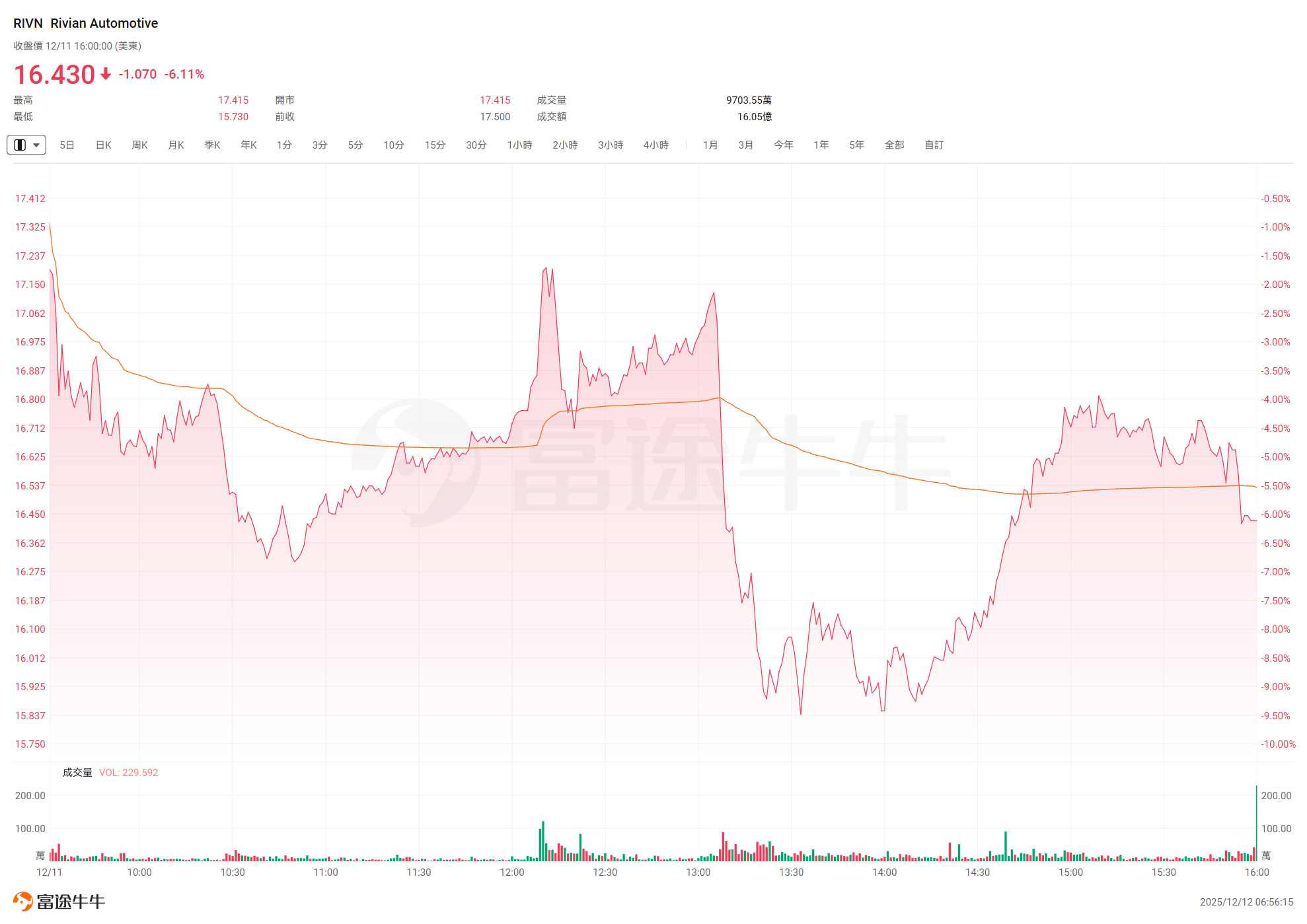
Investors reacted tepidly to the news. After the chip announcement, Rivian's stock briefly narrowed its losses but hit an intraday low in New York Thursday afternoon as management concluded their technical presentation, falling by as much as 10% before paring some losses. Rivian's shares have risen about 25% this year but remain over 80% below their peak shortly after the company’s 2021 IPO.
Selling software and achieving L4 autonomous driving is the ultimate goal.
For years, major automakers have been competing to develop more advanced autonomous driving systems while painting a future for investors where vehicles eventually achieve full autonomy. However, most manufacturers still rely on specialized chipmakers like NVIDIA, Mobileye, or Qualcomm, as developing proprietary AI chips presents high technical challenges and is costly.
NVIDIA is now the world's most valuable company, dominating the market for data center chips used to train AI models. Its automotive chip business remains small, accounting for about 1% of total sales, but the company is working to increase this proportion.
Tesla is an exception. The company designs its own in-vehicle chips and makes them standard hardware in its vehicles to demonstrate the necessity of long-term investment. Tesla also adheres to a 'pure vision approach,' arguing that relying solely on cameras more closely mimics human driving habits and deeming additional sensors like LiDAR too costly.
Rivian disagrees with this view. It sides with the majority of robotaxi companies and other automakers, emphasizing the crucial value of LiDAR in monitoring the vehicle’s surroundings and complementing other sensors.
Scaringe said:
"LiDAR has undergone significant changes. It is no longer an expensive component but rather a very small part of the overall vehicle cost."
Production of Rivian's R2 model will begin in the first half of 2026, with deliveries starting shortly thereafter. The initial vehicles will not be equipped with the new chips or LiDAR, resulting in more limited autonomous driving capabilities.
Starting in 2027, Rivian will gradually roll out software versions enabling point-to-point travel without requiring the driver to keep their hands on the steering wheel or focus on the road.
Initially, this will be limited to highways, with expansion to more road types later. Rivian’s ultimate goal is to convince customers and investors of the value of its higher-margin software business by allowing private vehicles to operate autonomously even when unoccupied, achieving what SAE defines as 'L4' autonomy, or full self-driving capability.
In L4 autonomous vehicles, passengers can lie down in the back seat and sleep while the vehicle independently takes them to their destination under normal traffic and weather conditions. Waymo, the leader in U.S. robotaxis (under Alphabet), considers its vehicles to be at Level 4 autonomy.
Scaringe stated on Thursday that Rivian’s upcoming autonomous vehicles will also allow the company to enter the robotaxi sector, whereas Tesla, despite years of promising a robotaxi, has yet to deliver one.
He said:
“Although our initial focus will be on privately owned vehicles, as they account for the vast majority of driving miles in the U.S., these technologies also enable us to enter the shared mobility business.”
The new system can learn and optimize from user driving behavior.
Rivian went public in 2021, marking one of the largest IPOs in U.S. history. At the time, the company was seen as a competitor to Tesla. Rivian was the first to launch full-size electric pickups and SUVs ahead of large traditional automakers. However, since then, the company has faced operational challenges—its sole plant in Illinois is expected to produce less than 50,000 vehicles this year, far below its capacity limit.
Due to continued cash burn, Rivian has been forced to repeatedly downsize its workforce, and its stock price has plummeted over 80% from its post-IPO high. Despite this, Volkswagen has committed nearly $6 billion to their joint venture project to leverage Rivian's expertise in software and electronics. Meanwhile, Rivian continues to recruit top talent from Tesla, Apple, and Silicon Valley.
At the core of Rivian’s current vehicles and the upcoming R2 SUV is a foundational system called the Large Driving Model. This system can learn from both past and future driving behaviors, enabling Rivian to enhance the autonomous driving capabilities of older R1 models, which lack LiDAR and are equipped with NVIDIA Orin chips, before the more complete R2 platform launches in 2027.
The first-generation software upgrade will offer relatively limited functionality, falling far short of Tesla’s current “Full Self-Driving” (FSD) feature.
Rivian will roll out an expanded version of its “Universal Hands Free” system to existing owners in the coming weeks, allowing vehicles to assist with hands-free driving across 3.5 million miles of roadways—a significant increase from the current 135,000 miles. However, the system will still be unable to handle many traffic scenarios.
The next-generation point-to-point navigation version is expected to launch next year, enabling vehicles to navigate, turn, and change lanes while still requiring drivers to keep their eyes on the road.
Tesla offers FSD services, with users able to pay a one-time fee of $8,000 or a monthly subscription of $99. The latest version can handle many routine driving tasks, from point-to-point navigation to hands-free lane changes, but still requires driver supervision at all times, meaning it does not qualify as fully autonomous driving.
Although Rivian’s vehicles remain far from true autonomy, Scaringe expressed willingness to license this technology to other automakers, including Volkswagen.
The system we have built is highly robust at the platform level. We can fully envision that, in the coming years, it will become a platform for external licensing.
Editor/Joryn