The year 2025 is drawing to a close, marking a tumultuous period: from Trump's return to the White House at the beginning of the year, the disruption of global markets by U.S. tariffs in April, to the Federal Reserve’s pivot towards an easing path, and the capital frenzy ignited by artificial intelligence...
As we look ahead to 2026, how can we seize new opportunities? Subscribe to our special feature."2025 Year in Review", let us reflect on the past, consolidate experiences, and together embrace the next chapter.
On December 11, 2025, the Hong Kong Monetary Authority (HKMA) announced a 25-basis-point cut in the benchmark interest rate to 4.0%, marking the third rate cut of the year. Following the Federal Reserve's rate cuts on September 18 and October 30, the HKMA reduced rates by 25 basis points each time. Against this backdrop of rate cuts, the relative attractiveness of high-dividend stocks has increased.
 The overall valuation of Hong Kong stocks is currently at a historically low level. Certain sectors, such as finance, energy, and utilities, along with traditional individual stocks offering stable high dividends, have become highly attractive to funds seeking steady returns. In an environment of a slowing credit cycle, dividend-paying assets can provide stable cash flow, mitigating risks from market volatility.
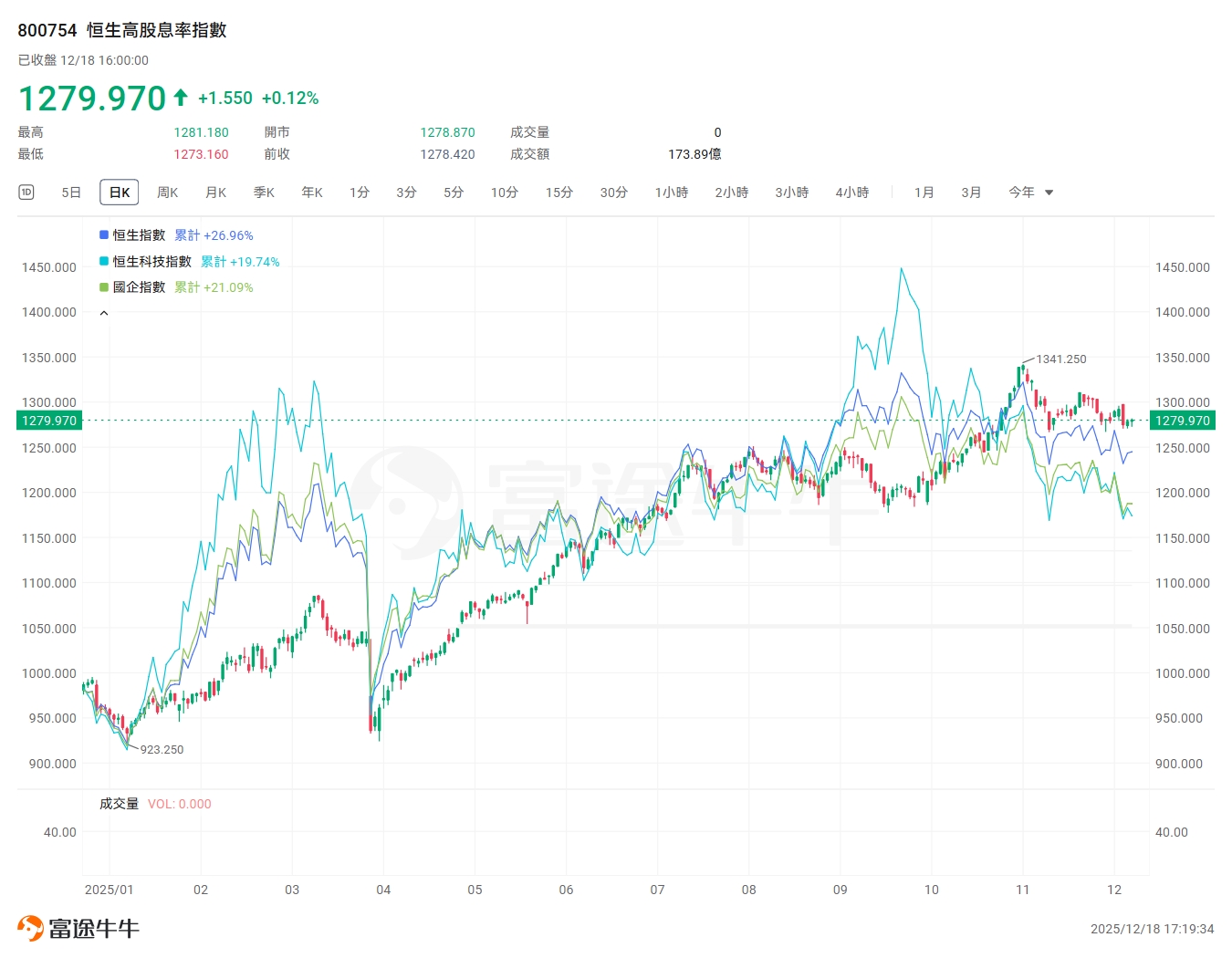
This year, the Hong Kong stock market has increasingly highlighted the dual value of 'defense + income' for high-dividend assets amidst fluctuations. For instance,$Hang Seng High Dividend Yield Index (800754.HK)$selects 50 stocks with the highest dividend yields, lower volatility, and consistent payouts from large companies in Hong Kong. As of the time of writing, the index has risen nearly 29% year-to-date, outperforming the Hang Seng Index's 23%, the Hang Seng Tech Index's 20%, and the H-share Index's 20% gains.
Based on the closing data of Hong Kong stocks as of December 17, Futubull has compiled a list of the top ten high-dividend Hong Kong stocks with trailing twelve-month (TTM) dividend yields above 5% and total market capitalization exceeding HKD 100 billion, ranked by their year-to-date gains, for reference. The stocks on this list span multiple core industries, supported by solid profitability and generous dividend policies, making them a focal point in the market.
Top 10 High-Dividend Hong Kong Stocks by Year-to-Date Gains
Among the top ten high-dividend Hong Kong stocks with the highest year-to-date gains, half belong to the broader financial sector, including New China Life Insurance, Bank of China (Hong Kong), CITIC Limited, CITIC Bank, and China Everbright Bank.
Among them,$NCI (01336.HK)$one stock has surged nearly 150% year-to-date, making it the top-performing high-dividend Hong Kong stock, with a dividend yield of 5.64%;$BOC HONG KONG (02388.HK)$Surged nearly 68%, with a dividend yield exceeding 6%;$CITIC (00267.HK)$Surged over 40%,$CITIC BANK (00998.HK)$Surged over 38%,$CEB BANK (06818.HK)$Surged nearly 32%, with dividend yields all exceeding 5%.
Two of them are real estate stocks, namely,$SWIREPROPERTIES (01972.HK)$and$HENDERSON LAND (00012.HK)$with year-to-date cumulative gains exceeding 42% and 33%, respectively, and dividend yields of 5.3% and 6.18%.
Food companies$WH GROUP (00288.HK)$Ranked second on the list of gainers, with a year-to-date increase of nearly 81% and a dividend yield reaching 12.35%; PetroChina$PETROCHINA (00857.HK)$Surged over 43% to rank fourth, with a dividend yield of 6.4%; rail and train equipment companies$CRRC (01766.HK)$Also made the list with an increase of more than 30% and a dividend yield of 5.76%.

From the year-to-date performance perspective, high-dividend stocks in the financial sector have seen significant gains. What core measures this year have supported their performance?
On December 5, the National Financial Regulatory Authority issued the 'Notice on Adjusting Risk Factors for Relevant Businesses of Insurance Companies' (hereinafter referred to as the 'Notice'), which lowered risk factors for relevant businesses of insurance companies. Generally speaking, insurance risk factors represent the capital occupation of insurance companies' investment and operational activities. The reduction of risk factors means that the capital efficiency of insurance companies has improved. Hong Kong-listed high-dividend stocks, with their relatively higher safety margins, meet the stock selection requirements of insurance funds.
In addition, since December, many listed securities firms have announced dividend implementation plans, entering the execution phase of a new round of dividend payouts.
Under the positive guidance of policies encouraging listed securities firms to raise cash dividend levels, the total amount of dividends distributed by listed securities firms this year has exceeded RMB 54.8 billion, with 14 firms having implemented dividends of over RMB 1 billion. Many securities firms have also recently added profit distribution plans for the third quarter, highlighting the current dividend attributes of securities stocks.
These events and policies have had a crucial impact on the dividend management of large state-owned enterprises (SOEs) and centrally-administered SOEs with substantial market capitalization and stable performance. As the backbone of market dividends, these companies’ dividend stability, payout ratios, and willingness to distribute dividends are expected to improve significantly, thereby providing investors with more reliable and stable returns on investment.
Outlook for High-Dividend Strategy in 2026
Looking ahead to 2026, institutional analysis indicates that non-listed insurers will implement the new insurance contract standard (IFRS 17) and the new financial instruments standard (IFRS 9) starting January 1, 2026. This is expected to significantly increase their demand for high-dividend stocks, bringing incremental capital inflows to the sector.
CICC notes that in 2026, investors may also moderately maintain a high-dividend allocation to address potential weakness in the overall credit cycle. If the credit cycle reverts to volatility, dividends will still hold allocation value to hedge portfolio fluctuations. The dividend yield of Hong Kong stocks is higher than that of A-shares (for instance, the dividend yield of the Hong Kong banking sector is 6.1%, compared to 4.3% for the A-share banking sector), making them particularly advantageous for mainland insurance funds and other investors who do not need to consider dividend taxes.
“While pursuing growth opportunities, timing can be adjusted based on trading congestion. Even if the direction is correct, if there is short-term overheating, it may be prudent to take profits and rotate into other areas with comparable long-term potential, including high-dividend assets offering stable returns.”
Slowing global economic growth, heightened stock market volatility, and reductions in policy rates have diminished the appeal of cash holdings. Investors will focus on 'quality': companies with strong earnings certainty, consistent dividend payouts, and tangible prospects for share price returns will become the preferred choice.
 Looking back at 2025, how did your investment returns fare?
 Did you reap substantial gains by making the right decisions?
 Which stocks or industries do you believe hold opportunities?
 Come share your annual summary!
Looking to pick stocks or analyze them? Want to know the opportunities and risks in your portfolio?For all your investment-related questions, just ask Futubull AI!

Editor/melody