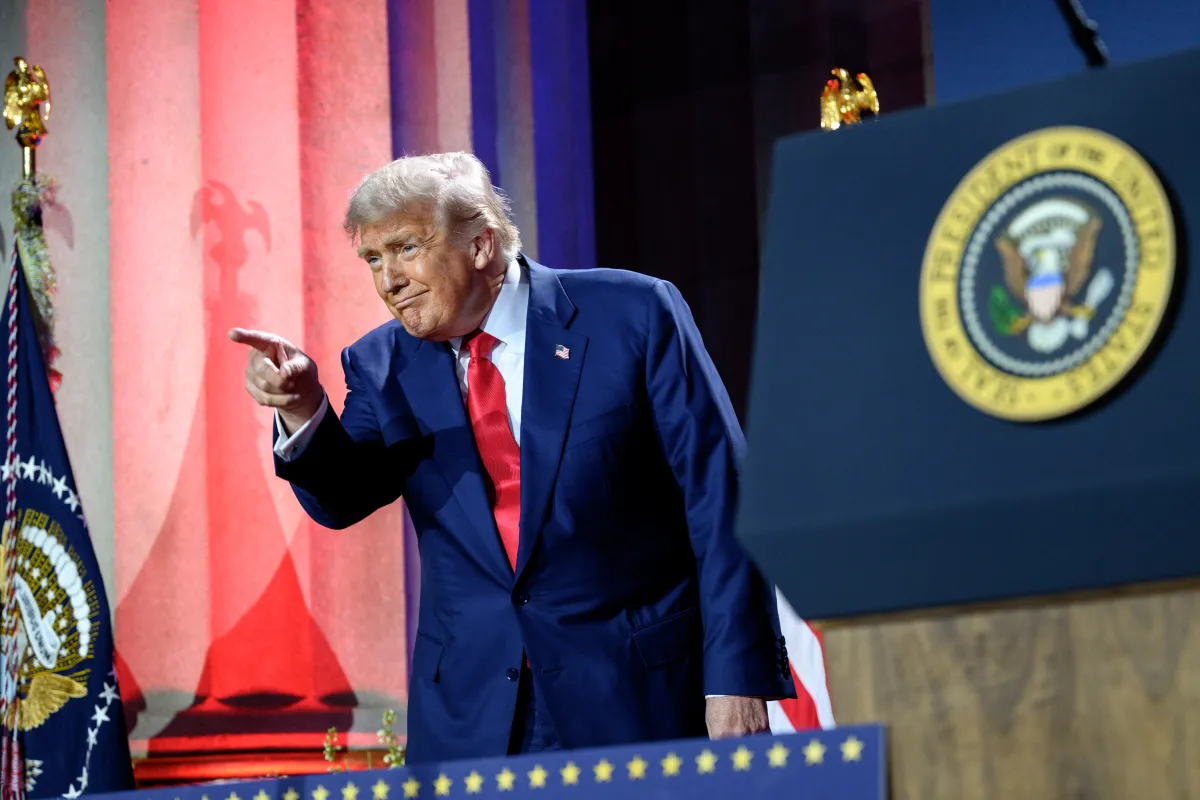
U.S. President Trump has currently interviewed three candidates for the position of Federal Reserve Chair. While these three individuals are aligned on the general direction of interest rate cuts, they differ significantly in terms of specific monetary policy details and balance sheet management.
To date, U.S. President Trump has interviewed three candidates to replace Federal Reserve Chair Powell in May next year. All three candidates support reducing interest rates but hold differing views on other aspects of monetary policy and come from diverse backgrounds.
Kevin Warsh is a former Federal Reserve governor with close ties to Trump's circle; White House economic advisor Kevin Hassett has been tested across two Republican administrations and is a staunch supporter of Trump; while Federal Reserve Governor Christopher Waller is an influential figure steering the Fed toward lower interest rates and a more conservative operational model.
 Their consensus is clear: Beyond agreeing that interest rates should be lower (aligning with Trump’s primary criticism of the Fed), they also believe that artificial intelligence can enhance economic productivity, enabling faster growth without triggering inflation.
However, a closer look at their recent public statements reveals significant differences, particularly regarding the speed or magnitude of rate cuts, how the Fed manages its balance sheet, and how the central bank should operate.
Below are brief profiles of the three candidates along with key statements they have made in their bids for the position:
Hassett
Hassett, 63, holds a Ph.D. in economics and worked at the Federal Reserve during the 1990s before joining the American Enterprise Institute (AEI), where he focused on tax policy and boosting supply-side advantages for the economy. Critics have sharply criticized his analytical errors, such as co-authoring the book Dow 36,000 in 1999 just before the dot-com bubble burst, claiming that stocks were severely undervalued, or using charts during Trump's first term suggesting the COVID-19 pandemic would quickly dissipate on its own.
Since serving as chairman of the White House Council of Economic Advisors during Trump’s first term, Hassett has remained within Trump’s inner circle. After the 2020 election, he advised Kushner’s investment firm Affinity Partners and was later promoted to Director of the National Economic Council after Trump returned to the White House. Among the three finalists, Hassett is undoubtedly the most optimistic about the impact government policies he helped formulate could achieve.
On interest rate cuts, Hassett said, “I think there’s plenty of room… With productivity growth plus capital stock growth, potential GDP growth could far exceed 3%, even surpassing 4%.”
Regarding the balance sheet, Hassett has not elaborated on the Federal Reserve’s balance sheet policy. However, key figures in the Trump administration, particularly Treasury Secretary Bessent, have argued that the Fed’s asset holdings demonstrate overreach. He has called for an “honest, independent, and non-partisan review of the entire institution.”
Regarding the culture of the Federal Reserve, Hassett once criticized in an interview that the Fed exhibits partisan bias and its research focus deviates from core issues. He also suggested that the 12 regional Fed presidents should be reviewed to determine “who is performing well and who is incompetent.”
Waller
Waller, aged 66, is the candidate furthest from Washington’s political circles among the three. A native of Nebraska with a Ph.D. in economics, he previously taught at the University of Notre Dame before becoming the head of research at the St. Louis Fed in 2009.
He has written extensively on monetary policy. After being appointed to the Federal Reserve Board by Trump in 2020, he leveraged this background to shape monetary policy debates with arguments based on theoretical and empirical analyses. These efforts contributed to the Fed accelerating its pace of interest rate hikes in 2022 to combat inflation, while more recently beginning to cut rates based on evidence of a weakening labor market.
His opportunity to succeed Powell in May next year may be limited by his lack of personal ties to Trump, and Trump may feel it could backfire similarly to his December 2017 decision to promote Powell from within the Fed.
As a current policymaker, his statements influence financial markets. Among the three strong contenders, Waller presents the most rigorous articulation of the Fed's issues and future outlook, which might make him appear too moderate. This, combined with his perceived independence from Trump, makes him the preferred choice for market participants.
On interest rate cuts, Waller noted, “We are still 50 to 100 basis points away from the neutral rate. We have room. We can bring rates down.”
Regarding the balance sheet, he stated, “Our balance sheet will naturally grow over time as currency demand and banks’ need for reserves increase… The size of our balance sheet now may be exactly where we want it to be.”
Unlike Warsh and Hassett, Waller does not believe that the Federal Reserve is constrained by partisan politics. As an official appointed by Trump, he has both supported and dissented fromthe Federal Open Market Committeethe policy decisions of the Federal Open Market Committee (FOMC). However, he has also expressed concerns about mission creep and has worked internally to narrow the focus on social issues and streamline staffing.
Warsh
Warsh, aged 55, is a lawyer who has served in various Republican administrations and currently advises investment legend Druckenmiller, as well as being a distinguished visiting fellow at Stanford University’s Hoover Institution. His father-in-law, Ronald Lauder (current honorary chairman of Estee Lauder), was an early supporter of Trump, and Warsh was considered for the role of Fed Chair during Trump’s first term.
He served as a Fed governor from 2006 to 2011. While then-Fed Chair Bernanke praised him as an effective liaison with Wall Street, Warsh opposed the scale of Bernanke’s bond-buying program and ultimately resigned because of it.
Since then, he has been a staunch critic of the Federal Reserve. As a strong contender to replace Powell, his criticisms have grown sharper, calling for a 'regime change' and 'disciplinary overhaul.' However, critics point out that he has not provided detailed specifics on the content or methods of reform to substantiate these claims.
Regarding interest rate cuts, Warsh previously stated, 'We can significantly lower interest rates to make 30-year fixed mortgages affordable... Low interest rates, combined with the technological revolution enabled by presidential policies and massive investments occurring both domestically and internationally, are the seeds of our productivity revolution.'
Warsh also views the Fed’s asset holdings as 'synonymous with the Fed's excessive intervention in the economy... Every action taken by the Federal Reserve expands their scale and scope, further eroding other macroeconomic areas.'
He has also fiercely criticized the culture of the Federal Reserve. Warsh previously noted, 'I’ve observed that the Fed is perhaps too willing to venture into forbidden territory... Issues like ‘climate change’ and ‘inclusiveness’ are politically charged topics. People have their own opinions and motivations... However, the Fed lacks both the expertise and the mandate to make political judgments in these areas.'
Looking to pick stocks or analyze them? Want to know the opportunities and risks in your portfolio? For all investment-related questions,just ask Futubull AI!

Editor/jayden