
The Bank of Japan (BOJ) considers that core inflation is still on a moderate upward trend, and the price movement remains largely consistent with the outlook target for the second half of the year. Despite the increase in nominal interest rates, the central bank expects real interest rates to remain significantly negative, implying that the overall financial environment will continue to be accommodative. Kazuo Ueda will hold a press conference at around 2:30 PM Beijing time to further elaborate on the considerations behind this decision and the future path of interest rates.
The Bank of Japan announced on Friday a 25-basis-point rate hike, raising the unsecured overnight call rate to 0.75%, the highest level since 1995.
The decision was announced after a two-day policy meeting and passed unanimously with a 9:0 vote, fully in line with market expectations. All 50 economists surveyed predicted that the Bank of Japan would raise rates this time, marking the first instance under Governor Kazuo Ueda’s leadership of a unanimous expectation for a rate hike.
 Following the announcement, the yen briefly surged against the dollar but then retreated, breaking below the 156 level during trading and falling 0.3% on the day. The market reaction indicates that this rate hike had been fully priced in by investors, also confirming the central bank's assessment — the current interest rate adjustment is not sufficient to alter the accommodative tone and appears to be part of a 'gradual normalization' process.
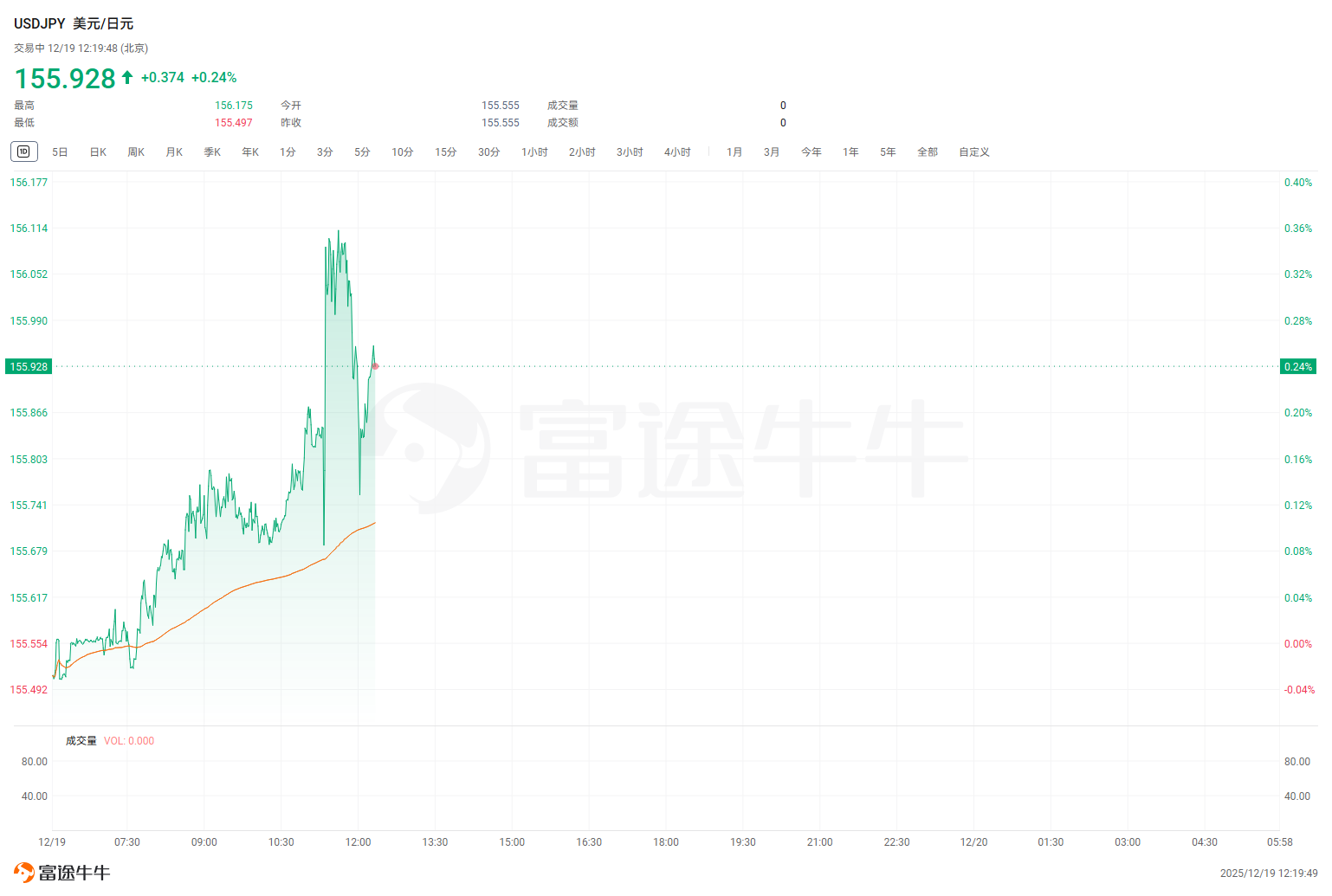
This rate hike did not come as a surprise. Previously, Kazuo Ueda, in a rare public statement, sent a clear policy signal indicating that conditions for a rate hike were maturing, paving the way for the market to price in the move in advance. Against the backdrop of gradually clearer inflation trends and more transparent policy communication, the Bank of Japan chose to methodically advance policy normalization.
Kazuo Ueda will hold a press conference at around 3:30 PM local time (2:30 PM Beijing time) to further elaborate on the considerations behind this decision and the future path of interest rates. The market generally expects that the Bank of Japan will continue to adopt a gradual, predictable, and data-dependent approach to raising rates, rather than aggressively tightening.
Reiterates that if the outlook materializes, rate hikes will continue.
In its policy statement, the Bank of Japan emphasized that if economic and price developments align with the current outlook, further rate hikes are expected.
The central bank stated that it would gradually adjust its policy stance based on improvements in economic activity and prices while maintaining an accommodative monetary environment to support economic recovery. The statement also noted that the likelihood of achieving the goals outlined in the 'Economic and Price Outlook' is increasing.
On inflation, the Bank of Japan considers that core inflation is still on a moderate upward trend, and price movements remain largely consistent with the outlook target for the second half of the year. Despite the increase in nominal interest rates, the central bank expects real interest rates to remain significantly negative, implying that the overall financial environment will continue to be accommodative and will not pose significant constraints on the economy.
The easing of political uncertainty has preserved room for interest rate hikes.
Notably, since October, Japan’s domestic political environment had cast a shadow over the prospects of monetary policy.
After Sanae Takachi, seen as an advocate for loose monetary policy, became prime minister, there were market concerns that the government might hinder the central bank's policy normalization efforts.
However, analysis suggests that persistent inflationary pressures and the political costs associated with a weak yen have led the government to refrain from obstructing the Bank of Japan’s recent interest rate hike, instead giving Kazuo Ueda space to continue advancing policy normalization.
Economic and wage data provide support.
From the perspective of economic fundamentals, the Bank of Japan's recent interest rate hike has been supported by data.
Recent economic indicators show that the tariff policies promoted by U.S. President Trump have not yet caused substantial damage to Japan’s economy. Meanwhile, major Japanese labor unions have set wage increase targets for the upcoming annual spring wage negotiations that are similar to last year’s levels – which resulted in the largest wage increases in decades – indicating that wage momentum remains intact.
This marks the first time Kazuo Ueda has raised interest rates again since January this year, highlighting his determination to steadily advance interest rate normalization amidst the gradual formation of a positive cycle between 'inflation-wage-policy.'
Editor/Lambor