
Japan takes action!
At noon on December 19, the Bank of Japan announced that it would raise the benchmark interest rate from 0.5% to 0.75%, in line with market expectations. This marks the highest interest rate level in 30 years and represents the first rate hike by the Bank of Japan in 11 months since January 2025.
Beyond the interest rate hike, another piece of news deserves greater attention. According to Bloomberg, the final draft of Japan’s tax reform plan shows that the Liberal Democratic Party and its coalition partner, Ishin no Kai, will agree to raise the income tax rate by one percentage point for all income brackets starting January 2027. The additional revenue will be used to meet Japan's defense needs.
 So, how significant is the impact?
Japan announces major news
The Bank of Japan unanimously voted 9:0 to pass the policy resolution. If economic and price forecasts are achieved, further interest rate hikes are expected to continue. Interest rates will be raised based on improvements in the economy and prices. After a brief drop, the US dollar against the Japanese yen surged rapidly. Correspondingly, the Japanese yen depreciated sharply.
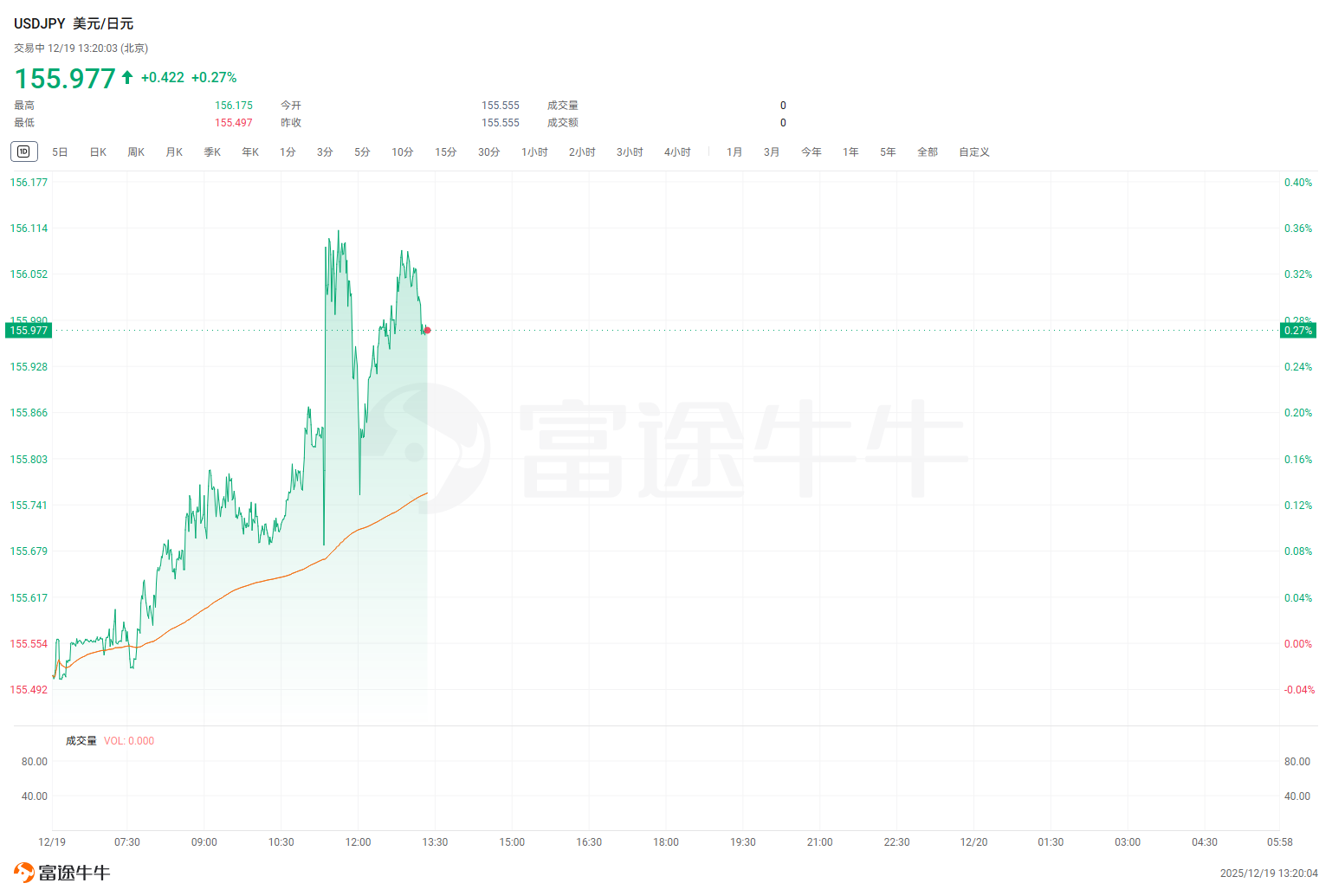
The Bank of Japan communicated extensively with the market regarding this interest rate increase, and the market has largely completed full pricing for the rate hike at this meeting. Bank of Japan Governor Kazuo Ueda previously strongly hinted that the Bank of Japan would likely implement another rate hike during the December monetary policy meeting, raising the policy interest rate from 0.50% to 0.75%.
CICC believes that the terminal interest rate for the Bank of Japan may hover around 1%-1.5%. In 2026, the Bank of Japan is expected to raise interest rates one to two times, with the policy rate likely settling between 1% and 1.25% by the end of 2026. Lastly, amid inflationary conditions, Japan’s fiscal situation has improved rapidly on the margin. Currently, Japan’s long-term interest rates (around 2%) are significantly lower than its nominal GDP growth rate (around 5%), alleviating concerns about Japan’s fiscal condition.
Additionally, Japanese Finance Minister Satsuki Katayama stated that consideration will be given to fiscal sustainability to some extent when drafting the budget for the next fiscal year. Confidence in the market will be bolstered by reducing the debt-to-GDP ratio. The Ministry of Finance previously estimated that raising the income tax exemption threshold would reduce tax revenue by JPY 400 billion, but current projections estimate a reduction of JPY 650 billion. Meanwhile, according to Bloomberg, the final draft of Japan’s tax reform plan shows that the Liberal Democratic Party and its coalition partner, Ishin no Kai, will agree to raise the income tax rate by one percentage point for all income brackets starting January 2027. The additional revenue will be used to meet Japan's defense needs.
Before the Bank of Japan’s interest rate hike, Mizuho Securities noted that the market had already priced in expectations of a rate hike at today’s policy meeting. However, if Governor Kazuo Ueda does not signal the timing of the next rate hike, the yen could face downward pressure. In a dovish rate hike scenario, this outcome appears more likely, and the USD/JPY exchange rate may test the 157 level, potentially rising to the recent high of 157.89 touched on November 20. On the other hand, if Ueda’s remarks bring forward market expectations for the next rate hike, the focus will shift to whether USD/JPY can break below the 154.35 level reached on December 5.
No change to liquidity trend
Japan's interest rate hike in July last year triggered a significant liquidity shock. Cao Liulong from Western Securities attributed this primarily to two reasons: the unwinding of a large volume of active 'carry trade and currency arbitrage' positions, which caused a liquidity shock; and the trading on expectations of a U.S. economic recession, which amplified the liquidity shock. However, the most active 'carry trade and currency arbitrage' positions have largely been unwound, weakening the preconditions for a liquidity shock triggered by a yen interest rate hike.
Nevertheless, global stock markets, represented by the U.S. equity market, have experienced a 'big bull market driven by excessive liquidity' for six years, inherently making them fragile. Coupled with renewed concerns over an 'AI bubble' in the U.S., risk aversion among investors is high. A yen interest rate hike could act as a 'catalyst' triggering a global liquidity shock. Such a liquidity shock would likely force the Federal Reserve to adopt quantitative easing (QE), so global stock markets might recover rapidly.
It is unlikely that Japan’s interest rate hike alone would directly cause a global liquidity shock. However, concerns about an 'AI bubble' in the U.S. stock market may amplify the impact of Japan's rate hike. Therefore, it is difficult for investors to predict whether a global liquidity shock will occur. They can only closely monitor conditions—similar to early April this year, if the U.S. experiences two to three consecutive episodes of simultaneous declines in stocks, bonds, and currencies ('triple sell-off'), it would indicate a significantly heightened probability of a liquidity shock.
Cao Liulong believes that even if Japan’s interest rate hike causes a liquidity shock, it will not alter the long-term trend of global monetary easing. Next year, excessive liquidity is highly likely to become even more abundant. The expansion of China’s trade surplus, combined with the Fed restarting its rate cuts, will drive the renminbi exchange rate back to a medium- to long-term appreciation trend, accelerating cross-border capital inflows. This will systematically lift China’s factor prices (PPI and CPI) out of deflation. The manufacturing and consumer sectors, which are pro-cyclical, will experience a 'Davies double whammy' of earnings growth and valuation expansion. Strategic asset allocation continues to favor A-share and H-share equities, treasury bonds present opportunities for recovery, gold remains a strategic holding, while U.S. stocks and bonds may remain volatile. If U.S. equities adjust downward to create room, and the Fed signals easing (or economic data supports continued rate cuts), there may be opportunities to bet on a rebound in U.S. equities.
Looking to pick stocks or analyze them? Want to know the opportunities and risks in your portfolio? For all investment-related questions,just ask Futubull AI!

Editor/Lambor