
The Bank of Japan remained vague about the future interest rate hike path, and the rate increase unexpectedly prompted a decline in the yen. Analysts widely believe that Kazuo Ueda's press conference later has become the last hope!
Analysts said that the yen weakened against the dollar after today's interest rate hike, as the Bank of Japan failed to provide clear guidance on the timing of future monetary policy tightening. Although the central bank raised its benchmark interest rate to the highest level since 1995 as expected, investors are now looking ahead to a press conference by Governor Kazuo Ueda later on Friday for any further insights into the outlook.
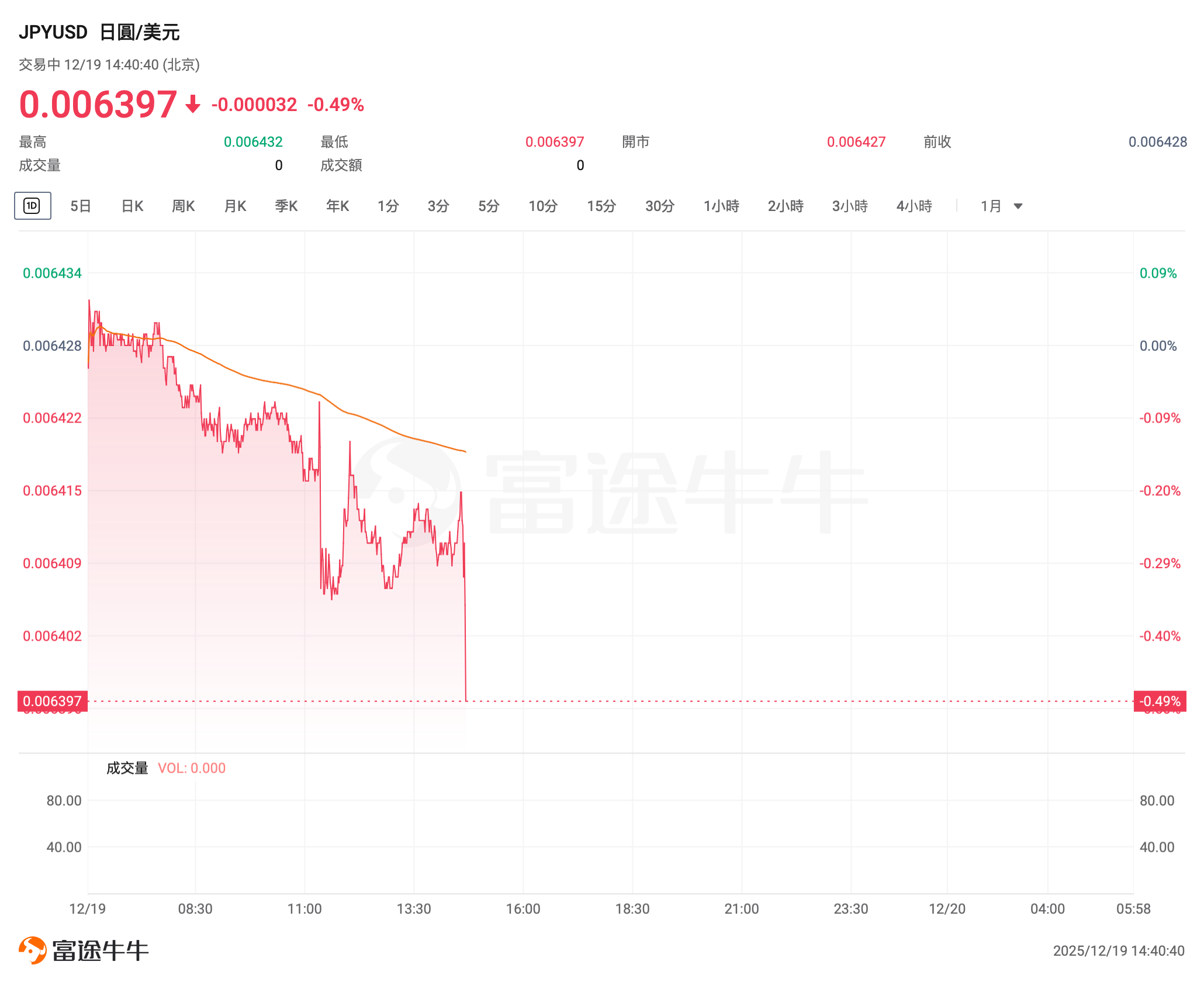
Below are views from strategists:
Kieran Williams, Head of Asia FX at InTouch Capital Markets
 "The market has partially turned its attention to Governor Kazuo Ueda’s press conference later and seems to be signaling some skepticism about whether he can deliver a sufficiently hawkish message. The focus is on the future interest rate path and terminal rate. If Ueda fails to convince the market that his stance is tilting hawkish, we will see further yen weakness."
Felix Ryan, Strategist at ANZ Group
"We are seeing a stronger USD/JPY, which may indicate that the market hasn’t yet seen clear signals regarding the pace or scope of the Bank of Japan’s rate hikes, something that could be clarified in Ueda’s press conference later today. While we do expect the Bank of Japan to continue raising rates (with a 25-basis-point hike in April 2026), we believe the yen will still lag among G10 currencies over the next year due to unfavorable interest rate differentials. We project USD/JPY to reach 153 by the end of 2026."
Hiroshi Namioka, Chief Strategist at T&D Asset Management
"The weaker yen and rebound in equities likely reflect an overly cautious reaction in the market prior to the announcement. If the yen continues to weaken from here, I think Ueda will adopt a more hawkish tone during the press conference. The fact that the Bank of Japan has indicated actual rates will remain significantly low even after the policy change suggests a terminal rate higher than 0.75%, with continued rate hikes."
Rong Ren Goh, Fixed Income Portfolio Manager at Eastspring Investments
"USD/JPY is rising because there are no signs of more imminent rate hikes, and dissenting views on the price outlook were expressed by Takada So and Tamura Naoki despite the unanimous decision to raise rates. Investors are focused on Governor Kazuo Ueda’s press conference later today, but I don’t think we will get much more clarity on the path of policy rate increases."
Given that the Bank of Japan (BOJ) is currently attempting to rein in the economy with monetary tightening only after it overheats, market concerns have arisen that more, rather than fewer, rate hikes may be required going forward, skewing risks toward higher interest rates. Therefore, if the BOJ does not clarify its path or make a commitment, the market may continue to price in the risk of the central bank falling behind the curve.
Masahiro Yamaguchi, Head of Investment Research at Sumitomo Mitsui Trust Bank
The yen's depreciation is based on the view that real interest rates will remain negative for some time, while the stock market has expanded gains due to the weaker yen. Governor Ueda’s press conference will likely need to adopt a fairly hawkish tone to prevent the yen from gaining further depreciation momentum. On the other hand, if the yen weakens further, the pace of rate hikes could become uncertain again.
Eugenia Fabon Victorino, Head of Asia Strategy at SEB Singapore Branch
Although the statement leaves room for further rate hikes, it does not indicate any change in the pace of tightening. Therefore, we expect the earliest timing for the next rate hike to be around June or July of next year. The market has grown accustomed to the BOJ’s gradual approach. This decision has largely been priced in. Given the BOJ’s refusal to provide any hints regarding the timing of the next rate hike, the path of least resistance is to go long USD/JPY. The only hope for USD/JPY to retreat from current levels to 152 must come from a pullback in the dollar, which we anticipate occurring in the first quarter. It is unlikely that Governor Ueda will adopt a more hawkish stance than the statement itself. With no change in the pace of rate hikes, traders may push USD/JPY up to 157.
Ryutaro Kimura, Senior Fixed Income Strategist at AXA Investment Managers
We cannot rule out the possibility that Governor Ueda may adopt a cautious stance toward future rate hikes, aligning with Prime Minister Sanae Takagi’s intention to allow only limited rate increases to curb yen depreciation. Should this occur, the likelihood of renewed yen depreciation pressure in the foreign exchange market would be very high. However, this would also increase frustration within Prime Minister Takagi’s administration, which is highly averse to yen weakness, and might prompt the BOJ to accept further rate hikes. Therefore, even if Governor Ueda’s press conference leans dovish, any decline in interest rates following the BOJ meeting could be temporary, contingent upon the foreign exchange market’s reaction.
Editor/Doris