Source: CITIC Securities Research
Authors: Qiu Xiang, Gao Yusen, Chen Zeping, Liu Chuntong, Zhang Mingkai, Chen Feng
The factors driving the appreciation of the RMB are gradually increasing, and market attention is also beginning to heat up. Investors need to gradually adapt to asset allocation in an environment of sustained RMB appreciation. Looking at the seven rounds of RMB appreciation cycles over the past 20 years, the exchange rate is not a decisive factor in determining industry allocation. However, some industries do perform better in the initial stages of forming expectations for sustained appreciation, and the market may replicate such 'muscle memory.' Additionally, cost-income analysis shows that approximately 19% of industries will see improved profit margins due to appreciation, and these sectors will gradually gain more attention from investors. Moreover, policy responses aimed at curbing excessively rapid one-sided appreciation trends have become even more significant factors influencing industry allocation. Under the backdrop of continuous RMB appreciation, industry allocation can focus on three drivers: short-term muscle memory, changes in profit margins, and policy shifts. In this issue, we provide a detailed review of potentially benefiting industries.
The factors driving the sustained appreciation of the RMB are gradually increasing,
Market attention is also beginning to rise.
We believe investors need to gradually begin adapting to asset allocation in an environment of sustained RMB appreciation. In the first 11 months of this year, China's cumulative trade surplus reached USD 1.076 trillion, a year-on-year increase of 21.7%, setting a new historical record. More importantly, the willingness of export enterprises to convert their foreign exchange earnings into RMB has been steadily rising. By October this year, the proportion of the trade surplus converted into actual receipts had exceeded 100%, marking the biggest difference compared to previous years.
 Since 2022, we estimate that exporters have accumulated about USD 1 trillion in pending foreign exchange conversion. Once expectations for RMB appreciation take hold, the repatriation of overseas funds will create positive feedback loops that continuously strengthen the trend. In addition to long-term allocation needs, global speculative capital’s demand for tangible assets has also been increasing this year. For instance, every time the cryptocurrency Fear & Greed Index dropped significantly (indicating panic) this year, it corresponded to a rapid increase in holdings of SPDR Gold ETFs—a phenomenon that cannot be fully explained by central bank gold purchases or private gold buying.
Moreover, real cash-flow-generating assets, such as container ships, have begun to attract interest from funds deposited within the cryptocurrency sector. This year, the tokenization trend for tangible assets has notably outpaced the previous focus on virtual asset tokenization. As the currency of the world's largest manufacturing country (tangible assets) and the largest commodities consumer (tangible consumption), the intrinsic value of the RMB will continue to be reevaluated in the future.
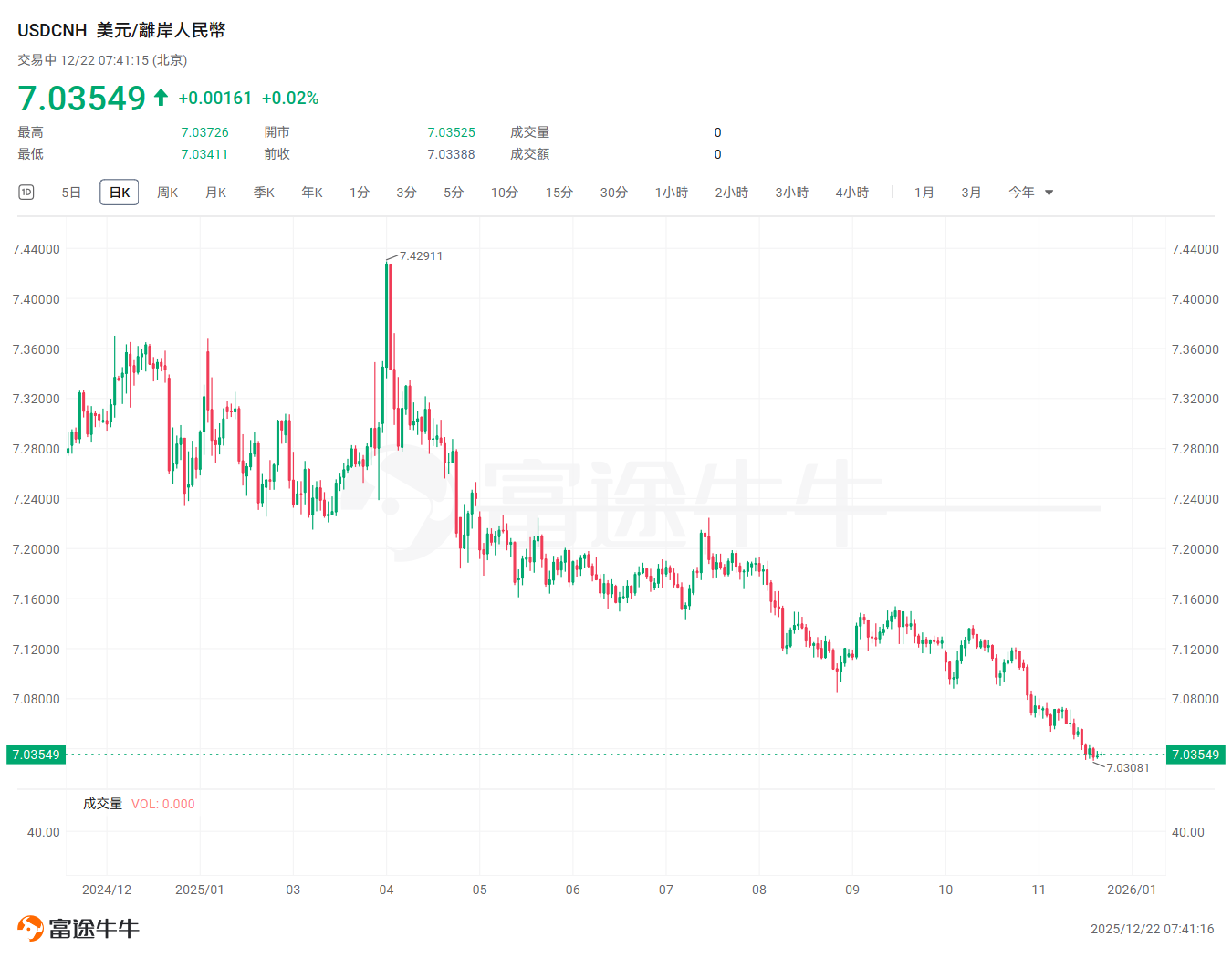
In the short term, U.S. inflation data for November was significantly lower than expected, further fueling market expectations for potential Federal Reserve interest rate cuts next year. This will also reinforce market attention on the trend of RMB appreciation. Currently, the offshore spot exchange rate for USD/CNY is approaching the 7.0 level, while the 1-year, 2-year, and 5-year forward exchange rates have risen to 6.90, 6.79, and 6.44, respectively. Since December, the 1-year forward rate has appreciated cumulatively by 313 points, with the premium widening continuously.
Looking at the seven rounds of RMB appreciation cycles over the past 20 years,
the exchange rate is not the dominant factor in industry allocation.
The decisive factor
Over the past 20 years, there have been seven rounds of RMB appreciation. The first round was from July 2005 to July 2008, driven by macro factors such as exports and urbanization. The core narrative was 'revaluation of RMB assets,' with the best-performing sectors being non-banking finance, non-ferrous metals, coal, chemicals, and electric power.
The second round, from June 2010 to August 2015, occurred during China's transition from a traditional economy to an emerging one. The RMB's appreciation, coupled with abundant liquidity, benefited industries such as computing, media, telecommunications, and consumer services.
The third round, from January 2017 to February 2018, was characterized by a robust recovery in the macroeconomic cycle and accelerated inflows of foreign capital into the A-share market. Sectors with high ROE (Return on Equity) and stable structures—such as food and beverage, home appliances—as well as pro-cyclical sectors like steel, coal, banking, and real estate performed well.
Among the four subsequent rounds of appreciation cycles, the period from May 2020 to May 2021 exhibited relatively strong continuity. During this time, China was the first to recover globally, showcasing its powerful supply chain advantages. Core assets such as electric power, food and beverage, and consumer services reached extreme levels of investor concentration. Other brief periods of appreciation were primarily driven by short-term economic expectation adjustments.
Based on historical experience, RMB appreciation is merely a pricing outcome within specific phases and does not play a dominant role in industry allocation.
Some industries tend to perform better at the onset of a sustained appreciation expectation,
as the market may replicate muscle memory.
At the beginning of RMB appreciation cycles, the market sometimes engages in trading based on common-sense transmission logic. For example, companies heavily reliant on imported raw materials benefit from a stronger domestic currency, which lowers procurement costs and increases profit margins. This kind of logic is highly transmissible, easy to understand, and widely accepted. If an industry shows no significant flaws in terms of business conditions, the market may use the macroeconomic rationale of benefiting from appreciation to form short-term consensus trades.
Typical examples include the aviation sector (where dollar-denominated costs for aviation fuel, parts, maintenance fees decrease, alleviating exchange rate pressure on dollar liabilities), paper manufacturing (where reduced import costs for raw materials like pulp enhance processing and trade margins), and gas utilities (which rely on imported raw materials). However, over longer timeframes, profitability in these industries ultimately depends on supply and demand dynamics. RMB appreciation serves only as a narrative logic, exerting limited influence on earnings.
From the perspective of cost-revenue analysis, approximately 19% of
industries will experience an increase in profit margins due to currency appreciation.
Based on the 2023 national economic input-output table data, we conducted a cost-revenue analysis under the backdrop of RMB appreciation for 211 sub-sectors. Industries benefiting from RMB appreciation can be roughly categorized into four groups:
1) Upstream resources and raw materials, including: steel, non-ferrous metals, petrochemicals (refining), basic chemicals (fertilizers, coatings, chemical fibers, plastics, etc.), building materials (refractory materials), electronics (semiconductor materials);
2) Domestic demand consumer goods, mainly including: agriculture, forestry, animal husbandry, and fishery (feed, vegetable oil, sugar), light manufacturing (papermaking, paper products), consumer electronics, etc.;
3) Service-related sectors, including: electricity and public utilities (gas), transportation (shipping), commerce and retail (import-based cross-border e-commerce), social services (quality inspection services, industrial design services, motor vehicle and electronic product repair);
4) Manufacturing equipment, mainly including machinery (metal products & metal processing equipment), electronics (semiconductor equipment).
Policy responses made to curb overly rapid unilateral appreciation trends have, in fact,
become a more significant factor influencing sector allocation.
The more important factors
Maintaining currency stability and preventing the emergence of unilateral appreciation expectations may be one of the issues the central bank will face next year. An overly rapid appreciation of the RMB could trigger speculative behaviors, which would also undermine the competitive advantage of the manufacturing sector.
To ease the pressure of RMB appreciation, we believe there are broadly two policy approaches: First, adopting a loose monetary policy to suppress real interest rates. From this perspective, next year is likely to see monetary policy that is more accommodative than expected, which is significant for stimulating domestic demand sectors and driving the market to new heights.
Second, partially relaxing restrictions on overseas financial investments by local financial institutions and even residents. This is crucial for diversifying asset allocation exposure and enhancing expected returns. It can genuinely propel the overseas expansion of China’s wealth management industry, while sectors like securities and insurance will unlock new growth opportunities, better articulating the narratives of globalization and growth.
Against the backdrop of the RMB's sustained appreciation, attention can be directed towards
short-term muscle memory-driven factors, profit margin changes, and
policy change-driven factors.
If the RMB begins to appreciate continuously, we believe that in terms of allocation, attention can be focused on three key drivers: short-term muscle memory, profit margin changes, and policy shifts. The first driver involves assets influenced by short-term muscle memory. A review of the seven rounds of RMB appreciation since 2000 shows that in the early stages of sustained RMB appreciation, industries such as aviation, gas, and papermaking tend to benefit significantly in terms of costs or foreign debt, thus often exhibiting notable stock price elasticity, which has become an ingrained market response.
The second driver involves assets driven by changes in profit margins. Industries with high dependence on imported raw materials and inputs but low reliance on export of finished products may experience noticeable margin improvements due to cost savings during periods of sustained RMB appreciation. Key sectors include: 1) Upstream resources and raw materials, including steel, non-ferrous metals, oil refining, basic chemicals (potash fertilizers, coatings, chemical fibers, plastics), and construction materials (refractory materials); 2) Domestic consumer goods such as agricultural products (feed, vegetable oil, sugar, etc.); 3) Service-related sectors like shipping and import-oriented cross-border e-commerce; and 4) Manufacturing equipment, primarily construction machinery.
The third driver involves assets influenced by policy changes. Beneficiaries of policy shifts mainly refer to those gaining from potential monetary easing or relaxation of capital account restrictions on outbound investments. The former includes duty-free businesses and real estate developers (which are inherently prone to benefit in an appreciation cycle), while the latter encompasses the globalization potential of financial sectors such as securities firms and insurance companies.
Risk factors
Intensified friction between China and the US in technology, trade, and finance; domestic policy measures, implementation effectiveness, or economic recovery falling short of expectations; unexpected tightening of macro liquidity at home and abroad; further escalation of conflicts in Russia-Ukraine or the Middle East; slower-than-expected inventory reduction in China's real estate sector.
Editor/Rocky