
①The Bank of Japan's interest rate hike last week triggered a new wave of yen selling, driving the yen to its lowest level against major global currencies this year or even in history; ②Japanese government bonds also faced a fresh round of selling on Monday; ③With the approach of the 'double holiday' season (Christmas and New Year), reduced liquidity further increased the likelihood of a sharp depreciation of the yen.
Following the unexpected plunge in the yen's exchange rate after the Bank of Japan raised interest rates last Friday, Japan’s top foreign exchange official expressed public concern on Monday. Traders are also currently assessing the likelihood of the Japanese government being compelled to intervene in the currency market.
As of press time, the euro-yen exchange rate hit another record high on Monday, which is equivalent to the yen falling to a new historical low against the euro. The offshore yuan-yen exchange rate remained volatile after reaching a record high last Friday, while the yen-dollar exchange rate stayed near its lowest point of the year. As of press time, the pair was trading at 157.5.
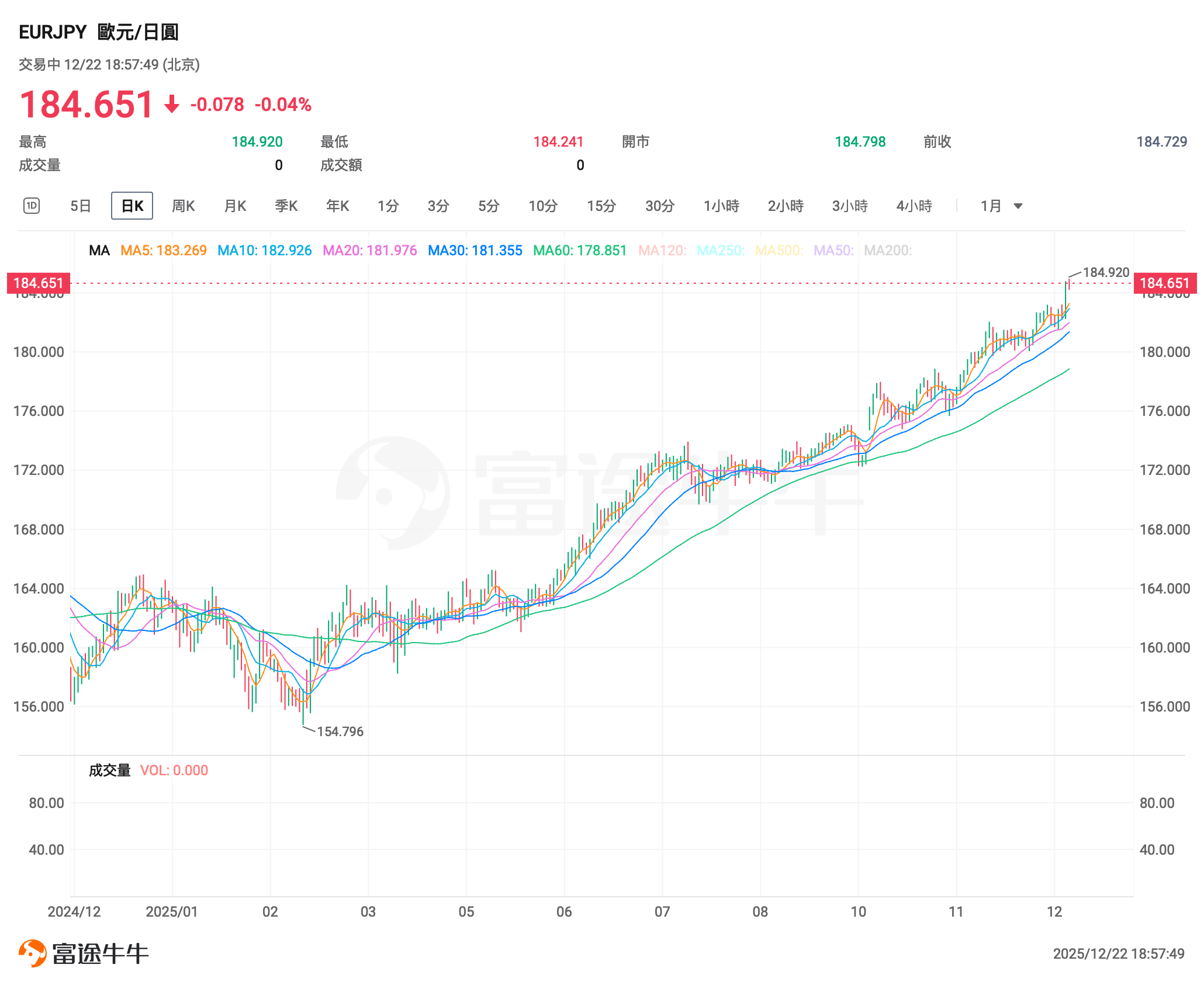
 (EUR/JPY Daily Chart, Source: TradingView)
The sell-off in Japanese government bonds continued. On Monday, the yield on Japan's benchmark 10-year government bond surged by 7.5 basis points (Note: Rising bond yields indicate falling bond prices), reaching levels unseen since February 1999. The yield on two-year government bonds, which are more sensitive to monetary policy, also climbed to its highest level since 1997.
Japan's monetary and economic policies have become entangled in a complex quagmire: Traders were disappointed by the Bank of Japan's failure to provide a clear path for future interest rate hikes; meanwhile, the yen's depreciation has raised concerns about rising inflation in Japan, exacerbating the sell-off in sovereign bonds. At this critical juncture, the Japanese government is also planning to issue additional government bonds to fill budget gaps, further fueling market anxiety.
As the yen continues to depreciate, the likelihood of the Japanese government being forced to intervene in the currency market is rapidly increasing.
Atsushi Mimura, Japan's top foreign exchange affairs official and Deputy Minister of Finance for International Affairs, publicly stated on Monday that the cumulative depreciation of the yen against the dollar exceeded 1% since last Friday, describing it as a 'unilateral and abrupt' fluctuation, which he expressed deep concern about.
Mimura added that the Japanese government hopes to take 'appropriate measures to address excessive volatility.' This statement was interpreted by traders as an early warning signal to prepare the market for potential intervention.
Yujiro Goto, Chief Foreign Exchange Strategist at Nomura Securities, noted that attention should be paid to the wording used by Mimura going forward. If he begins referring to the currency movement as 'disorderly,' the market may interpret it as a signal that foreign exchange intervention is imminent.
The last time Tokyo authorities were forced to intervene in the foreign exchange market was in July 2024, when the US dollar against the Japanese yen reached 161.96, the highest level since the 1980s. Due to the upcoming 'double holiday' period of Christmas and New Year this week and next, which typically sees thin trading activity in global markets, the probability of unilateral abnormal movements in the foreign exchange market will also significantly increase.
Editor/Doris