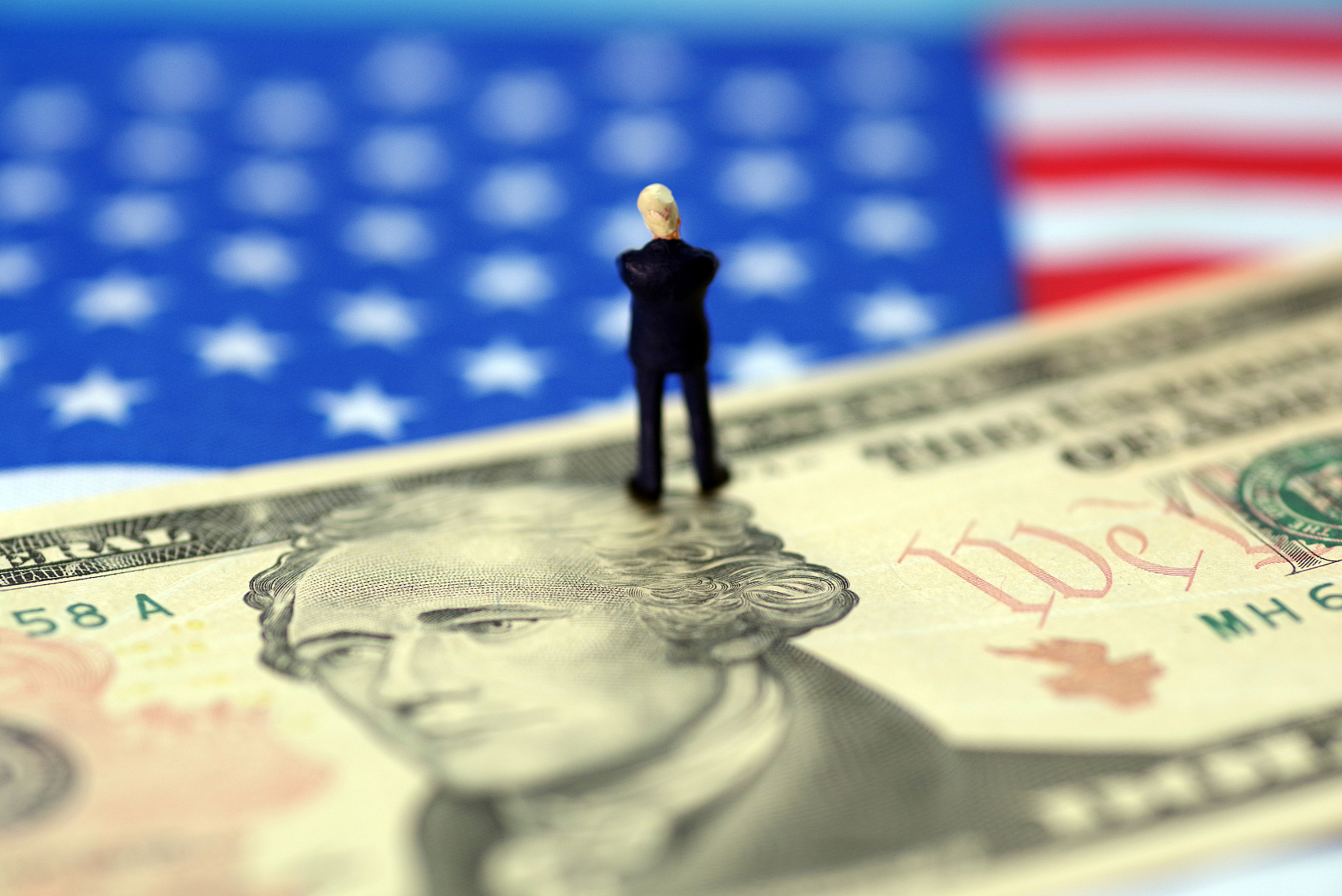
After a dismal year for the US dollar, while there are signs of stabilization or short-term rebound, market consensus expects the dollar to resume its decline by 2026 due to converging global economic growth, expectations of interest rate cuts by the Federal Reserve, and persistently high valuations.
After a dismal year, the US dollar is showing signs of stabilization. However, many investors believe that the currency's decline will resume next year amid a rebound in global economic growth and further monetary easing by the Federal Reserve.
This year, the US dollar has plummeted 9% against a basket of currencies and is on track for its worst performance in eight years. This trend has been primarily driven by expectations of Federal Reserve rate cuts, narrowing interest rate differentials between the US and other major currencies, and concerns over US fiscal deficits and political uncertainty.
 Investors widely anticipate that with other major central banks maintaining their current stance or tightening policies, coupled with the potential for a more dovish approach under the new Federal Reserve Chair,$USD (USDindex.FX)$the dollar will weaken further. Typically, when the Federal Reserve lowers interest rates, the dollar tends to fall as lower US rates reduce the attractiveness of dollar-denominated assets, thereby decreasing demand for the currency.
Karl Schamotta, Chief Market Strategist at Corpay, stated, 'Fundamentally, it remains an objective fact that the US dollar is still overvalued.' For investors, accurately gauging the trajectory of the dollar is crucial. While a weaker dollar can boost multinational companies’ profits through the conversion of overseas earnings, it also enhances the appeal of international markets via exchange rate gains.
A survey conducted by Reuters between November 28 and December 3 showed that despite the US Dollar Index rebounding nearly 2% from its September low, foreign exchange strategists maintained their forecast for a weaker dollar in 2026. Data from the Bank for International Settlements indicates that the real broad effective exchange rate of the dollar (its inflation-adjusted value against a basket of foreign currencies) stood at 108.7 in October, only slightly below the historical peak of 115.1 reached in January. This suggests that the dollar remains overvalued.
Shift in Global Economic Growth Momentum
The expectation of a weakening dollar stems from the convergence of global growth rates. As other major economies gain momentum, the growth premium enjoyed by the US is expected to narrow. Anujeet Sareen, Portfolio Manager at Brandywine Global, noted that next year will see stronger growth in other parts of the world.
Investors pointed out that fiscal stimulus in Germany, policy support in China, and improved growth trajectories in the Eurozone are expected to erode the 'US growth premium' that has supported the dollar in recent years. Paresh Upadhyaya, Strategy Director at Amundi, Europe’s largest asset management firm, remarked, 'As growth prospects in other parts of the world begin to improve, the dollar will continue to weaken.'
Even some investors who believe the most severe phase of the dollar's decline has ended noted that any significant setbacks to US economic growth could weigh on the currency’s performance. Jack Herr, Investment Analyst at GuideStone Funds, while not anticipating a sharp depreciation of the dollar in 2026, highlighted that any weakness next year could impact the dollar.
Divergence in central bank policies
Expectations that the Federal Reserve will continue to cut interest rates while other central banks remain on hold or raise rates may also weigh on the dollar. The Fed reduced rates in December with a significant divergence among policymakers, and their median forecast indicates an additional 0.25 percentage point cut next year.
As Powell prepares to step down and Trump appoints the next Federal Reserve Chair, markets may price in expectations of a more accommodative Fed policy next year, given Trump’s consistent push for lower rates. Several leading candidates for the role, including Kevin Hassett, Kevin Warsh, and current Governor Christopher Waller, have advocated for interest rates below current levels.
Eric Merlis, co-head of global markets at Citizens, noted that although markets anticipate limited action by the Fed next year, they believe the U.S. is heading toward a slowdown in economic trends and weaker employment growth. Currently, they are positioning themselves by shorting the dollar against other G10 currencies. In contrast, traders expect the European Central Bank to maintain stable rates through 2026, with the possibility of a rate hike not ruled out.
Not a simple linear decline
Despite a bearish long-term outlook for the dollar, investors caution that a short-term rebound cannot be ruled out. Ongoing enthusiasm for artificial intelligence and the resulting capital inflows into U.S. equities may provide temporary support for the dollar.
Saling mentioned that the growth boost from the reopening of the U.S. government earlier this year, along with tax cuts passed this year, could lift the dollar in the first quarter. However, he believes this is unlikely to serve as a sustained driver for the dollar's performance throughout the year.
Editor/melody