
①The annual increase in international gold prices exceeded 70% in 2025, and Wall Street institutions are generally optimistic about next year; ②Many factors drove the rise in gold prices this year, from safe-haven demand triggered by uncertainties surrounding the U.S. government at the beginning of the year, to investment purchases by Chinese and North American investors, and then to the Federal Reserve's interest rate cuts in the second half of the year. These reasons collectively reinforced the upward trend in gold prices and will continue to exert influence next year.
Cailian News, December 22 (Editor: Ma Lan) For precious metal investors, 2025 has been a legendary year, with the annual increase in international gold prices exceeding 70%, surprising most people and prompting Wall Street banks to continuously revise their reports.
At the end of last year, global institutions and investors generally predicted that gold prices would rise with volatility this year, with target ranges between $2,200 and $2,400 per ounce. However, this price level was achieved as early as the first quarter of this year. On March 18, gold closed above $3,000 per ounce for the first time, seemingly heralding an extraordinary year.
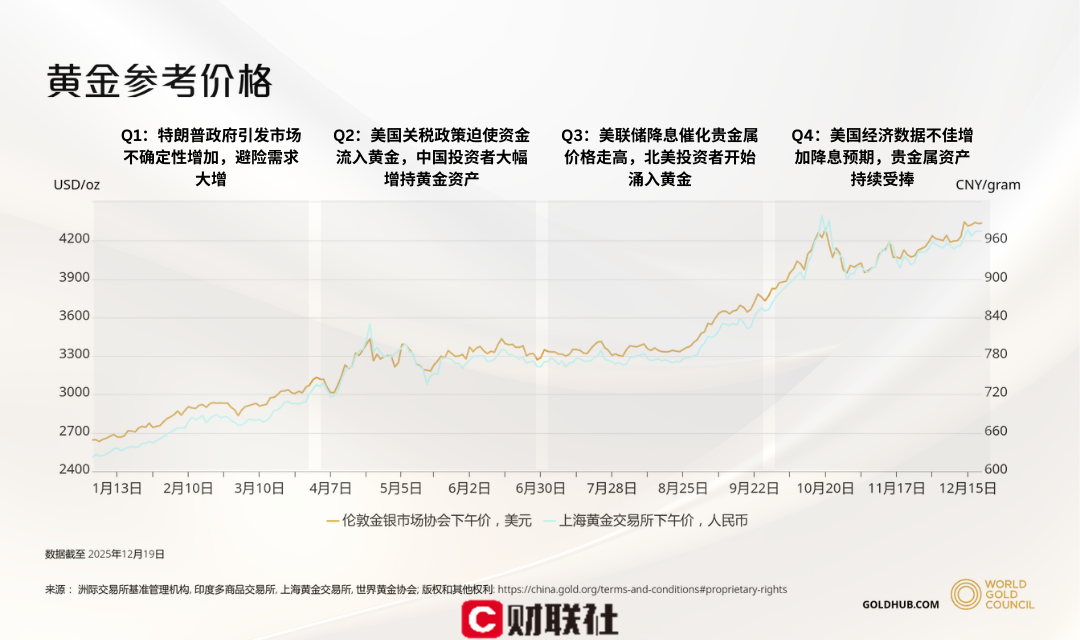
 The main driving force behind the rise in gold prices in the first quarter came from global investors’ cautious attitude towards the new U.S. administration. Due to President Trump’s constant threats to impose tariff policies, which were later delayed due to various statements, coupled with ongoing geopolitical conflicts in the Middle East and between Russia and Ukraine, market uncertainty intensified, amplifying gold’s safe-haven appeal.
Subsequently, gold prices briefly fell in early April when Trump announced reciprocal tariffs but quickly surged on April 21, breaking through the $3,500 per ounce threshold. Safe-haven demand was the primary force behind this record-breaking rally in gold prices.
An increasing number of institutions and large investors began warning about the unsustainability of global debt. In June, Chris Temple, founder of The National Investor magazine, pointed out that the bond market had started to sound alarms over the corrupt and dire state of U.S. debt, making gold a safe-haven asset even more favored than sovereign debt.
As the market began to flood into gold, its investment attributes also started gaining attention. Data from the World Gold Council showed that inflows into gold ETFs in the first half of 2025 hit the highest levels since the first half of 2020.
John Reade, Senior Market Strategist at the World Gold Council, emphasized in April that if the rise in gold prices in the first quarter of this year was mainly driven by U.S. tariff issues and Western ETF buying, the theme of the second-quarter rally became a surge in interest from Chinese investors.
In April, the total scale of 14 gold ETFs in the Chinese market broke through $120 billion, growing by over 70% compared to the beginning of the year.
Following a steady rise in the first half of the year, gold prices entered a nearly three-month consolidation phase, fluctuating between $3,200 and $3,500 per ounce, building momentum for the subsequent volatile movements.
The key factor behind the latest surge in gold prices lies in the Federal Reserve's interest rate cut on September 17. Some analysts believe that the rate cut suggests the U.S. economy may be on the brink of stagflation. In other words, investors need to incorporate more tangible assets into their strategic portfolios.
According to a report by the World Gold Council, gold ETF inflows reached a record $26 billion in the third quarter, with the North American market accounting for $16.1 billion. This indicates that, following 'Chinese aunties,' North American investors have also embraced precious metals. Meanwhile, silver prices have also risen significantly, even outpacing gold with more volatile movements.
The second half of the year remains filled with unknown variables. Although geopolitical tensions in the Middle East and between Russia and Ukraine have started to ease, disruptions from the U.S. continue to emerge — from the October government shutdown announcement, to U.S.-China trade negotiations, to disputes over the Federal Reserve chair selection. These events ultimately helped gold steadily climb higher.
On Tuesday this week, London gold once again set a new historical record, surging to $4,497.41 per ounce at one point. The market continues to be influenced by expectations of further Federal Reserve interest rate cuts and currency depreciation trades driven by the weakening of the dollar and U.S. creditworthiness, allowing gold to shine again towards the end of the year.
Drivers of Gold Price Increases
In summarizing this year’s gold market, investors can easily observe that geopolitical factors which previously dominated gold trading are fading from the spotlight, replaced by uncertainties in U.S. government policies and the Federal Reserve’s accommodative monetary stance.
Most institutions’ initial predictions for gold price ranges were quickly surpassed by actual movements, leaving many investors in a state of confusion akin to 'a floating cloud obscuring their vision.' Despite watching gold prices rise continuously, they struggled to accurately grasp its correct rhythm.
However, the primary factors driving gold’s rise in the coming year have become quite clear: the focus is on the U.S. economy, specifically the pace of Federal Reserve interest rate cuts and market sentiment towards the dollar.
Goldman Sachs noted in its latest report that the Federal Reserve has entered an extended easing cycle, and declining real interest rates are bullish for gold. Additionally, the dollar may weaken cyclically, further enhancing gold’s appeal.
JPMorgan further added that global investors are increasingly concerned about the stability of the financial system. Unsustainable debt levels in the U.S., Europe, and some G7 member countries are eroding the status of fiat currencies, reinforcing gold’s role as the ultimate safe-haven asset.
The unsustainability of Western fiscal policies and the decline in the status of the US dollar are also among the key reasons for central banks continuously increasing their gold reserves, which in turn further drives up the price of gold.
Against this backdrop, the upward trajectory for gold next year is quite clear. However, potential risks include a soft landing of the US economy or a surge in risk appetite within capital markets comparable to the momentum seen in artificial intelligence over the past two years.
In addition, Fed policy may cause short-term volatility, as changes in the magnitude and pace of interest rate cuts, along with shifts in the Fed’s policy stance, could impact gold prices. However, these factors cannot alter the medium- to long-term trend of gold prices so long as the broader macro environment remains unchanged.
Based on a synthesis of reports from various Wall Street institutions, the mainstream view holds that the average gold price next year will range between $4,500 and $5,000 per ounce, implying an increase of 0.3% to 11.5% from current levels.
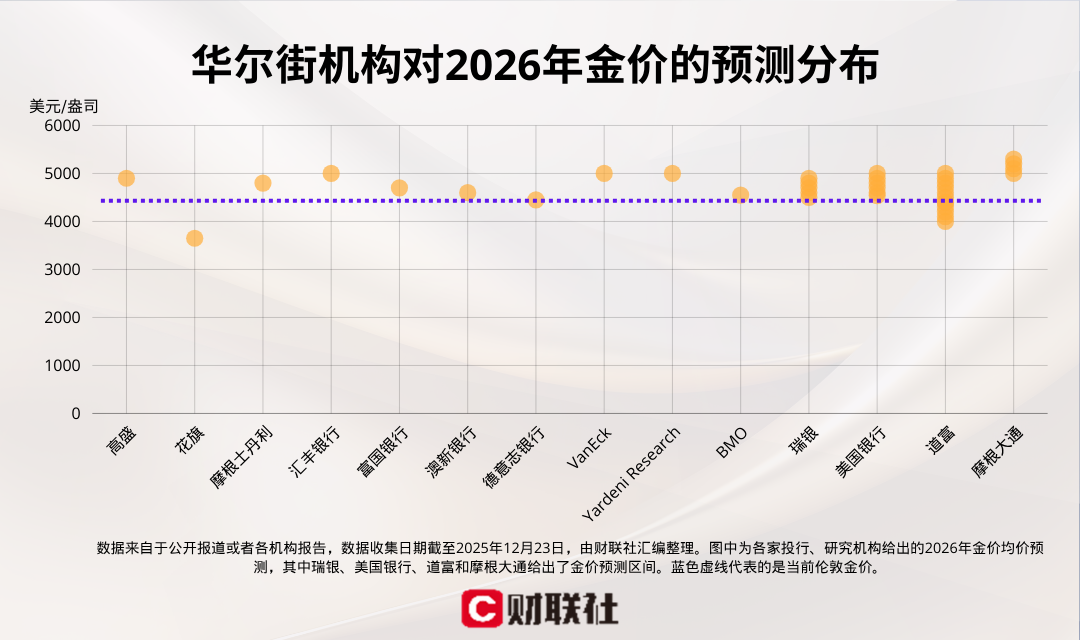
Although this is less impressive compared to this year's 70% rise, given that gold prices are already at historical highs and have doubled since the beginning of the year, Wall Street's forecasts could be considered relatively optimistic.
However, considering the frequency with which Wall Street has revised its reports this year, investors might not need to treat the projected range as an absolute target, as global markets will always present new "gray rhino" or "black swan" events.
Looking to pick stocks or analyze them? Want to know the opportunities and risks in your portfolio?For all your investment-related questions, just ask Futubull AI!

Editor/jayden