
Amid the backdrop of surging global energy demand and AI computing power, the race for nuclear fusion commercialization has intensified. Trump Media Group's $60 billion acquisition of TAE has triggered turbulence in the capital markets, while a Chinese startup has set a new world record in high-temperature superconducting magnet technology. Both the US and China are accelerating the transition of nuclear fusion from laboratory research to grid-scale applications through massive financing and breakthroughs in core technologies.
Driven by the dual forces of surging energy demand and the explosion of artificial intelligence computing power, controllable nuclear fusion technology—considered the 'Holy Grail' of clean energy—is rapidly transitioning from laboratories to capital markets. Recently, with the completion of a multi-billion-dollar merger and acquisition deal in the United States, as well as breakthroughs achieved by Chinese startups in key magnet technologies, the global race for nuclear fusion commercialization has entered a feverish stage.
The latest focus in this area comes from Trump's media group. According to media reports on the 23rd, $Trump Media & Technology (DJT.US)$ an agreement has been reached to merge with nuclear fusion startup TAE Technologies through a $6 billion deal. Following this news, DJT shares surged nearly 70% at one point. Under the terms of the deal, shareholders from both sides will each hold approximately half of the equity in the combined entity, and Trump’s media group, as the majority shareholder, will become the holding company for TAE Power Solutions and TAE Life Sciences.
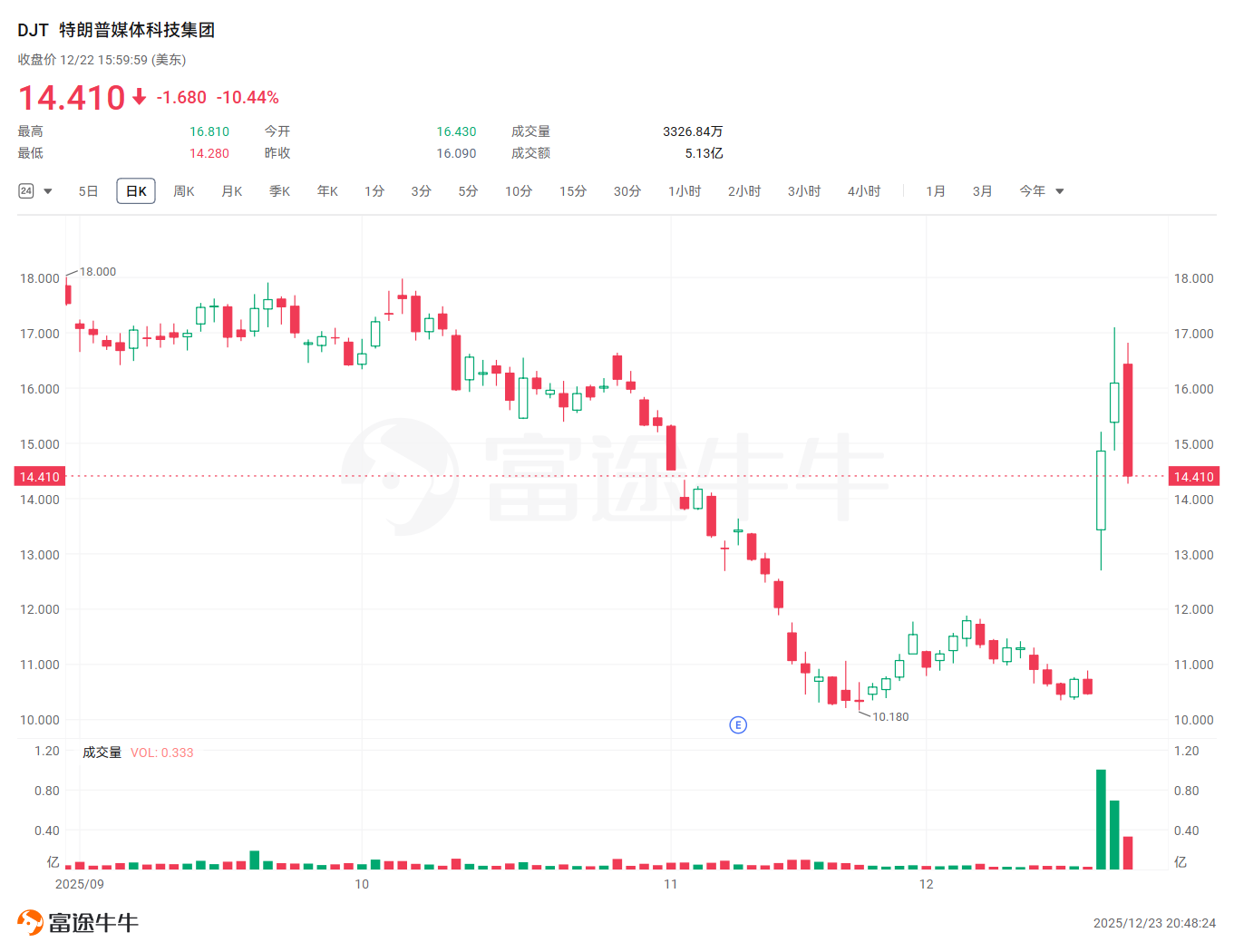
 This transaction not only triggered significant volatility in the secondary market but also marked a notable escalation in top-tier capital’s commitment to the nuclear fusion sector. Founded in 1998, TAE Technologies boasts an impressive lineup of investors including Google, Goldman Sachs, Chevron Technology Ventures, and Sumitomo Corporation of America. The company plans to adopt neutral particle beam and magnetic technology rather than standard laser approaches, with construction of its first commercial-scale fusion power plant slated to begin in 2026.
Meanwhile, China is demonstrating strong momentum in catching up in this cutting-edge field. According to Xinhua News Agency, Shanghai-based Energy Singularity, which focuses on high-temperature superconducting tokamak technology, made a breakthrough in March by achieving a magnetic field strength of 21.7T, surpassing the record previously held by MIT and CFS. The company aims to complete a next-generation tokamak by 2027, achieving the critical commercial fusion metric of a tenfold energy gain.
Numerous giants enter the fray as the U.S. experiences a surge in nuclear fusion investments.
Amidst the global nuclear renaissance and persistently rising energy demand, nuclear fusion technology, which had long been stagnant, is regaining favor among investors. Prior to Trump’s deal, tech giants had already begun positioning themselves. Helion Energy, backed by OpenAI founder Sam Altman, started construction of its first commercial nuclear fusion power plant last August in Chelan County, Washington, successfully passing rigorous environmental assessments.
More crucial validation of commercialization comes from the signing of power purchase agreements (PPAs). Two years ago, Microsoft signed an agreement with Helion Energy to purchase electricity generated from nuclear fusion starting in 2028. Constellation Energy was designated as the marketer for zero-carbon electricity from Helion’s Orion facility. Helion’s prototype “Trenta” has achieved the critical fuel temperature of 180 million degrees Fahrenheit and is attempting to bypass traditional steam turbine cycles by directly converting released energy into electricity using pulsed magnetic inertial fusion (MIF) technology.
Additionally, Commonwealth Fusion Systems (CFS), based in Massachusetts and collaborating with MIT, has raised approximately $3 billion. By developing high-temperature superconducting magnets, the company is committed to validating net energy production from its SPARC device and paving the way for the commercial power plant ARC.
Accelerating technological breakthroughs: Chinese enterprises set new records in core metrics.
Meanwhile, China is entering this competition at an extremely rapid pace. Currently, China holds the largest number of nuclear fusion patents globally, with project construction speeds repeatedly setting records. In the process of commercialization, Chinese private enterprises are making substantial progress on key technical routes.
According to reports from the Xinhua News Agency, in Shanghai, the Energy Singularity team, which focuses on high-temperature superconducting tokamak technology, is challenging the limits of magnetic field strength and achieved a breakthrough in March this year: its magnet reached 21.7T, surpassing the record held by the Massachusetts Institute of Technology (MIT) and CFS Corporation. The company plans to build a new generation tokamak by 2027, achieving a commercial fusion key indicator with an energy gain of 10 times.
In addition to Energy Singularity, China’s nuclear fusion startup ecosystem is becoming increasingly vibrant. Hainiu Fusion, based in Chengdu, has adopted a linear field-reversed configuration (FRC) technical approach similar to that of the U.S.-based Helion Energy, aiming to create modular “mini-suns.” Meanwhile, in Xi’an, Star Ring Fusion, founded by former members of Tsinghua University, completed the construction of a fusion experimental device in just 279 days. Investment institutions, including Sequoia China and Light Chariot Capital, have begun paying attention to this hard-tech track, and some companies have started exploring the “spin-off” commercial applications of neutron sources in fields such as medical isotope production.
Commercialization Challenges and the Patience of Long-Term Capital
Despite frequent technological breakthroughs, nuclear fusion still faces severe challenges in achieving true grid-scale commercial applications. It is generally acknowledged within the industry that the current operation time of devices is mostly at the level of hundreds of seconds, far below the requirements for long-term stable power generation. Additionally, the development of advanced materials capable of withstanding extreme high temperatures and strong neutron radiation remains in its early stages, and achieving net energy gain requires more efficient system coordination.
The disparity in funding scale is also a notable characteristic of the current competition between China and the United States. According to industry estimates, over the past five years, private funding in this field in China totaled approximately USD 500 million, compared to around USD 5 billion in the United States during the same period. Compared to the often multi-billion-dollar financing rounds of U.S. startups, leading Chinese enterprises such as Energy Singularity have demonstrated extremely high capital efficiency.
For investors, nuclear fusion remains a long-cycle investment theme. As Kang Jianshu, Executive Director of Light Chariot Capital, stated, this field is suitable for long-term investors dedicated to cultivating hardcore technologies, with investment horizons potentially lasting 8 to 10 years. However, with the integration of HTS materials, artificial intelligence, and advanced manufacturing technologies, the feasibility timeline for commercial nuclear fusion is being rapidly revised.
Editor/jayden