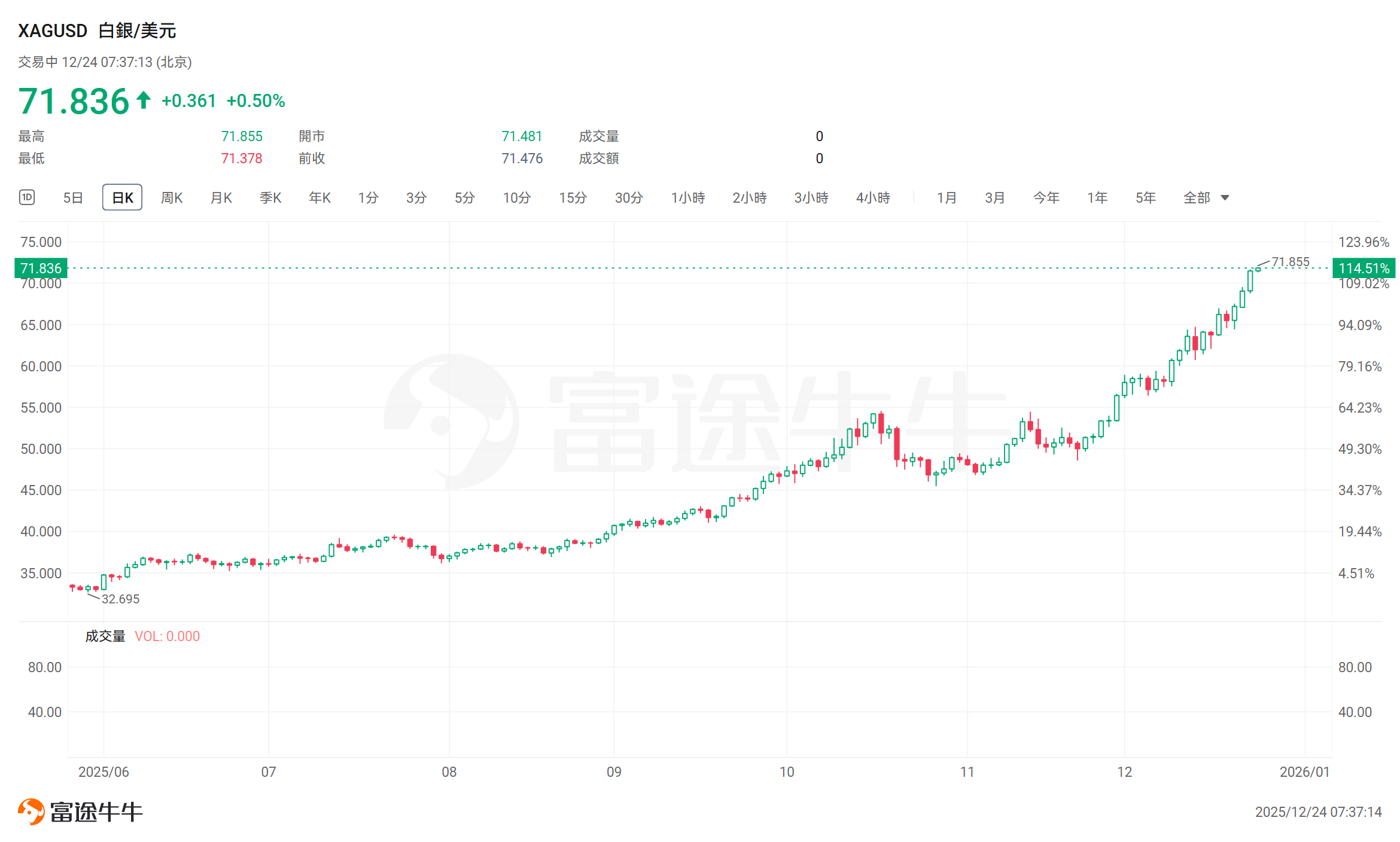
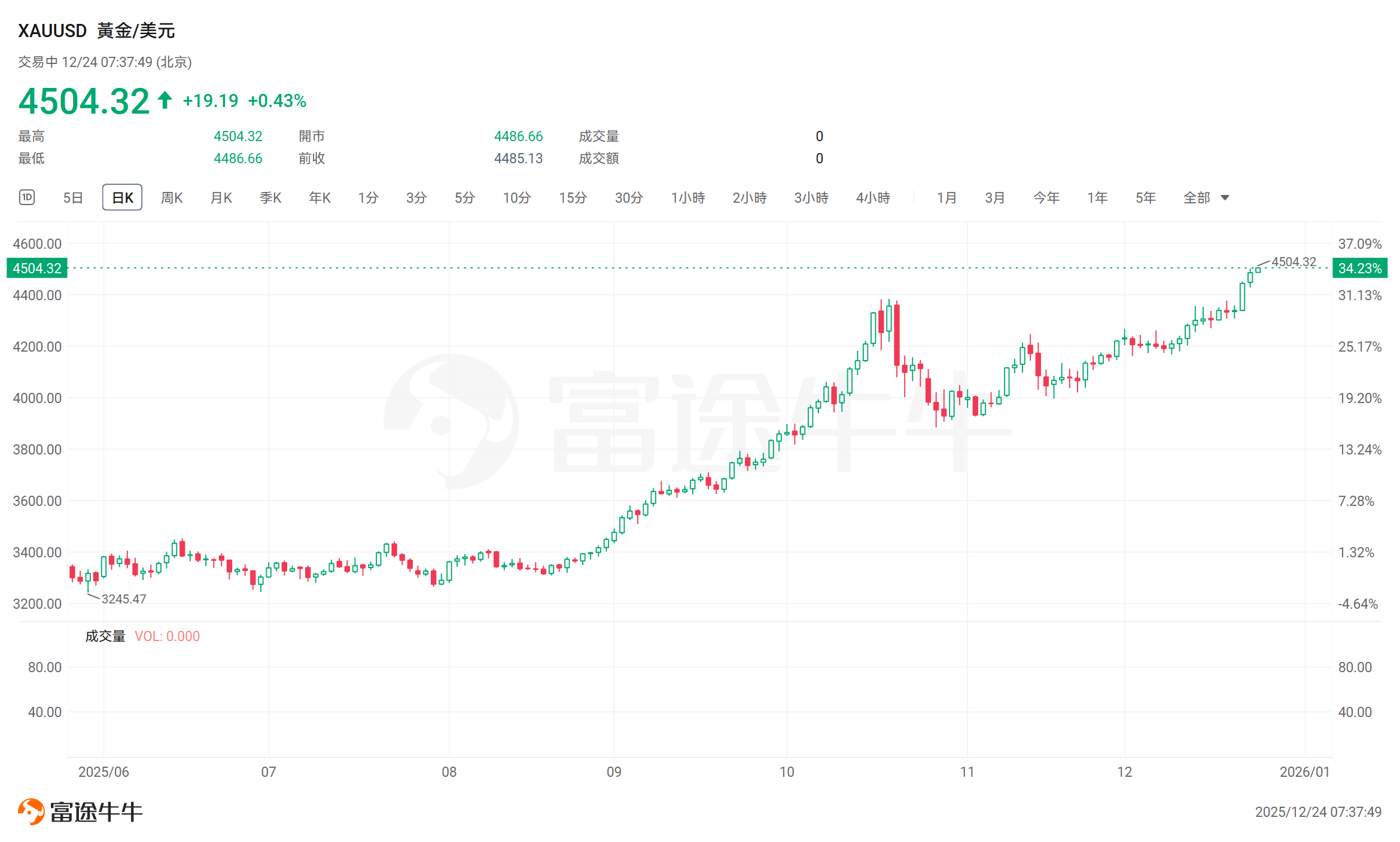
On Tuesday, spot silver surpassed $71 per ounce for the first time, while spot gold approached the $4,500 mark. Driven by escalating geopolitical tensions and expectations of further interest rate cuts by the Federal Reserve, gold prices have surged by more than two-thirds year-to-date, while silver prices have risen approximately 140%, exhibiting even stronger momentum.
Driven by escalating geopolitical tensions and expectations of further interest rate cuts by the United States, gold and silver prices surged to new all-time highs.
New York time on Tuesday, $XAG/USD (XAGUSD.FX)$ Breaking through the USD 71 mark for the first time, it reached a high of USD 71.855, setting another all-time high with an increase of over 148% year-to-date.
 $XAU/USD (XAUUSD.CFD)$ Breaking through the USD 4,500 mark, it hit a high of USD 4,504.32, setting a new record high with an accumulated increase of over 71% year-to-date. Prices of platinum and palladium also rose in tandem.
Traders are betting that the Federal Reserve will cut interest rates again next year following three consecutive rate cuts, which would be supportive for non-interest-bearing precious metals.
In addition, rising geopolitical tensions over the past week have further strengthened gold's appeal as a safe-haven asset, particularly amid developments in Venezuela, where the U.S. has imposed a blockade on the country’s oil tankers while intensifying pressure on President Nicolás Maduro’s government.
Ahmad Assiri, a strategist at Pepperstone Group, stated in media reports that geopolitical friction has re-entered market narratives. He referenced the seizure of oil tankers, noting that while these developments have not yet triggered a full-scale risk-off sentiment, they undeniably bolster the background demand for gold as a key hedging asset.
Total holdings of gold ETFs have risen every month.
Year-to-date, gold prices have surged by more than two-thirds, putting them on track for the best annual performance since 1979. Supporting this rally are substantial ongoing purchases by central banks worldwide and continuous inflows into exchange-traded funds (ETFs). According to data from the World Gold Council, total holdings of gold ETFs have increased every month this year except May.
Analysts noted that a series of aggressive measures taken earlier this year by President Trump aimed at reshaping the global trade system, alongside his threats to the independence of the Federal Reserve, have added fuel to this bull market. Investors have also been driven by what is termed the 'currency debasement trade,' spurred by concerns that mounting debt levels could erode long-term value, leading them to exit sovereign bonds and their underlying currencies.
Strong buying in ETFs has been one of the key drivers behind the significant rise in gold prices. Year-to-date, holdings in the world's largest precious metals ETF, managed by State Street Global Advisors — $SPDR Gold ETF (GLD.US)$ — have increased by more than one-fifth.
The Chief Economist of Muthoot Fincorp stated that the inflow of funds into gold ETFs over the past few months has mainly come from retail investors rather than institutional investors. He pointed out that due to the lower stickiness of retail funds, price volatility will remain at a relatively high level.
Previously, when gold prices retreated in October from the interim high of $4,381 per ounce, the market once believed the rally was overheated. However, gold prices quickly rebounded and have since shown momentum to extend gains into next year. Goldman Sachs is among several banks forecasting that gold prices will continue to rise through 2026, with a base-case scenario predicting $4,900 per ounce and suggesting greater upside risks.
Silver Outshines Gold
Silver has surged approximately 140% this year, outperforming even gold. The recent rally has been driven by speculative inflows, while persistent supply mismatches at major trading hubs—following a historic short squeeze in October—have further fueled price increases.
In India, buyers imported significant amounts of silver driven by the Hindu festival of Diwali. Meanwhile, holdings in global silver ETFs continued to climb. This surge in demand collided head-on with tight inventories in the London benchmark market, leading to a supply squeeze.
Since then, there has been a noticeable increase in silver inflows into London vaults, but most of the world's available silver remains concentrated in New York. Traders are awaiting the results of an investigation by the U.S. Department of Commerce assessing whether key mineral imports pose a threat to national security, which could trigger tariffs or trade restrictions on silver.
Meanwhile, in China, silver inventories linked to the Shanghai Futures Exchange fell to their lowest levels since 2015 last month.
Beyond its financial asset characteristics, silver is deeply embedded in global supply chains, widely used in electronics, solar panels, and medical device coatings. According to data from the Silver Institute, global demand for silver has exceeded mine production for five consecutive years.
Analysts: $4,500 and $70 Levels Are Not Difficult to Break
From a technical perspective, gold’s Relative Strength Index (RSI) has entered overbought territory, reading above 80 as of Tuesday. Silver is also nearing 80 and has remained elevated for about two weeks. Typically, readings above 70 are considered overbought signals.
However, this has not deterred investors. Assiri from Pepperstone noted that instead of seeing a large influx of selling, gold and silver have continued to attract buying interest during their upward trajectory.
He pointed out that such behavior indicates that the $4,500 and $70 levels are more like reference points within the trend rather than insurmountable ceilings. Therefore, at least for now and over the holiday period, both metals remain well-supported.
Looking to pick stocks or analyze them? Want to know the opportunities and risks in your portfolio? For all investment-related questions,just ask Futubull AI!

Editor/Stephen