
①Since the beginning of this year, as silver prices have continued to rise while crude oil prices have been falling continuously, the rare phenomenon of 'silver being more expensive than oil' has reappeared after 45 years; ②John Rapley, a political economist at the University of Cambridge, recently published an article pointing out that the last time silver prices were higher than crude oil, it was followed by hyperinflation, skyrocketing interest rates, market crashes, and economic recession.
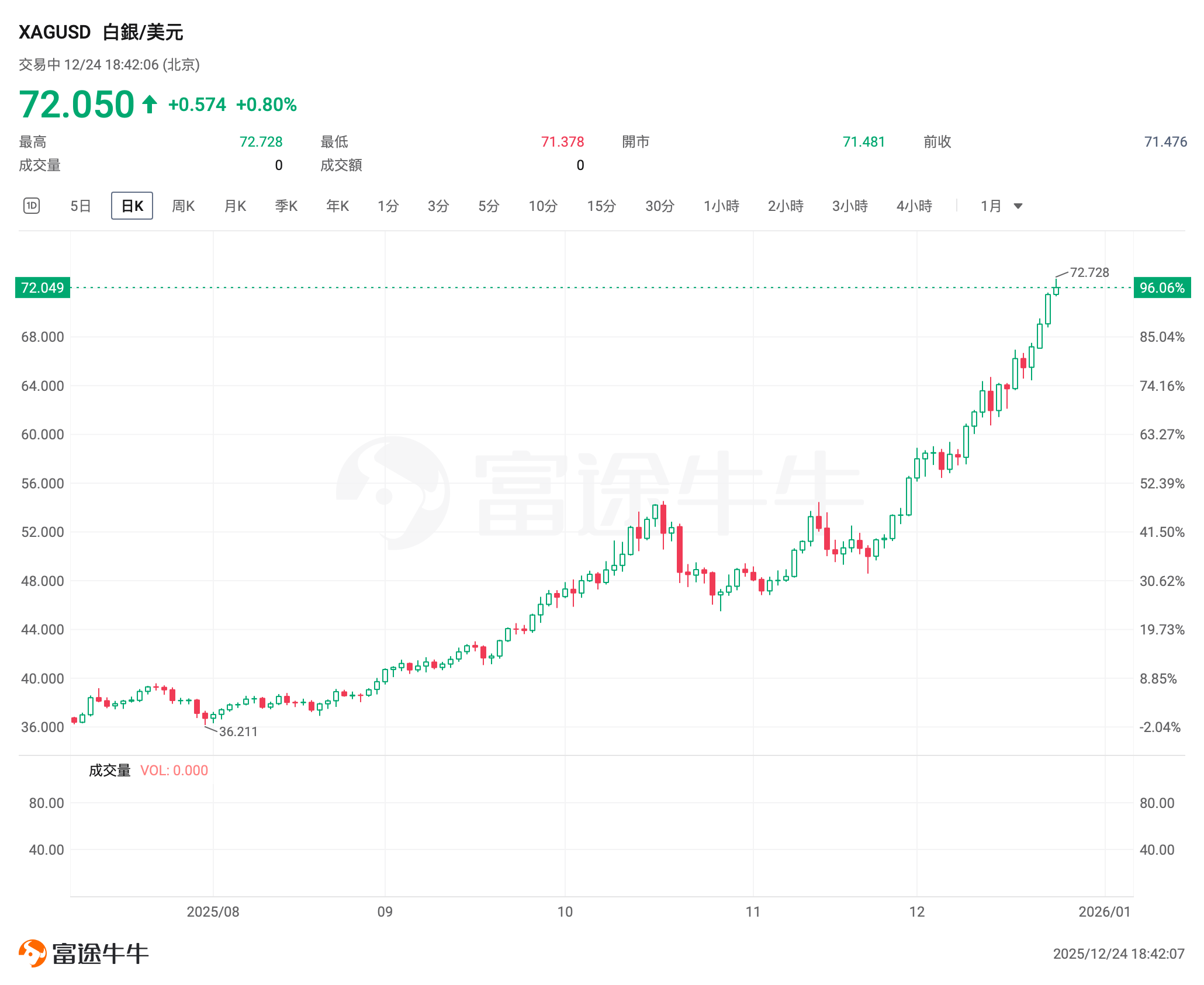
Since the beginning of this year, with the $XAG/USD (XAGUSD.FX)$ continued rise in prices and the persistent decline in crude oil prices, the rare phenomenon of 'silver being more expensive than oil' has reappeared after 45 years. Some analysts have warned that this could be an ominous sign for the economy.
The latest market data shows that during Wednesday’s Asian trading session, spot silver surpassed the $72 per ounce threshold for the first time, having risen by more than $43 this year, with gains nearing 150%. Currently, international oil prices are trading around $60 per barrel.
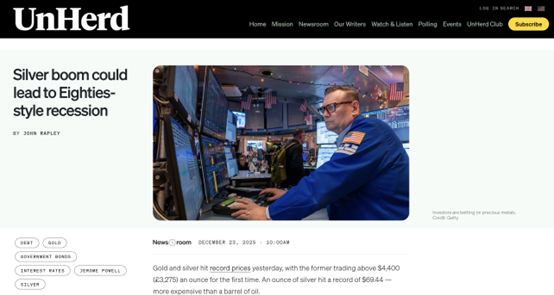
 John Rapley, a political economist at the University of Cambridge and a senior fellow at the Johannesburg Institute for Advanced Study, published an article on Tuesday in the British in-depth commentary site UnHerd titled “Silver Boom Could Lead to Eighties-Style Recession.” He explained the fundamental logic behind the surge in silver prices and warned of potentially catastrophic consequences.
In the article, Rapley noted that although the rally in silver had been ongoing for some time, two key developments this year accelerated the trend. The first was Federal Reserve Chair Powell’s speech in August at the Jackson Hole Economic Symposium, signaling that the Fed would adopt a looser monetary policy. The second was New York Fed President Williams’ remarks in November, paving the way for a Fed rate cut in December. During the interval between these two speeches, silver rose by 25%; shortly after Williams’ remarks, silver surged another 40%.
The message from the markets appears clear: traders are betting that central banks in Western nations, facing soaring fiscal deficits, will dilute debt by printing money. To hedge against the risk of fiat currency depreciation, investors are flocking to assets whose supply cannot be altered by central banks or governments.
Also noteworthy are the assets that have not participated in the rally: for instance, cryptocurrencies once heralded as 'digital gold.' Over the past month, Bitcoin prices have stagnated, falling about 10% this year and nearly 30% from their peak this fall. In contrast, precious metals have performed impressively: gold prices have risen nearly 10% over the past month, while silver prices have surged 40%.
For much of the cheap-money era following 2008, Bitcoin successfully capitalized on currency devaluation trades. But now, as this trade seems to have entered a new phase that may carry even greater risks, traders are opting to return to more traditional 'safe havens.' This phenomenon is profound: when faced with human creations like fiat currencies and cryptocurrencies versus ancient value stores like gold and silver found in nature, investors are choosing to trust the latter.
This situation will place central banks in a dilemma by 2026: Should they maintain relatively loose monetary policies and allow their currencies to depreciate further? Or should they strengthen defensive measures and fulfill their ultimate duty – maintaining public confidence in their national currencies?
If currencies continue to depreciate relative to gold, this impact will eventually spill over into other commodity sectors such as industrial metals, permeating the entire economic supply chain. At that point, inflationary pressures may intensify, government bond prices could decline, thereby pushing interest rates higher. Ultimately, all this could trigger market panic.
In fact, bond yields have begun to show upward pressure — over the past month, long-term government bond yields in most advanced economies have risen by 15 to 25 basis points. This trend is clearly not a vote of confidence in monetary stability.
The stability of modern economies hinges on public trust in the value of money, a point that cannot be overstated. However, this trust is now gradually eroding. While a crisis has not yet materialized, central banks have been warned: if they remain complacent amid surging gold and silver prices, markets may turn their backs on them.
Rapley noted at the end of the article that the last time silver prices exceeded those of crude oil was in the early 1980s. What followed was hyperinflation, skyrocketing interest rates, market crashes, and economic recession. Although history does not necessarily repeat itself, a similar fiscal crisis has now become a very real possibility.
Editor/Doris