
① Some experts believe that the continuous rise in U.S. debt risks, coupled with increased volatility in U.S. Treasury yields, has marginally reduced the attractiveness of dollar assets, prompting capital to flow into safe-haven assets such as gold, which constitutes the main support for rising gold prices; ② Market analysis suggests that the Federal Reserve is expected to maintain a loose monetary policy in the coming months, and declining interest rates will reduce the opportunity cost of holding gold.
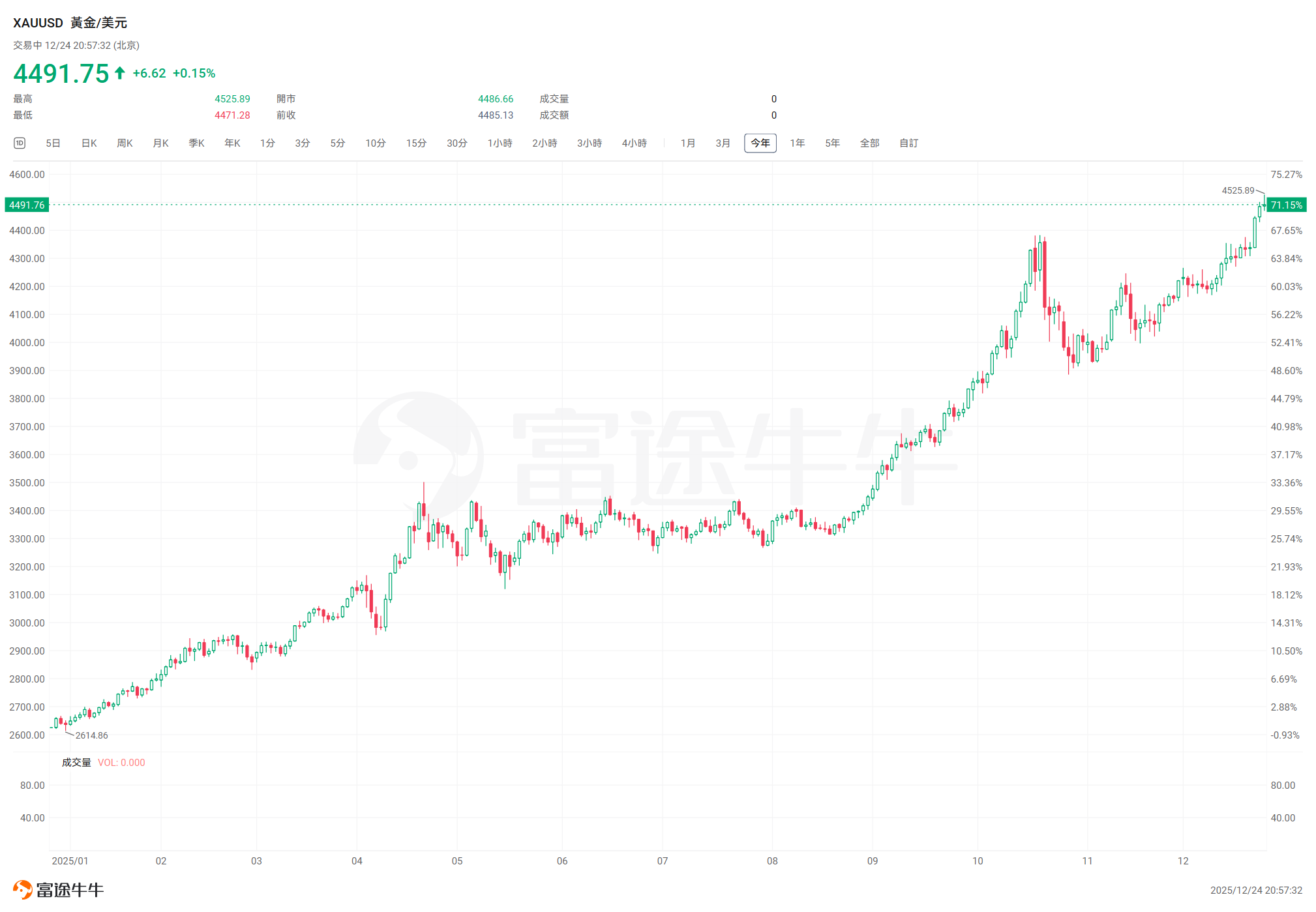
Today, spot gold (London gold) surpassed the US$4,525 per ounce mark, setting a new all-time high, with a year-to-date increase of over 71%. After two months of volatility, international gold prices have returned to their peak.
In response, multiple experts told Cailian Press that the fundamental reason behind the strong performance of gold is the restructuring of global monetary credibility, primarily due to the ongoing rise in U.S. debt risks and increased volatility in U.S. Treasury yields, which has reduced the marginal attractiveness of dollar assets and driven capital flows into safe-haven assets like gold.
 Previously, central banks of certain countries announced plans to sell gold, leading some investors to believe that this marks the end of gold's best phase. However, some industry insiders pointed out that the U.S. will remain in a rate-cutting cycle next year, with the global macroeconomic environment and order structure continuing to evolve, thus supporting the long-term allocation value of gold.
The safe-haven attribute of gold is prominent, and the market expects the Federal Reserve to continue cutting interest rates in the future.
Today, spot gold hit a new all-time high by surpassing $4,525 per ounce for the first time, with a cumulative rise of over 71% this year.
On December 24, prices of 24K gold jewelry from several domestic brands rose. Among them, Chow Sang Sang’s gold price per gram was RMB 1,411, up RMB 8 from the previous day and RMB 44 higher than on December 22; Lao Feng Xiang’s price was RMB 1,406, up RMB 7 from the previous day and RMB 41 higher than on December 22; Chow Tai Fook’s price was RMB 1,410, up RMB 7 from the previous day and RMB 42 higher than on December 22.
Market participants told Cailian Press reporters that the fundamental reason behind the sharp rise in gold prices remains the ongoing rise in U.S. debt risks, with fiscal risks forming the primary support for gold prices.
Lü Chengtao, Managing Partner of Qianxiang Asset Management, told Cailian Press that the fundamental reason for gold’s strength lies in the restructuring of global monetary credibility, primarily driven by high debt and high-interest conditions, which have challenged the credibility of the U.S. dollar. Countries are strategically choosing to increase their gold reserves to optimize currency holdings and hedge against dollar risks.
“With the U.S. entering a rate-cutting cycle, real interest rates falling, and the U.S. Dollar Index weakening, these conditions typically benefit gold. Additionally, recent geopolitical tensions in certain regions have further strengthened gold’s role as a safe-haven asset,” said Lü Chengtao.
Qu Rui, Senior Deputy Director of the Research and Development Department at Oriental Gold Credit, also told Caixin that U.S. fiscal risks will continue to provide primary support for gold prices.
"Currently, U.S. debt risks are continuously rising, and market concerns over the sustainability of U.S. fiscal policy have not been alleviated. Coupled with increased volatility in U.S. Treasury yields, the attractiveness of dollar-denominated assets has marginally declined, driving capital flows into safe-haven assets like gold, forming the main support for gold price increases," he stated.
Relevant personnel from the UBS Wealth Management Office told Caixin that the Federal Reserve is expected to continue easing in the coming months. A decline in interest rates will reduce the opportunity cost of holding gold. "Our baseline scenario is that the Federal Reserve will cut interest rates again in the first quarter of 2026. The downward trend in interest rates will enhance gold’s appeal compared to cash and bonds, especially when inflation remains high or real interest rates are negative."
From an international perspective, although some tensions have eased, geopolitical risks remain elevated. Volatility may re-emerge, which will also support gold in continuing to play its role.
Has gold investment peaked? Some investors have already announced their exit.
Public data from the World International Monetary Fund shows that, despite a more than 60% increase in gold prices in 2025, demand remains robust. The share of gold in global central bank reserve assets has risen to 26%, becoming a significant driver of gold price increases in the market.
However, market sentiment towards gold investment has begun to shift toward conservatism, with some well-known investors announcing their exit. Li Bei, head of Banxia Investment and a renowned private equity fund manager, previously stated that gold's best phase has passed. After adjusting for inflation, the real price of gold may have entered a high range. She pointed out that some other central banks have sold gold. "I believe this is an important and symbolic signal. Therefore, I sold my holdings in gold."
Regarding the subsequent trend of gold, market opinions remain divided; however, more institutions still believe that gold has the potential to rise. Economist Yu Fenghui stated that recent gold sales by other central banks are insufficient to alter the overall trend.
"First, it is essential to clarify that, despite some central banks selling gold, major global economies such as China and India are still continuously purchasing gold to diversify foreign exchange reserve risks and enhance financial market stability. Secondly, gold, as a safe-haven asset, has seen its appeal further strengthened amidst global economic uncertainties and regional geopolitical tensions. Therefore, the sale of gold by individual central banks does not pose a threat to the overall upward trend; instead, it is more likely a local adjustment rather than a sign of market reversal. In summary, the fundamental drivers of gold price increases have not changed," noted Yu Fenghui.
On the other hand, from a macro perspective, the U.S. remains in a rate-cutting cycle next year, and the global macroeconomic landscape and order structure are undergoing continuous transformation. Influenced by these factors, many institutions are optimistic about gold’s long-term allocation value.
Lü Chengtao noted that, in the long term, the allocation value of gold remains, but in the short term, as a large amount of ETF funds, CTA funds, and some speculative capital have been progressively increasing their allocation to gold, there is a risk of crowded trading in the short term. 'However, using the renminbi as an alternative to gold and the US dollar is still at a relatively early stage. The continuous expansion of renminbi settlement scales in trade, coupled with China's highly competitive advantage in international markets for its goods; along with year-end foreign exchange settlement demand, indeed contributes to the appreciation of the renminbi. In the long run, if the domestic economy stabilizes and household income and consumption continue to improve, the renminbi will have further room for appreciation.'
Looking ahead to next year, the global macroeconomic environment and order structure continue to evolve, particularly due to the policies and variability under the Trump administration, leading to heightened economic uncertainty. Central banks, based on strategic security and asset allocation needs, will strengthen their gold reserve strategies.
'The United States will remain in a rate-cutting cycle next year. The continued cooling of the US labor market, coupled with controllable risks of inflation rebounding, provides support for the Federal Reserve to continue cutting rates next year. As a result, market expectations for monetary easing by the Fed persist, which in turn supports gold prices,' said Qu Rui.
'For most investors, holding a certain proportion of gold in their portfolios helps enhance diversification and serves as a prudent strategy to address unexpected situations. Although gold is not a panacea, it can still play a role in constructing a cautious investment portfolio,' stated the Chief Investment Office of UBS Group Wealth Management.
Editor/melody