
2025 will witness not only fluctuations in numbers but also the collapse of a series of perceptions: an AI giant could lose $60 billion in a single day, the US dollar might experience its worst decline in half a century, while gold and silver, symbols of the 'old era,' awaken with unexpected vigor... This article reviews ten extreme market movements to examine how the market seeks new anchors amid the collapse of narratives.
In 2025, global markets were severely shaken by multiple storms: abrupt policy changes, technological revolutions, and macroeconomic shifts. From NVIDIA's single-day crash wiping out $600 billion to the US dollar’s worst decline in 52 years, from tariff boomerangs to unexpected yen maneuvers – these extreme scenarios have redefined traders' understanding.
This article reviews the year’s top ten stunning market performances, each representing a snapshot of market logic being abruptly torn apart and hastily rebuilt. Collectively, they reveal a core reality: in an era of fragile consensus and narrative-driven dynamics, the greatest risks often stem from widely accepted stories suddenly shifting tone.
1. DeepSeek Shockwave: NVIDIA loses $600 billion in a single day as the AI narrative faces a 'faith collapse.'
 Due to concerns over a potential valuation bubble burst in AI stocks triggered by DeepSeek's release of a new model, the share price of the global AI computing leader plummeted by 17% in a single day on January 27 local time. $NVIDIA (NVDA.US)$ Nearly $600 billion in market capitalization evaporated instantly, marking not only the company’s largest single-day decline in history but also setting a terrifying record for the largest single-day market value loss by a company in U.S. stock market history.
This is by no means an isolated collapse, but rather an 'avalanche-style stock market crash' sweeping across the entire technology sector. The semiconductor index plummeted over 9%, with multiple U.S. tech stocks suffering heavy losses. Broadcom fell more than 17%, Taiwan Semiconductor dropped over 13%, the Nasdaq Composite Index closed down 3.07%, and the S&P 500 Index declined 1.46%. Even traditionally safe-havensafe-haven assetsgold was sold off due to liquidity pressures triggered by the stock market plunge, falling more than 1% on the day.
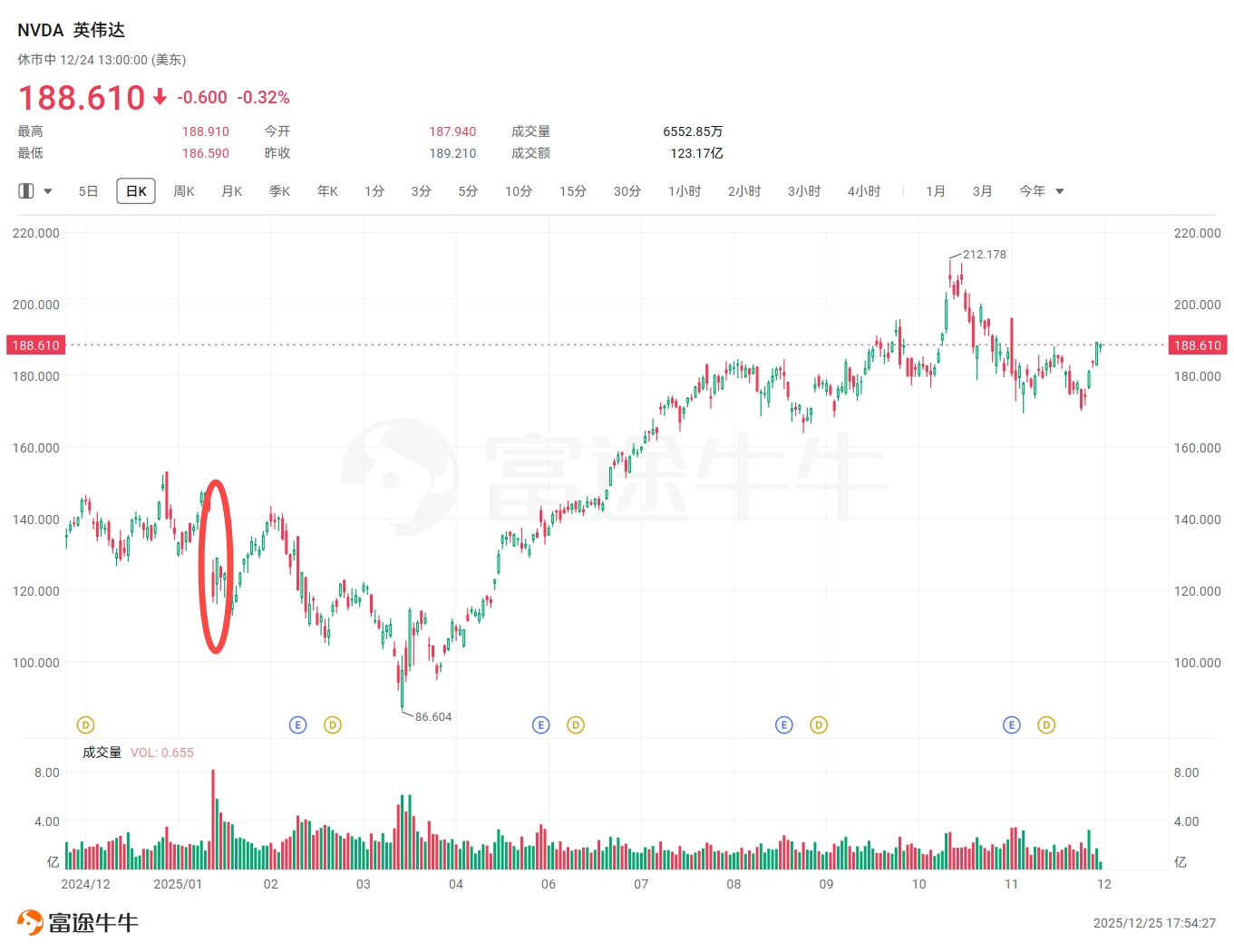
The market abruptly realized that low-cost, high-efficiency AI models might destroy the technological moats built through massive capital expenditures by industry giants. This plunge became a brutal watershed moment, prompting the market to reassess the robustness of the technological barriers underpinning current giants’ high valuations, as well as the return cycles on their vast capital spending.
NVIDIA subsequently achieved a 'triumphant return' by surpassing a market capitalization of $5 trillion in October with solid earnings reports. Analysts from JPMorgan and Citigroup on Wall Street stated that DeepSeek’s efficiency breakthrough does not pose a threat to NVIDIA’s business; instead, it could accelerate the adoption of artificial intelligence by making it more accessible and cost-effective.
Nonetheless, that crash marked a shift in the market’s AI investment approach, moving from indiscriminate 'narrative hype' to a ruthless 'performance validation' phase. In 2026, the AI sector is expected to experience significant divergence, with the key question remaining: when will AI investments begin to yield returns and justify the enormous capital expenditures?
2. Tariff 'Boomerang': Trump reverses his stance within a week, triggering a V-shaped rollercoaster in US stocks.
In April 2025, global markets were precisely targeted by a week-long 'policy horror show,' then dramatically pardoned, completing a textbook 'V-shaped rollercoaster.'
On April 2, the bombshell detonated. Trump signed an executive order announcing the imposition of 'reciprocal tariffs' on major trading partners. The specter of a global trade war instantly loomed. Market fears of supply chain disruptions and recession surged dramatically, with the S&P 500 plummeting over 10% in just two days—one of the worst two-day performances since World War II, second only to events such as the pandemic crash, the global financial crisis, and the 1987 'Black Monday.' Market capitalization evaporated by $5 trillion—equivalent to wiping out the entire GDP of France. Both the U.S. and European stock markets hovered on the brink of bear territory, with widespread distress.
However, just a week later on April 9, the plot took a dramatic turn. Trump announced on social media that he was authorizing a 90-day tariff suspension for certain countries. Risk appetite quickly rebounded, with the S&P 500 surging 5.7% that week—the largest weekly gain since November 2020—and subsequently trending higher. Year-to-date, it has risen approximately 15%, repeatedly hitting new highs.
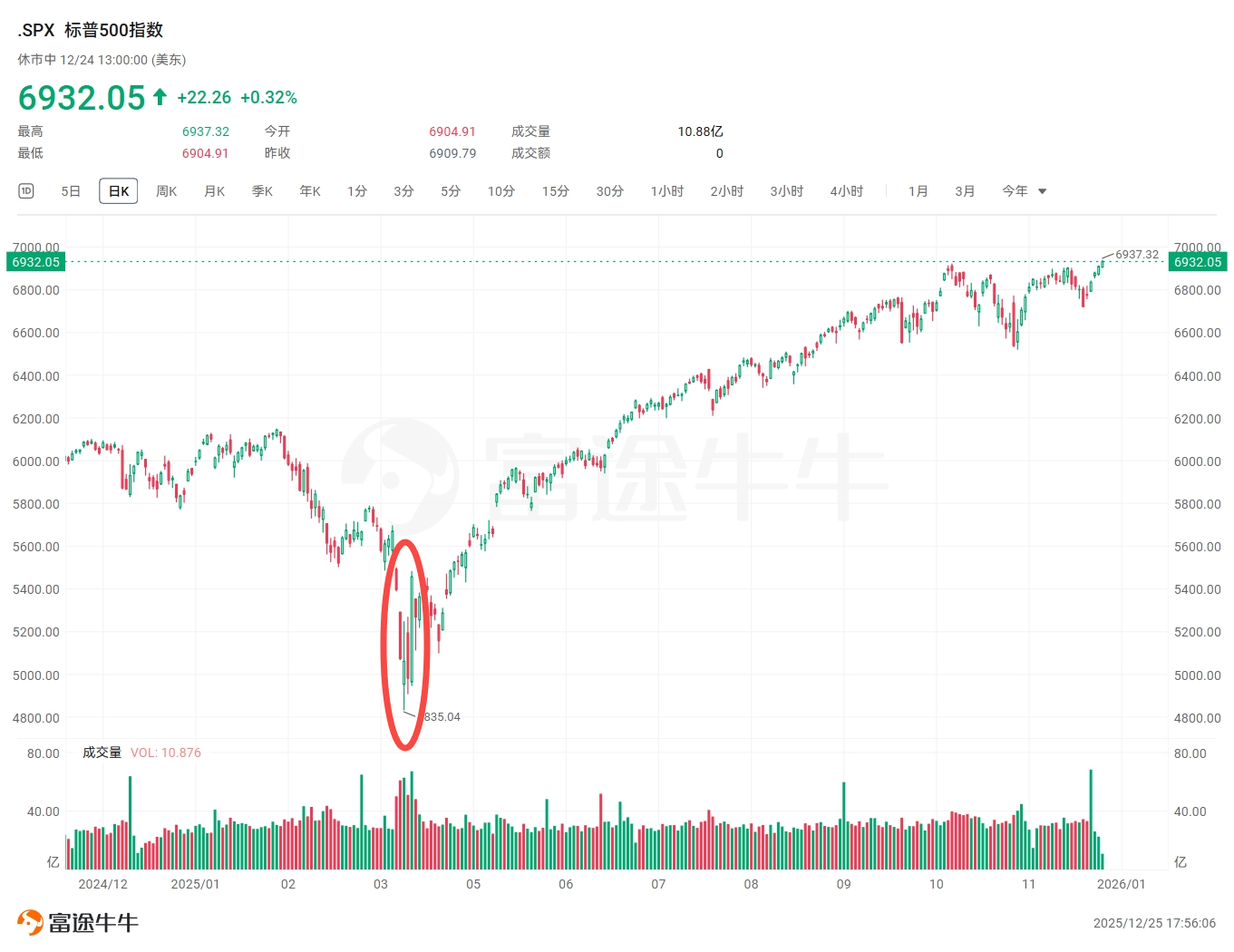
This classic playbook of 'announce-shock-retract-rebound' became a key lesson for markets in understanding the 'Trump Trade.' It demonstrated that his 'maximum pressure' approach had become a predictable policy tool. As a result, when new tariff threats resurfaced in October, the market's knee-jerk reaction had already been dulled. Investors no longer panicked into selling but calmly viewed it as another 'much ado about nothing' tactical disruption.
3. Middle East Conflict Ignites Oil Price Shock: A 10% Surge Followed by a 12% Collapse; War Premium Fails, Planting Seeds for Bear Market
In June 2025, the outbreak of conflict in the Middle East subjected the global crude oil market to an extreme stress test of 'fear versus reality,' revealing a dangerous signal: In an era of structural oversupply, even the flames of war struggle to melt the ice of a bear market.
On June 13, missiles ignited the 'panic premium.' Israel and Iran engaged in direct military conflict, attacking each other’s critical infrastructure. Traders’ nerves tightened instantly. Oil prices soared, with Brent crude jumping from around $68-69 per barrel to approximately $78—a rise of over 10%. What was being traded was no longer crude oil but apocalyptic visions of potential shipping disruptions in the Strait of Hormuz, with some analysts even predicting a surge to '$130.'
However, the war premium proved short-lived. Within days, markets realized that actual supply disruptions remained limited, and Iran’s oil production was largely unaffected. The bubble of fear burst rapidly. On June 23, oil prices plunged nearly 9%, falling for three consecutive days, dropping over 12%, and entering a volatile downward channel. As of this writing, Brent crude is trading near $62 per barrel.
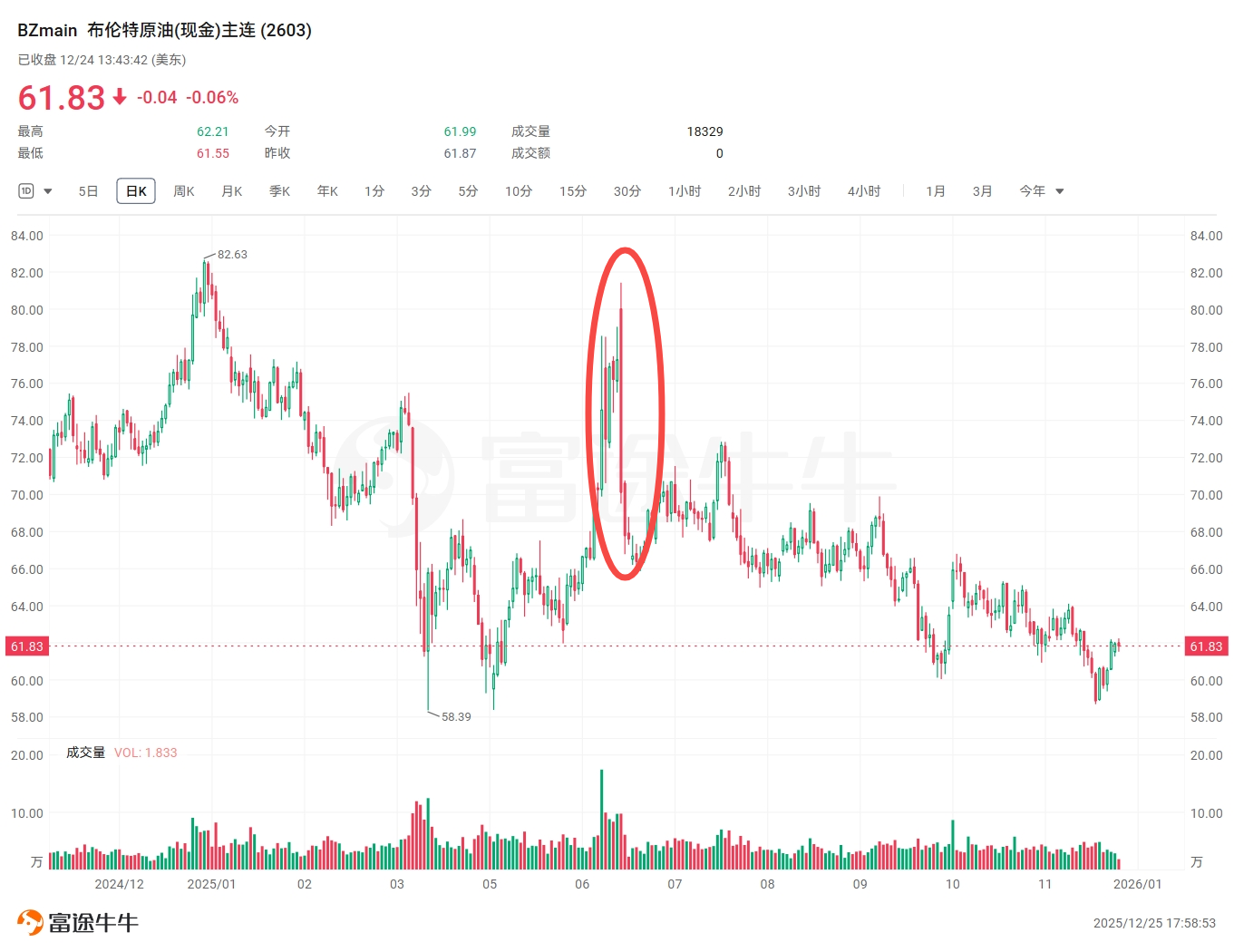
This rollercoaster ride ruthlessly confirmed a shift in the core logic of the crude oil market: Amid structural oversupply pressures, geopolitics has been downgraded from 'the ace that dominates prices' to 'noise that creates volatility.'
Investment banks have issued increasingly pessimistic forecasts, with analysts warning that without coordinated production cuts by OPEC+, oil prices could fall to the $30 range by 2027, reminiscent of the pandemic-induced collapse in 2020. From a technical analysis perspective, crude oil has been locked in a persistent descending channel since early 2025, confirming a structural bearish trend rather than a temporary pullback. The year 2026 will be one where oil trading lacks a structural bullish anchor.
4. New York Copper's 'Tariff Shock': A 21% Single-Day Collapse and the Fatal Gap in Expectations
At the end of July 2025, the copper futures market at the New York Mercantile Exchange (COMEX) witnessed a financial stampede triggered by a 'failure in expectation management.' This was not due to a sudden deterioration in fundamentals but rather a pure slaughter of long positions orchestrated by a policy-driven 'expectation gap.'
In the early morning of July 31, 2025, Beijing time, the main COMEX copper futures contract plummeted during trading, hitting a low of $4.33 per pound, representing a 21% plunge from the previous day’s close. The trigger for the collapse in New York copper prices was an unexpectedly stringent copper tariff policy. On July 30 local time, the White House issued an announcement stating that starting August 1, a 50% tariff would be imposed on imports of semi-finished copper products, while refined cathode copper and scrap copper were unexpectedly exempted. This 'selective taxation' created a significant divergence from Trump’s vague statement on July 9 about imposing a 50% tariff on all copper imports.
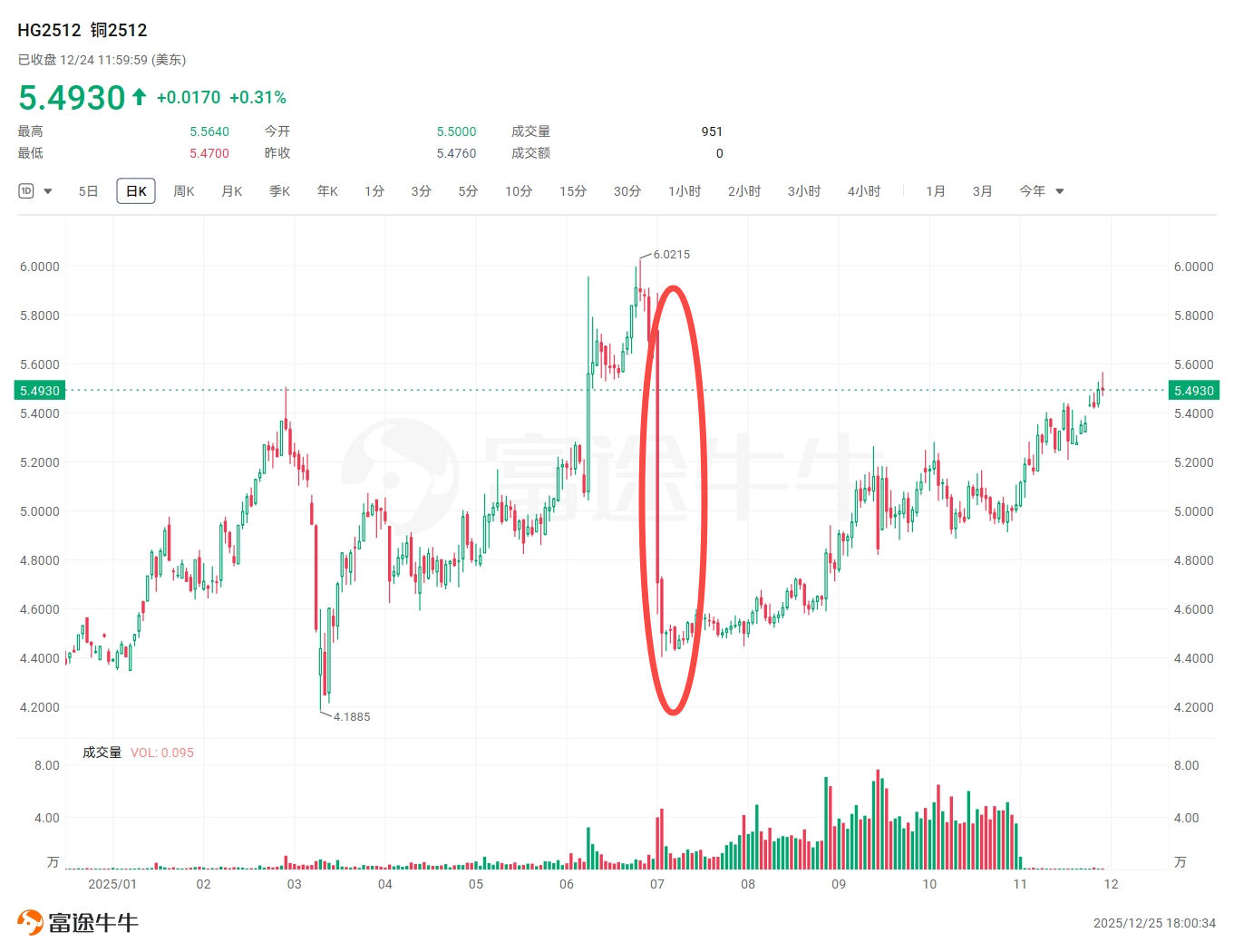
Previously, global traders had aggressively moved massive amounts of physical copper to the U.S. to avoid the anticipated blanket tariff, creating crowded 'tariff arbitrage' long positions. Once the exemption list was released, the arbitrage logic collapsed instantly, leaving a large number of slow-reacting long positions to suffer catastrophic liquidations. The market's cruelty lies in the fact that sometimes, 'half-bad' news is more damaging than 'completely bad' news—it precisely targets the most crowded trades.
However, this shock did not bring an end to the turmoil in the copper market. After the collapse, copper prices rebounded as narratives around tightening global supply and AI data center demand resurfaced, reigniting bullish sentiment. Investment banks such as Goldman Sachs and Citi predicted that if the U.S. tariff implementation were delayed, a more severe structural shortage driven by 'stockpiling effects' would emerge globally in 2026, pushing copper prices to new highs.
Goldman Sachs stated that copper was its top metal pick for the coming year, with the core rationale being the expectation that U.S. copper tariffs would be postponed until 2027. This implies that the U.S. will continue to stockpile copper at a premium in 2026, thereby exacerbating supply shortages in non-U.S. markets and dominating pricing dynamics. Citi also noted that as parties rush to ship copper to the U.S., copper prices could rise to $13,000 per ton by the second quarter of next year. However, current copper prices already reflect highly crowded speculative long positions and excessive optimism regarding AI data centers. Should tariffs be implemented earlier or market sentiment reverse, prices would face significant downside risks.
5. Oracle's 'AI Circular Trading' Shakes the Tech World: $300 Billion Deal Sparks 40% Surge and 45% Plunge
In September 2025, an agreement dubbed the 'Petroleum Contract of the AI Era' not only sent $Oracle (ORCL.US)$ 's stock price soaring to unprecedented heights but also pushed the entire tech industry’s skepticism about AI business models to its peak.
On September 10, Oracle signed a $300 billion computing power procurement agreement with OpenAI, shocking the entire tech world. This news directly ignited the market, sending Oracle's stock soaring over 40% intraday and closing up nearly 36%, adding approximately $250 billion to its market value in a single day. Founder Larry Ellison briefly became the world's richest person. The significance goes beyond this—it marks a pivotal turning point, signaling the official debut of the 'AI closed-loop ecosystem' narrative: giants serving as both customers and suppliers, forming an infinite growth story within an internal cycle.
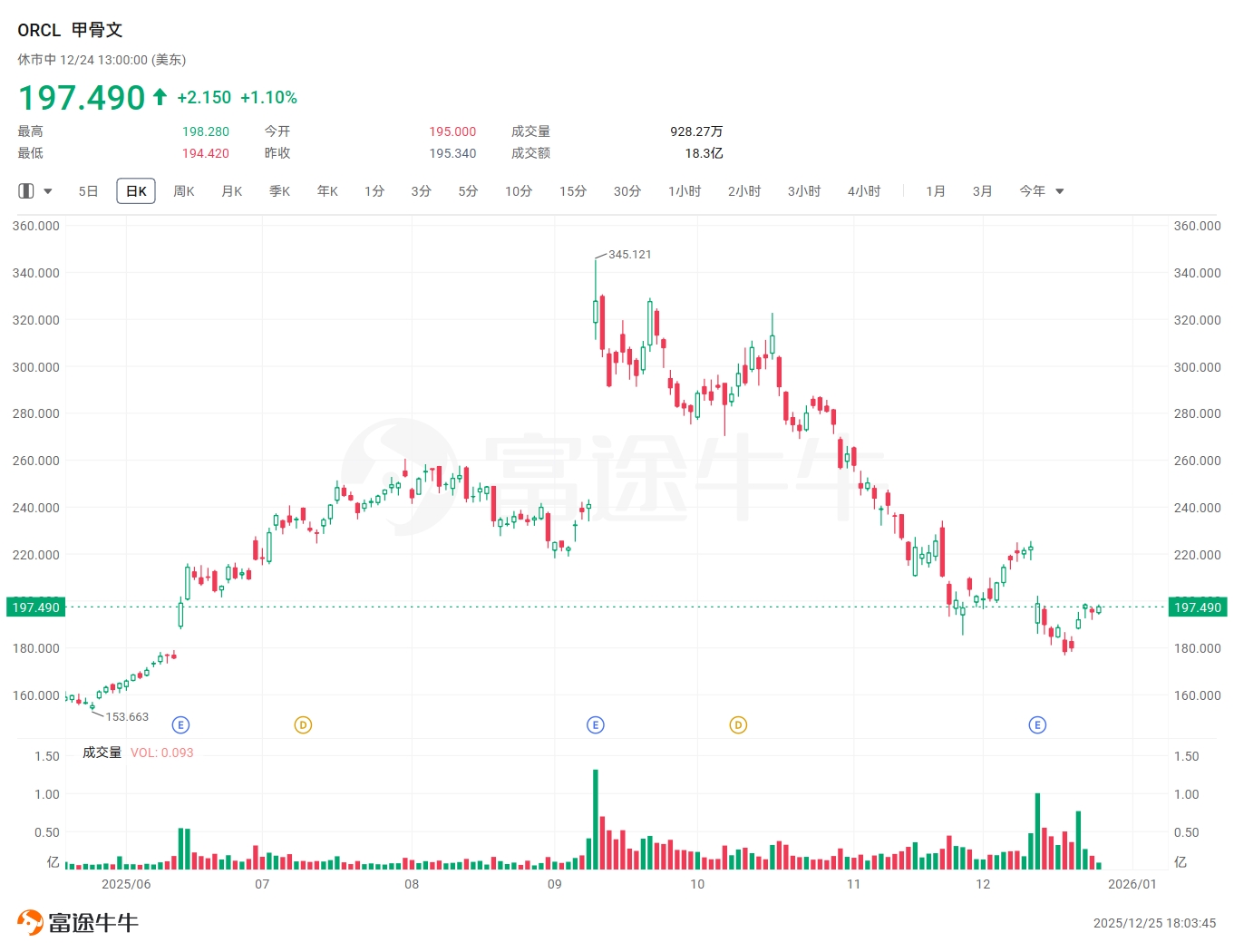
However, beneath the euphoria, a chill has emerged. This model, dubbed 'AI Circular Trading,' has sparked questions: when top-tier players in the industry purchase each other’s services and record them as revenue, are they truly creating new value for the world, or is it an intricate, system-contained numbers game? The boundaries of growth authenticity have begun to blur.
The market quickly delivered a harsh verdict. As quarterly earnings reports were disclosed, Oracle's actual profitability and external customer expansion fell short of the market's exuberant expectations. Its stock price plummeted from the September peak, with a staggering 45% decline, nearly halving in value. This became one of the most instructive cases of 2025: the market first zealously assigned it a valuation as 'the next cloud giant,' only to brutally disprove it with financial statements.
6. Gold’s 'US$4000 Blitz': A Credit Game of 3.5% Surge and 6.3% Shakeout
In 2025, gold staged its strongest and most dramatic rally since 1979. It was no longer merely a safe haven but had transformed into a yardstick for measuring the credibility of global monetary systems. Its price fluctuations became a real-time, ongoing drama about 'trust' and 'doubt.'
On October 8, an epic surge unfolded. Catalyzed by multiple crises — the U.S. government shutdown impasse, economic risk warnings, and sudden geopolitical conflicts — gold prices surged relentlessly within hours, breaking through key resistance levels and historically surpassing the US$4000/ounce mark, with a single-day maximum increase exceeding 3.5%. This bullish candlestick represented the market’s collective vote on weakening sovereign credit and escalating policy uncertainty.
However, thirteen days later, a textbook-style 'long squeeze' descended. On October 21, gold prices plunged by 6.3% at one point, marking the largest drop in over a decade. This was not due to a reversal in fundamentals but rather a stampede-like deleveraging triggered by technical selling and the collective collapse of long leverage at historical absolute highs. It sent a chilling warning to all traders: even the strongest trends never move in a straight line.

This rise and fall vividly illustrated gold’s dual role in 2025: it served both as the ultimate safe-haven asset, attracting capital inflows during market panic, and as a crowded trade, triggering violent volatility when sentiment overheated. Its core driver had evolved from a simple inflation hedge to a higher-dimensional repricing of the 'long-term credibility' of the dollar-centric global monetary system.
Looking ahead to 2026, the key pillars supporting gold remain robust: central banks’ ongoing 'de-dollarization' gold-buying demand, major economies’ uncontrollable fiscal deficits and debt expansion, and the resultant erosion of monetary credibility. Gold no longer needs an immediate crisis to justify its value; it simply requires the world to continue along its well-worn path: debt expansion, fragile alliances, and policy instability.
The ultimate risk may lie in just one factor: if the Federal Reserve unexpectedly reverts to a tough 'hawkish' stance, it could temporarily disrupt gold’s momentum. However, as long as the credibility underlying fiat currencies continues to erode gradually, the enduring logic behind gold’s brilliance will remain unchanged.
7. Silver’s 'Furious Awakening': The Fire-and-Ice Saga of 150% Annual Gain and 7% Flash Crash
In 2025, silver staged an epic 'underdog comeback.' Shaking off its label as gold’s 'shadow asset,' it soared with an astonishing annual gain of approximately 150%, declaring itself the most explosive and captivating star on the commodities stage. That year, silver’s K-line chart depicted an intense battle between a 'fundamental bull market' and the fragility of trading structures.
The 'three driving forces' supporting its rise are rock-solid: first, a historic supply shortage; second, explosive industrial demand; third, a decisive technological breakthrough—prices have surged past and stabilized above the $50-$54 range, a 13-year 'iron ceiling' that had long suppressed the market. This marks silver's entry into a new era of price discovery.
However, precisely due to the excessive rise and overheated expectations, silver's trajectory has not been smooth but rather filled with extreme volatility and 'shakeouts.'
On April 4, spot silver prices in New York fell sharply by 7.06% during the tail session, closing at approximately $29.59 per ounce, extending the sharp decline triggered by tariffs on April 3, with the cumulative maximum drop over two days exceeding 15%.
On October 21, London spot silver plummeted by 7.11% in a single day, marking the largest decline since early 2021. By October 24, New York silver prices had retreated to $48.07 per ounce, down 11.7% from their peak.
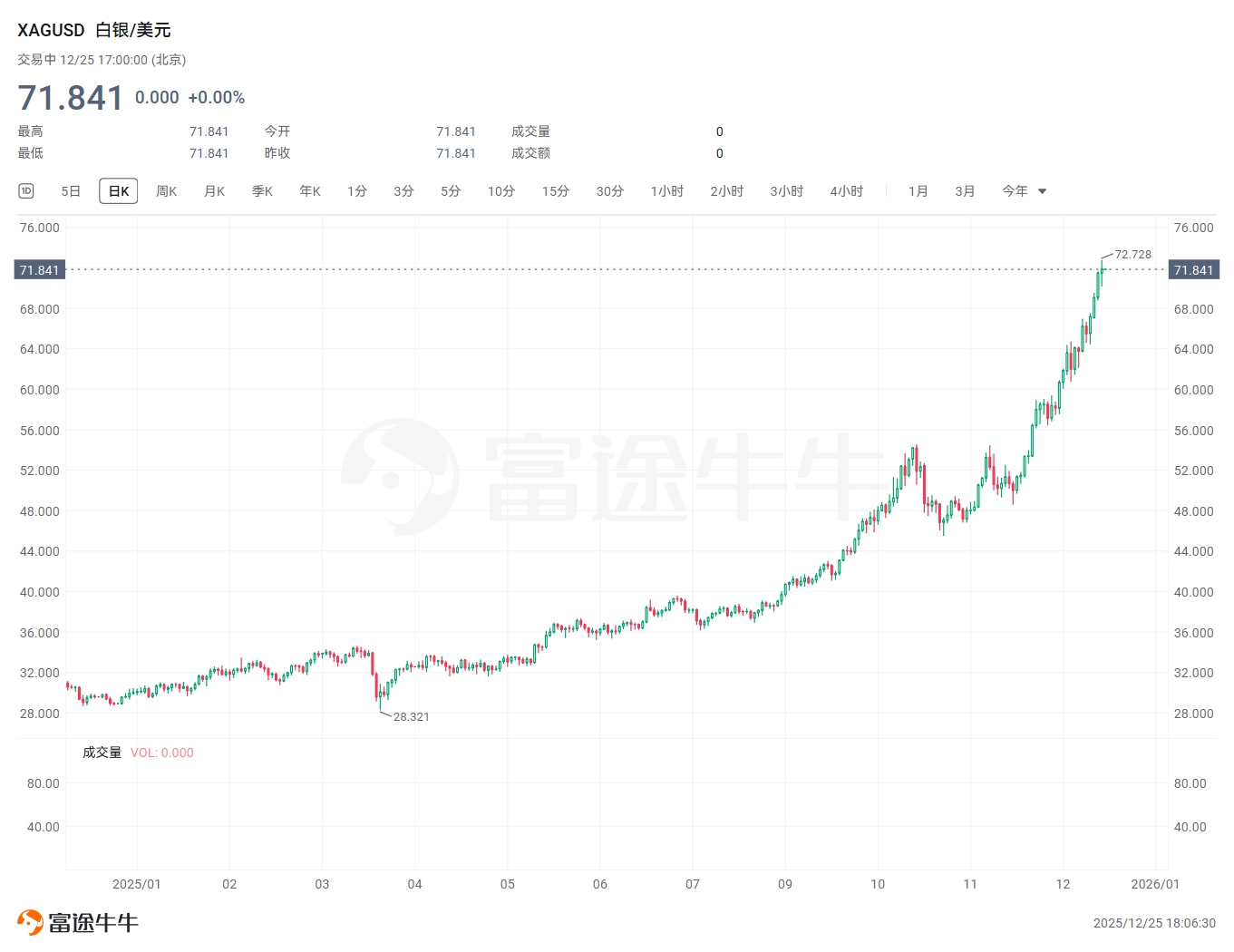
These flash crashes do not signal the end of the trend but rather represent a violent purge of excessive leverage and floating profits. By the end of 2025, silver prices exhibited a pattern of 'short-term consolidation with fluctuations, long-term upward movement,' reaching around $72 at the time of writing.
Looking ahead, silver has become a 'high-odds asymmetric opportunity.' Its solid supply-demand fundamentals provide a bottom-line support for long-term appreciation, distinguishing it from purely speculative assets; meanwhile, its inherent high volatility means that any deep correction driven by market sentiment or macroeconomic disturbances could present an opportunity to position for the long-term trend. The story of silver is no longer about gold but about a unique metal at the intersection of the industrial revolution and monetary attributes, striving toward its deserved revaluation amidst intense turbulence.
8. The Dollar’s 'Worst Defeat in 52 Years': A -12.5% Decline Sparks Questions About Hegemony
Investors and analysts may well remember 2025 as the year when the dollar's 'invincible armor' developed deep cracks. This bull run of the dollar once seemed unstoppable—until its momentum came to an abrupt halt.
In the first half of the year, the US Dollar Index plummeted by 10.8%, dropping sharply from the 110 level in mid-January to a low of 96.37 on July 1, marking its worst first-half performance since the collapse of the Bretton Woods system in 1973. During this period, it fell nearly 2% on April 19, experienced nine consecutive trading days of decline starting June 19, and hit a slight new low of 96.21 on September 17 following the Federal Reserve's interest rate cut. By the end of the third quarter, the index had fallen by approximately 12.5%, spending most of the second half of the year hovering near its 12-month low.
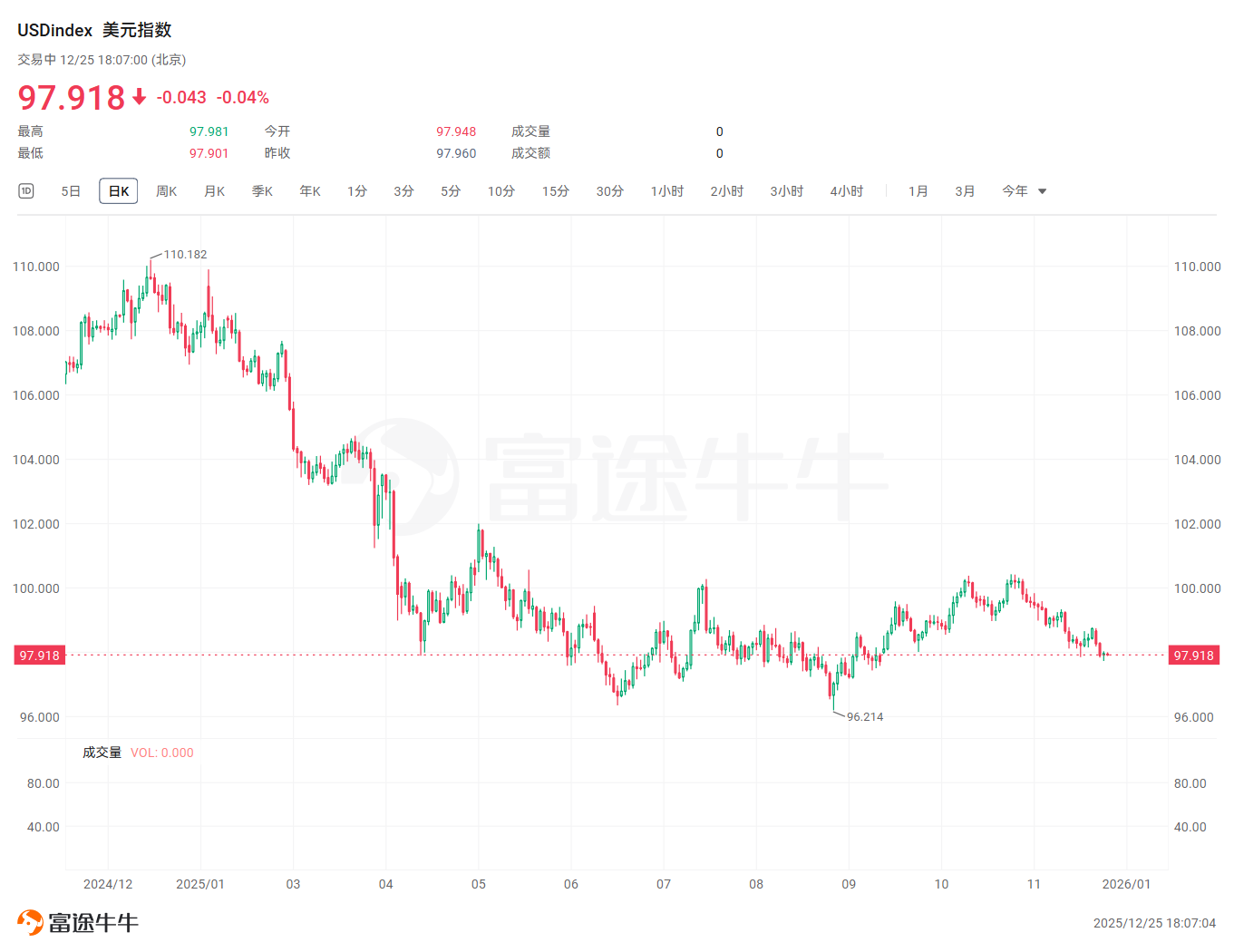
Market sentiment deteriorated under the triple pressures of erratic tariff threats from the Trump administration, deep concerns about the outlook for US public debt, and expectations of Federal Reserve rate cuts. As a result, US assets and the dollar itself were rapidly repriced. For much of 2025, the core narrative in the markets revolved around rethinking whether the United States still deserves the premium it has enjoyed for more than a decade.
The key question for 2026 is whether global markets will complete this repricing of the US dollar, or ultimately conclude that, for better or worse, the United States remains the lowest-risk haven in the world.
Looking ahead, some strategists, including those at Morgan Stanley, anticipate that the US dollar will weaken further as US economic growth slows, its interest rate advantage narrows, and global investors continue to hedge their exposure. Other perspectives, however, suggest that renewed trade tensions or a sharper slowdown in the US economy could once again trigger a 'flight-to-safety' sentiment, reviving demand for the dollar.
9. A-share market 'a decade in the making,' reclaims the 4,000-point mark.
In 2025, China’s A-share market underwent a tumultuous 'confidence stress test.' Its defining narrative was the Shanghai Composite Index's tenacious rise amidst intense external shocks and internal policy support, culminating on October 28 when it breached the symbolic 4000-point threshold for the third time in a decade.
This confidence test began with an extreme release of pressure. On April 7, under the shadow of Sino-US trade conflict, the Shanghai Composite plummeted 7.3% in a single day, losing the 3100-point level. However, this sharp decline became a turning point for market sentiment. Subsequently, a series of decisive and intensive policy measures—from liquidity support to institutional reforms—quickly stabilized market expectations, forming a solid 'policy floor.' The market soon realized that the leadership's resolve to defend financial stability was unwavering.
Thereafter, the index steadily climbed, driven by two narratives: the industrial theme of 'technological self-reliance' and the capital flow story amid an 'asset drought.' However, the journey was far from smooth. In early October, Trump introduced the extreme threat of an additional 100% tariff hike, causing the market to drop sharply and testing its resilience once more. But this time, the market's panic threshold had significantly increased. As external pressures showed signs of negotiation breakthroughs, coupled with internal high-level meetings fostering development consensus, the A-share market digested negative news with greater composure and eventually completed the psychologically significant surge above 4000 points.
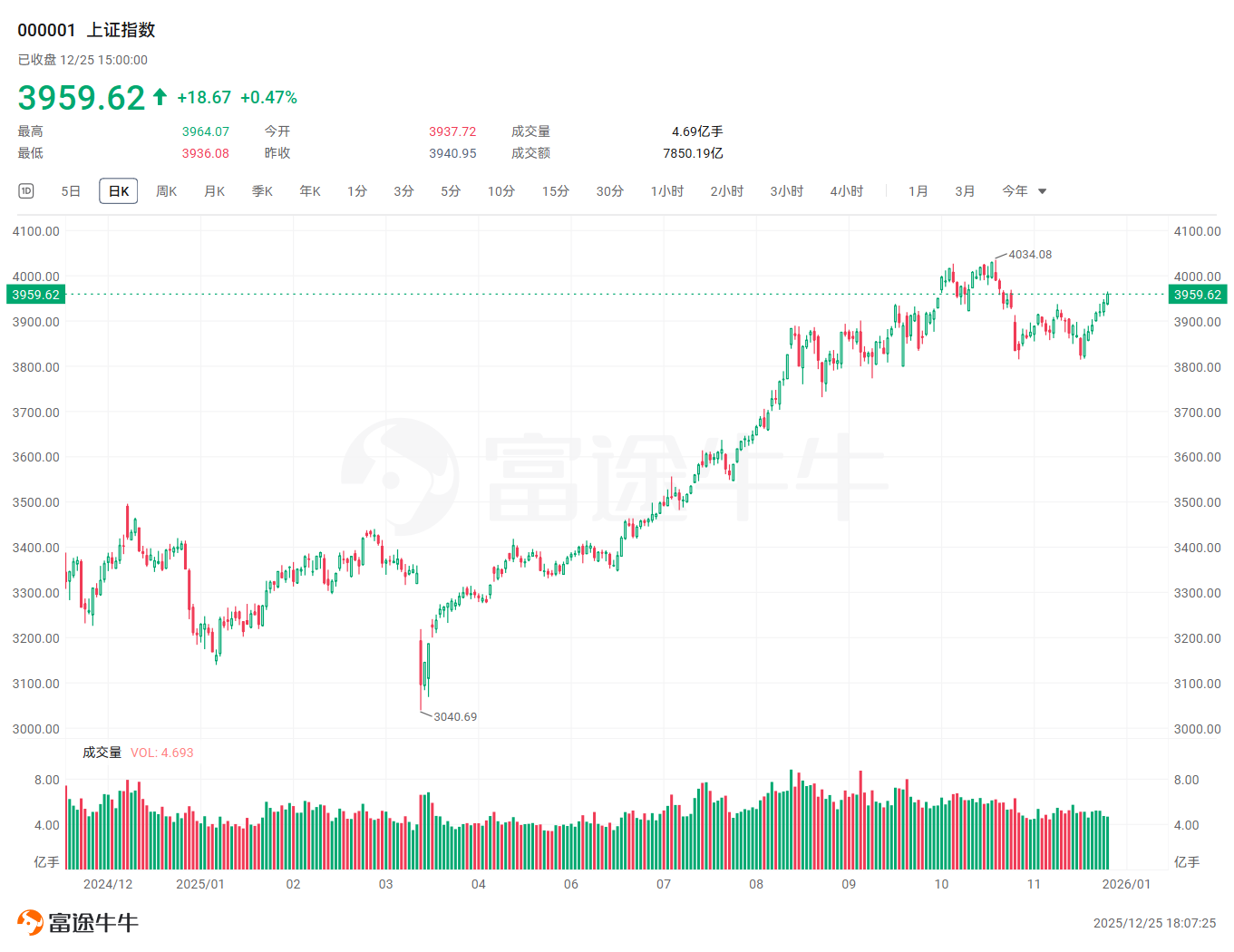
The year's performance revealed a new paradigm: China’s A-share market is gradually shedding its old script of being 'unilaterally impacted' by external risks, shifting instead to a 'China narrative' jointly shaped by domestic policies, industrial trends, and capital flows. The market began assigning certainty premiums to domestically controlled technology supply chains and high-dividend assets that remain uniquely attractive in a globally low-interest-rate environment.
Looking ahead to 2026, the core logic driving the market remains clear: against the backdrop of a prolonged 'asset drought' caused by persistently declining risk-free rates, the long-term trend of household savings migrating into equity markets through various channels remains irreversible, while technological breakthroughs and market capitalization reform will continue to provide structural opportunities. The 4000-point mark is not the end but rather a declaration: China’s A-share market is reconstructing its independent value discovery trajectory and risk pricing system within a complex global environment.
10. The Yen’s 'Reverse Massacre': The Policy Paradox of Two Rate Hikes Yet a 12% Plunge
In 2025, the Japanese yen staged a perplexing 'reverse operation' in the global foreign exchange market. The yen's weakness emerged as the biggest surprise in the forex market in 2025. At the start of the year, the yen appeared strong as markets anticipated the Bank of Japan's exit from ultra-loose monetary policy, with USD/JPY even retreating to near 140. However, this momentum did not last. Despite two rate hikes by the Bank of Japan, it failed to save the yen. The USD/JPY exchange rate has now rebounded to the high volatility range of 154–158, almost wiping out all the yen's gains from previous months, with the annual trajectory likely ending at 'zero.'
What is particularly perplexing is that the Federal Reserve has already cut interest rates three times this year, leaving the dollar in a weakened state, while the Bank of Japan has raised interest rates twice within the year. Yet, instead of appreciating continuously, the yen has frequently come under pressure.
On January 24, the Bank of Japan raised interest rates by 25 basis points, but the yen remained almost flat and later entered a sustained depreciation channel. On December 19, the Bank of Japan raised interest rates again by 25 basis points, yet the US dollar surged 1.4% against the yen. Since bottoming out in April, the US dollar-yen exchange rate successfully climbed over 12% by Christmas, during which time the dollar weakened against all other major currencies, and the Japanese stock market remained stable. The yen even fell to new historical lows against some major currencies; for instance, the euro-yen rate soared to near 185.
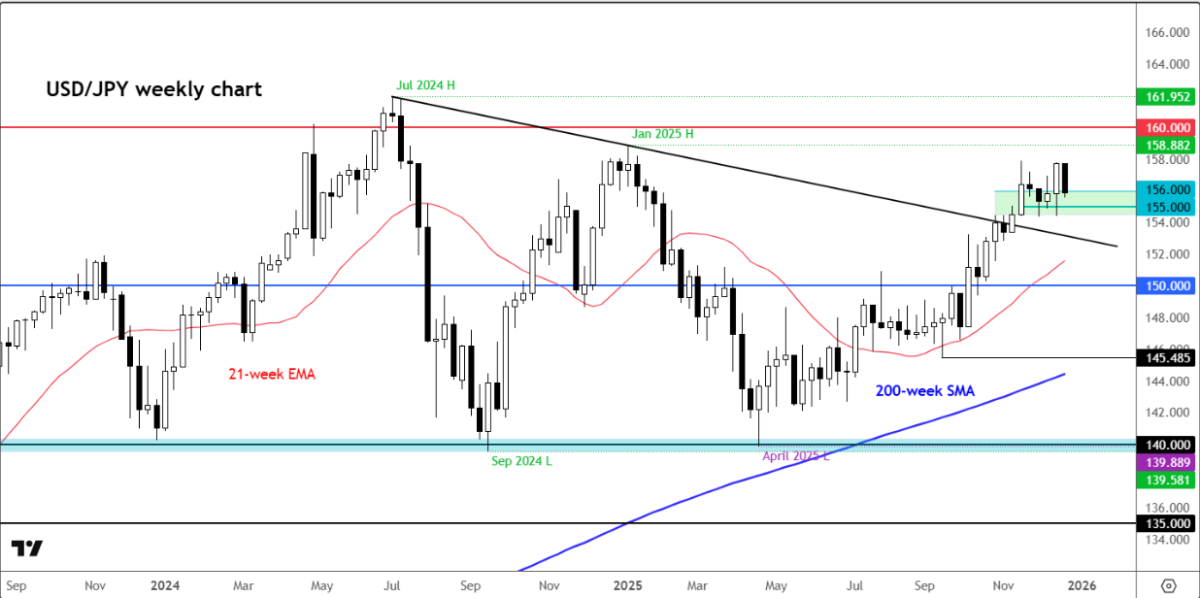
This fully exposes the crux of the issue: investors’ focus has shifted away from the Bank of Japan’s modest pace of interest rate hikes to the aggressive spending plans driven by Japan's “fiscal dominance.”
Investors are skeptical that Japan’s contradictory policy mix of 'expansionary monetary easing coupled with rate hikes' can genuinely revitalize its economy. Worried about ballooning fiscal deficits and persistent inflationary pressures, they have been consistently dumping Japanese government bonds and the yen. Even verbal warnings from the Japanese government about potential currency market intervention are seen by the market as only offering temporary relief. Unless this 'schizophrenic' policy mix changes course, the yen will struggle to make a real comeback.
Epilogue: Between narrative and reality, seeking a new benchmark for 2026.
The 2025 market has taught us that extreme movements are never an accident but rather an inevitable eruption caused by the accumulation of multiple contradictions. AI bubbles, tariff battles, geopolitical risks, credit reassessments—every storm is reshaping the pricing anchors of assets.
Looking toward 2026, the core contradictions have not disappeared but merely taken on new forms: AI investments will enter a brutal phase of performance realization; geopolitical conflicts will shift from 'black swan' events to becoming常态化 risk premiums; and the credibility of monetary policy will continue to be challenged by fiscal expansion.
The real insight may lie in this: In an era where narratives inflate easily and collapse just as quickly, the greatest Alpha no longer comes from chasing trends but from identifying those 'cracks in consensus'—remaining clear-headed when everyone else is intoxicated by stories, and seeing the core when collective panic takes hold.
 Looking to pick stocks or analyze them? Want to know the opportunities and risks in your portfolio? For all investment-related questions,just ask Futubull AI!

Editor/jayden