Source: Tencent Technology
Author: Guo Xiaojing
Three years after the rise of ChatGPT, Zhipu AI and Minimax, two leading large model companies in China, have successively released their prospectuses, offering the global market its first opportunity to comprehensively analyze the true commercial strength of large model unicorns within a transparent financial framework.
The race for the title of 'the world's first large model stock' is unfolding between two Chinese companies, but the commercial details revealed in their prospectuses are far more noteworthy than the title itself.
 These two documents, hundreds of pages long, clearly present three key dimensions: the true quality of the companies' revenue, the extent to which computing power costs squeeze profits, and the survival period that cash reserves can support.
More importantly, the 'abnormal data' in the prospectuses shows that the two companies are taking radically different paths toward achieving a closed business loop—like parallel universes.
And these two paths represent the most likely directions for China's large model companies to achieve breakthroughs in the current market environment.
Section 01: Two sets of abnormal data, two survival statuses of China’s large model companies
The table below summarizes the core data of the two large model unicorns, with the most striking aspect being the difference in gross profit margins: Zhipu AI at 56.3% and Minimax at just 12.2%.
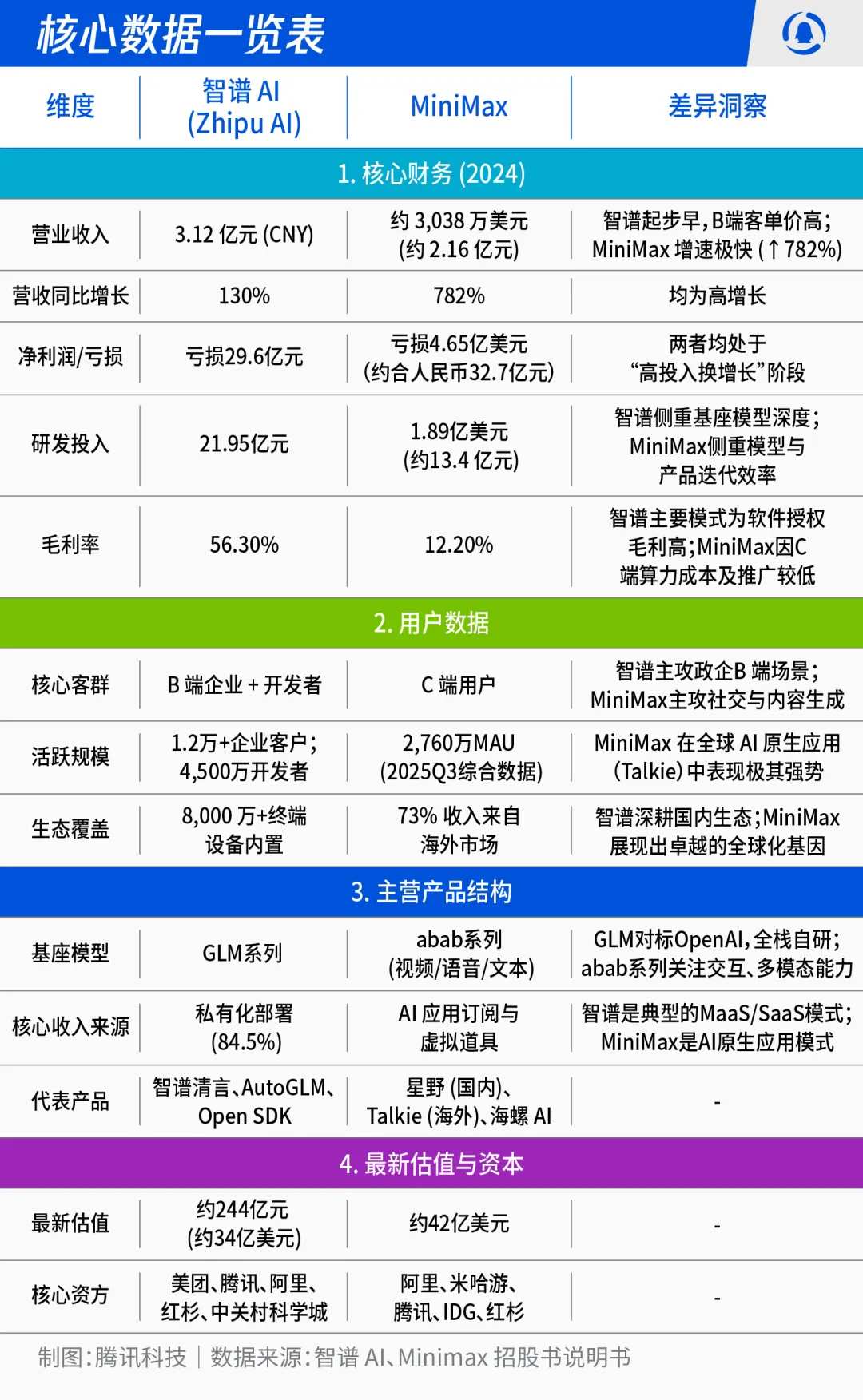
In theory, companies with similar businesses may show some variation in gross profit margins due to differences in cost control capabilities, but not to such an extreme degree. Behind this significant gap lies the fundamentally different commercial essence of the two companies.
Gross Profit Margin Formula: Gross Profit Margin = (Revenue - Operating Costs) / Revenue
From the prospectus, it is clear that Zhipu AI's operating costs mainly include: labor costs (wages for service and deployment personnel, accounting for approximately 54.4%), computing service fees (22.1%), warranty provisions, and outsourced technical fees.
The key point is that Zhipu AI categorizes a significant portion of its model training expenses as research and development costs rather than operating costs, making its gross profit margin appear more like that of a traditional software company.
In contrast, Minimax's operating costs primarily consist of computing power expenses (third-party cloud service fees) and the distribution and customer acquisition costs for AI-native products. Although model R&D also consumes substantial computing resources, B2C operations require real-time, high-frequency services for tens of millions of monthly active users, with inference costs being directly accounted for as operating expenses.
Zhipu AI: Certainty and Ceiling in the B2B Sector
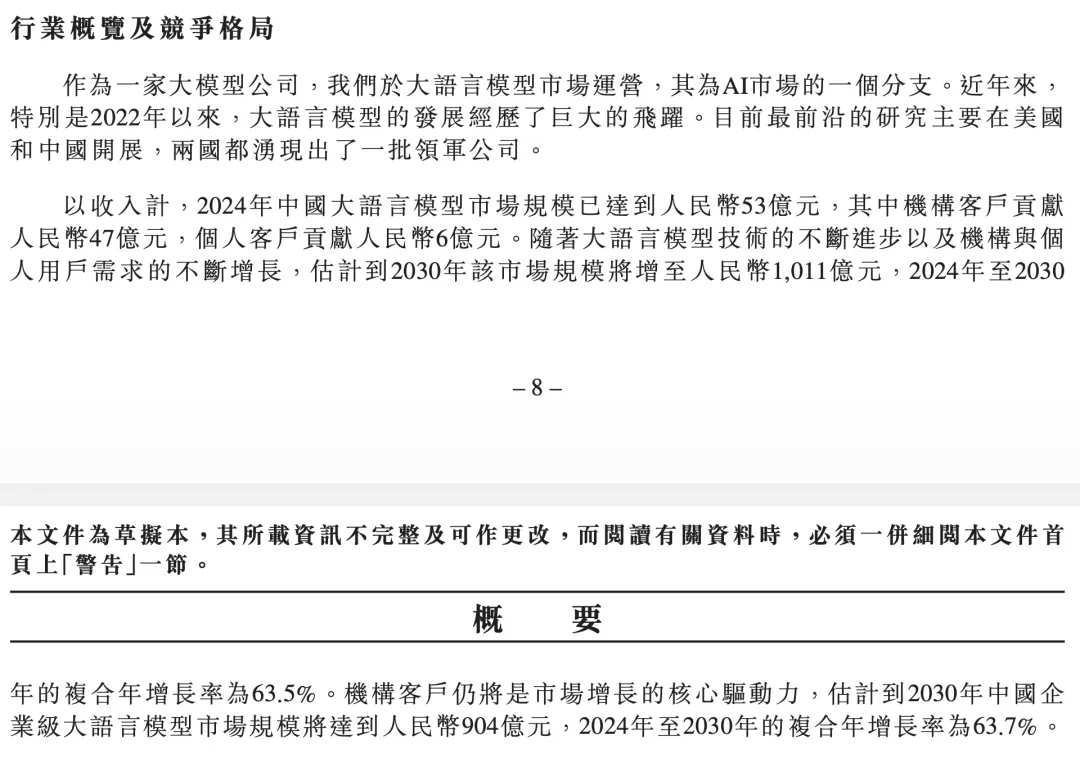
Zhipu’s choice of a 'heavier' B2B route aligns with the realities of China's large model market. According to the prospectus, the 2024 market size for China's large language models is 5.3 billion yuan, with institutional clients contributing 4.7 billion yuan (88.6%). The sector is projected to grow at a compound annual growth rate of 63.5% over the next five years, driven primarily by institutional clients. Individual user willingness and motivation to pay remain insufficient.
Zhipu has demonstrated strong competitiveness in the B2B sector, with its client base increasing from 48 in 2022 to 123 in 2024, and its average annual revenue per client rising from 1.14 million yuan to 2.15 million yuan.
However, the revenue structure reveals underlying concerns. In the 2024 fiscal year, 85% of revenue came from localized deployments, while only 15% was derived from cloud-based APIs. Localized deployment entails heavy customization, labor-intensive delivery, and long cycles; meanwhile, the proportion of lighter cloud-based MaaS business continued to decline, with gross margins dropping from 76.1% to 3.4%.
More concerning is the concentration of clients: revenue from the largest client exceeded 10% of total revenue, and the top five clients approached 50%. This implies that losing any major client could lead to significant revenue volatility.

An industry expert close to Zhipu noted, "I am optimistic about MaaS platforms on public clouds, where marginal costs continue to decrease and value can be scaled efficiently. However, I am not optimistic about privatized MaaS. Historically, unless privatized middleware achieves global leadership (e.g., Oracle databases), mid-tier products relying on project-based earnings generate volatile 'hard-earned money.'"
How to break through the growth ceiling after penetrating leading institutions, and how to make cloud-based MaaS the second growth driver, are the core challenges faced by Zhipu AI, as well as the area of future potential.
Minimax: The Inevitable Choice of Going Global
In Minimax's prospectus, another set of noteworthy data shows a fundamental shift in revenue regions, from an initial 80% domestic income to 73% overseas income by 2025. Meanwhile, the revenue share of the 'Open Platform' (corresponding to Zhipu AI’s cloud business) dropped from 78.1% in its early stages to 28.9% in the first nine months of 2025.
This set of data indicates that Minimax is firmly pursuing a C-end strategy, telling a more 'internet-centric' story. AI-native applications (including Talkie and Conch AI) have become the main source of revenue, accounting for approximately 71%.
However, it is an objective fact, as stated in Zhipu AI’s prospectus, that the proportion of paying individual users in China is extremely low. This is a common dilemma faced by large model companies in China: the domestic market lacks a subscription payment habit, and free products from major tech companies are intensifying competition.
For Minimax, going global is the only path to breaking open the TOC growth bottleneck at this stage.

Section 02: The Global Growth Strategy Embedded in Large Model DNA
Sequoia China partner Zheng Qingsheng recently discussed on a business podcast that this generation of AI-native products is inherently global. Large models are trained on global data, giving AI-native products an innate ability to transcend geographical boundaries.
From this perspective, 'going global' is not only Minimax’s choice but also an inevitable path for all Chinese AI-native companies.
Although Zhipu has chosen the B2B route, it is also expanding overseas. The prospectus shows that its localized deployment has already generated revenue in the Southeast Asian market (Southeast Asia accounted for 11.1% of revenue in the first half of 2025) and it is actively participating in the construction of local 'national foundational platforms.' This reflects an overseas expansion path focused on empowering B2B rather than directly acquiring customers.
Compared to Minimax's aggressive global transformation (73% overseas revenue), Zhipu's international expansion is still in the early exploratory stage. However, the commonality between the two companies lies in their efforts to avoid reliance on a single market while exploring the global opportunities presented by the large model era.
The commercialization strategies of Zhipu AI and Minimax essentially represent optimal solutions derived under real market conditions based on their respective characteristics—one focuses deeply on the B2B sector to seek certainty, while the other bets on overseas expansion targeting explosive C2C growth.
These two seemingly parallel paths both aim to find sustainable growth trajectories amid the current immaturity of China’s large model market.
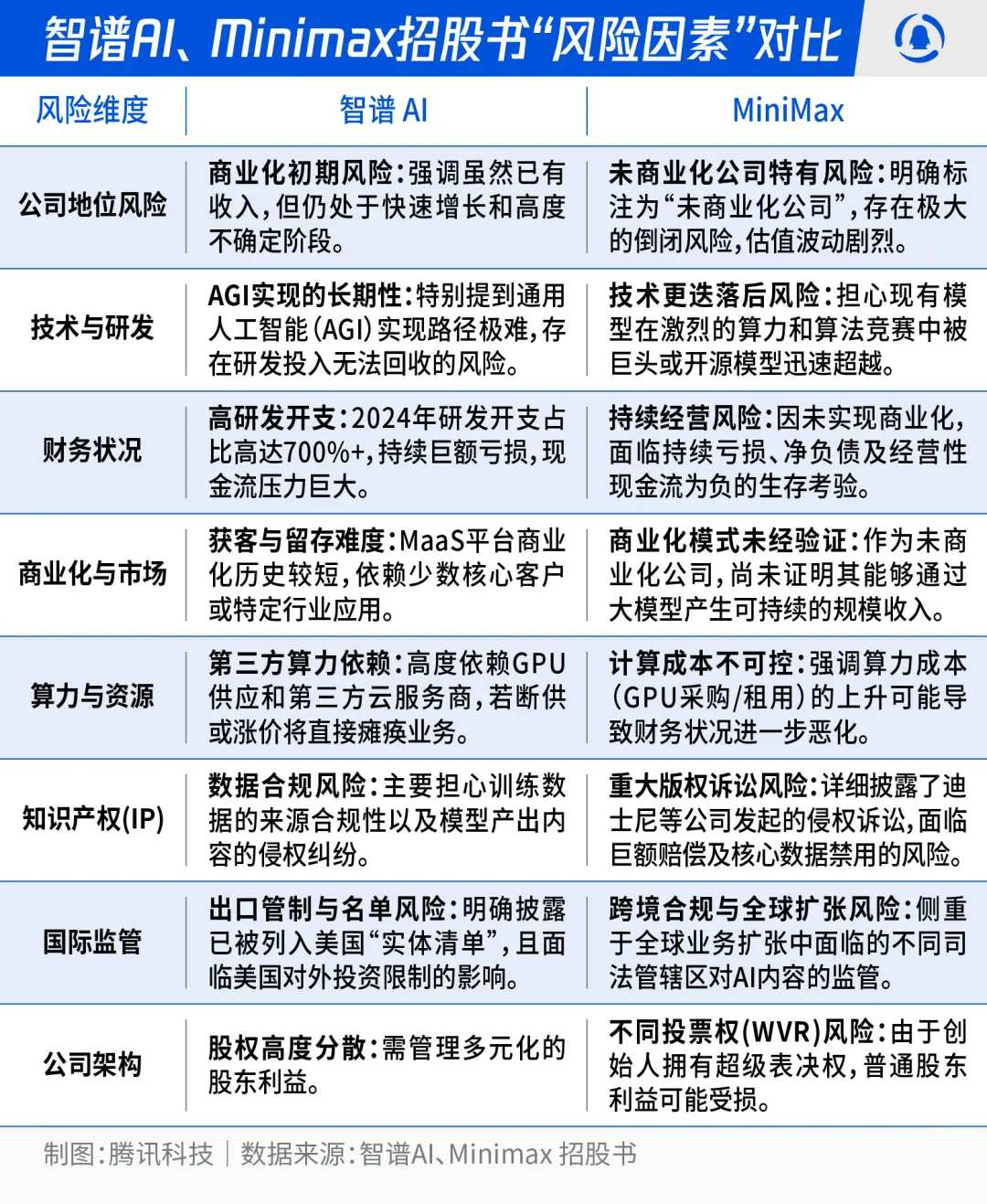
However, the prerequisite for 'sustainable growth' is survival. The 'Risk Factors' section of the prospectus is a core component that listed companies must disclose, revealing the key challenges the company will face in future development.
Section 03: Risk Factors in the Prospectus
From an industry-wide perspective, both companies have expressed concerns about the extremely high survival threshold in the field of large model research and development.
Due to the rapid iteration of AI technology, both companies exhibit deep anxiety over the risk of 'technological obsolescence'—today’s lead could be instantly nullified by tomorrow’s algorithmic breakthroughs.
Additionally, the heavy reliance on expensive computing power resources and massive losses due to R&D expenditures far exceeding revenues are financial gaps the entire industry must overcome on the path toward Artificial General Intelligence (AGI).
The development of large models remains a protracted war of long-term investment. Both Zhipu and Minimax are investing in R&D at a scale of 1 to 2 billion RMB annually, with over 70% of this expenditure allocated to computing costs.
More challenging is that as the number of users grows, the cost of inference computing power consumed per user is also increasing, which is completely contrary to the logic of marginal cost dilution through user scale in the internet era.
However, both companies provided relatively clear expectations regarding their cash reserves in their prospectuses.
Zhipu AI: As of December 31, 2024, cash and cash equivalents amounted to approximately RMB 2.457 billion, a significant increase from RMB 1.33 billion at the end of 2023. Combined with available bank financing and short-term investments as of the end of October 2025, the overall financial position remains relatively robust.
In terms of cash burn rate, Zhipu AI's net operational consumption for the entire year of 2024 was RMB 2.245 billion, averaging about RMB 187 million per month. Entering the first half of 2025, the cash burn rate accelerated, with operating cash outflows reaching RMB 1.327 billion in the first six months, raising the monthly average consumption to approximately RMB 221 million.
The prospectus explicitly states: "As of October 31, 2025, its cash and cash equivalents are sufficient to maintain financial viability post-IPO. Calculations show that, based on the outflow rate of the first half of 2025, the cash balance at the end of 2024 could last for about 11 months without considering new financing. However, due to ongoing equity financing received throughout 2025, the cash runway has been significantly extended."
Minimax: As of September 2025, it held a cash balance (including cash, equivalents, and wealth management products) of approximately USD 1.046 billion. At the current monthly burn rate of about USD 27.9 million, even excluding IPO proceeds, the existing reserves could last for approximately 37.5 months. Including IPO funds, its survival period and risk resistance capabilities would further strengthen.
The IPOs of the two companies are more like strategic 'preemptive moves' rather than emergency measures.
In terms of differentiated risks, the concerns of the two companies are entirely different.
Zhipu’s risk disclosures focus on 'supply chain security and geopolitical issues,' particularly how to advance AGI self-research under a complex international environment and how to address fierce competition during the early stages of commercialization as an independent developer.
In Minimax’s risk disclosures, it candidly acknowledges its high risk of closure as an 'uncommercialized company' and provides detailed disclosure of unresolved copyright infringement lawsuits with international film giants such as Disney and Netflix.
Before proving the feasibility of its business model, the company must first survive amid cross-border legal disputes and high operational costs.
04. Valuation Paradox: How to Price?
Just a few days ago, OpenAI, the catalyst behind this wave of generative AI enthusiasm, was reported to be preparing for a new round of financing with a valuation potentially reaching USD 830 billion, which is 200 times the valuation of Zhipu/Minimax (approximately USD 4 billion).
According to publicly available media reports, OpenAI’s revenue in the first half of 2025 was USD 4.3 billion, and Sam Altman estimated that the annualized revenue by the end of the year would exceed USD 20 billion, approximately 70 times the revenue scale of Zhipu/Minimax.
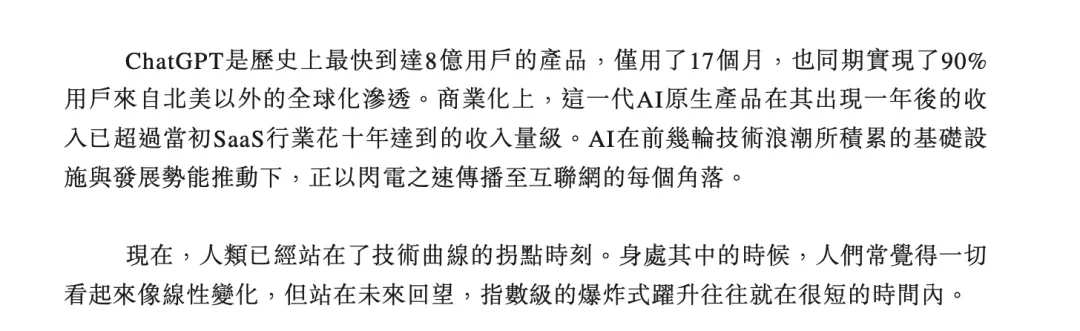
Using OpenAI as a benchmark for rough comparison, the valuation of Zhipu/Minimax seems not high. However, considering OpenAI's growth rate, the potential for Zhipu/Minimax appears equally immense.
However, switching to a different reference point leads to an entirely opposite conclusion.
As of 16:00 on December 23, 2025 (Hong Kong stock market closing time), $KINGSOFT (03888.HK)$ the market value of the Hong Kong-listed software company was approximately RMB 39.576 billion, with revenue in 2024 amounting to about RMB 10.318 billion.
$BABA-W (09988.HK)$ The total market capitalization was RMB 2.81 trillion, with revenue in 2024 at RMB 941.17 billion. Comparing solely based on revenue scale against Kingsoft Software and Alibaba, the valuation of Zhipu AI/Minimax is already relatively high.
Of course, there is no precedent for AI large model companies going public globally, which presents an entirely new business model for the capital markets. The ultimate valuation of large model companies will depend on the long-term fair value that the market eventually assigns.
The large model industry is entering a brutal elimination phase. Currently, Alibaba Qwen, DeepSeek, and ByteDance maintain their positions in the first tier due to their ecosystem and computing power advantages, while independent unicorns like Minimax and Zhipu are facing greater competitive pressure at the 'general foundation' level.
More critically, valuations exceeding 20 billion have pushed the capacity of the primary market to its limits. At this point, pursuing an IPO represents both the most appropriate and urgent timing.
Chen Shi, Investment Partner at Fengrui Capital, told Tencent Technology: "For large model unicorns like Zhipu AI and Minimax, the true significance of going public does not lie in the initial valuation but rather in gaining an extended period for refinement through the secondary market, alleviating financial pressures where commercial revenue still falls short of covering the rate of cash burn. For these companies, short-term stock price fluctuations over six months or a year are merely superficial; whether they can successfully implement commercial applications within the time gained will be the decisive factor in determining their ultimate valuation."
 Use Futu for new stock subscriptions, with truly zero interest, zero handling fees, and zero cash subscription*. Get ahead in the grey market trading.Come and experience it now >>
Editor /rice