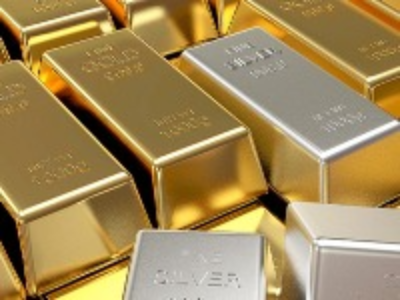
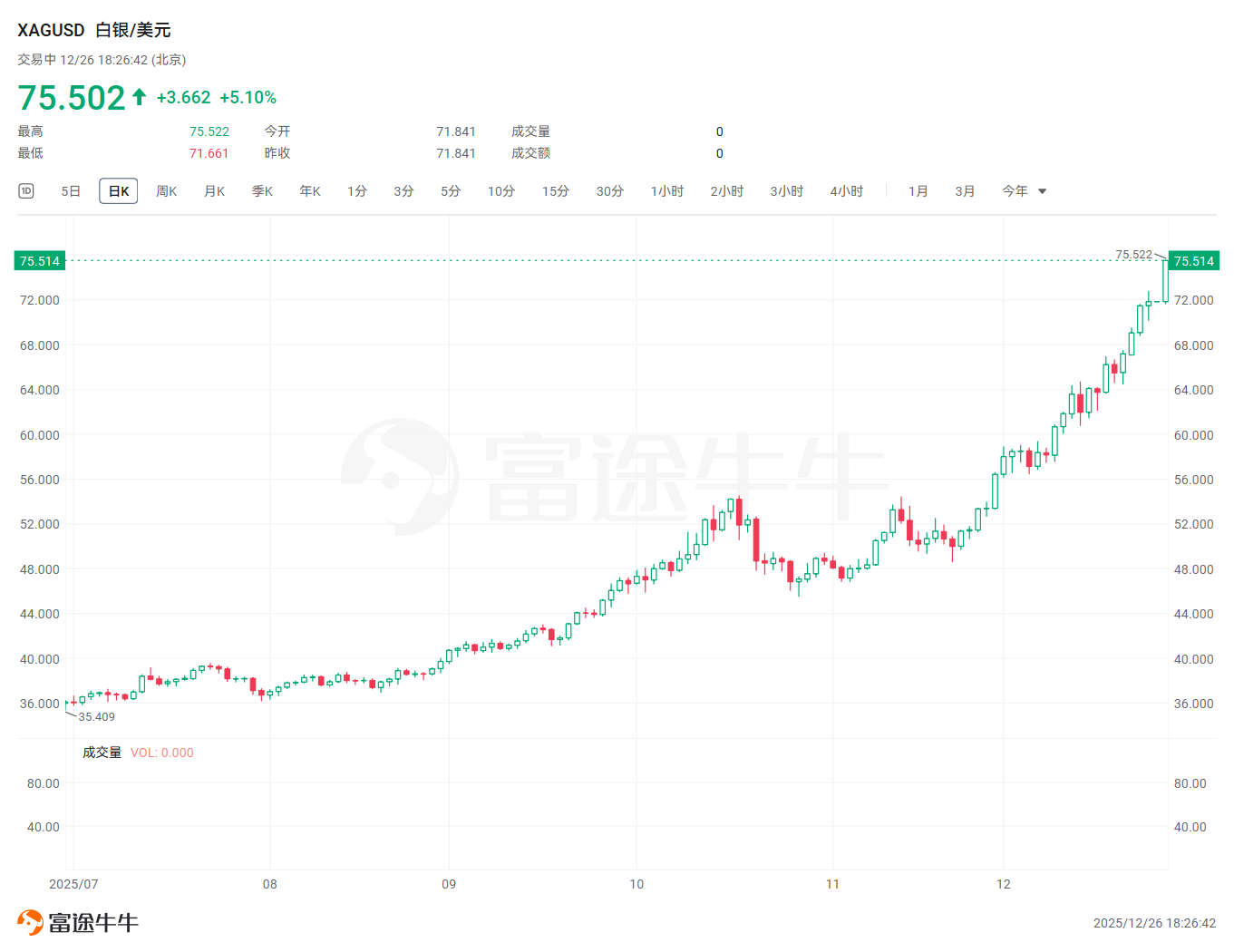
The global precious metals market rebounded strongly after a brief adjustment: spot silver surged above $75 per ounce, rising over 5% intraday and setting a new all-time high; spot platinum soared by 8%; gold steadily recovered, with spot gold reaching as high as $4,530 per ounce. Meanwhile, base metals also rose broadly, with both New York copper futures and the Shanghai copper main contract hitting record highs.
After a brief adjustment yesterday, the global precious metals market quickly resumed its upward trend and surged collectively. Driven by escalating geopolitical tensions, persistent supply mismatches in key spot markets, and a weakening US dollar, both precious metals and non-ferrous metals experienced significant price spikes.
In terms of precious metals, silver and gold prices reached new all-time highs, while platinum and palladium also strengthened in tandem. Copper prices surged significantly in both the Shanghai and New York markets, as the market repriced for tightening global supply in 2026.
 Precious Metals:
Spot silver recorded its fifth consecutive daily gain on Friday, surpassing $75 per ounce at its peak, with an intraday rise of over 5%, extending its record high.
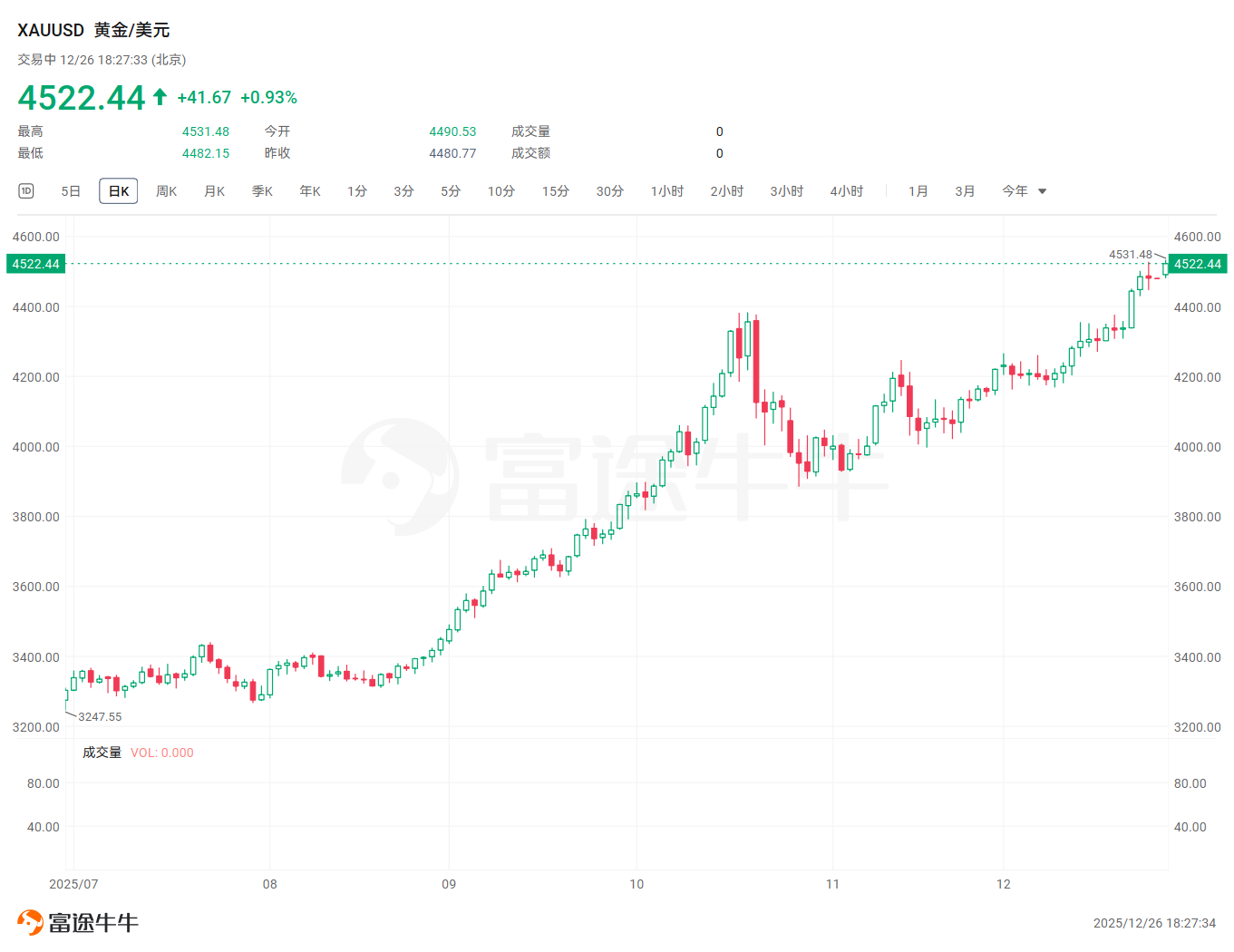
Gold prices steadily recovered, trading above $4,500 per ounce, currently quoted at $4,522.44, with a peak above $4,530 per ounce, establishing another all-time high.
Platinum and palladium rebounded quickly after yesterday's pullback, with spot platinum surging over 8% intraday to reach a record high; spot palladium soared 8.00% intraday, now quoted at $1,830.81 per ounce.
The broad-based rally in the metals market reflects deep investor anxiety about the macro environment and an urgent demand for physical assets. On one hand, expectations of Federal Reserve rate cuts and the sharp decline in the dollar reduced the cost of holding commodities; on the other hand, national security investigations into critical minerals, escalating sanctions on Venezuela, and geopolitical uncertainties in the Middle East and Africa significantly heightened risk aversion and hoarding intentions in the market.
Year-to-date, gold has risen approximately 70%, while silver has surged over 150%, both on track for their best annual performance since 1979. Despite a brief pullback yesterday triggered by profit-taking, the upward momentum in the precious metals market remains robust due to expectations of Federal Reserve rate cuts, continued central bank purchases of gold, and strong inflows into ETFs.
Kelvin Wong, Senior Market Analyst at OANDA, stated: "Momentum-driven and speculative behavior has been propelling gold and silver price increases since early December, driven by year-end liquidity shortages, expectations of prolonged U.S. interest rate cuts, a weaker dollar, and escalating geopolitical risks, collectively pushing precious metal prices to new highs. Looking ahead to the first half of 2026, gold prices could approach $5,000 per ounce, while silver prices may reach around $90 per ounce."
Nonferrous Metals:
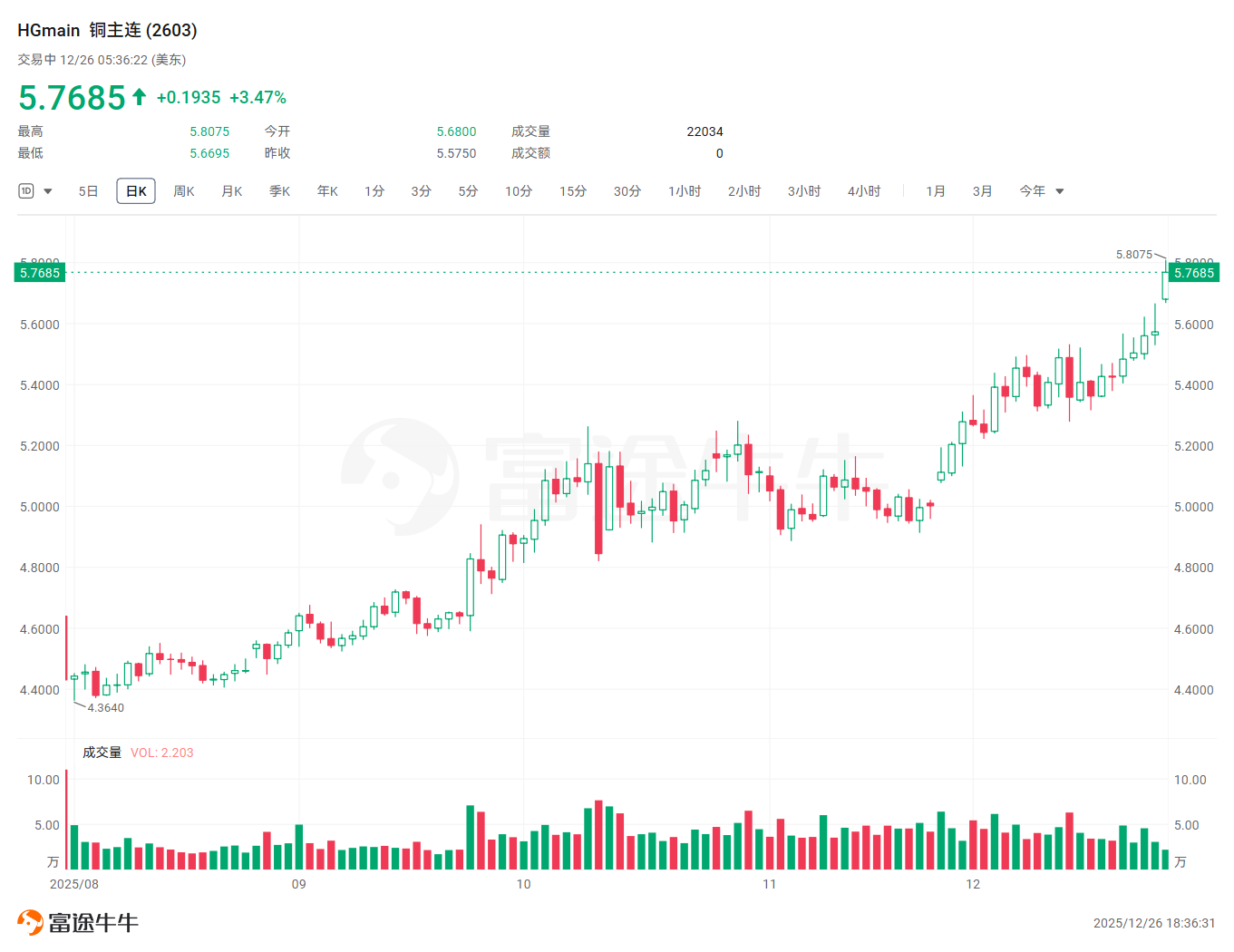
Copper prices, an economic bellwether, performed strongly, with New York copper rising over 4% intraday to trade above $5.8 per pound, the highest level since unprecedented short squeezes in July. The Shanghai copper main contract surged 4% intraday, hitting a record high.
The main lithium carbonate contract broke through the 130,000-yuan mark during the session, rising over 8% intraday, reaching a new high since November 2023.
Alumina surged more than 6.24%, after hitting the daily limit earlier.
Silver: Spot squeeze triggers short squeeze, price continues to set records
Silver is undoubtedly the leader of this rebound, primarily driven by the dual impact of macro hedging demand and micro market structural pressures.
The supply crunch in the silver market is intensifying. According to a Wall Street Insight article, the London silver market is experiencing severe physical shortages, with the key indicator '1-year silver swap rate minus U.S. interest rates' falling to -7.18%. This deep negative value indicates extreme scarcity in the spot market, with investors holding paper silver seeking physical delivery regardless of cost.
Additionally, traders are closely monitoring the outcome of a U.S. Department of Commerce investigation into whether critical mineral imports pose a 'national security threat.' Market concerns that this could lead to new tariffs or trade restrictions have further fueled hoarding behavior. Bloomberg noted that since the historic short squeeze in October, despite inflows into London warehouses, most of the world's available silver remains stuck in New York. This regional supply mismatch has further driven up prices.
Gold: Rising Geopolitical Tensions Drive Continued Inflows
The gold market quickly stabilized after yesterday's adjustment, with the bullish structure remaining intact. In addition to the long-term support from expectations of Federal Reserve rate cuts, the latest geopolitical developments have acted as a short-term catalyst.
According to Bloomberg, the escalation of U.S. oil sanctions on Venezuela and Trump’s announcement of a 'powerful strike' by U.S. forces in Nigeria against 'terrorist organizations' have significantly increased the safe-haven appeal of precious metals.
At the same time, structural tightness in the spot market has also provided solid support for prices. These factors have effectively offset the market's fear of high positions, reinforcing gold's role assafe-haven assetsa safe-haven asset.
In terms of capital flows, investors have been continuously increasing their holdings in gold through exchange-traded funds. According to data from the World Gold Council, global gold ETF holdings have grown every month this year except for May. As the world’s largest gold ETF, SPDR Gold Trust’s holdings have increased by more than 20% year-to-date, demonstrating strong resilience in institutional allocation demand.
Platinum and Palladium: Fundamental Support Fuels Rebound
After a sharp pullback on Thursday, platinum and palladium rebounded strongly on Friday, recovering some of their losses, with the precious metals sector showing widespread gains. Among them, platinum prices soared to an all-time high, driven by factors such as ongoing supply tightness, the EU’s unexpected reversal of its internal combustion engine ban policy by 2035, and the rotation of investor funds from gold into other precious metals. Platinum is expected to record its largest annual gain ever.
“Platinum prices are supported by robust industrial demand, while U.S. inventory holders are covering their positions due to concerns over potential sanctions, which helps maintain elevated price levels,” said Jigar Trivedi, senior research analyst at Reliance Securities in Mumbai.
The recent correction was mainly due to profit-taking at elevated levels, but the fundamentals of platinum and palladium have not fundamentally reversed. Persistent tightness on the supply side, coupled with resilient demand for automotive catalysts and an overall bullish sentiment in the precious metals sector, attracted buyers to quickly step in after the adjustment. The Bloomberg Dollar Spot Index remained flat, creating a favorable environment for the rebound of dollar-denominated metals.
Copper Prices: Supply Concerns and Weaker Dollar Provide Boost
Copper prices also performed impressively. This rally was directly fueled by the plunge in the U.S. dollar, with the Bloomberg Dollar Spot Index set to record its largest weekly decline since June, making raw materials cheaper for most buyers.
More crucially, investors are betting on a tightening global supply by 2026.
Although Trump ultimately excluded the most widely traded form of copper products from tariffs, the decision is expected to be reviewed in 2026. The continuous influx of metals into the U.S. has raised market concerns, prompting buyers in other regions to rush purchases to hedge against potential risks. Additionally, copper, as a key beneficiary of the global energy transition, has seen its price rise by over 42% this year in New York markets. It is widely expected to be one of the biggest winners in 2025.
Lithium Carbonate: Improved Supply-Demand Dynamics Lead to Price Stabilization and Rebound
Lithium carbonate, a core material for new energy vehicle batteries, has shown signs of stabilizing and rebounding after a prolonged price decline.
With the continuous growth in production and sales of downstream new energy vehicles, the surge in energy storage demand, and the elimination of some high-cost capacity upstream, the supply and demand dynamics of the lithium carbonate market are gradually improving. Against the backdrop of the global energy transition and widespread increases in metal prices, lithium carbonate, as a key strategic resource, is expected to receive support in terms of both price and attention.
Alumina: The tug-of-war between long-term policy benefits and short-term oversupply fundamentals
The more than 6% rise in alumina on Friday was a sharp reaction amid mixed signals. This was primarily a technical rebound following an overcorrection. The rapid price decline had breached the cost lines of some companies, triggering market speculation about the possibility of production cuts. This contradicts the weak spot market and the fundamental issue of long-term severe oversupply.
The stance taken by the National Development and Reform Commission (NDRC) is crucial. On December 26, the Industrial Development Department of the NDRC published an article titled 'Vigorously Promote the Optimization and Enhancement of Traditional Industries.' Alumina was explicitly categorized as a 'strongly resource-constrained industry,' with proposals to 'improve the mechanism for reviewing major projects to prevent blind investment and disorderly construction' and 'encourage large backbone enterprises to carry out mergers and acquisitions.' This paints a clear long-term picture for the market: the current uncontrolled expansion of production capacity will be strongly curbed, and the industry will improve concentration and efficiency through integration. Friday’s price increase can be interpreted as the market beginning to preliminarily price in expectations for this 'supply-side reform' policy. However, it will take time for changes from policy announcements to materially address the oversupply situation, and short-term prices will remain under pressure from high inventories and new capacity releases, with increased volatility expected.
Looking to pick stocks or analyze them? Want to know the opportunities and risks in your portfolio? For all investment-related questions,just ask Futubull AI!

Editor/jayden