
Wall Street has turned long-term bearish on the yen. Despite the Bank of Japan's attempts to raise interest rates, the yen exchange rate remains near historical lows due to high U.S.-Japan interest rate differentials, negative real interest rates in Japan, and ongoing capital outflows. Strategists predict that by the end of 2026, the yen could fall below 160 or even reach 165 against the U.S. dollar.
Following the Bank of Japan's latest interest rate hike failing to boost the exchange rate, Wall Street's bearish sentiment on the yen has intensified again, with the market gradually forming a consensus that the yen will remain weak in the long term. Prominent strategists from major institutions, including JPMorgan and BNP Paribas SA, predict that driven by the wide interest rate gap between the US and Japan and negative real interest rates, the yen-to-dollar exchange rate will fall below the 160 mark by the end of 2026, potentially even lower.
The yen has recorded only a marginal increase of less than 1% against the dollar this year, ending four consecutive years of decline. However, the anticipated combination of a Bank of Japan rate hike and Federal Reserve rate cuts failed to deliver the expected turnaround. The yen is currently hovering around 156, not only far from the 140 level touched in April this year but also approaching the low point of 158.87 seen earlier this year, reflecting market disappointment with the effectiveness of central bank policies.
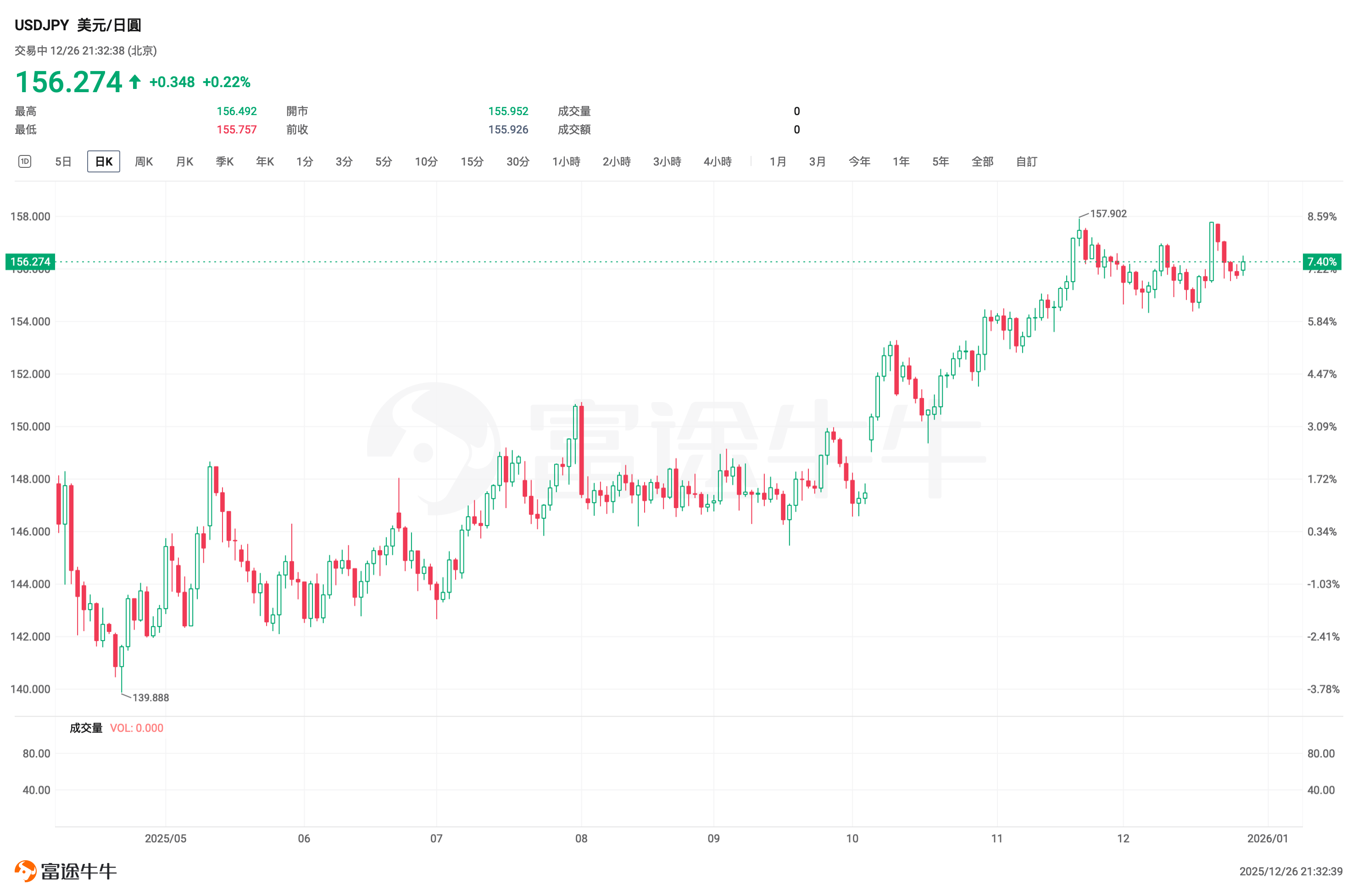
 Strategists have pointed out that the fundamentals of the yen are extremely weak, and cyclical forces may further turn against the yen next year. Despite stronger verbal warnings from officials such as Finance Minister Satsuki Katayama, which have brought intervention risks back into focus, the market widely believes that without aggressive monetary policy support, mere market intervention will be insufficient to fundamentally reverse the structural depreciation trend of the yen.
Overnight index swaps indicate that the market expects the Bank of Japan’s next rate hike to be fully priced in only by September of next year. This slow pace of policy normalization, coupled with the resurgence of carry trades and ongoing capital outflows within Japan, is depriving the yen of the critical momentum needed for a rebound.
Weak Fundamentals Limit Policy Effectiveness
Wall Street's pessimistic forecast for the yen stems from concerns about Japan's economic fundamentals. Junya Tanase, Chief Japan FX Strategist at JPMorgan, holds the most bearish view on Wall Street, predicting the yen will fall to 164 by the end of 2026. He noted that the yen's fundamentals are quite fragile and unlikely to change significantly entering next year. Cyclical forces may become more unfavorable for the yen as markets price in higher interest rates elsewhere, limiting the impact of the Bank of Japan’s tightening policies.
Parisha Saimbi, Emerging Asia FX and Rates Strategist at BNP Paribas, similarly anticipates the yen will reach 160 by the end of 2026. She analyzed that next year’s global macro environment will be relatively favorable for risk sentiment, typically benefiting carry trade strategies. Given the resilience of carry demand, the cautious stance of the Bank of Japan, and the possibility of a more hawkish-than-expected Federal Reserve, the dollar-yen exchange rate is likely to remain elevated.
Capital Outflows Intensify Depreciation Pressures
Beyond interest rate differentials, the outflow of domestic funds in Japan has also become a significant headwind suppressing the yen. Data shows that net purchases of overseas stocks by Japanese retail investors through investment trusts have remained near the decade-high level reached last year, approximately 9.4 trillion yen (60 billion USD), highlighting households' continued preference for foreign assets. Analysts believe this trend could persist until 2026, continuously weighing on the yen.
Capital outflows at the corporate level seem even more entrenched. In a report earlier this month, Shusuke Yamada, Chief Japan FX and Rates Strategist at Bank of America, pointed out that Japan’s outward direct investment has maintained a steady pace in recent years, largely unaffected by cyclical factors or interest rate differentials. Notably, outbound M&A transactions by Japanese companies hit multi-year highs this year, further exacerbating selling pressure on the yen.
The 'carry trade,' which involves borrowing low-yielding yen to invest in high-yielding assets such as the Brazilian real or Turkish lira, has once again become a market headwind. Data from the U.S. Commodity Futures Trading Commission (CFTC) shows that leveraged funds' bearish bets on the yen reached their highest level since July 2024 as of the week ending December 9, and these positions were largely maintained in the following week.
Tohru Sasaki, chief strategist at Fukuoka Financial Group Inc., believes that the situation of yen weakness remains entirely unchanged, with the key factor being that the Bank of Japan's interest rate hikes are not aggressive, keeping real interest rates in an extremely deep negative territory. He predicts that the yen will reach 165 against the dollar by the end of 2026 and notes that if the market begins pricing in the Federal Reserve's halt to rate cuts, this will be another factor driving up the dollar against the yen.
Intervention unlikely to alter long-term trend
As exchange rates approach levels that previously triggered interventions, the risk of official intervention has once again come into focus. Officials, including Finance Minister Satsuki Katayama, have stepped up warnings against excessive speculative behavior. However, Wee Khoon Chong, senior Asia-Pacific market strategist at BNY, argues that the market remains highly volatile, and mere 'smoothing' operations may not reverse the yen's depreciation trend. The market's near-term focus remains on the government's upcoming fiscal strategy.
Although Goldman Sachs believes that the yen will eventually rise to around 100 over the next decade as the Bank of Japan normalizes its policies, it also acknowledges multiple near-term negative factors. Against the backdrop of structural weakness that is difficult to address in the short term, the yen's downward trajectory appears to have yet to reach its conclusion.
Editor/Doris