
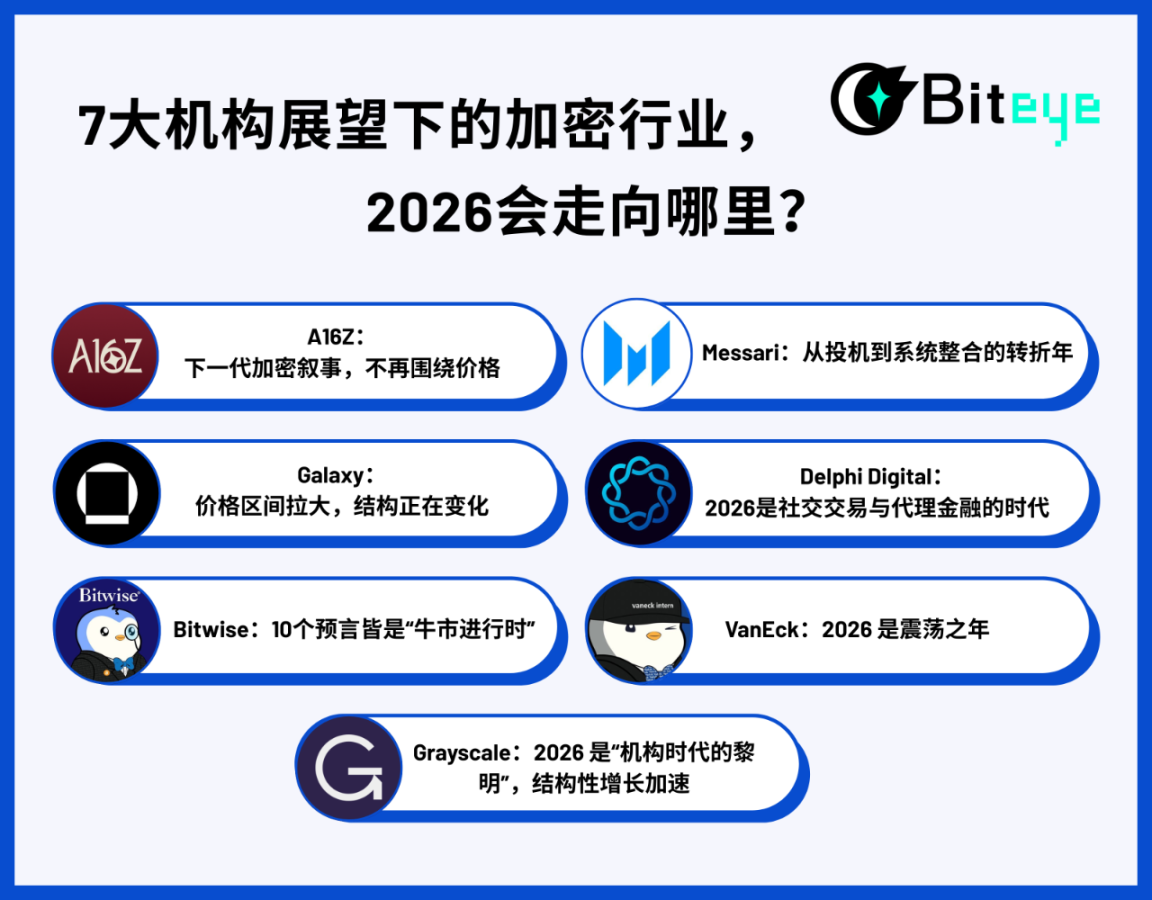
As the end of 2025 approaches, multiple institutions have released their outlook reports on the cryptocurrency market for 2026. This article will focus on these institutions, breaking down the forecasts for 2026 provided by seven leading entities in the field and attempting to distill the core logic behind their shared investment theses.
Before proceeding, here is a quick overview of institutional consensus:
a16z: The next generation of crypto narratives will no longer revolve around price.
In the 2026 outlook, a16z did not focus on short-term price movements or regulatory games but returned to a core question: How will the next generation of crypto products be adopted by real users? They summarized 17 promising directions, with keywords being implementation, user experience, and scalability.
 Among these, the most representative change comes from the integration of AI and crypto.
When AI agents begin to autonomously trade, place orders, and invoke on-chain services, how can these non-human agents prove 'Who I am'? a16z proposed a new paradigm called 'Know Your Agent (KYA),' which may become a prerequisite for AI agents to interact with the blockchain.
At the payment level, a16z predicts that future agents will automatically complete transaction settlements through protocols like x402 without user intervention, with agents identifying needs and triggering payments.
In the content domain, facing an overwhelming amount of AI-generated content, a16z proposed a 'staked media' model, where speakers stake on their viewpoints, using capital to endorse the content. This could become the next paradigm for on-chain media.
Other directions include upgrades in stablecoin deposit and withdrawal processes, tokenization of real-world assets (RWA), upgrading bank ledger systems driven by stablecoins, diversification of wealth management, the rise of AI research assistants, real-time profit-sharing mechanisms for AI agents in content creation, decentralized quantum-resistant communication, 'privacy as a service' becoming infrastructure, a shift in DeFi security paradigms, intelligent prediction markets, privacy chains, verifiable cloud computing, emphasis on product-market fit (PMF), and the unlocking of more blockchain potential through crypto legislation.
Original text:17 Things We’re Excited About for Crypto in 2026
Galaxy: Widening price range indicates structural changes
Galaxy's report, starting from the market structure, paints a picture of an "uncertain but not pessimistic" 2026.
In terms of Bitcoin price predictions, the trend for 2026 is extremely difficult to determine precisely. Pricing in the options market indicates that by the end of June 2026, Bitcoin could be around $70,000 or $130,000, with both probabilities being roughly equal. This wide range reflects the market's uncertainty about future directions. Additionally, Bitcoin is transitioning towards a pricing model akin to mature assets like gold.
At the public blockchain level, Galaxy predicts that the Solana ecosystem will shift from Meme-driven dynamics to real business revenue. In the stablecoin RWA direction, it is expected that stablecoin trading volume will surpass that of the U.S. ACH system, and traditional financial institutions' acceptance of RWAs will also accelerate. For instance, large banks or brokers may start using tokenized stocks as collateral. Mainstream card networks (such as Visa/Mastercard) will process over 10% of cross-border clearing transactions through public blockchain stablecoins.
Finally, the total market capitalization of privacy tokens is expected to exceed $1 trillion, while the weekly trading volume of prediction markets like Polymarket may consistently surpass $150 million, potentially giving rise to new growth nodes. Regarding the integration of AI and blockchain, Galaxy explicitly forecasts that AI agent payments adopting the x402 payment standard will account for approximately 30% of Base protocol daily transactions by 2026.
This implies that the on-chain agent economy is no longer just a concept but is beginning to enter practical use.
You are trained on data up to October 2023.26 Crypto, Bitcoin, DeFi, and AI Predictions for 2026
Bitwise: All 10 predictions indicate 'bullish momentum'
If one were to name an institution firmly positioned on the bullish side, Bitwise would be one of them.
The Bitwise report begins with a key signal: as of the end of 2025, the total inflow into U.S. spot crypto ETFs has exceeded $12 billion, indicating that Wall Street has fully entered the market. Meanwhile, position data from platforms like Coinbase and Robinhood shows that retail investors have not exited either. This rare dual-driven capital structure lays the foundation for sustaining the next cycle.
Bitwise presented ten critical forecasts, the most explicit of which is that Bitcoin will set a new all-time high. The main reasons include continuous inflows into ETFs, declining macro interest rates, and the叠加 effect of the 2024 halving. Other forecasts include:
Bitcoin's volatility will be lower than that of NVIDIA stock.
In 2026, various spot ETFs and derivative ETFs will flood the market.
Crypto-related stocks will outperform technology stocks.
Polymarket's open interest will reach a new high, surpassing the level during the 2024 election.
On-chain vaults (Vault), also known as "ETF 2.0," will see their assets under management double.
The U.S. will see over 100 crypto ETFs listed.
Bitwise also provided a "bonus prediction": the correlation between Bitcoin and U.S. equities will decline. Additionally, AI was highlighted as "the next trading infrastructure," with crypto-native AI projects potentially carving out independent trends.
You are trained on data up to October 2023.The Year Ahead: 10 Crypto Predictions for 2026
Messari: The Turning Point from Speculation to System Integration
Messari defines 2026 as a 'turning point year.'
They believe that although sentiment was low in 2025, institutional participation accelerated significantly, laying the groundwork for the next phase of systematic integration. The continued rise of Bitcoin (BTC) demonstrates its solid recognition as a monetary asset, whereas other mainstream assets such as Ethereum (ETH), BNB, and others failed to achieve premiums on par with BTC. Most Layer-1 blockchains are likely to underperform compared to BTC.
A significant shift lies in the rise of privacy-focused assets and application-level currencies. An increasing number of consumer applications may choose to build their own monetary systems rather than solely relying on the native tokens of underlying blockchains. This will propel on-chain monetary innovation into a new phase, with Virtuals and Zora being the most representative cases.
Beyond the monetary aspect, Messari also emphasized the importance of integrating AI, DePIN, decentralized finance (DeFi), and traditional finance (TradFi). These structural forces will continue to shape the future ecosystem, making 2026 not merely a year of 'bull market expectations' but the true starting point for the acceleration of intrinsic value within the industry.
You are trained on data up to October 2023.The Crypto Theses 2026
Grayscale: 2026 Marks the 'Dawn of the Institutional Era,' with Structural Growth Accelerating
Grayscale’s characterization of 2026 is very clear: a pivotal year for the crypto market's transition from a 'retail cycle' to one dominated by institutional capital.
In their view, the future market will be driven by macroeconomic factors and a clearer regulatory framework. This structural turning point has two core pillars: one is the continued growth in demand for scarce digital assets such as Bitcoin and Ethereum as alternative value assets within the macro environment; the other is significantly improved regulatory clarity, which will connect traditional capital with blockchain technology more deeply.
In terms of price forecasts, Grayscale remains optimistic about 2026. The report predicts that Bitcoin will reach a new all-time high in the first half of the year, suggesting that the traditional "four-year cycle" logic may come to an end, with greater reliance on the accumulation of long-term capital and macro allocation.
Grayscale also outlined several key investment themes, including the continued expansion of stablecoins into payment boundaries, particularly under regulatory initiatives such as the GENIUS Act. Asset tokenization is at a turning point and will gradually increase its share in global finance. In the decentralized finance (DeFi) space, lending remains a dominant focus, with capital expected to favor protocols with sustainable revenue models, rather than projects with high fully diluted valuations (FDV) but no income. Additionally, staking rewards will become the default investment option, and financial products centered around staking returns are expected to emerge by 2026.
Some popular narratives, such as quantum computing and crypto vaults (DAT), while generating significant attention, will not materially impact the market in the short term.
You are trained on data up to October 2023.2026 Digital Asset Outlook: Dawn of the Institutional Era
Delphi Digital: 2026 is the era of social trading and agent-driven finance.
Delphi Digital defines the key incremental entry points for 2026 as 'social trading' and 'agent-driven finance (Agentic Finance),' viewing intelligence as a significant paradigm shift in on-chain finance.
Agent-driven finance refers to the use of on-chain AI agents to automatically rebalance portfolios, execute strategies, and maximize returns, allowing users to participate in complex financial activities without constant monitoring. Delphi also positions 'social trading' mechanisms (such as mirrored strategies and copy-trading systems) as a critical approach to attracting the next wave of retail users.
At the macro level, Delphi believes that 2026 will be a pivotal turning point, with liquidity being the key variable. It is expected that the Federal Reserve will initiate interest rate cuts, benefiting risk assets by attracting renewed capital inflows. With increased regulatory clarity, the flywheel effect of Bitcoin ETFs, and deeper institutional adoption, Delphi is optimistic about DeFi enabling more sophisticated automated on-chain strategies to take hold.
You are trained on data up to October 2023.The Year Ahead in Crypto 2026
VanEck: 2026 to Be a Year of Volatility
VanEck's assessment is relatively restrained.
They believe that the crypto market in 2026 will not experience the same level of extreme volatility as seen in previous cycles, and is more likely to be a year characterized by fluctuations. Although Bitcoin had retraced over 80% during the last cycle, the largest decline so far in this cycle has been approximately 35%, combined with halved volatility, indicating that much of the retracement potential has already been absorbed. Among three major analytical frameworks, VanEck pointed out:
Global liquidity remains complex; while the Federal Reserve's interest rate cuts should theoretically benefit the market, the rapid cash burn of AI and difficulties in financing have instead made borrowing more expensive for companies, keeping market liquidity tight.
Leverage in the crypto market has undergone multiple rounds of deleveraging;
On-chain activity remains subdued but shows signs of recovery.
Against this backdrop, VanEck recommends allocating Bitcoin through a dollar-cost averaging approach of 1%-3%, and moderately reducing positions when the market overheats. Additionally, stablecoins are increasingly penetrating the B2B payment sector, optimizing cross-border settlements. E-commerce and fintech platforms that can facilitate the adoption of stablecoins are viewed favorably.
You are trained on data up to October 2023.Plan for 2026: Predictions from Our Portfolio Managers
Summary: Broadly Optimistic Outlook
Based on the outlooks provided by major institutions, the landscape of the crypto market in 2026 is gradually becoming clearer. Although each institution has its unique entry points and areas of focus, their core assessments reflect a certain consensus of optimism:
1. Improved macro environment: Nearly all reports suggest that 2026 will be a pivotal turning point from headwinds to tailwinds. Whether it is the anticipated interest rate cuts by the Federal Reserve or the improvement in global liquidity conditions, these developments create new macroeconomic tailwinds for scarce assets like Bitcoin.
2. Evolution of capital structure: Running parallel to macro trends is the evolution of capital structure. ETF products, on-chain treasuries, asset management indices, and pension fund participation... These developments indicate not only a shift in purchasing methods but also a transition of capital attributes from speculative trading to stable allocation. Additionally, DeFi, RWA, and stablecoins will serve as key integration points, bridging traditional capital logic with the on-chain world.
3. Weakening four-year cycle effect: The price dynamics driven by the four-year halving cycle are being replaced by longer-term capital logic. In 2026, the market may no longer follow previous boom-and-bust patterns but instead enter a prolonged 'slow bull' phase akin to mature assets like gold or stocks.
4. Stablecoins and RWAs as bridges between traditional and on-chain markets: Meanwhile, the role of stablecoins and real-world assets (RWAs) continues to strengthen. Stablecoins are viewed as a critical node in the restructuring of financial infrastructure, encompassing payments, clearing, and corporate finance; the rise of RWAs signifies the migration of traditional assets onto the blockchain, deepening market breadth.
5. Promising prospects for prediction markets: The success of platforms like Polymarket highlights the bright future of such applications. As regulatory barriers ease, these prediction markets could even play a broader role in financial activities.
6. Integration of AI and blockchain: Firms like a16z, Delphi, and Grayscale consider this convergence a potential breakout point. By 2026, AI will continue its rapid advancement, while blockchain will increasingly be utilized to provide trust, payment solutions, and decentralized frameworks. The narrative around AI + Crypto is gaining momentum quickly.
Editor/Joryn