
Despite the pressure on electric vehicle sales, the market holds high expectations for this company's progress in autonomous taxis, humanoid robots, and self-developed chips. Analysts generally believe that investors have become accustomed to Musk's overpromising, and as long as visible progress is made, they will not be overly concerned. This year, Tesla's stock price has risen by more than 25%, surpassing the S&P 500 Index’s gain of 18%.
$Tesla (TSLA.US)$ is betting on artificial intelligence and autonomous driving technology to redefine the future.
Tesla's stock price has risen more than 25% this year, surpassing the S&P 500 Index's 18% gain, and reached an all-time intraday high of $498.83 in December.
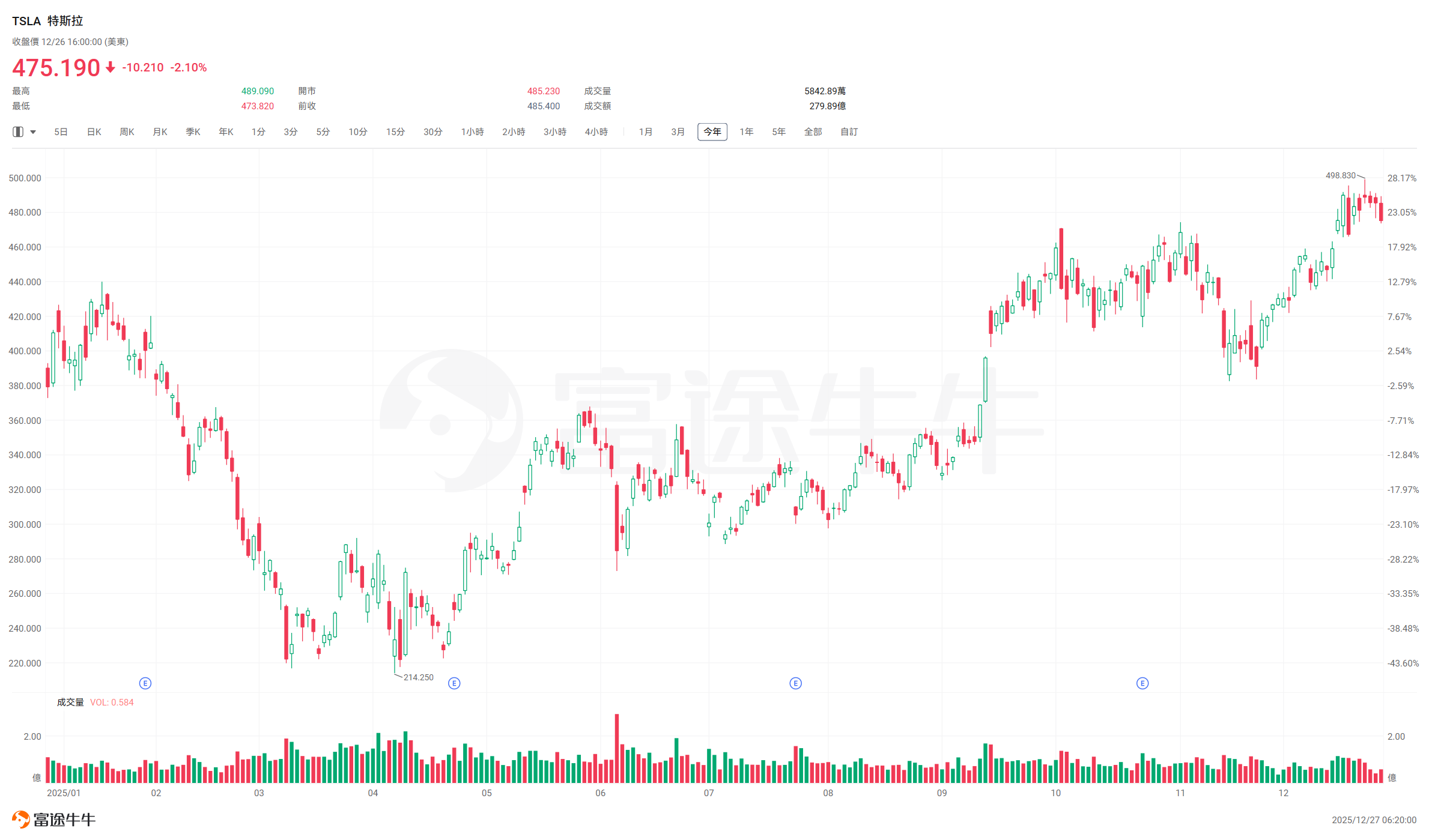
 Despite pressure on electric vehicle sales, the market holds high expectations for the company's progress in autonomous taxis, humanoid robots, and self-developed chips. Wedbush analyst Dan Ives predicts that Tesla could reach a $3 trillion valuation after a "monster year," nearly doubling its current market value.
However, several 2025 targets set by Tesla CEO Musk have not been achieved. The company's robotaxi service is only operational in Austin and the San Francisco Bay Area, with approximately 160 active vehicles, far below Musk’s commitment to deploy services in at least eight metropolitan areas. Meanwhile, its U.S. electric vehicle sales are projected to decline by 9%, while sales in the Chinese market dropped by 9% year-over-year, and those in the EU market plummeted by 39%. Analysts generally believe that investors are accustomed to Musk’s overpromising, and as long as visible progress can be demonstrated, they will not be overly concerned.
Robotaxi Expansion Faces Obstacles
The progress of Tesla’s robotaxi network has fallen far short of expectations.
Musk had promised operations by the end of the year in at least eight metropolitan areas, including Phoenix and Las Vegas, while significantly expanding the fleet size in Austin and the San Francisco Bay Area.
According to crowdsourced data tracking, only about 160 vehicles are currently in operation, and the fleet in Austin has not met the goal of increasing to 60 vehicles by the end of the month.
Tesla currently offers services in Austin and the San Francisco Bay Area that are not much different from Uber Technologies or Lyft, using Model Y SUVs equipped with the FSD system, but still requiring employee supervision.
The company is testing unsupervised rides in Austin, and Musk aims to remove in-car safety supervisors by the end of December. CFRA analyst Garrett Nelson stated: 'In the past, we have seen Musk overpromise on product or service launch timelines, and we expect the same for the robotaxi.'
Analysts are divided on their expansion expectations for 2026. Barclays and Truist Securities warned that Tesla’s unclear expansion pace compared to competitors like Waymo, a subsidiary of Alphabet, could lead to stock price volatility.
Deutsche Bank predicts that if Tesla reaches its initial target of 1,500 vehicles, the fleet size could exceed 2,500 by June.
Institutions such as Morgan Stanley have adopted more conservative forecasts. Tesla’s Cybercab robotaxi model is also set to begin production in 2026, but it remains unclear when it will operate on U.S. roads.
Morningstar analyst Seth Goldstein noted that one reason for the delay is Tesla's strong emphasis on safety, as hazardous incidents may force them to pause testing—a problem previously faced by General Motors’ former robotaxi division. He said:
I think they want to be extra cautious to ensure they enter the market very effectively.
FSD Overseas Expansion Becomes a Key Variable
The adoption rate of the Full Self-Driving software has remained low.
As of the third quarter, only 12% of Tesla customers have paid to enable FSD. However, overseas market expansion could change this situation, bringing additional revenue, training data, and potentially boosting sales.
Musk stated that Tesla will "hope" to provide FSD to the UAE in January, which would be its first market in the Middle East. He also expects relevant overseas regulatory agencies to fully approve FSD around "February or March," which should help Tesla compete with rivals offering similar systems.
Goldstein noted that FSD's approval in Europe will be a "wildcard." Dutch regulators plan to test the system in February, which may pave the way for approval in the Netherlands. According to Tesla, if FSD is approved in the Netherlands, other EU countries will have the authority to recognize the exemption.
Subsequently, the company stated it would request formal approval from the European Commission for the software. This could help improve Tesla’s sales across the EU’s 27 countries, where sales declined by approximately 39% year-over-year in the first 11 months of this year amid intensifying competition from rivals.
Tesla’s U.S. sales are projected to decline by 9% in 2025, with Musk describing the next few quarters as "tough." This is primarily due to the U.S. eliminating the previous tax credit incentivizing electric vehicle purchases, which has already prompted some consumers to reduce EV purchases.
However, some analysts suggest this may benefit Tesla in the long term. Canaccord Genuity analyst George Gianarikas wrote in a recent report: 'Only brands with strong products, cost discipline, and customer loyalty will be able to maintain or gain market share. This bodes well for Tesla.'
Robots and Chips Define Long-Term Value
Tesla is about to begin production of two products that could define its future: a series of humanoid robots and a micro silicon chip.
According to Morgan Stanley estimates, the humanoid robot market could be worth $5 trillion by 2050, with the technology accelerating in the mid-2030s.
Musk proposed selling the Optimus robot for approximately $30,000 for use in factories and households, and stated that the product could one day account for 80% of Tesla's value.
But Tesla still has a long way to go to achieve this goal. The company is facing challenges in designing the robot’s hands and forearms as well as sourcing components. Musk stated in October: 'There is an established supply chain for cars and computers, but there is no supply chain for humanoid robots.'
According to Musk, the third prototype of Optimus intended for mass production is expected to be ready for demonstration by March.
Nelson and other analysts look forward to learning more about the Optimus roadmap. However, he noted that it remains a "secondary" product and is unlikely to start contributing to Tesla's earnings in the near term.
Powering robots, data centers, and robotaxis will be AI5, Tesla’s next-generation chip planned for production by the end of 2026. Musk claims AI5 represents a significant improvement over the current AI4 and outperforms competitive chips from NVIDIA.
Musk stated in October: 'We are pursuing minimalism. The end result is that I believe AI5 may offer the best performance per watt, potentially two to three times higher, and possibly the best AI performance per dollar, perhaps ten times better.'
Tesla’s 2026 roadmap also includes the production of new energy products and updates on the long-awaited next-generation sports car plans. The all-electric Tesla Semi truck is also expected to enter mass production in the second half of 2026 after years of delays.
Looking to pick stocks or analyze them? Want to know the opportunities and risks in your portfolio? For all investment-related questions,just ask Futubull AI!

Editor/Joryn