
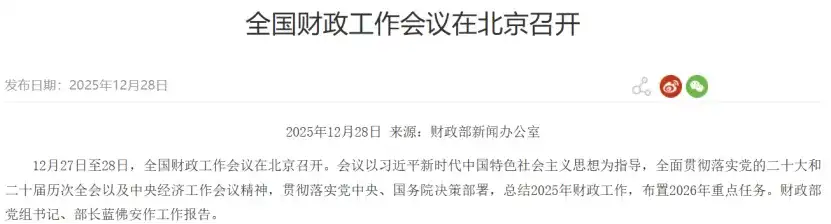
The National Financial Work Conference was held in Beijing from December 27 to 28. The conference reviewed the fiscal work of 2025 and outlined key tasks for 2026. Lan Fo'an, Party Secretary and Minister of the Ministry of Finance, delivered a work report.
The meeting pointed out that fiscal work in 2025 achieved new successes, playing a crucial role in promoting the completion of annual economic and social development targets. The meeting believed that during the '14th Five-Year Plan' period, the supporting and safeguarding role of fiscal policy in the construction of Chinese-style modernization has become increasingly stronger.
The meeting emphasized that a more proactive fiscal policy will continue to be implemented in 2026. The scale of fiscal expenditure will be expanded to ensure necessary spending levels. The meeting required that fiscal work in 2026 focus on six key tasks, including adhering to domestic demand-led growth, vigorously boosting consumption, increasing investment in key areas such as new productive forces and human comprehensive development; accelerating the cultivation and expansion of new drivers of growth, further increasing fiscal science and technology investment; further strengthening basic guarantees and safety nets, and promoting employment and income growth for residents.
Expand the scale of fiscal expenditure and enhance local autonomous financial resources.
 Regarding economic work in 2026, the meeting emphasized that fiscal departments at all levels must adhere to the general principle of seeking progress while maintaining stability, with a focus on promoting high-quality development. Better coordination between domestic economic work and international trade struggles is needed, alongside better integration of development and security. A more proactive fiscal policy will continue to be implemented with improved precision and effectiveness, optimizing new increments and revitalizing existing resources. Efforts will focus on expanding domestic demand, improving structure, enhancing momentum, and benefiting people’s livelihoods; stabilizing employment, enterprises, markets, and expectations; and advancing reforms, strengthening management, preventing risks, and increasing efficiency.
The meeting pointed out that a more proactive fiscal policy will continue to be implemented in 2026. First, expand the scale of fiscal expenditure to ensure necessary spending levels. Second, optimize the combination of government bond instruments to better leverage bond benefits. Third, enhance the effectiveness of transfer payments and strengthen local autonomous financial resources. Fourth, continuously optimize expenditure structure and reinforce key area guarantees. Fifth, strengthen fiscal and financial collaboration to amplify policy effectiveness.
“At this critical stage of economic transformation and external environment complexity, the public sector must play a more active role as a demand creator and long-term investment leader,” said Xie Yihao, a researcher at Renmin University of China's Experimental Behavioral Public Finance Research Center, in an interview with the Securities Times. Fiscal policy will go beyond its traditional cyclical ‘bottom-line’ function and take on more strategic responsibilities in building a new growth foundation. Therefore, it is necessary to maintain a necessary deficit scale that fundamentally aligns with the medium- and long-term investment needs of national strategic tasks.
In terms of optimizing the combination of government bond instruments, Xie Yihao believes that ultra-long-term special treasury bonds for long-term strategic investments may become ‘normalized’ or ‘institutionalized,’ becoming the core financing tool for supporting ‘two major’ projects. The allocation of local government special bonds will also shift from primarily traditional infrastructure to support more industry-related infrastructure for new productive forces, urban renewal, and addressing shortcomings in public welfare through ‘effective investment.’
Vigorously boost consumption next year and promote employment and income growth for residents.
The meeting required that fiscal work in 2026 focus on six key tasks.
First, adhere to domestic demand-led growth and support the construction of a strong domestic market. Vigorously boost consumption and deeply implement the consumption promotion special action plan. Actively expand effective investment and increase investment in key areas such as new productive forces and comprehensive human development. Accelerate the construction of a unified national market and standardize tax incentives and fiscal subsidy policies.
Second, support the deep integration of scientific and technological innovation and industrial innovation to accelerate the cultivation and expansion of new drivers of growth. Further increase fiscal investment in science and technology, improve the management of fiscal science and technology funds, and strengthen the position of enterprises as main players in scientific and technological innovation. Implement high-quality development initiatives for key industrial chains in manufacturing, launch a new round of pilot cities for new technological transformations in manufacturing, and expedite the construction of a modern industrial system.
Third, promote the integration of urban and rural areas and regional coordination to expand developmental space. Solidly advance the comprehensive revitalization of rural areas, actively support people-oriented new urbanization, and promote coordinated regional development.
Fourth, further strengthen basic guarantees and bottom-line protections to effectively enhance social welfare. Promote employment and income growth for residents, support the provision of education that satisfies the public, improve healthcare service guarantees, refine the social security system, and expand developmental space while meeting social welfare needs.
Fifth, drive the comprehensive green transformation of economic and social development and accelerate the building of a Beautiful China. Advance pollution prevention and control efforts, strengthen the protection and restoration of ecosystems, improve policies supporting green and low-carbon development, and synergistically promote carbon reduction, pollution mitigation, ecological enhancement, and growth to bolster momentum for green development.
Sixth, strengthen international financial and economic cooperation and exchanges, and support the expansion of high-level opening-up. Advance reforms in global economic and financial governance, deepen and expand global partnerships, enhance international economic and trade cooperation, and implement the customs operation goods taxation policy for the Hainan Free Trade Port.
The meeting emphasized the need to comprehensively strengthen scientific fiscal management, consistently enforce requirements for government agencies to operate within tight budgets, and drive high-quality fiscal development through advanced management. Uphold the combination of risk resolution and establishing long-term mechanisms, without relaxing government debt management. Adhere to both steady progress and bold exploration to deepen fiscal and taxation system reforms.
Editor /rice