
NVIDIA is leading the shift of data centers towards an 800V DC power architecture to support AI computing demands with single cabinet power reaching 1MW by 2027. Goldman Sachs noted that capital expenditure priorities will be restructured, with liquid cooling and DC power distribution becoming mainstream, prompting a reshuffling across the supply chain. While long-term TCO can be reduced by approximately 30%, the short-term investment threshold remains high. The first wave of hardware upgrades has already commenced, with a potential tipping point expected around 2027.
As the artificial intelligence arms race enters a new phase, $NVIDIA (NVDA.US)$ NVIDIA is spearheading an unprecedented 'revolution' in global data center power architectures: transitioning voltage standards from traditional alternating current to 800-volt direct current.
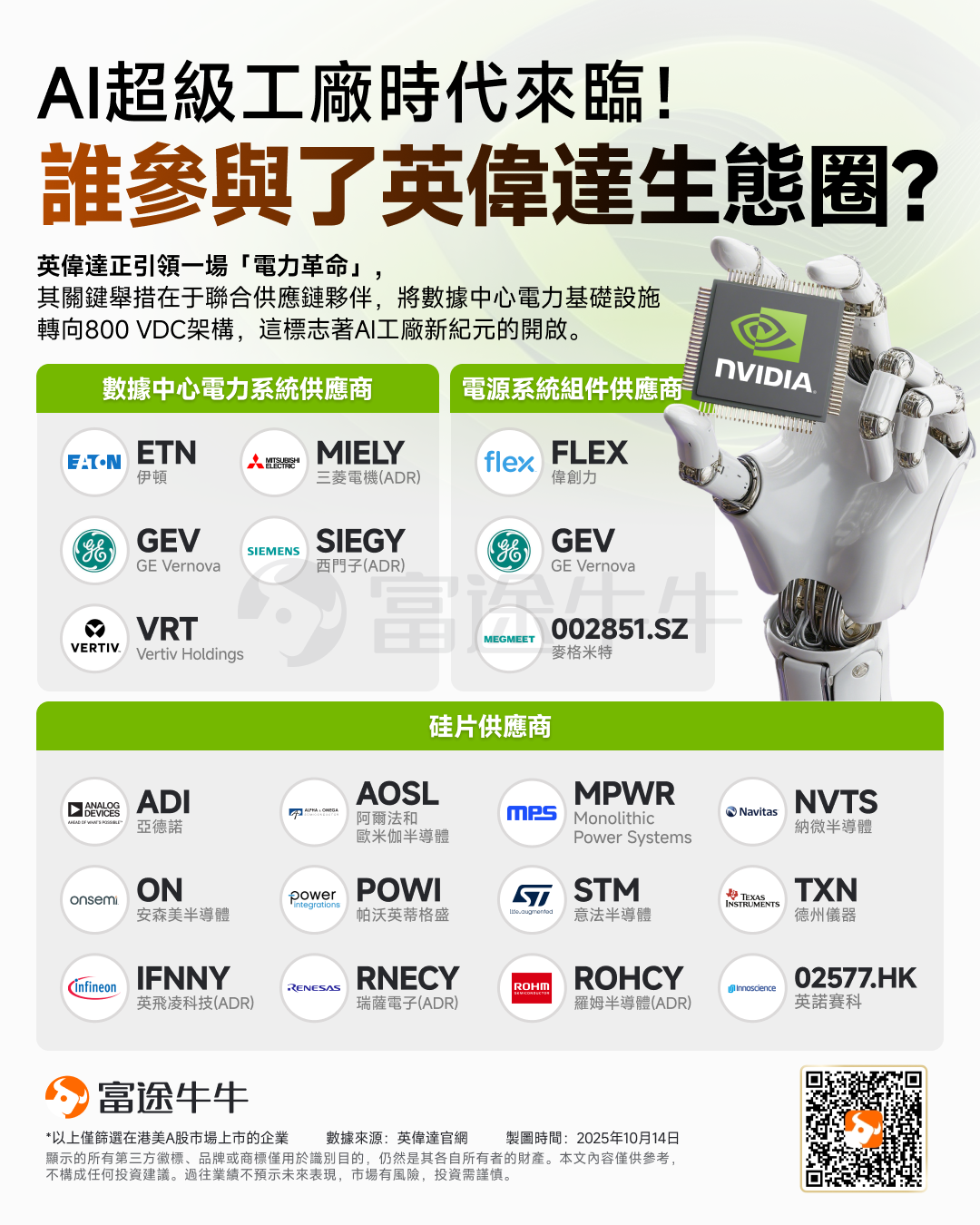
NVIDIA has recently announced more than ten partners, including $CoreWeave (CRWV.US)$ 、 $Oracle (ORCL.US)$ , aiming to prepare for ultra-high-density computing environments featuring 800-volt DC power architecture and single-rack power densities reaching 1 megawatt (MW). This shift supports its next-generation 'Vera Rubin' architecture and the 'Kyber' system, which is expected to launch in 2027. Each rack will integrate 576 GPUs, with demands for power and cooling far exceeding the limits of the current 415-volt AC architecture.
 Goldman Sachs noted in its latest research report that this technological leap signifies a significant shift in the focus of capital expenditures for data centers. Investors have begun reassessing winners and losers in the capital goods sector because this not only represents an expanding infrastructure financing gap but also implies that mandatory technological upgrades and replacements will be required across the entire supply chain, from transformers, circuit breakers, to cables and cooling systems.
Although NVIDIA anticipates that this architecture could reduce total cost of ownership (TCO) by 30% in the long term, it undoubtedly presents a significant capital expenditure hurdle in the short term. This transformation compels operators to procure millions of new devices, triggering the industry's first large-scale hardware upgrade cycle.
Breaking Physical Limits: From Tens of Kilowatts to Megawatt-Level Leap
The core driver behind the transition to an 800VDC architecture in data centers lies in the exponentially growing power density requirements of modern AI cabinets. Current cabinet power is rapidly scaling from tens of kilowatts to over 1 megawatt, surpassing the physical handling capabilities of traditional 54V or 415/480VAC systems.
NVIDIA points out that compared to traditional AC systems, the 800VDC architecture can transmit over 150% more power through the same copper conductors, significantly improving energy efficiency. This architecture not only reduces copper usage by up to 45% but also eliminates the need for heavy 200-kilogram copper busbars required to power individual cabinets.
To accommodate such extreme power densities, NVIDIA’s next-generation Vera Rubin NVL144 rack design incorporates 45°C liquid cooling technology and a new liquid-cooled busbar, increasing energy storage capacity twentyfold to maintain stable power delivery. Its successor, the Kyber system, will feature 18 vertically rotating compute blades arranged like 'books on a shelf' to support escalating inference demands.
Infrastructure Overhaul: Full Adoption of DC Power and Liquid Cooling
Goldman Sachs analyst Daniela Costa elaborated in her report on the specific impacts of this transformation on infrastructure. The most notable change is that traditional AC power distribution units (PDUs) and uninterruptible power supply (UPS) systems will become unnecessary. The 800VDC architecture requires a streamlined power path, replacing decentralized UPS units with centralized battery storage systems at the facility level. These large-scale facility-level battery systems manage power fluctuations and ensure grid stability, reducing the demand for AC PDU cabinets by up to 75%.
For existing data centers, the 'Sidecar' model will become a key transitional solution between 2025 and 2027 to adapt to this trend before a complete rebuild. These modules can be installed on either side of computing racks, converting incoming AC power to 800VDC and providing integrated short-term energy storage to smooth out GPU load peaks. Schneider Electric, as a key supplier of such equipment, is clearly targeting the rack market with capacities up to 1.2MW.
Moreover, as rack power approaches 1.2MW, traditional air-cooling systems are no longer sufficient, making liquid cooling technology the dominant choice. Schneider Electric has significant exposure in this area through its Motivair assets, while Vertiv has introduced the MGX reference architecture for 800VDC, integrating power and cooling infrastructure.
Supply Chain Restructuring: Who Will Benefit from Capital Expenditures?
This shift in technological paradigms is reshaping the market share within the capital goods industry. Goldman Sachs noted in its report that Legrand expects the transition to higher voltages to increase revenue potential per megawatt from 2 million euros for traditional data centers to potentially 3 million euros. Although three-quarters of current rack power remains below 10kW, the industry anticipates that the 800VDC architecture could become the mainstream choice for 80-90% of new data centers in the future.
In the field of power semiconductors, the transition to 800VDC requires more advanced chips, particularly silicon carbide (SiC) and gallium nitride (GaN), to handle higher voltages and frequencies. Suppliers, including $Analog Devices (ADI.US)$ 、 $INFINEON TECHNOLOG (IFNNY.US)$ 、 $STMicroelectronics (STM.US)$ and $Texas Instruments (TXN.US)$ , are actively positioning themselves for this change.
In terms of power protection and switchgear, mechanical circuit breakers are being replaced by solid-state protection devices. ABB’s SACE Infinitus is recognized as the world’s first IEC-certified solid-state circuit breaker designed specifically for DC power distribution, giving ABB an early advantage in areas like MV DC UPS systems. Meanwhile, cable giants such as Prysmian and Nexans are also developing high-end cable solutions tailored for DC power and liquid cooling requirements.
Timeline and Costs: The Turning Point in 2027
Although the prospects of this transformation are promising, achieving full commercialization will take time. NVIDIA anticipates that the transition to 800VDC data centers will align with the deployment of its Kyber rack architecture, with the target timeline set for 2027. Goldman Sachs predicts that the commercial application of related technologies will begin to show economies of scale around 2028.
Jim Simonelli, Chief Technology Officer of Schneider Electric's Data Center division, stated that the migration to 800VDC represents a 'natural evolution' accompanying the increase in computing density. While this transition will reduce operational costs and maintenance expenses in the long term, for data center operators who must foot the bill, it implies the need for substantial additional investment over the next five years, on top of addressing the already known $5 trillion AI funding gap, to support the largest infrastructure overhaul in history.
Looking to pick stocks or analyze them? Want to know the opportunities and risks in your portfolio? For all investment-related questions,just ask Futubull AI!

Editor/KOKO