
The spot price of silver plunged sharply after reaching a record high of up to USD 84 per ounce earlier in the Asian trading session.
The most frenzied precious metal so far this year — $XAG/USD (XAGUSD.FX)$ — continues to surge to record highs, breaking above $80 per ounce for the first time in history and reaching as high as $84 on Monday, extending a recent wave of historic year-end gains.
However, the spot price of silver plummeted after hitting an all-time high of $84 per ounce earlier in the Asian session on Monday, highlighting profit-taking by speculative funds. This also suggests that as the RSI indicator approaches technical correction levels, silver volatility may become increasingly intense.
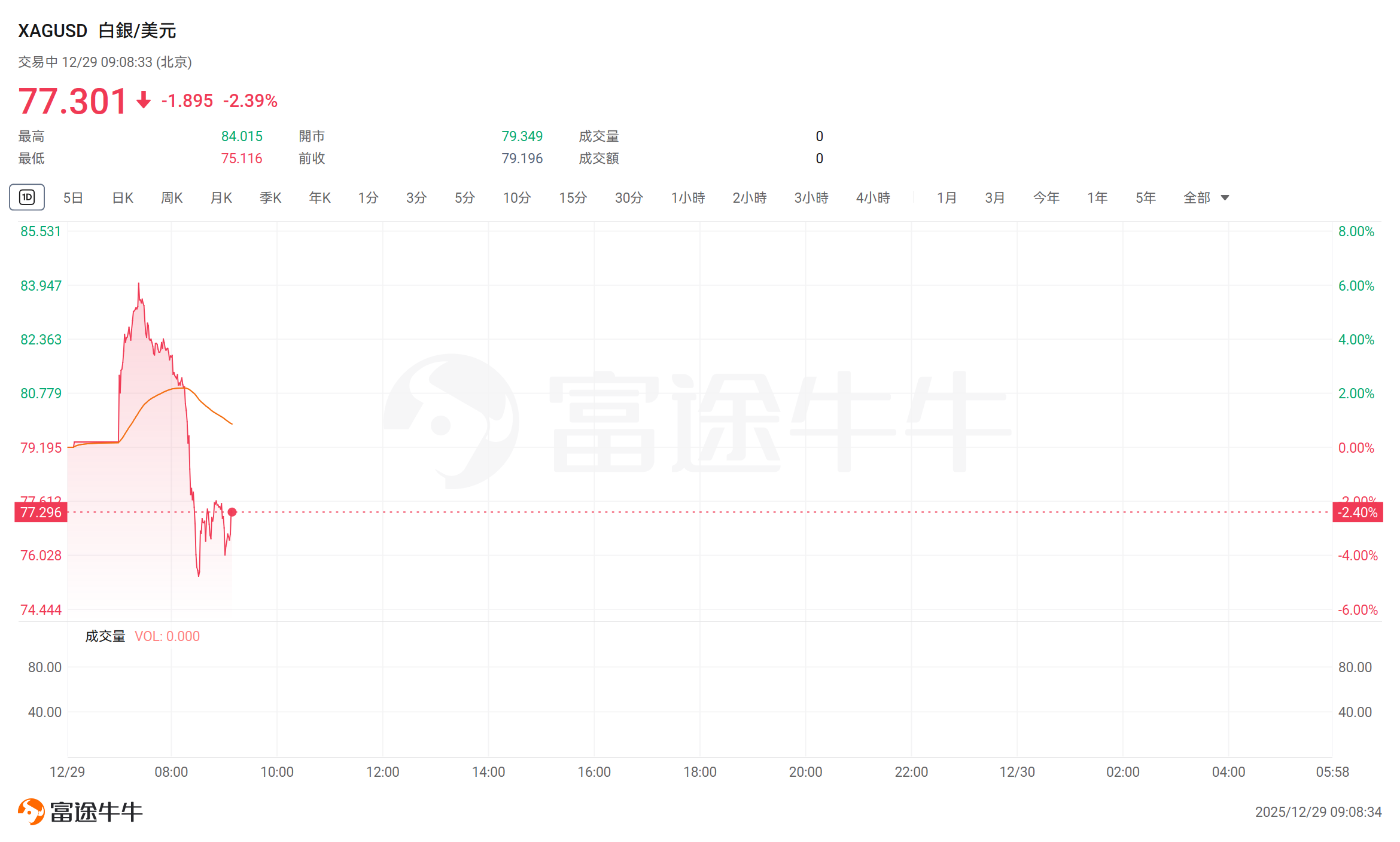
 Currently, the intraday trading price of spot silver rapidly shifted from a gain of 6% to a drop of 3%, settling at $76 per ounce. $XAU/USD (XAUUSD.CFD)$ Short-term movements also sharply declined due to the plunge in silver prices, falling below the $4,500 mark and retreating about $50 from its daily high.
This white metal has risen for six consecutive trading sessions, with cumulative gains of about one-quarter during this period — the largest six-day gain recorded since 1950. The recent rally has been fueled by inflows of speculative capital and ongoing supply mismatches at major global commodity trading hubs following a short squeeze in October.
Gold, silver, and platinum group precious metals have significantly strengthened this year, primarily driven by large-scale purchases by central banks worldwide (mainly gold), continued massive inflows into global precious metal exchange-traded funds (ETFs), and strong support from the Federal Reserve's recent three consecutive interest rate cuts. Typically, lower borrowing costs are highly favorable for such non-interest-bearing commodities, and traders are betting that the Fed will cut rates two to three more times by 2026.
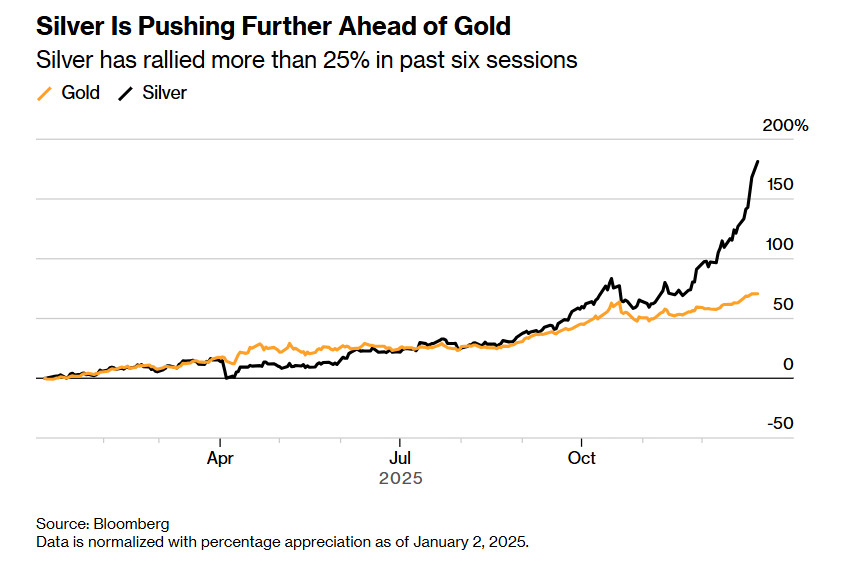
As illustrated above, silver has become increasingly volatile this year, with year-to-date gains reaching an astonishing 165%. Additionally, silver, which had long lagged behind gold, is now outperforming it — rising over 25% in the past six trading days. "There is no doubt that we are witnessing a generational bubble in the silver market," said Tony Sycamore, a market analyst at IG Australia.
Technical indicators suggest that silver's rally may be too rapid. The metal’s 14-day Relative Strength Index (RSI) reading is near 80, well above the threshold of 70 that is considered “overbought.”
The reasons for silver’s unexpected outperformance compared to gold vary, but the core logic lies in escalating geopolitical tensions between the U.S. and Venezuela, tight supplies, and liquidity risks. First, the silver market has a smaller supply. Both inventory and liquidity are relatively tight, and liquidity can evaporate quickly. The London gold market holds approximately $700 billion in gold reserves that can be borrowed during liquidity crunches, whereas silver lacks similar reserves. A historic supply shortage occurred last October.
Weakening of the U.S. dollar is also a key driver behind the sustained record highs of precious metals like gold and silver. The Bloomberg Dollar Spot Index — a critical gauge of the dollar’s strength — has fallen more than 10% this year and dropped nearly 1% last week alone, marking its largest weekly decline since June. A weaker dollar is typically very beneficial for gold and silver movements.
Surpassing Apple and Microsoft! Silver Ranks Among Top Three Global Asset Market Values
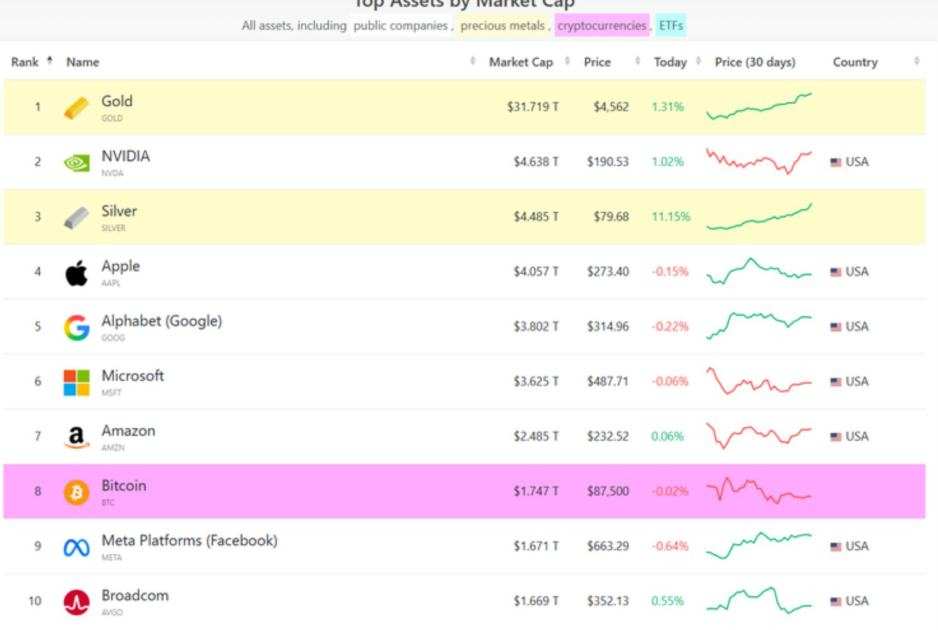
The latest statistical data shows that silver has leaped to become the third most valuable asset globally, trailing only gold and $NVIDIA (NVDA.US)$ total market capitalization, surpassing the market values of tech giants such as $Apple (AAPL.US)$ 、 $Alphabet-A (GOOGL.US)$ and $Microsoft (MSFT.US)$ .
According to CompaniesMarketCap data, the market value of silver once reached $4.485 trillion; gold's total market value leads with $31.719 trillion, while chip giant NVIDIA follows closely with a market cap of $4.638 trillion, having reached $5 trillion earlier in the year.
As silver continued to hit record highs recently, on December 27, Elon Musk expressed concerns, stating directly that this was 'not a good thing' for global industrial development.
Musk made these latest comments on the social media platform X. In response to popular discussions about the explosive growth in silver trading prices due to 'severe global supply shortages,' Musk commented: 'This is not good. Silver is needed in many industrial processes.'
Statistical data show that the global silver market has been in a structural deficit for five consecutive years, with physical inventories rapidly depleting and inventory levels at major exchanges significantly declining. The market is facing a real-time supply squeeze rather than just a rise driven by risk aversion.
Statistics from 2025 indicate that global silver demand reached 1.24 billion ounces, while supply amounted to only 1.01 billion ounces, meaning the market is facing a supply gap of between 100 million and 250 million ounces. This supply-demand imbalance is described as a 'structural deficit,' with no signs of a quick fix.
The core reason for this situation lies in the rigidity of global mining supply. Silver mining is mostly a byproduct of copper and zinc extraction, and new mines typically take over a decade to develop, with ore quality also declining. At the same time, increased recycling has been insufficient to fill the gap, leaving the supply side struggling to meet surging demand.
A more severe signal comes from the plunge in inventory data. Since 2020, COMEX (New York Mercantile Exchange) silver inventories have fallen by 70%, while silver inventories in London Metal Exchange (LME) vaults have dropped by 40%. At the current rate of demand, available silver stocks in some regions can last only 30 to 45 days.
Is it possible for silver to break through $100?
In summary, the core logic behind this sharp rally in silver is: 'Macroeconomic expectations of a Fed interest rate cut + structurally tight supply + strengthening industrial growth narrative + momentum-driven/speculative forces/FOMO (Fear of Missing Out)' collectively pushing silver prices into an unparalleled 'precious metals acceleration phase.'
The repricing of the industrial demand narrative can be considered a novel logic behind this round of silver price surge, as highlighted in the latest research report by the World Silver Association: the vigorous progress in AI data center construction, the transition toward electrification and renewable energy (including photovoltaics), and the global shift toward electric vehicles, compounded by the ongoing supply-demand gap, have made silver no longer merely "following gold"; the World Silver Association noted that the three pillars driving silver demand growth are the 17% compound annual growth rate in the photovoltaic industry, the 13% compound annual growth rate in the electric vehicle sector, and the explosive expansion of global AI data centers.
The World Silver Survey forecasts in this report that these industries will continue to drive industrial demand for silver through 2030. The report emphasizes that global data center IT power capacity has grown from 0.93 gigawatts in 2000 to nearly 50 gigawatts by 2025, a staggering 53-fold increase. This exponential growth implies a larger-scale deployment of servers, switches, and cooling systems worldwide, each requiring silver for their core components.
The World Silver Survey stresses that silver’s extensive penetration and application in data centers are based on three key properties: highest electrical conductivity ensures minimal energy loss during power transmission in servers, which is critical for data centers requiring 99.999% uptime; excellent thermal conductivity helps maintain safe temperature ranges, reducing cooling energy consumption (cooling systems account for 7-30% of total data center energy usage); and high corrosion resistance protects components under high electrical loads and fluctuating temperatures.
In the eyes of some veteran analysts and traders specializing in commodities, silver’s recent explosive rally lays an important foundation for it to break through the $100 super threshold. However, they generally consider silver reaching/touching $100/ounce as an 'extreme bull market target.'
Philippe Gijsels, a senior strategist from BNP Paribas, believes that driven by the strong momentum of the Federal Reserve's interest rate cuts and market euphoria, the rally in silver will extend until 2026, and he predicts that it is "very likely" for silver to reach $100 per ounce by the end of 2026. Keith Neumeyer, CEO of First Majestic, has repeatedly expressed in interviews since the beginning of this year his long-term view that silver prices will reach triple digits ($100 per ounce or higher).
Paul Williams, Managing Director of Solomon Global, stated that silver’s dual attributes as both an industrial metal and a store of value continue to attract global capital inflows, with long-term bullish support factors strengthening. Williams previously predicted in October, when silver approached $50, that it would break through $100 before the end of 2026.
Editor/KOKO