
According to a Bloomberg survey, none of the 21 strategists are bearish, predicting that the S&P 500 Index will rise by an average of 9% by 2026, marking the fourth consecutive year of gains and setting the longest winning streak in nearly two decades. Previously bearish institutions like JPMorgan have completely reversed their stance, raising their target to 7,500 points. However, veteran strategists warn: when everyone is optimistic, it becomes concerning. A few cautious voices highlight risks such as high valuations, Fed policy, and tariffs.
Wall Street has formed a rare optimistic consensus: the U.S. stock market will achieve its fourth consecutive annual rise in 2026, marking the longest winning streak in nearly two decades.
On December 29, according to a Bloomberg report, after the S&P 500 index rebounded by approximately 90% from its low point in October 2022, sell-side strategists have almost entirely abandoned their bearish stances. A survey by Bloomberg showed that none of the 21 market forecasters surveyed predicted a decline in the stock market next year. The average forecast on Wall Street implies a further 9% increase in the S&P 500 index by 2026.
 Despite unresolved risks such as the artificial intelligence bubble, the direction of the Federal Reserve's policies, and uncertainties surrounding Trump's second term, Wall Street strategists have collectively chosen optimism. If this extremely optimistic consensus materializes, the U.S. stock market will experience its longest annual upward cycle since before the global financial crisis. Should the most optimistic prediction come true, the S&P 500 index will see four consecutive years of double-digit returns for the first time since the dot-com bubble of the 1990s.
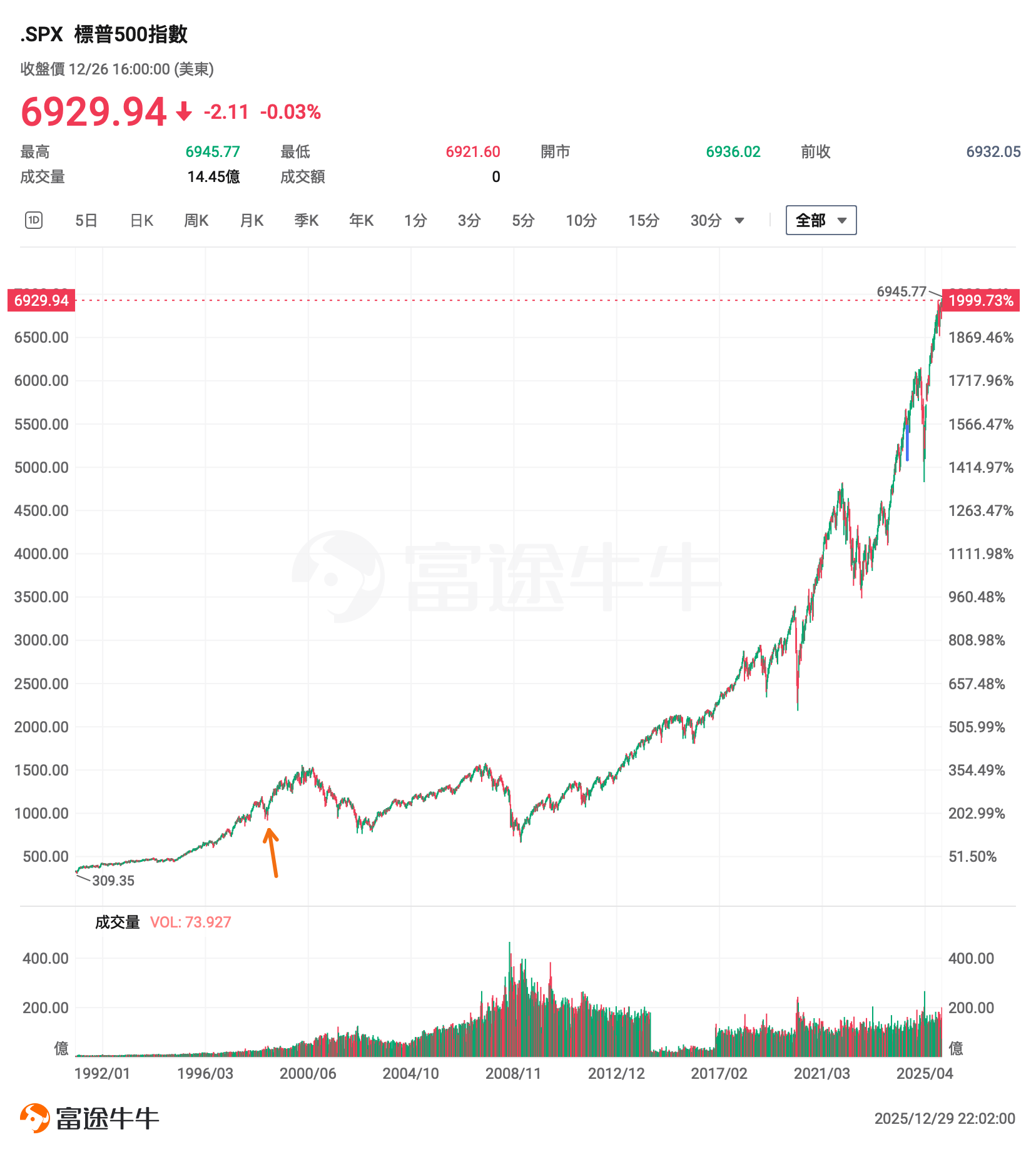
The report notes that this unified optimism marks a complete shift by strategists after years of 'forecast failures.' Faced with the remarkable resilience shown by the stock market amidst volatility, previously bearish analysts (such as those at JPMorgan) have been forced to continuously raise their forecasts to keep pace with actual market performance.
Notably, while no strategist predicts a significant market crash, some are still highlighting risks. Senior market strategist Ed Yardeni expects the S&P 500 index to close next year at 7,700 points, representing an 11% increase from last Friday’s closing price. However, even this long-term bull is concerned about the lack of dissenting views: "Pessimists have been wrong for so long that people have grown tired of that narrative. But when everyone becomes optimistic, it actually worries me a bit."
A comprehensive shift among sell-side strategists
The prolonged market rally has forced pessimists to 'surrender,' with JPMorgan’s abrupt change in stance serving as a prime example of this trend.
Analysts at the bank held an extremely pessimistic view in early 2025, once predicting a 12% decline in the stock market that year, but this was proven incorrect by the subsequent market rebound.
Now, JPMorgan has abandoned its cautious stance and expects the S&P 500 index to rise to 7,500 points in 2026, driven by robust corporate earnings and low interest rates.
Mislav Matejka, Head of Global and European Equity Strategy at JPMorgan, stated that the optimism is also based on resilient growth, cooling inflation, and the surge in AI-related stocks reflecting an underlying economic transformation rather than an impending bubble burst.
"If the economy turns out to be weaker than we forecast, the stock market may not necessarily view it negatively. The market will rely on the Federal Reserve to take on the heavy lifting."
Meanwhile, most strategists believe that fundamentals are sufficient to sustain the continuation of the bull market.
Manish Kabra, Head of U.S. Equity Strategy at Societe Generale SA, pointed out that the macro environment remains solid. The U.S. economy expanded at its fastest pace in two years during the third quarter, driven by resilient consumer and business spending. Additionally, the Federal Reserve's interest rate cuts and Trump’s tax reduction bill are also seen as economic stimulus factors.
Manish Kabra stated:
"Just because the year has changed does not mean you need to alter your perspective. The earnings outlook remains robust, and growth is expanding from technology stocks to a broader range of sectors."
Resilience following turbulence
This overwhelmingly bullish sentiment has been reinforced after the market experienced significant volatility in 2025.
It was reported that in early 2025, the market faced a sell-off amid potential challenges posed by DeepSeek to U.S.-based AI companies and the chaotic trade war initiated by Trump.
The S&P 500 Index plummeted nearly 20% between mid-February and early April, edging toward bear market territory. At that time, strategists were lowering their forecasts at the fastest pace since the market collapse during the COVID-19 pandemic.
However, the stock market subsequently staged one of the swiftest rebounds since the 1950s, forcing analysts to revise their target prices upward.
Michael Kantrowitz, Chief Investment Strategist at Piper Sandler & Co., stated that the past five years have been marked by extremely high uncertainty, causing investors to become highly short-term focused and data-sensitive, with shifts in consensus views often triggered by minimal factors. Given this level of uncertainty, he has ceased issuing year-end price targets for the S&P 500 Index.
A minority of cautious voices
Although no strategist is forecasting a significant downturn, some are still highlighting risks.
Christopher Harvey of CIBC Capital Markets is one of the few strategists who maintained a bullish stance amid the 2025 volatility and made accurate predictions. He forecasts that the S&P 500 Index will close at 7,450 points by the end of 2026 but also warns that the market may be underestimating numerous macroeconomic risks.
The risks identified by Harvey include: the Federal Reserve potentially keeping interest rates unchanged for longer than traders anticipate; the United States possibly imposing additional tariffs on Canada or Mexico; and corporate executives potentially attempting to manage earnings expectations following a period of robust growth.
He believes these factors could begin to disrupt the market’s equilibrium.
Savita Subramanian of Bank of America has adopted a cautious stance due to valuation constraints, setting a target of 7,100 points.
Her forecast range reflects significant uncertainty: in the event of a recession, the stock market could plummet by 20%; however, if earnings significantly exceed expectations, there could also be a surge of 25%.
Editor/Doris