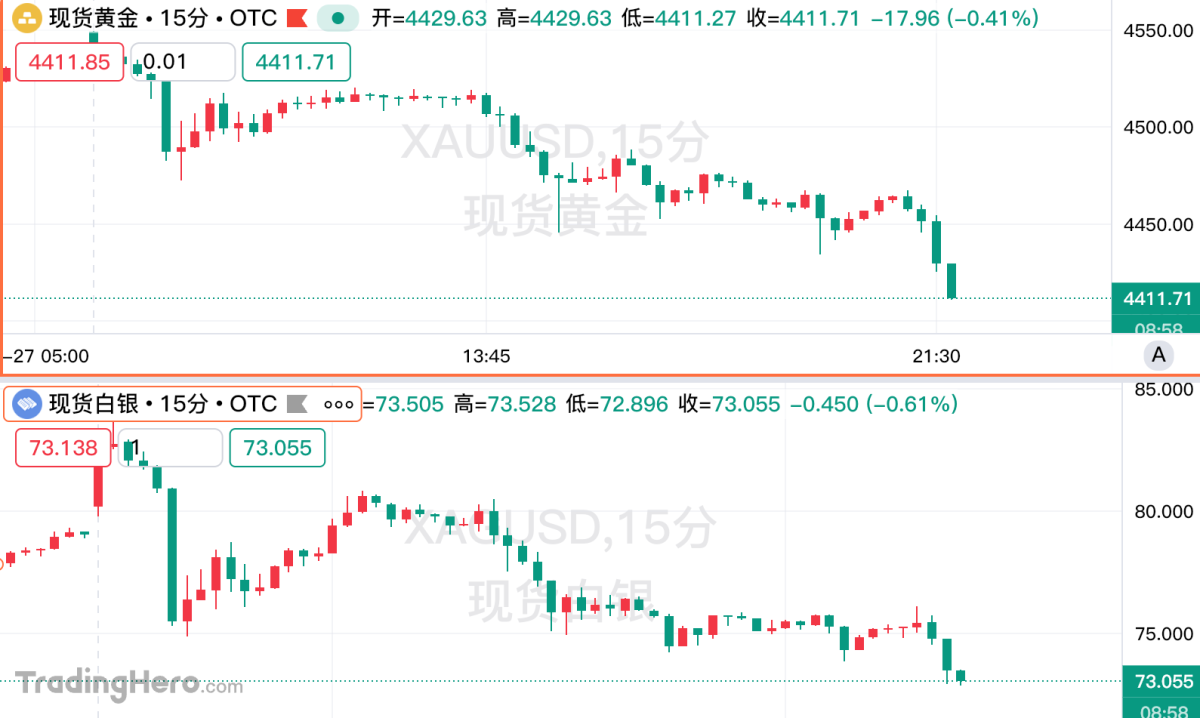
Spot gold plunged by a hundred dollars in a single day, and silver plummeted 7.00% intraday! The sudden downturn in the gold and silver markets – is it profit-taking triggered by easing geopolitical tensions, or a prelude to the Fed's shift to a hawkish stance?
As of the U.S. trading session on Monday, spot gold plummeted over $100 intraday, and spot silver fell by 7.00% intraday. The decline in geopolitical risks curbed the inflow of safe-haven funds, prompting investors to take profits.
Ricardo Evangelista, an analyst at ActivTrades, stated: 'The decline in gold prices, which followed record highs, is mainly attributed to traders taking profits before the end of the year. The preliminary optimism from the U.S. government regarding progress in Ukraine peace talks also provided slight headwinds.'
 The market is focused on the release of the Federal Reserve's December meeting minutes, scheduled for early Wednesday, for clues about the interest rate outlook. Traders anticipate two rate cuts next year. Non-yielding assets tend to perform better when interest rates are low.
Analysts at UBS Group noted in a report: 'Gold prices are currently at a significant premium. If the Federal Reserve unexpectedly shifts to a more hawkish stance and substantial ETF outflows impact the market, there could be downside risks.'
Silver Faces Short-Term Obstacles
Alexander Campbell, the former head of commodities at hedge fund giant Bridgewater, suggested that silver is encountering several short-term obstacles. Investors might consider staying on the sidelines until these issues are resolved before entering the market.
Campbell, now CEO and founder of Black Snow Capital, analyzed the current trading dynamics of silver as follows: In December alone, this commodity rebounded by approximately 30%.
As of 2025, the return on silver has reached an impressive 156%. Despite recording its largest-ever single-day dollar gain last Friday, prices retreated on Monday. Back in February this year, Campbell pointed out that demand from the solar energy sector had pushed the silver market into structural shortages.
In a Substack column, Campbell acknowledged that these short-term obstacles, which must be overcome, are indeed formidable.
For traders, the primary risk lies in tax-related selling pressure. Once trading resumes in the new year, positions held for over 12 months may be liquidated for tax purposes. Such capital gains, particularly those generated by deep-in-the-money options expiring on December 31, will benefit from lower tax rates. Traders may prefer to remain inactive during the last three trading days of 2025, waiting until after the year-end to realize profits.
Secondly, Campbell believes that given the strong performance of US Q3 GDP data, the US dollar may strengthen in the near term. A stronger dollar typically creates headwinds for commodities priced in dollars. He also noted that the Chicago Mercantile Exchange (CME) has increased margin requirements for silver trading, effective December 29. This will reduce leverage and speculative appetite in the market.
Campbell further pointed out that many commentators are highlighting the 'overbought' technical condition of silver, and this year’s surge in silver prices is likely to encourage substitution with copper in industrial applications.
However, despite considering all these factors, Campbell remains enthusiastic about silver. He positively addressed the issue of 'copper substitution' and observed that while there are valid reasons supporting this trend in the long term, the current payback period for switching facilities from silver to copper is approximately 18 months—a timeframe too long for solar manufacturers to justify the required investment.
Additionally, Campbell noted that the solar industry, as a major source of silver demand, reaches its break-even point at a silver price of $134 per ounce, which is about 70% higher than the current spot price.
Campbell argued that the current premium on physical silver holds significant reference value. He observed that physical silver was trading at $91 per ounce in Dubai and $85 in Shanghai, while the COMEX futures price was only $75. Campbell remarked: 'When such a sharp divergence occurs between physical prices and paper prices, one side must be wrong—and historically, it is usually not the physical market.'
According to Campbell, the London Over-the-Counter (OTC) market for physical silver is currently experiencing the highest 'spot premium'—where short-term or spot prices exceed forward prices—in decades. Meanwhile, the options market is pricing in upside tail risks.
Technical factors also support the case for rising silver prices. Positioning data from the Commodity Futures Trading Commission (CFTC) shows no extreme positioning in the market, indicating that 'upward momentum remains,' while silver ETFs like iShares Silver Trust are still catching up with demand.
However, in Campbell's view, the true fundamental driver for silver lies in the 'inelastic' demand from the solar industry (forecasted at 290 million ounces in 2025 and 450 million ounces by 2030) and demand from data centers. He stated: 'Every AI query requires electrons. Marginal electrons mean silver. Solar power needs silver.'
Editor/Joryn