
Source: China Securities Journal
Author: Shi Qian
Robots are back in the spotlight!
On the morning of December 30, within less than an hour after the market opened, the A-share robotics sector moved from a lower opening to a strong rally, triggering a wave of limit-up surges. Among them, $T-MAX (920270.BJ)$ surged by 30%, while $Zhejiang XCC Group (603667.SH)$ quickly hit the upper trading limit. By midday, the number of stocks that had reached the limit-up or gained over 10% reached 18.
 Notably, just before the midday closing, Hong Kong-listed stocks $Robotics (LIST23593.HK)$ also experienced a sudden collective surge. This market movement indicates that the robotics sector has regained its momentum.
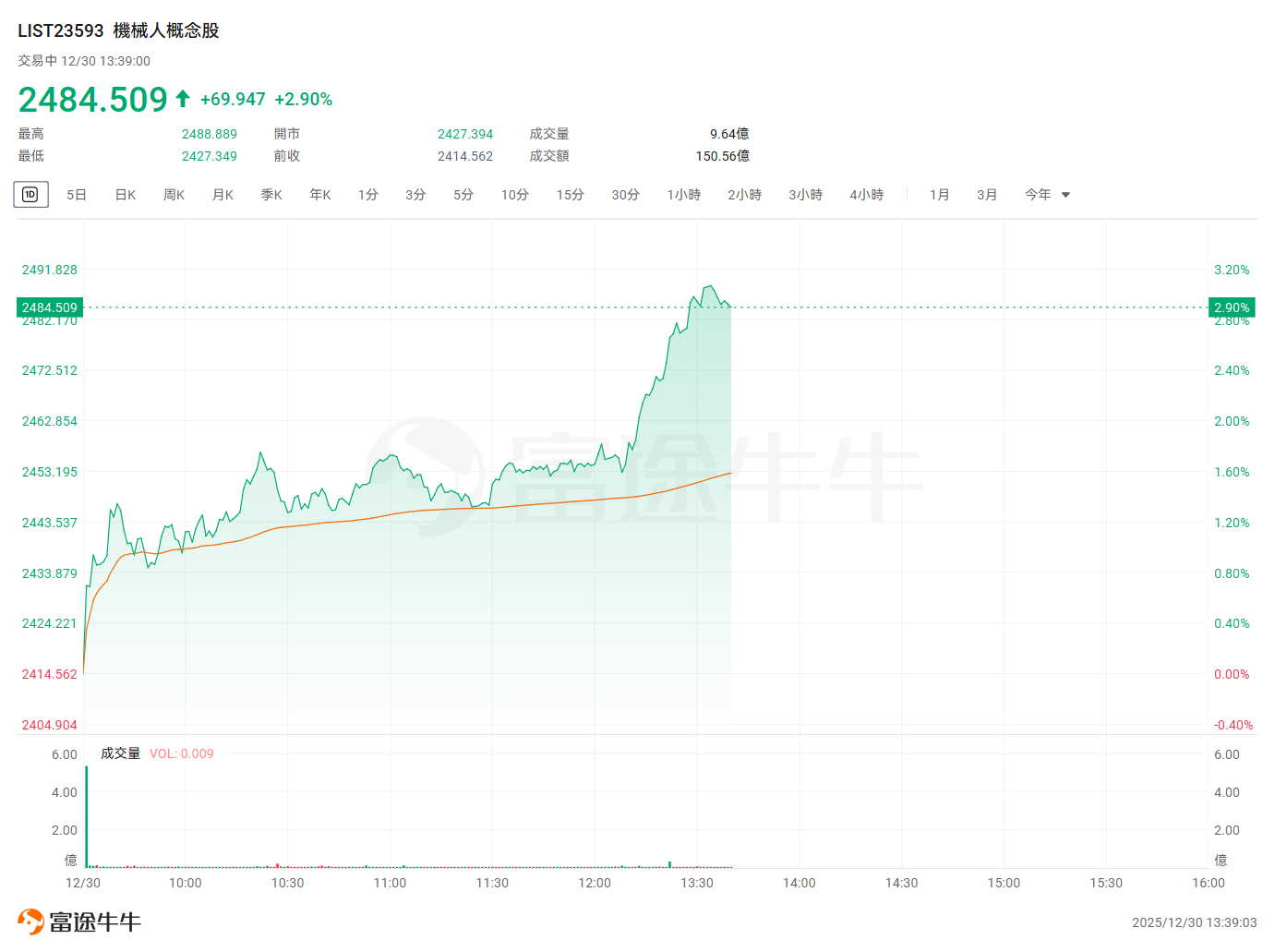
So, what exactly are the driving factors behind this? Analysts believe it may be related to two rumors. One is that the Trump administration is considering issuing an executive order on robotics in 2026; the other suggests that suppliers have recently been visiting North America, with Tesla Optimus packages expected to be issued soon, and the market has already begun to warm up.
Two Major Developments Incoming
Not long ago, U.S. Commerce Secretary Lutnick recently held frequent meetings with CEOs in the robotics industry, showing 'full support' for accelerating the development of the sector. He also mentioned that the Trump administration is considering issuing an executive order on robotics in 2026. These actions indicate that, following AI, robotics technology has become the next major battleground in the U.S. tech strategy.
After accelerating the development of artificial intelligence, the Trump administration is now shifting its focus to robotics, planning to issue an executive order on robotics technology in 2026. The U.S. Department of Transportation is also preparing to establish a robotics task force before the end of the year. 'We are committed to the development of robotics technology and advanced manufacturing because they are core to bringing critical production back to the United States,' stated a spokesperson for the U.S. Department of Commerce.
On the other hand, rumors suggest that supply chain companies have recently been visiting clients in North America, and the market expects$Tesla (TSLA.US)$ The Optimus project is about to be outsourced. Meanwhile, $JD.com (JD.US)$ a collaboration between Unitree Robotics and another company has been announced. The first offline experience store from this partnership will open on December 31, promoting the commercial deployment of humanoid robots and consumer engagement.
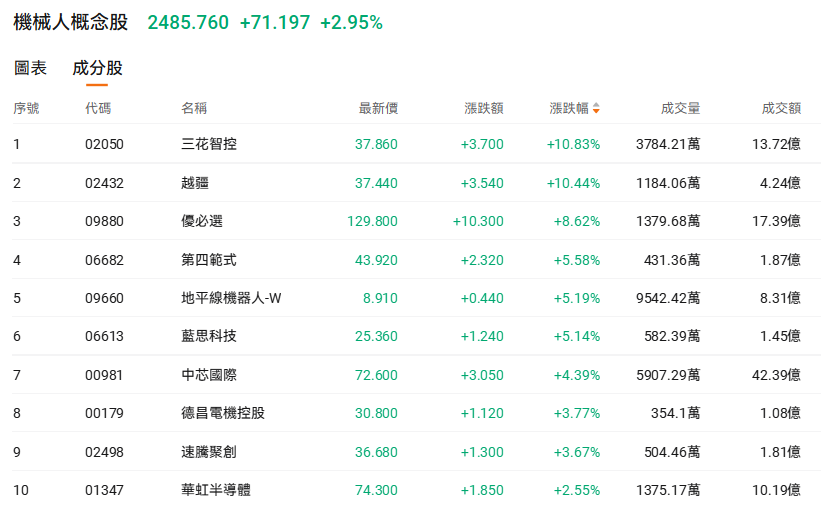
Today, $Robotics (LIST23593.HK)$ staged a major comeback. $SANHUA (02050.HK)$ 、 $DOBOT (02432.HK)$ rising over 10%, $UBTECH ROBOTICS (09880.HK)$ rising more than 8%, $FOURTH PARADIGM (06682.HK)$ 、 $HORIZONROBOT-W (09660.HK)$ 、 $LENS (06613.HK)$ Up more than 5%.
Data from Zhongyuan Securities shows that industrial robot production continues to grow: In November 2025, China’s industrial robot output reached 70,188 units, increasing by 20.6% year-on-year; cumulative production from January to November was 673,800 units, up 29.2% year-on-year. After three years of adjustments since 2021, the robotics industry chain is nearing the end of its correction phase, with output showing sustained positive growth and accelerating momentum, signaling a cyclical recovery for the sector.
On the eve of mass production,
Guotai Haitong noted that humanoid robots are approaching the critical point for mass production.
As the metronome of global industrial progress, Tesla's third-generation humanoid robot (Gen3) has become increasingly clear in its path to mass production. In early December 2025, the Optimus team released a new video showcasing the robot’s ability to run steadily on complex terrains, marking a generational contrast with its earlier unsteady gait and demonstrating substantial advancements at the “cerebellum” level (responsible for motion control).
More importantly, Musk has reiterated in multiple public appearances the goal of initiating large-scale mass production by 2026, highlighting three key challenges Gen3 is addressing: achieving human-level dexterous hands, an AI 'brain' capable of understanding the real world, and design-for-manufacturability targeting millions of units.
As the industry approaches the eve of mass production, the value and investment pace of each link are being reassessed. Currently, value creation is highly concentrated in upstream core components, particularly in the rotating joints and linear joints (assemblies) that constitute the execution system, with their value proportion reaching up to nearly 70%. Specifically, the precision manufacturing and integration of motors (frameless torque, hollow cup), reducers (harmonic, RV), and screws (planetary rollers) are key to cost reduction and efficiency improvement. Relevant companies are undergoing a critical validation period, transitioning from sample submission (A/B samples) to securing small-batch orders (RFQ), representing the most certain investment theme at present. Meanwhile, components such as dexterous hands, six-dimensional force sensors, and 3D vision sensors, which are crucial for robotic precision operations and environmental perception, continue to attract significant market attention as technological high grounds and directions for next-generation hardware innovation.
 Looking to pick stocks or analyze them? Want to know the opportunities and risks in your portfolio? For all investment-related questions,just ask Futubull AI!

Editor/Rocky