The year 2025 is drawing to a close, marking a tumultuous period: from Trump's return to the White House at the beginning of the year, the disruption of global markets by U.S. tariffs in April, to the Federal Reserve’s pivot towards an easing path, and the capital frenzy ignited by artificial intelligence...
As we look ahead to 2026, how can we seize new opportunities? Subscribe to our special feature."2025 Year in Review", let us reflect on the past, consolidate experiences, and together embrace the next chapter.
The U.S. equity ETF market in 2025 has provided investors with a vivid lesson: the gainers list showcases the explosive power of 'trends,' while the capital inflow list reveals the unshakable nature of 'core holdings.' This article will guide you through the market fog to interpret the seemingly contradictory 'dual trends' and uncover how market capital is positioning itself in ETFs.
Top 10 Gainers in ETFs: Precious Metals 'Won Big,' Semiconductors Thrived Amid Risk
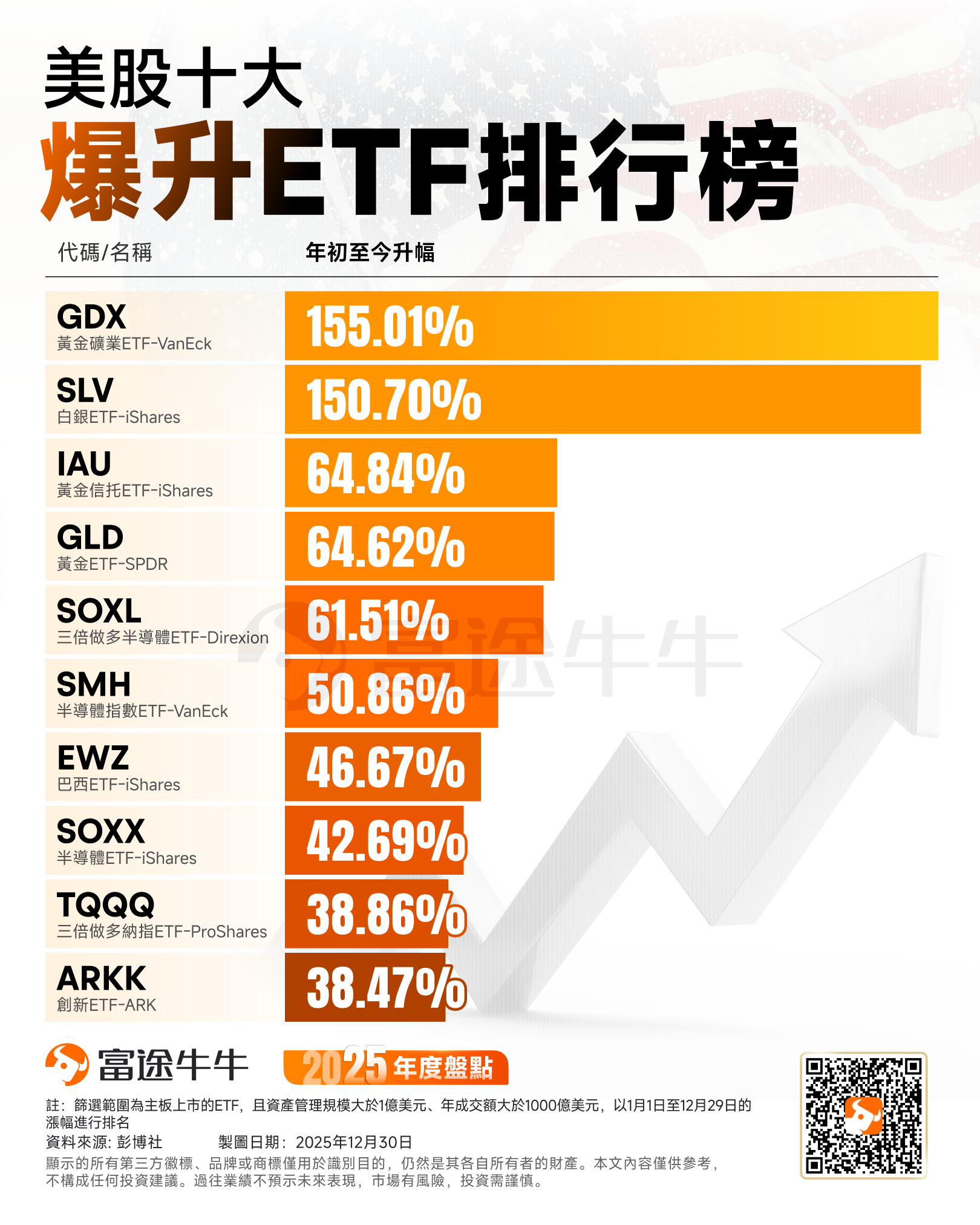
 In 2025, the list of top performers was almost entirely dominated by 'physical assets' and 'hard tech.' In one sentence: the triumph of 'high-volatility assets.'
This list is extremely 'stimulating.' Gold, silver, mining, semiconductors, and leveraged ETFs – all are representative high-volatility assets. This also means that the high returns of 2025 mainly came from extreme bets on macro narratives (rate cuts/inflation/safe havens) and industry narratives (AI/computing power).
The top four spots on the list were all occupied by gold- and silver-related ETFs: $VanEck Gold Miners Equity ETF (GDX.US)$ 、 $iShares Silver Trust (SLV.US)$ 、 $Gold Trust Ishares (IAU.US)$ 、 $SPDR Gold ETF (GLD.US)$ 。
While most of the rest were related to semiconductors and technology: $Direxion Daily Semiconductor Bull 3x Shares ETF (SOXL.US)$ 、 $VanEck Semiconductor ETF (SMH.US)$ 、 $iShares Semiconductor ETF (SOXX.US)$ 、 $ARK Innovation ETF (ARKK.US)$ 。
Top 10 ETFs by Capital Inflow: Large-Cap Indexes Show Steady Strength at Lows
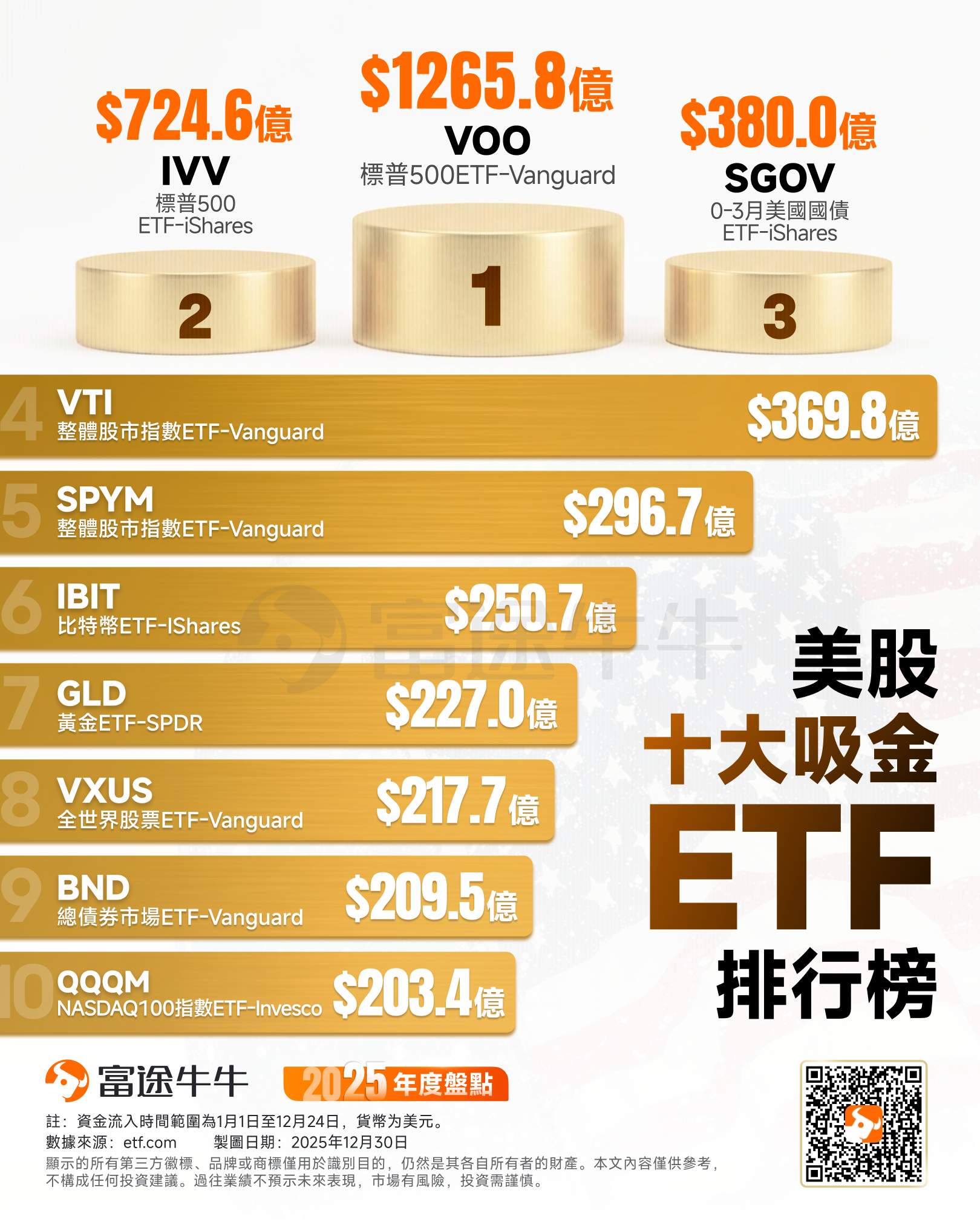
Compared to the noise of the gainers list, the capital flow list appears exceptionally calm. The core logic behind market inflows is very clear.
Three Main Drivers of Net Capital Inflow
Core Holdings: The S&P 500 remains king, with the first half of the list completely dominated by $Vanguard S&P 500 ETF (VOO.US)$ 、 $iShares Core S&P 500 ETF (IVV.US)$ , as well as representing the entire U.S. stock market, the $Vanguard Total Stock Market ETF (VTI.US)$、 $SPDR Portfolio S&P 500 ETF (SPYM.US)$ take the lead.
Cash-like management: Short-term bonds are a necessity. $iShares 0-3 Month Treasury Bond ETF (SGOV.US)$ ranks third. When the interest rate outlook is uncertain, parking funds in low-risk, highly liquid short-term bonds is a relatively prudent strategy.
Asset allocation needs: $iShares Bitcoin Trust (IBIT.US)$ and $SPDR Gold ETF (GLD.US)$ Both made it into the TOP 10. The fact that they were heavily purchased in 2025 indicates that the market places significant importance on both BTC and gold during asset allocation.
The Dual Narrative of U.S. Equity ETFs: A Perfect Blend of Offense and Defense
Looking back from the end of 2025, the US equity ETF market has witnessed two clear and parallel core trends. This reflects that in the face of macroeconomic changes, funds with different characteristics are making entirely distinct allocations:
Trend One: Aggressive positioning, betting on high volatility. Precious metals such as gold and silver, combined with mining stocks doubling in value, and leveraged ETFs in the semiconductor industry have seen both volume and price soar. Active capital has generated substantial excess returns through highly volatile assets amid the precious metals bull market and the AI industrial wave.
Trend Two: Increasing positions in large-cap stocks and short-term bonds to solidify certainty. Hundreds of billions of dollars in new capital did not blindly chase highs but instead steadily flowed into S&P 500 and short-term bond ETFs. This demonstrates that true “Big Money” is leveraging market upswings while remaining focused on long-term large-cap index products and cash-like reserves.
Based on the market performance in 2025, a simple and actionable ETF allocation strategy can be summarized.
Layer A: Core holdings
Products: VOO / IVV / VTI tracking the S&P 500 Index
This serves as the ballast for your portfolio. Regardless of whether 2026 turns out to be bullish or bearish, ensure you capture the market’s average return.
Layer B: Cash and buffer
Products: SGOV (ultra-short-term bonds) or $Vanguard Total Bond Market ETF (BND.US)$
Place the 'temporarily idle funds' or 'ammunition waiting for opportunities' in SGOV. If the stock market retraces, this will be your capital to increase positions.
Layer C: Offensive/Hedging Instruments
Hedging: GLD/IAU, as an important component of major asset classes, it remains indispensable.
Offensive: SMH/SOXX (semiconductors). If optimistic about the continued development of the AI industry chain, semiconductors remain the sharpest spear.
Aggressive: SOXL (triple-leveraged semiconductors), etc.
 Looking back at 2025, how did the returns from your fellow investors' ETF portfolios perform?
 Which ETF generated the highest returns for you?
 How do you plan to adjust your ETF portfolio in 2026?
 Share your annual review and outlook now!
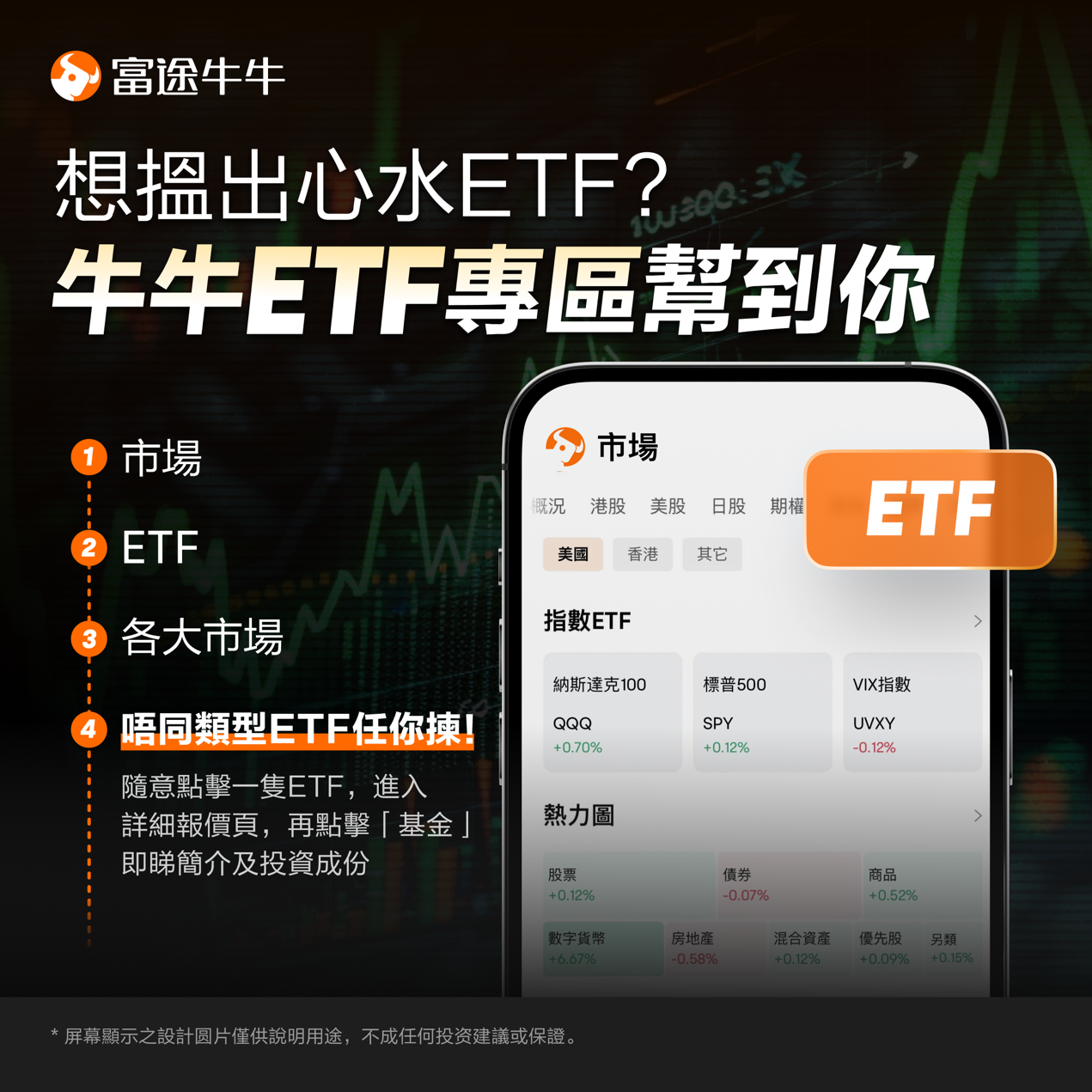
How to choose ETFs?Smartly use tools to select high-quality ETFs.
Editor/Ray