
Significant move by the 'National Team'.
After the Hong Kong stock market closed on January 2, according to disclosures from the Hong Kong Exchange, the National Integrated Circuit Industry Investment Fund Co., Ltd. (hereinafter referred to as 'National Integrated Circuit Fund') $SMIC (00981.HK)$ increased its shareholding in SMIC's H shares from 4.79% to 9.25% on December 29, 2025.
In terms of market performance, Hong Kong-listed chip stocks surged across the board. By the close on the 2nd, Huahong Semiconductor soared more than 9%, while SMIC surged over 5%. A brokerage firm analyzed that with the global semiconductor cycle bottoming out and rebounding, coupled with dual support from domestic policies and funds, leading manufacturers represented by SMIC will enter a window period for both earnings and valuation recovery.
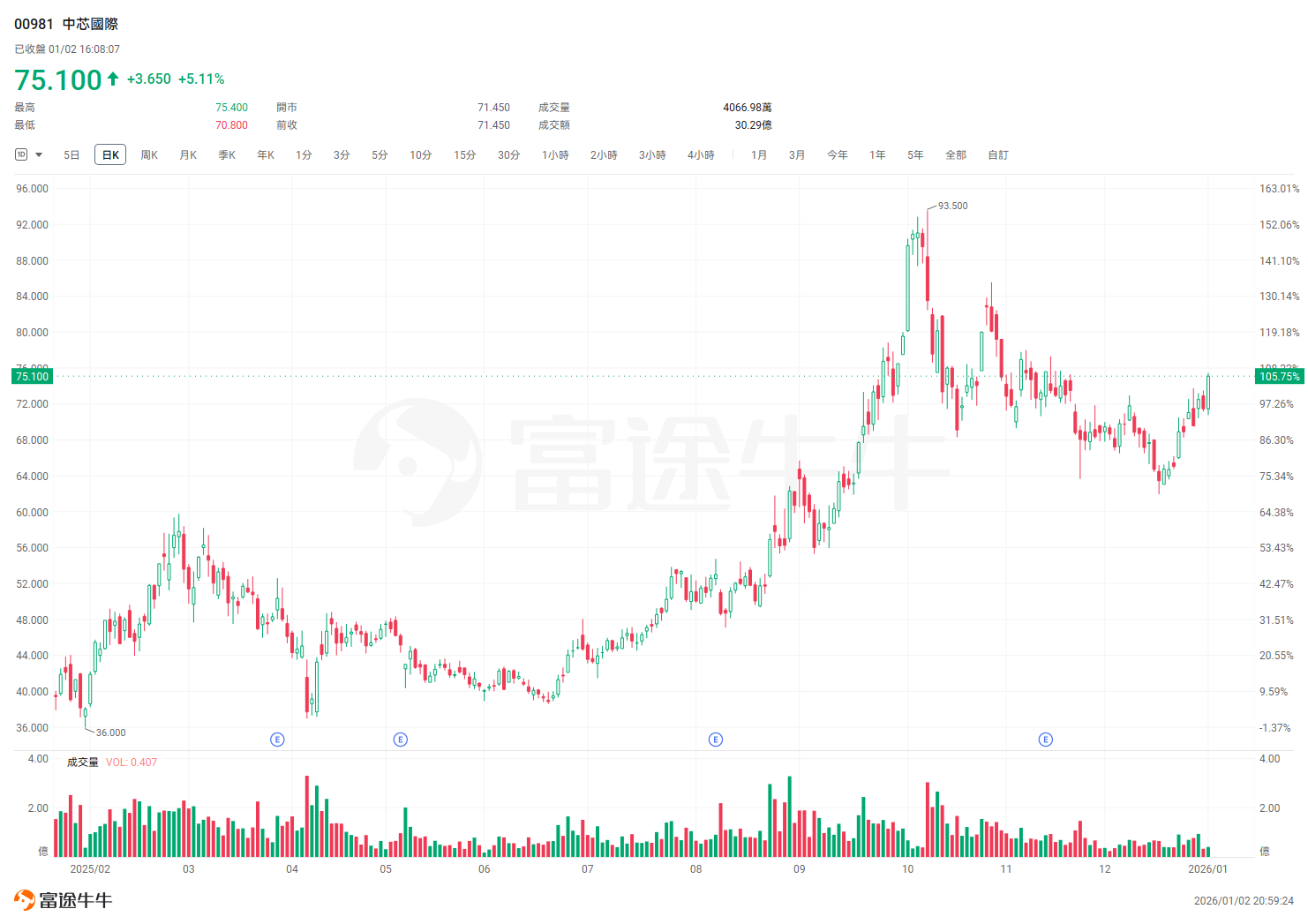
Significant move by the 'National Team'
 On January 2, according to information from the Hong Kong Exchange, the National Integrated Circuit Fund increased its shareholding in SMIC's H shares from 4.79% to 9.25% on December 29.
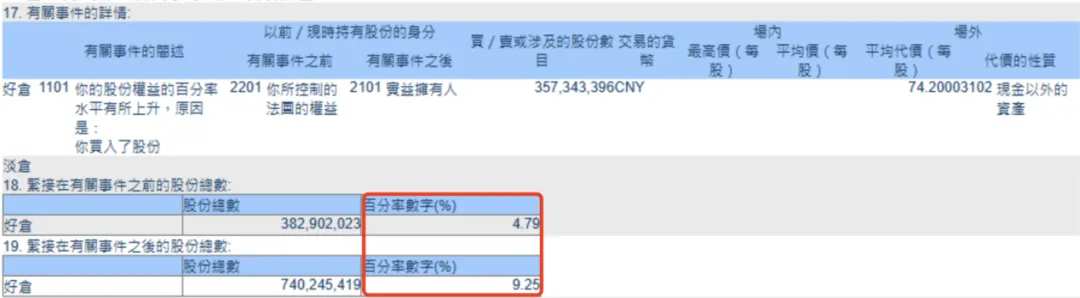
According to the recent disclosure of SMIC’s simplified equity change report, SMIC plans to issue shares to five counterparties, including the National Integrated Circuit Fund, to acquire their combined 49% stake in SMIC Northern Integrated Circuit Manufacturing (Beijing) Co., Ltd. The transaction values the target assets at 40.601 billion yuan, with the share issuance price set at 74.20 yuan per share, expecting to issue approximately 547 million new shares. Upon completion of the transaction, SMIC Northern will become a wholly-owned subsidiary of SMIC.
Prior to this equity change, the National Integrated Circuit Fund indirectly held approximately 383 million shares of SMIC’s Hong Kong-listed shares through its acting-in-concert party Xinchip (Hong Kong) Investment Co., Ltd., accounting for 4.79%. After the transaction, the total shareholding of the National Integrated Circuit Fund and its acting-in-concert parties will increase to about 740 million shares.
The National Integrated Circuit Fund has committed not to transfer the shares obtained through this transaction within 12 months from the date of issuance completion.
Data shows that SMIC is one of the world's leading integrated circuit wafer foundries and a leader in China's mainland integrated circuit manufacturing industry. It possesses leading process manufacturing capabilities, production capacity advantages, and service support, providing 8-inch and 12-inch wafer foundry services and technical support to global customers.
SMIC Northern, one of the key subsidiaries of SMIC, was initially established in 2013 by SMIC Beijing, SMIC, Zhongguancun Development Group, and Beijing Industrial Investment. It currently provides customers with 12-inch integrated circuit wafer foundry services and complementary solutions across various process platforms.
SMIC stated that this transaction will further enhance the asset quality of the listed company, strengthen business synergy, and promote its long-term development. The main business scope of the listed company will remain unchanged before and after the transaction.
Surging across the board
In the market, Hong Kong-listed chip stocks surged across the board today. As of the market close, $HUA HONG SEMI (01347.HK)$ surged 9.4%, $SMIC (00981.HK)$ rose more than 5%, $CE HUADA TECH (00085.HK)$ 、 $SHANGHAI FUDAN (01385.HK)$ soared over 4%, $SOLOMON SYSTECH (02878.HK)$ increased by over 3%. Additionally, known as the 'Four Little Dragons of Domestic GPUs,' $BIREN TECH (06082.HK)$ surged 75.8% on its first day of listing, with a total market capitalization approaching HKD 81.3 billion.
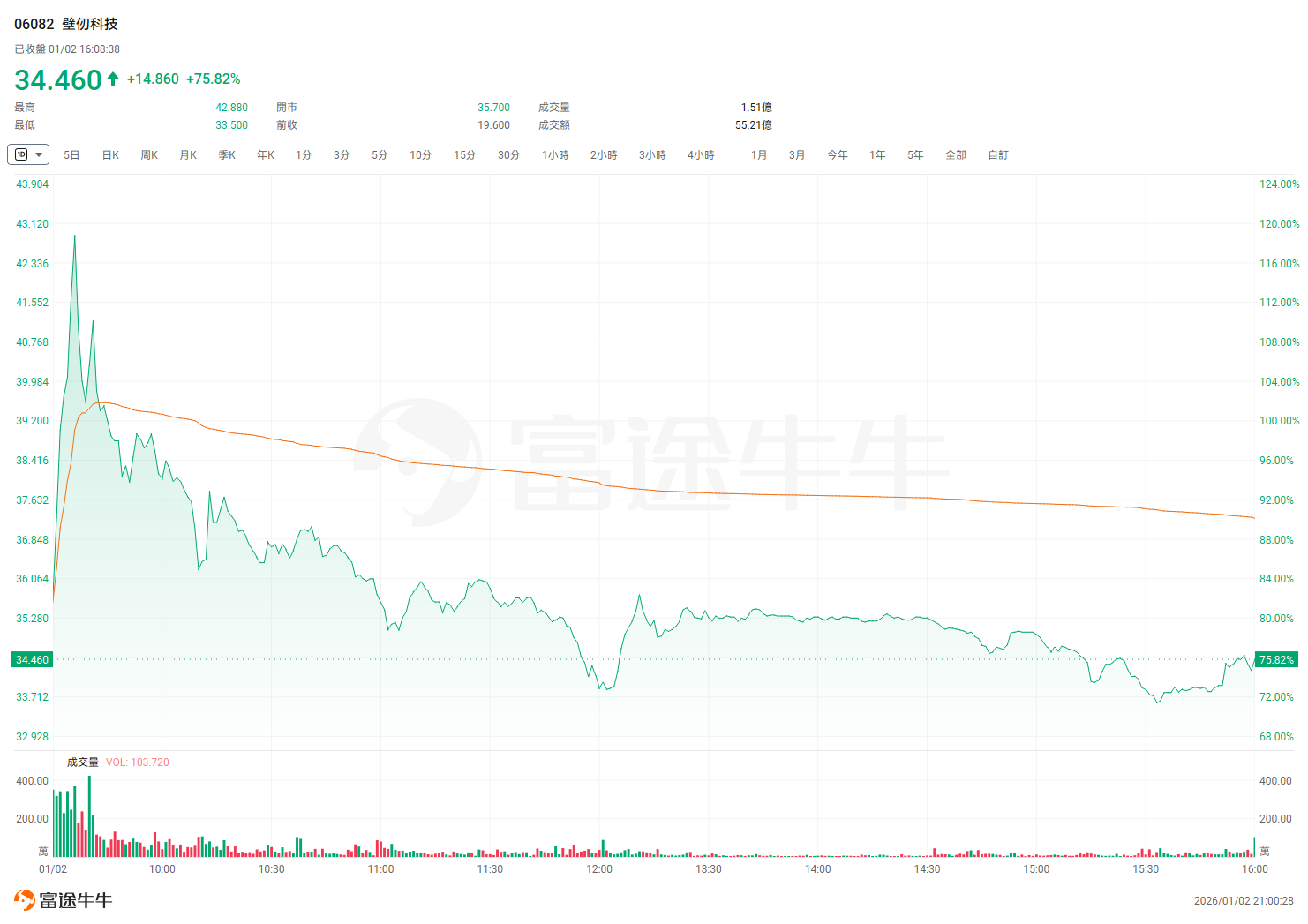
Guotai Junan believes that as the global semiconductor cycle bottoms out and rebounds, coupled with dual support from domestic policies and funding, manufacturing leaders represented by SMIC will enter a dual recovery window for performance and valuation.
Huatai Securities recently released a report indicating that the wave of investment in AI-driven computing infrastructure has entered an accelerated phase, and Chinese wafer foundries possess long-term allocation value under the logic of supply chain security.
Bank of America analyst Vivek Arya predicted that global semiconductor industry revenue will grow by 30% year-over-year in 2026, with the total scale surpassing $1 trillion.
Dongxing Securities stated that the AI-driven narrative is continuously strengthening: propelled by the vigorous development of generative artificial intelligence, demand for computing power is growing exponentially, and the AI chip sector is thriving. Against the backdrop of surging data center power requirements, it is recommended to focus on three high-quality tracks along the AI innovation cycle: semiconductor memory, semiconductor testing equipment, and magnetic components.
Regarding the outlook for Hong Kong stocks in 2026, CITIC Securities believes that Hong Kong stocks will initiate a second round of valuation recovery amid the interplay of policy benefits and external risks. The convergence of internal and external factors is expected to further expand upward potential. In this context, investment should focus on the main theme of 'earnings certainty + valuation elasticity,' concentrating on four major sectors: technology, pharmaceuticals, resources, and essential consumption. From a portfolio perspective, the revaluation of pricing power in resources and traditional manufacturing, as well as corporate international expansion, remain core areas for institutional allocation.
Guolian Minsheng Securities pointed out that in 2026, particularly in the first half of the year, the combination of a weak domestic economic recovery, ongoing Federal Reserve easing, and sustained industrial catalysts will remain favorable for Hong Kong stocks. On the capital front, Southbound funds are projected to have an incremental space of HKD 630 billion to HKD 105 billion in 2026, with relatively larger room for passive index funds and insurance capital; regarding foreign capital, as economic recovery progresses and corporate earnings expectations improve, foreign capital may continue its phased structural inflow in 2026.
Editor/Rice