
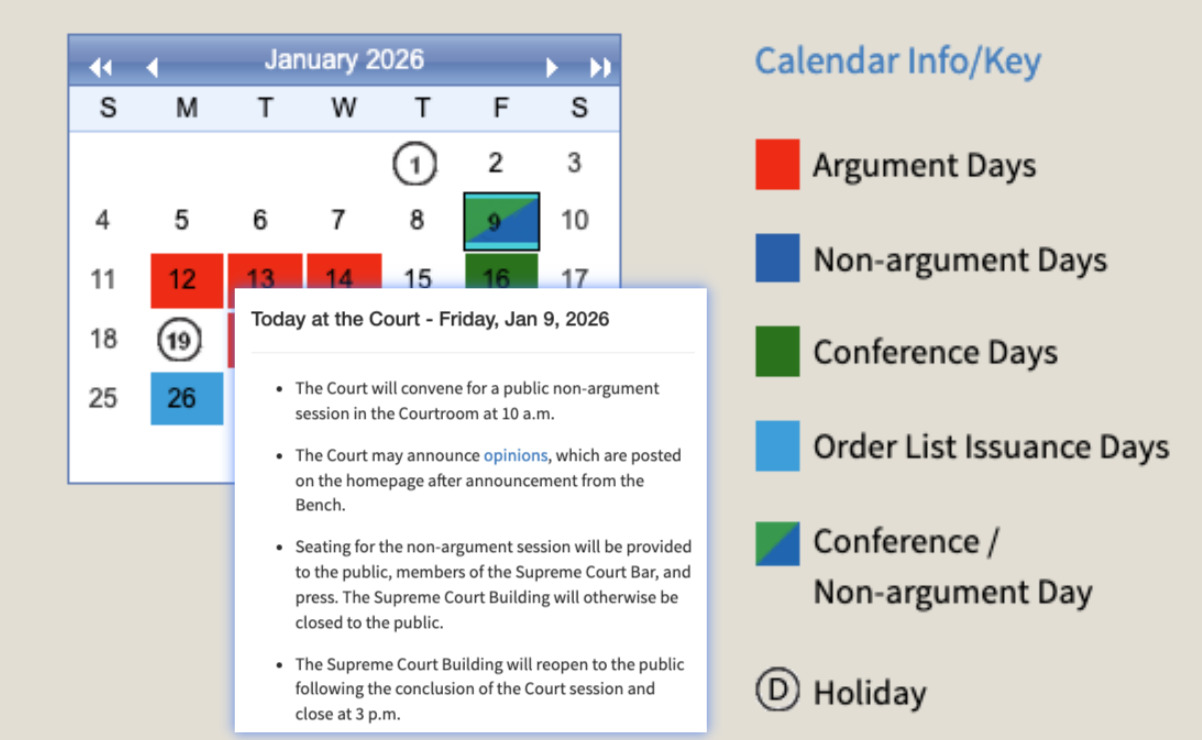
① The US Supreme Court has set January 9 as the first opinion release day of the year; ② According to convention, the US Supreme Court does not announce in advance which cases will be ruled on, so it can only be said that a ruling on the tariff case may be released; ③ As the amount of tariffs involved continues to accumulate over time, the US government also hopes that the court will make a decision as soon as possible.
Cailian Press, January 7 (Editor Shi Zhengzhi) According to reports from CCTV News and other media, the US Supreme Court's schedule shows that January 9 is listed as an opinion release day. This also means that this Friday becomes the earliest possible date for the ruling on Trump’s tariff case.
After taking office in January 2025, the Trump administration invoked the US International Emergency Economic Powers Act to introduce a series of tariff measures without congressional approval by issuing executive orders directly. Following rulings by the US Court of Appeals for the Federal Circuit and the US Court of International Trade that the current administration's comprehensive tariff policy was unlawful, the Trump administration appealed to the Supreme Court, where the case is currently under review. It is reported that the Trump administration has developed a plan to reimpose import tariffs in the event of an adverse ruling.
 It should be noted that the US Supreme Court never announces in advance which cases it will rule on. By 10 a.m. Washington time this Friday (11 p.m. Beijing time), when all the justices appear together, they may issue rulings on all debated cases. However, given that the US Supreme Court has agreed to expedite the hearing of the tariff case, the anticipation for a ruling this Friday is well-founded.
The focus of the case is whether it was unlawful for Trump to impose so-called “reciprocal tariffs” and “fentanyl tariffs” under the national security emergency declared pursuant to the 1977 International Emergency Economic Powers Act (IEEPA).
Although most of the justices of the US Supreme Court are conservative, during the oral arguments in November last year, several conservative justices, along with all liberal justices, expressed doubts about whether the International Emergency Economic Powers Act grants the president broad authority to impose tariffs.
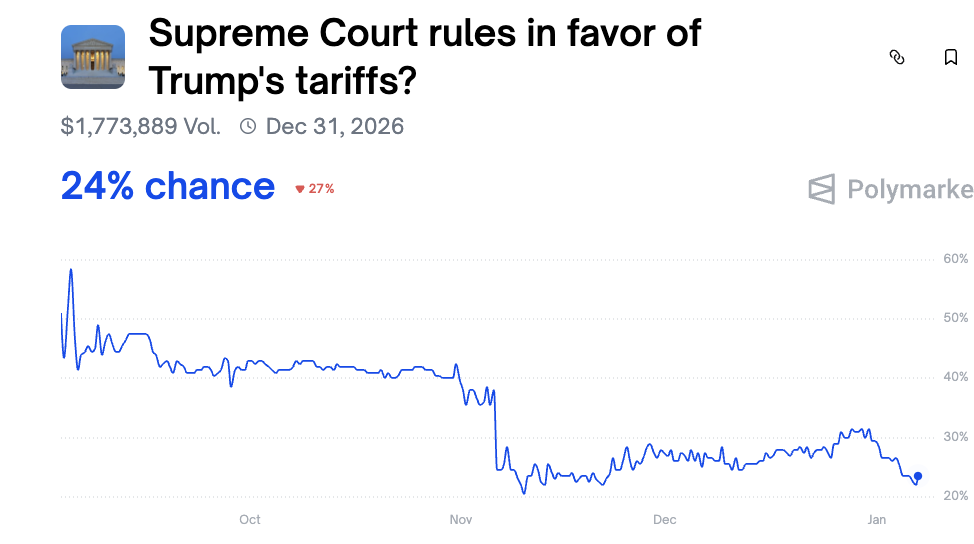
By the way, after the court session concluded in November last year, the prediction market Polymarket, known for its forecasts, saw the probability of Trump winning the case drop to the 20% range, where it remains.
In terms of timeline, on May 28 last year, the US Court of International Trade unanimously ruled that the “reciprocal tariffs” imposed by the Trump administration exceeded its statutory authority, and the legal basis for the “fentanyl tariffs” was incorrect, thus prohibiting the implementation of these tariff measures. On August 29 of the same year, the US Federal Circuit Court of Appeals upheld the lower court’s substantive ruling that the tariffs were illegal. The Trump administration subsequently appealed to the US Supreme Court.
The US government has repeatedly urged the Supreme Court to issue a ruling as soon as possible. US Treasury Secretary Bessent expressed concern that if the Supreme Court waits until June, a period of frequent rulings, to deliver an unfavorable verdict, the accumulated tariff figures could “cause significant disruption.” Official data show that in 2025, US government tariff revenue exceeded $200 billion.
Meanwhile, the US President himself has repeatedly expressed anxiety over the possibility of losing the case. In a social media post last Friday, Trump stated that a loss would “deal a terrible blow to the United States.” If the court rules against Trump on the tariff issue, it would undermine his signature economic policy and represent the biggest legal setback since his return to the White House.
In addition to the tariff case, the U.S. Supreme Court has several pending decisions, including a case involving the redistricting of Louisiana — which could result in the state gaining an additional district leaning toward Democratic candidates.
Given the busy schedule of the U.S. Supreme Court since it reconvened in January, the justices may arrange additional decision days in the coming weeks. The U.S. Supreme Court will hear the case on January 21 regarding Trump’s attempt to remove Federal Reserve Governor Lisa Cook from her position.
Looking to pick stocks or analyze them? Want to know the opportunities and risks in your portfolio? For all investment-related questions,just ask Futubull AI!

Editor/Stephen