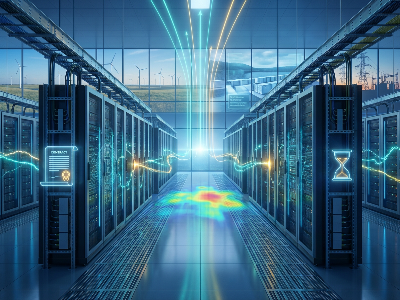
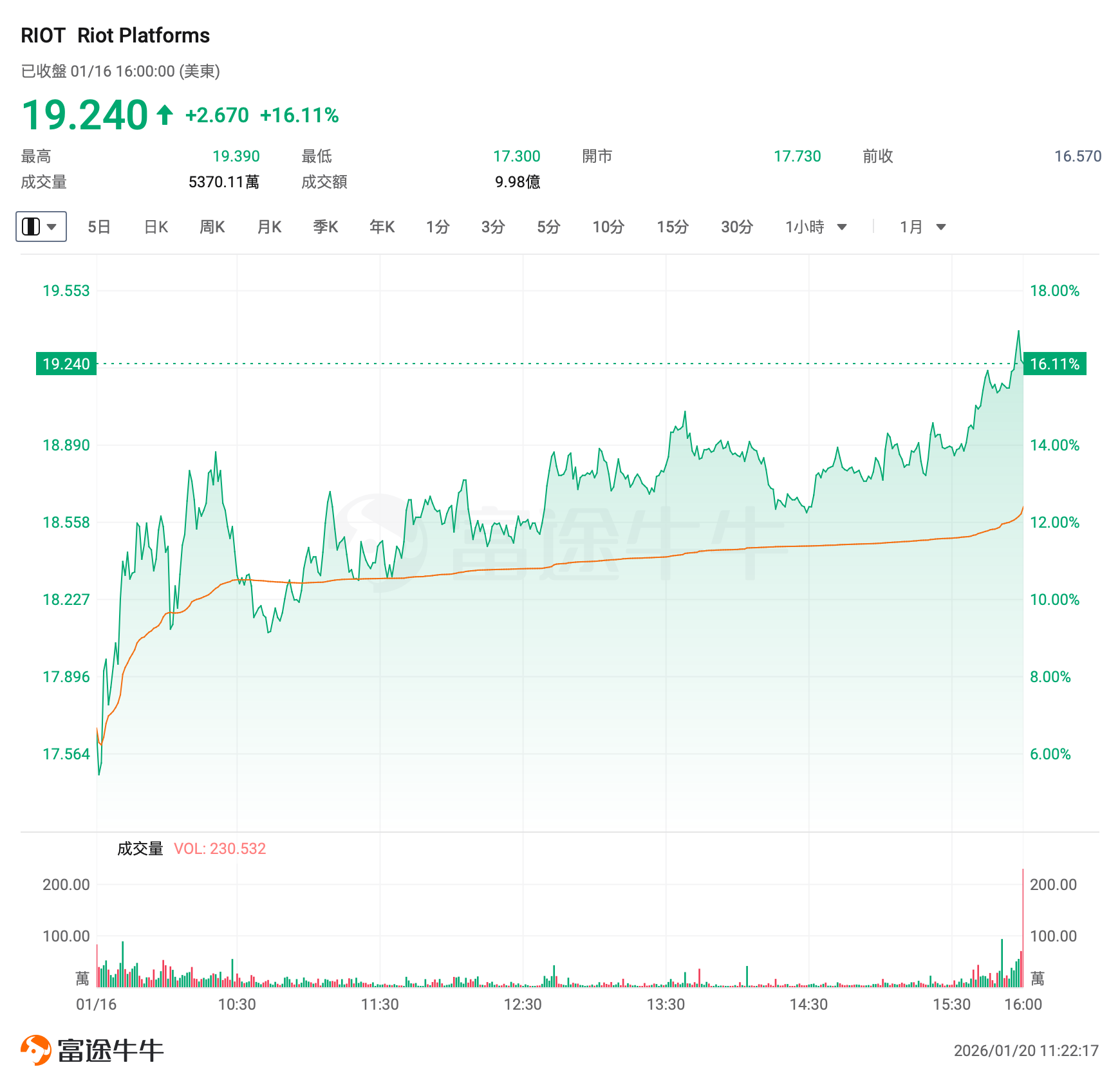
On January 17, 2026, the cryptocurrency mining company $Riot Platforms(RIOT.US)$ announced a major development: the company paid for an acquisition transaction valued at $96 million by selling approximately 1,080 Bitcoins, purchasing 200 acres of land in Rockdale, Texas.
In addition, Riot signed a data center leasing and service agreement with semiconductor giant Advanced Micro Devices (AMD.US) , initially deploying 25 megawatts of 'critical IT load capacity.' This initial 10-year agreement is expected to generate approximately $311 million in revenue for Riot. If three five-year renewal options are exercised, the total potential could reach $1 billion. Following this announcement, Riot's stock price closed up 16% last Friday.
This story is not an isolated case; it reflects a broader transformation wave sweeping through the entire cryptocurrency mining industry: shifting from pure Bitcoin mining to high-performance computing (HPC) and artificial intelligence (AI) computing power providers. This 'remarkable transformation' has not only salvaged the profitability model of mining companies but also driven a surge in their stock prices. Why has this transition been so effective?
The logic behind the valuation boost from the transition: From Bitcoin leverage to computing infrastructure
 $Bitcoin (BTC.CC)$ Mining was once the gold mine for these companies, but with the ongoing impact of Bitcoin's halving mechanism, the profit margins of this industry are facing severe challenges. Bitcoin halving refers to the event that occurs roughly every four years where miner rewards are cut in half, directly resulting in a sharp decline in mining income while energy costs remain high.
According to industry data, after Bitcoin’s halving in 2024, the gross profit margin of many mining companies dropped from over 70% at its peak to between 30%-40%. Pure mining operations are highly volatile, influenced by Bitcoin prices, hash rate competition, and electricity supply, making revenue difficult to predict.
This has forced leading publicly traded mining companies to seek diversification paths, and the rise of AI computing power has provided an ideal entry point. The core of this transition lies in the unique advantages of mining companies: they possess massive data center infrastructures, low-cost power resources, and efficient cooling systems. These facilities, originally used for Bitcoin ASIC miners, can be easily repurposed into GPU clusters for AI training and inference tasks.
For instance, mining companies have redirected their idle power to high-performance computing by signing AI hosting contracts, offering GPU-as-a-service. As AI contracts are typically long-term and fixed-price, this model not only generates more stable dollar revenue but also significantly improves profit margins, delivering steady cash flow. Industry analysts note that the profit margin of AI businesses can be over 25 times higher than Bitcoin mining, due to explosive growth in AI demand and relatively limited supply.
In terms of valuation logic, this transition has driven a fundamental revaluation of stock value. Previously, mining companies were primarily valued based on 'Bitcoin leverage,' with stock prices fluctuating alongside Bitcoin’s price. After shifting to AI, valuations have moved towards a 'computing power infrastructure' model, which is more akin to data center operators.
The transformation of mining companies continues. On January 19, according to Cointelegraph, the Bitcoin network hash rate fell below 1,000 EH/s for the first time since mid-September. Compared to the 7-day average high of 1,157 EH/s recorded on October 19, the current hash rate has dropped by nearly 15%. In an article posted on X on Monday, Leon Lyu, CEO and founder of StandardHash, attributed the decline in Bitcoin's hash rate to miners reallocating their computing power to AI computing services in pursuit of higher profit margins.
According to CoinShares, it is projected that by the end of 2026, the proportion of HPC revenue for some large mining companies will increase from the current 10%-20% to over 50%. This not only reduces reliance on Bitcoin but also attracts investment and partnerships from tech giants such as $Google-C (GOOG.US)$ 、 Microsoft (MSFT.US) and Advanced Micro Devices (AMD.US) , often accompanied by equity pledges or substantial financing, further enhancing the credibility and financial stability of these mining firms.
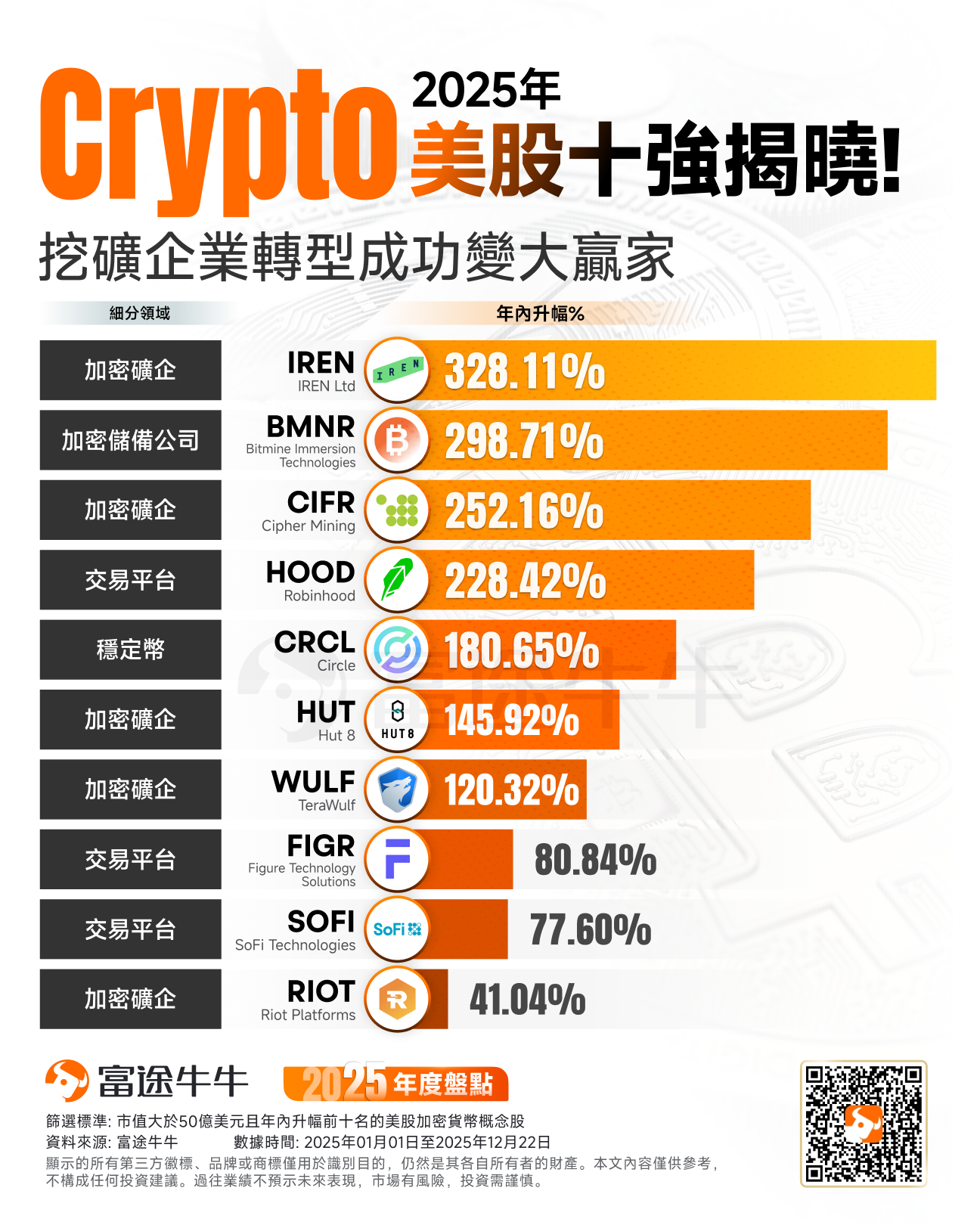
Market reactions confirm this logic. In 2025, the average share price increase of these transitioning mining companies exceeded both Bitcoin’s gains and other cryptocurrency-related stocks. Among the top ten best-performing cryptocurrency-related stocks on U.S. exchanges, five were companies pivoting toward AI, including $IREN Ltd(IREN.US)$ 、 $Cipher Mining(CIFR.US)$ 、 $Hut 8(HUT.US)$ 、 $TeraWulf(WULF.US)$ 、 $Riot Platforms(RIOT.US)$ , among which $IREN Ltd(IREN.US)$ rose over 300%, and $Cipher Mining(CIFR.US)$ increased over 200%.
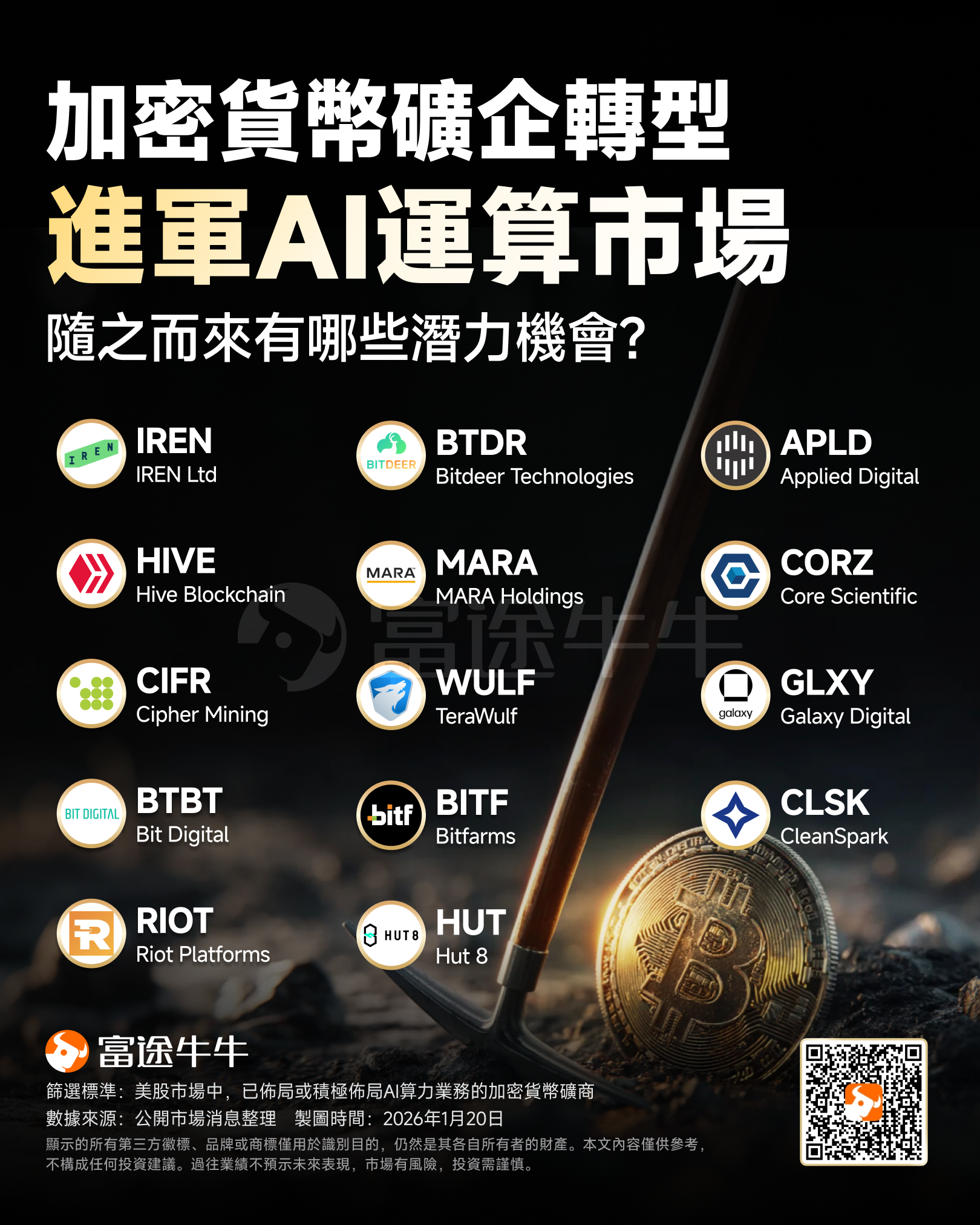
Overview of AI Transformation Concept Stocks in the Cryptocurrency Mining Industry
The transition of mining companies to AI computing power has become an industry trend, with both leading enterprises and emerging participants accelerating their deployment in this sector.
$IREN Ltd(IREN.US)$ : Transitioning from Bitcoin mining to AI cloud services. In November 2025, a five-year significant cooperation agreement was reached with Microsoft (MSFT.US) , under which Microsoft prepaid one year's contract amount to support the construction of the company’s data center at the Horizon site in Texas. This deal, totaling USD 9.7 billion, is expected to generate recurring annual revenue of USD 1.94 billion.
$Cipher Mining(CIFR.US)$ : In September 2025, an initial ten-year agreement was signed with Fluidstack to lease its data center capacity, equivalent to approximately USD 3 billion in revenue. $Google-C (GOOG.US)$ obtained the right to purchase a 5.4% stake in Cipher Mining and agreed to guarantee obligations worth USD 1.4 billion under the contract between Fluidstack and Cipher. In November 2025, the company announced a leasing agreement worth USD 5.5 billion with $Amazon(AMZN.US)$ Amazon Web Services (AWS).
$Core Scientific(CORZ.US)$ : Acquired by AI cloud provider $CoreWeave(CRWV.US)$ , signing a 12-year, USD 3.5 billion GPU infrastructure hosting agreement.
$TeraWulf(WULF.US)$ : Focused on AI hosting, TeraWulf signed two ten-year agreements with Fluidstack, leveraging its Lake Mariner data center campus in western New York to deliver over 200 megawatts of critical IT load. The total contracted revenue under these agreements amounts to USD 3.7 billion, which will increase to USD 8.7 billion if both five-year renewal options are exercised. $Google-C (GOOG.US)$ has agreed to provide $1.8 billion in funding to support project construction, in exchange for $Google-C (GOOG.US)$ the right to subscribe for approximately 41 million shares of TeraWulf common stock through warrants.
$CleanSpark(CLSK.US)$ : In October 2025, announced the expansion from pure Bitcoin mining into AI computing.
$Bitfarms(BITF.US)$ : In 2025, invested in upgrading its 18-megawatt mining facility in Washington, enabling it to handle high-performance computing and artificial intelligence workloads, utilizing advanced NVIDIA Vera Rubin GPUs.
$Hut 8(HUT.US)$ : Operates data centers and mining facilities in North America, actively advancing the integration of AI and HPC. In December 2025, the company signed a 15-year, $7 billion lease agreement with Fluidstack, leasing 245 megawatts of computing capacity at its River Bend data center campus to the latter.
$HIVE Digital Technologies(HIVE.US)$ : In July 2023, announced a shift in business focus toward cloud computing technology and artificial intelligence. By the end of 2024, deployed a new batch of NVIDIA GPU clusters in Quebec, targeting $100 million in HPC revenue by 2026.
$Applied Digital(APLD.US)$ : Launched AI cloud services through its wholly owned subsidiary Sai Computing, securing contracts with multiple AI clients.
$Riot Platforms(RIOT.US)$ : Converted 600 MW of idle power at the Corsicana facility for AI/HPC purposes, halting Bitcoin expansion; signed a data center lease and service agreement with Advanced Micro Devices.
$MARA Holdings(MARA.US)$ : Leveraged existing facilities to expand HPC; in August 2025, acquired 64% of Exaion, a tech subsidiary of Électricité de France, for $168 million in cash. The acquisition aims to expand MARA Holdings' business footprint in artificial intelligence infrastructure.
$Bit Digital(BTBT.US)$ In June 2025, the company announced a strategic transformation and will gradually shut down its Bitcoin mining operations. In the future, it will focus on building a company dedicated to Ethereum staking and treasury management. The company’s HPC business is primarily operated under the WhiteFiber brand, which provides GPU cloud services and operates platforms such as Enovum in data center operations.
$Galaxy Digital(GLXY.US)$ By October 2025, Galaxy Digital had secured $460 million in private investment to transform its former Bitcoin mining facility in Texas into a large-scale artificial intelligence data center.
$Bitdeer Technologies(BTDR.US)$ Through self-developed mining equipment and campus operations, the company is driving the development of AI and HPC businesses.
$Cango (CANG.US)$ In terms of AI computing power, the company leverages its experience in distributed operations and global energy deployment to create a standardized pool of GPU computing resources, focusing on meeting the differentiated needs of small and medium-sized enterprises.
Among these companies, $Core Scientific(CORZ.US)$ 、 $TeraWulf(WULF.US)$ 、 $Cipher Mining(CIFR.US)$ and $IREN Ltd(IREN.US)$ the transformation has been the most aggressive, achieving a leap from mining to cloud services through deep collaboration with technology giants. $Core Scientific(CORZ.US)$ was directly acquired, reflecting the voracious demand from AI players. $Bitfarms(BITF.US)$ and $HIVE Digital Technologies(HIVE.US)$ focused on regional advantages, such as low-cost electricity and GPU upgrades, adopting a more gradual approach to transformation. $Bitdeer Technologies(BTDR.US)$ retained its highly profitable Bitcoin mining operations as a core business while steadily upgrading some mining facilities into AI data centers.
Summary
From miners of digital gold to enablers of the AI era, former miners are completing a pivotal transition from the virtual world to the real economy.
The demand for AI is currently in a period of explosive growth, and the global shortage of computing power is expected to persist until 2030. With the recent intensification of power shortages in the United States, the market is gradually realizing that the main bottleneck in AI infrastructure development lies not in chips but in electricity. Mining companies’ power infrastructure is well-suited to meet the high energy consumption demands of AI, and their locations are often in energy-rich regions such as Texas or northern Canada. This not only lowers the threshold for transformation but also attracts substantial contracts.
Overall, the success of mining companies' transition can be attributed to the perfect alignment of industry pain points with market opportunities. By 2026, as more capacity comes online, these mining companies are expected to become a core force in AI infrastructure. Undoubtedly, this transformation from cryptocurrency mining to AI computing power is reshaping the future of the crypto industry.
 Fellow investors, do you see value in the revaluation opportunities brought about by mining companies' transformation?
Looking to pick stocks or analyze them? Want to know the opportunities and risks in your portfolio? For all investment-related questions,just ask Futubull AI!

Editor/Doris