
The Japanese bond storm is sweeping the globe, with Citi warning that funds employing risk parity strategies may be forced to cut their positions by as much as one-third to control overall portfolio risk, potentially triggering up to $130 billion in bond sell-offs in the U.S. alone.
Citigroup Global Markets noted that the sharp rise in volatility of Japanese government bonds 'could lead to increased volatility in other asset classes, particularly U.S. Treasuries, necessitating a reduction in overall portfolio size.'
Mohammed Apabhai, head of trading strategy for Asia at Citigroup, wrote in a report to clients on Tuesday that risk parity funds may need to sell up to one-third of their current risk exposure, potentially triggering bond sales of up to $130 billion in the U.S. alone.
 These funds target equal volatility and allocate capital across multiple asset classes, ranging from equities to bonds and commodities.
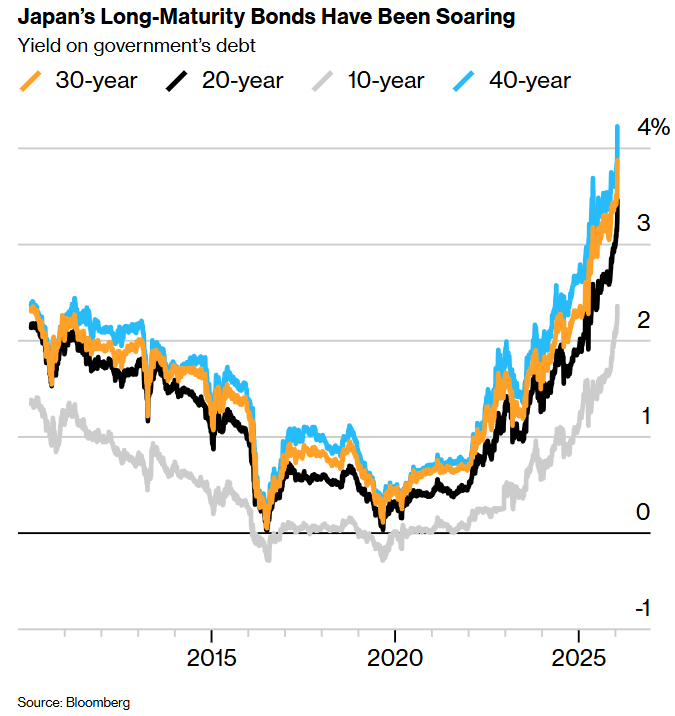
The election pledge by Japanese Prime Minister Sanae Takachi to cut food taxes triggered a surge in long-term bond yields, with the yields on 30-year and 40-year Japanese government bonds rising more than 25 basis points on Tuesday to hit new highs. With Japan set to hold snap elections on February 8, investors are concerned about further volatility ahead.
An indicator measuring liquidity in Japanese government bonds climbed to a record high on Tuesday, highlighting what is widely perceived as a 'buyer's strike' in the market.
Apabhai pointed out that the South Korean bond market is also highly vulnerable to rising volatility in Japanese government bonds. Since early July 2024, foreign investors holding South Korean government bonds have incurred cumulative losses exceeding 10%, increasing the risk of stop-loss selling starting.
He added that British government bonds might be similarly vulnerable.
With fiscal concerns intensifying, volatility in Japan’s once-dormant bond market has been rising since the beginning of last year, exerting significant spillover effects globally. This follows the Bank of Japan's abandonment of yield curve control policies and the start of its reduction in purchases of Japanese government bonds.
Global bond investors are increasingly bearish on Japanese government debt due to mounting fiscal concerns and the pressure of gradually rising interest rates. This has reignited interest in what has long been referred to as the 'widow-maker' trade - shorting Japanese government bonds, which would profit when yields spike.
Tuesday's selloff added pressure on Japanese life insurance companies holding large portfolios of government bonds. An investment manager at one of Japan’s major life insurance firms stated that concerns about future stability will make it difficult for these insurers to return to Japanese government bonds, even if yields become more attractive.
The message to Japanese policymakers from the market is unmistakable: If you plan to finance a sharply higher level of spending without new revenues, be prepared to see yields surge. Given how unforgiving the global 'bond vigilantes' appear to be right now, this message isn't likely to be softened, even as growth concerns emerge due to the prospect of new U.S. tariffs.
This is essentially the market pricing in Japan's 'Truss moment,'" said Masahiko Loo, Senior Fixed Income Strategist at State Street Investment Management. The term 'Truss moment' refers to former British Prime Minister Liz Truss, who triggered a severe bond selloff with an unfunded package of tax cuts and left office in 2022.
 Looking to pick stocks or analyze them? Want to know the opportunities and risks in your portfolio? For all investment-related questions,just ask Futubull AI!

Editor/Liam